Annapurna Base Camp Trek: A Complete 2026 Guide
Plan an Annapurna Base Camp trek with up-to-date facts on permits, the route, altitude, seasons, and safety for first-time Himalayan trekkers.
A glacial amphitheatre of 7,000- and 8,000-metre giants, reached on a trail that starts in rice terraces.
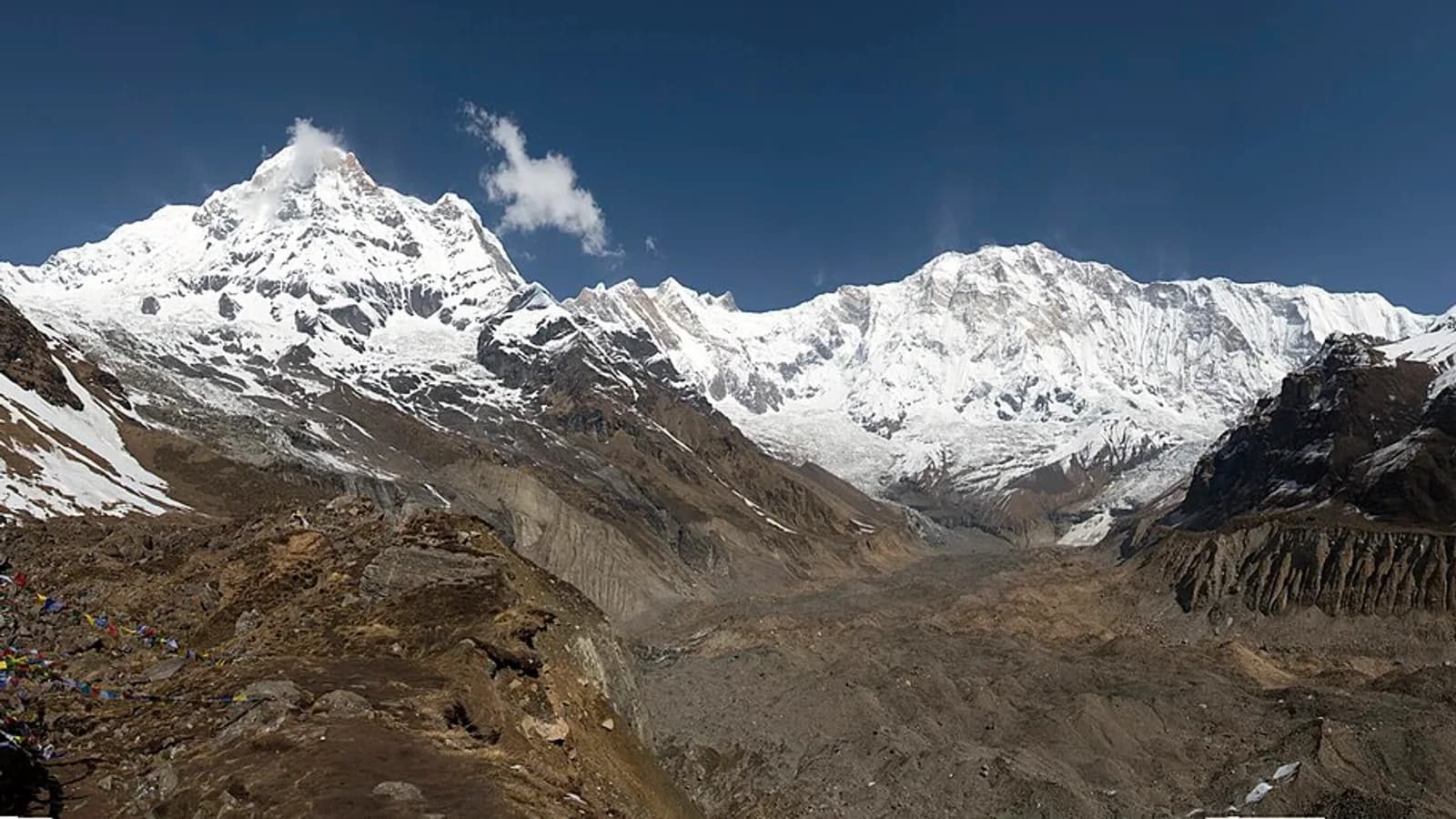
The Annapurna Base Camp trek is one of Nepal's most loved Himalayan walks, and for good reason: in a single week or two it carries you from warm rice terraces and Gurung villages into a glacial amphitheatre ringed by some of the highest mountains on Earth. Annapurna Base Camp (often shortened to ABC) sits at roughly 4,130 metres inside the Annapurna Sanctuary, a high bowl with a near 360-degree wall of peaks. This guide pulls together the practical facts you actually need before you go: permits, the route, altitude, seasons, and safety.
Key takeaways
- Annapurna Base Camp sits at about 4,130 m (13,550 ft); the highest you sleep is usually Machhapuchhre Base Camp at around 3,700 m.
- You need an ACAP permit (NPR 3,000 for foreign nationals, as of 2024) issued by the National Trust for Nature Conservation; it is now QR-linked to your passport.
- Since 1 April 2023, foreign independent trekkers must hire a licensed guide or porter for Nepal's national park and conservation-area trails.
- Most people walk it in 7 to 14 days, with spring and autumn the prime seasons for clear skies.
- It is a moderate trek, but the Deurali–Machhapuchhre stretch can be avalanche-prone in winter, and altitude sickness is always a possibility.
Where Annapurna Base Camp is, and what makes it special
Annapurna Base Camp lies deep inside the Annapurna Sanctuary, a glacial basin in north-central Nepal reached through a single narrow gap in the mountains between the peaks of Hiunchuli and Machhapuchhre. The only way in is on foot. Once you arrive, you stand inside what trekkers describe as a natural amphitheatre, with a horseshoe of giants surrounding you.
The wall of peaks around the Sanctuary includes some of the most famous mountains in the Himalaya:
| Peak | Approx. height | Note | | --- | --- | --- | | Annapurna I | 8,091 m | The first 8,000 m peak ever summited (1950) | | Machhapuchhre (Fishtail) | 6,997 m | Sacred and closed to climbing | | Annapurna South | ~7,219 m | Towers directly above the Sanctuary | | Gangapurna | 7,454 m | Part of the surrounding ring | | Hiunchuli | ~6,441 m | Guards the Sanctuary's entrance gap |
Because you are standing at the foot of these walls rather than viewing them from a distance, sunrise at ABC is the highlight of the trek for many visitors. If you want to understand how this route compares to the other classic Annapurna walk, see Annapurna Circuit vs Base Camp, and for the eternal Nepal trekking debate read Everest Base Camp vs Annapurna Base Camp.
The route: from Pokhara to the Sanctuary
Most Annapurna Base Camp treks are organised out of Pokhara, Nepal's lakeside trekking hub. From there a short drive (commonly cited as roughly an hour to the Nayapul area, though many itineraries now use higher road heads) puts you at the trailhead. If you are travelling overland from the capital first, our guide to the Kathmandu to Pokhara tourist bus covers your options.
From the road head the trail climbs through the Modi Khola valley and a sequence of well-known stops. A typical north-bound progression looks like this:
- Ghandruk — a large, photogenic Gurung village with mountain views (see Ghandruk village).
- Chhomrong — the last permanent village before the Sanctuary, perched on a steep hillside.
- Sinuwa, Bamboo, Dovan, Himalaya — forested, increasingly remote teahouse settlements.
- Deurali — where the valley narrows and the air begins to feel thin.
- Machhapuchhre Base Camp (MBC) — around 3,700 m, the usual final overnight before ABC.
- Annapurna Base Camp (ABC) — roughly 4,130 m, the trek's high point and turnaround.
The walk is done as a there-and-back route through the Sanctuary's single entrance, so you descend along much of the same trail. Daily walking is commonly in the range of four to seven hours, with plenty of stone steps. Accommodation along the way is in teahouses; if that style of trekking is new to you, read our overview of teahouse trekking in Nepal.
A sample itinerary frame
Itineraries vary widely by operator and fitness, but a balanced plan often spreads the climb over more days to aid acclimatisation and adds buffer time in Pokhara. Shorter 7-day versions exist and are popular, while 10- to 14-day plans give a gentler rhythm. For a deeper look at where the money goes, see our dedicated Annapurna Base Camp trek cost breakdown.
Permits and rules you cannot skip
Trekking in the Annapurna region is governed by the Annapurna Conservation Area Project (ACAP), managed by the National Trust for Nature Conservation (NTNC). You must carry a valid ACAP permit, and it is checked at staffed checkpoints on the trail.
| Item | Foreign nationals | SAARC nationals | | --- | --- | --- | | ACAP permit (as of 2024) | NPR 3,000 | NPR 1,000 |
A few important points on permits and rules:
- Where to get it: ACAP permits can be obtained at NTNC/ACAP offices in Kathmandu and Pokhara, or online via the official NTNC e-permit portal at epermit.ntnc.org.np.
- QR system: Reporting indicates that since around October 2024 the NTNC system ties the permit to your passport and uses QR scanning at checkpoints rather than paper stamps.
- TIMS: The Trekkers' Information Management System (TIMS) card requirement was reported as dropped for Annapurna trekkers from April 2023, although some agencies still arrange one. Confirm the current position before you travel.
- Children: Some sources note that young children (commonly cited as under 10) are exempt from the ACAP fee.
Because fees and rules in Nepal change from season to season, treat every figure here as a planning estimate (NPR, as of 2024) and reconfirm with an official source or a registered agency close to your trip.
The mandatory guide rule
Since 1 April 2023, Nepal's tourism authorities have required solo or "free independent" foreign trekkers to be accompanied by a licensed guide or porter on trails in national parks and conservation areas, a change confirmed in reporting and in a U.S. Embassy alert. The stated reasons are trekker safety, faster response to emergencies, and more local employment. The rule does not apply to Nepali trekkers. In practice this means foreign visitors to ABC should plan to trek with a guide. Our guide on tipping trekking guides and porters in Nepal helps you budget for the human side of the trip.
Best time to trek Annapurna Base Camp
Two windows stand out for ABC:
- Spring (March to May): Warmer temperatures, frequently clear skies, and rhododendron forests in bloom on the lower trail.
- Autumn (September to November): Settled, post-monsoon weather, with sharp visibility that often peaks from mid-October into late November.
Summer (the monsoon) brings rain, leeches at lower elevations, and clouds that obscure the peaks, while winter delivers cold, snow, and a higher avalanche risk on the upper sections. For a broader seasonal picture across the country, see best time to visit Nepal.
| Season | Months | Conditions | | --- | --- | --- | | Spring | Mar–May | Warm, clear, rhododendrons in bloom | | Monsoon | Jun–Aug | Wet, cloudy, leeches lower down | | Autumn | Sep–Nov | Stable weather, best visibility | | Winter | Dec–Feb | Cold and snowy, higher avalanche risk up high |
Altitude, safety, and difficulty
The Annapurna Base Camp trek is usually rated moderate. It does not push into the extreme altitudes of some Himalayan routes, but at 4,130 m it is high enough that altitude sickness is a real concern. Symptoms such as headache, nausea, and dizziness can begin around 3,000 m and above, roughly from the Deurali area upward. Estimates in trekking sources put the share of trekkers affected by acute mountain sickness (AMS) in the region of 20 to 30 percent, mostly mild. Walking at a sensible pace, staying hydrated, and not gaining sleeping altitude too quickly all help. Our altitude sickness Nepal trekking guide explains the warning signs and the golden rule of descending if symptoms worsen.
The other hazard to know about is avalanche and landslide terrain. The stretch between Deurali and Machhapuchhre Base Camp runs through a narrow, steep section near Hinku Cave that is the trek's main avalanche zone. Slides have caused fatalities here in winter conditions, and the same slopes can be landslide-prone in heavy rain. Sticking to recognised seasons, listening to your guide, and not pushing through in poor conditions are the key precautions.
A few practical safety habits for ABC:
- Build in time so you are not gaining altitude too fast.
- Carry adequate travel insurance that covers high-altitude trekking and, ideally, helicopter evacuation. See Nepal trekking insurance and helicopter evac.
- Keep your ACAP permit and ID accessible for checkpoints.
- Treat or filter your drinking water, and pack layers for sharp temperature swings.
What to pack and prepare
You do not need technical mountaineering gear for ABC, but you do need solid trekking essentials: broken-in boots, warm layers for the cold mornings near base camp, a rain shell, a good sleeping bag rating, sun protection, and a basic first-aid and medication kit. A reasonable level of fitness makes the days of stone steps far more enjoyable. For a region-wide checklist, our Nepal trekking packing list is a useful starting point.
Knowing a handful of Nepali phrases goes a long way with teahouse owners and on the trail. Browse Nepali phrases every trekker should know before you set off, and explore our wider trekking trail guides for more routes.
Combining ABC with the rest of your trip
Because the trek starts and ends near Pokhara, it pairs naturally with a few relaxed days by the lake. See things to do in Pokhara for ideas once your legs are tired. Trekkers looking for a shorter, quieter alternative in the same massif often consider the Mardi Himal trek, which shares the early trail before branching off to a high ridge.
Sources
- New Requirements For Use of Trekking Guides/Porters Effective April 1, 2023 — U.S. Embassy in Nepal
- No more solo treks. Guides mandatory from April 1 — The Kathmandu Post
- Annapurna Conservation Area Project (ACAP) — National Trust for Nature Conservation (NTNC)
- NTNC Online e-permit portal (ACAP, MCAP)
- The Annapurna Conservation Area Permit — Discovery World Trekking
- Annapurna Trek Permits (2025): TIMS & ACAP Explained — Shikhar Adventure
- Annapurna Base Camp Trek: Complete 2026 Guide — Mountain Treks Nepal
- Best Time for Annapurna Base Camp Trek — Nepal Hiking Adventure
- Is Annapurna Base Camp Trek Safe? — Base Camp Hike
- Annapurna Sanctuary Private Trek — Wilderness Travel
Frequently asked questions
- How high is Annapurna Base Camp?
- Annapurna Base Camp sits at about 4,130 metres (13,550 feet), and the highest place you sleep is usually Machhapuchhre Base Camp at roughly 3,700 metres.
- How many days does the Annapurna Base Camp trek take?
- Most itineraries run 7 to 14 days of walking, depending on where you start, your pace, and how many acclimatisation or rest days you build in.
- Do I need a permit for the Annapurna Base Camp trek?
- Yes. You need an Annapurna Conservation Area Project (ACAP) permit, which cost NPR 3,000 for foreign nationals as of 2024, issued by the National Trust for Nature Conservation.
- Is a guide mandatory for Annapurna Base Camp?
- Since 1 April 2023, Nepal requires foreign independent trekkers to hire a licensed guide or porter for trails in national park and conservation areas; the rule does not apply to Nepali trekkers.
- Is the TIMS card still required for Annapurna?
- Reporting indicates TIMS was dropped for Annapurna trekkers from April 2023, though some agencies still arrange one; always confirm current rules before you go.
- When is the best time to trek to Annapurna Base Camp?
- Spring (March to May) and autumn (September to November) generally give the clearest skies and most settled weather, with autumn known for sharp post-monsoon visibility.
- Is the Annapurna Base Camp trek dangerous?
- It is considered moderate and most people finish without serious incident, but the Deurali to Machhapuchhre Base Camp stretch can carry avalanche risk in winter and altitude sickness is always possible.
- Where does the Annapurna Base Camp trek start?
- Trails typically begin near Nayapul or other road heads about an hour or so from Pokhara, then climb through villages like Ghandruk and Chhomrong toward the Sanctuary.
Spotted an error in this post? Tell us or suggest a correction.
Related posts
ABC Trek: A Plain-English Guide to Annapurna Base Camp
The ABC trek (Annapurna Base Camp) explained — the route, how many days it takes, difficulty, the best seasons, and what daily trail life is really like.
Read postAma Dablam Climb: 2026 Expedition Guide (6,812m)
An Ama Dablam climb and expedition guide for 2026 — height, the Southwest Ridge route, camps, fixed ropes, difficulty, permits, cost and the best seasons.
Read postAnnapurna vs Manaslu: Which Trek Should You Choose?
An Annapurna vs Manaslu decision guide for trekkers — compare permits, crowds, difficulty, infrastructure and cost to pick the right Himalayan route.
Read postAsan Bazaar Kathmandu: Old Town Market Guide
A visitor guide to Asan bazaar, Kathmandu's oldest market — its six-road square, Annapurna Temple, what to buy, when to go, and how to get there.
Read postAyurveda Nepal: A Traveller's Guide to Healing
Ayurveda Nepal explained for tourists — the history, the doshas, treatments like Panchakarma and Shirodhara, where to go and how to choose a centre safely.
Read postBest Restaurants Pokhara Lakeside: Where to Eat
The best restaurants in Pokhara Lakeside — lakeside trout, wood-fired pizza, Tibetan momos and healthy cafes, with what to order and rough 2026 prices.
Read post