Nepali Phrases Every Trekker Should Know Before Lukla
Eight Nepali phrases that earn warmer dal bhat, faster rooms, and the quiet respect of porters — tested on Everest, Annapurna, and Langtang.
The Khumbu doesn't reward fluency. It rewards effort.
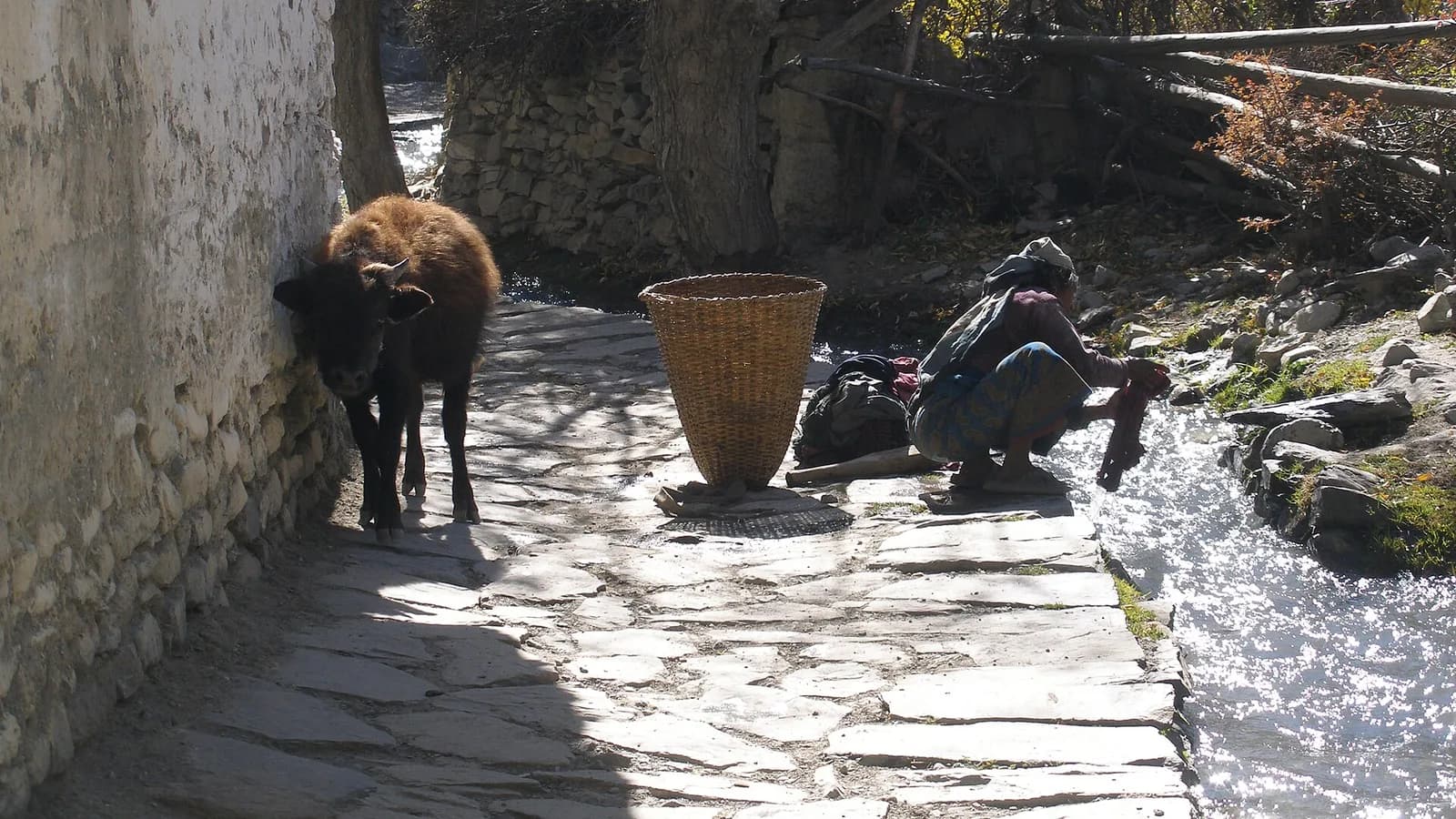
Most tourists arrive in Kathmandu with three Nepali words — namaste, dal bhat, dhanyabaad — and assume that's enough. For the trail, it isn't quite. Not because porters and lodge owners can't speak English (most can), but because a handful of well-placed Nepali phrases changes the social contract. You stop being a paying ghost and start being a guest.
Here are the eight phrases that actually move the needle on a long trek. None of them require grammar — they're all short, useful, and pronounceable on day one.
1. Namaste — the universal opener
Everyone knows this one, but most foreigners say it like a punctuation mark. Slow down. Press your palms together at chest height. Make eye contact. Then say it.
On the Everest Base Camp trail, this single gesture marks you as someone who paid attention before booking the flight. Lodge owners notice. Sherpa porters notice. The full phrase is just namaste — नमस्ते, but the warmth comes from the gesture, not the word.
2. Dhanyabaad — but only when it counts
Thank you in Nepali is dhanyabaad (धन्यवाद). Foreigners over-say it. Among Nepali friends and family, gratitude is shown through reciprocity — passing food, refilling water, walking the slower person to their room. Saying dhanyabaad for every tiny kindness sounds transactional.
Save it for shops, restaurants, guides, and porters at the end of a long day. For everything in between, a smile and a small head nod does the same job.
3. Kati ho? — How much is it?
The single most useful trekking phrase outside of greetings. How much is it in Nepali is kati ho? (कति हो?). Use it at every teahouse, every bakery, every Sherpa-run shop along the way.
A second-tier version: kothako kati? — "how much for the room?". On the trail, rooms are usually cheap (sometimes free) if you commit to dinner and breakfast at the lodge. That's the local arrangement. Knowing how to ask in Nepali signals you understand the rules.
4. Tato paani chha? — Is there hot water?
Above 3,500m, hot water becomes a serious question. Gas and solar heating are expensive at altitude, and most lodges charge separately for showers. Is there hot water in Nepali is tato paani chha? (तातो पानी छ?).
The follow-up question — kati ho? — usually nets a price between 300 and 600 NPR depending on elevation. Pay it. Cold-water dunks above Dingboche are how altitude sickness gets a foothold.
5. Malai lek lagyo — I have altitude sickness
The most important emergency phrase on the high routes. Altitude sickness in Nepali is malai lek lagyo (मलाई लेक लाग्यो) — literally "altitude has caught me."
Above Namche (3,440m) on the Everest trek, every guide and lodge owner is watching foreign trekkers for signs of AMS. Saying this phrase in Nepali makes the situation legible immediately — no fumbling, no translation lag, no doubt. They will react fast and correctly: lower elevation, oxygen, descent.
If you're trekking solo, learn this phrase before you fly to Lukla.
6. Kati ghanta? — How many hours?
Nepali distances are unreliable. "Just over there" can mean a 90-minute climb. "Fifteen minutes" can mean two hours. Asking kati ghanta? (कति घण्टा?) — "how many hours?" — gets you a more honest answer than asking kati tadha? (how far?).
On the Annapurna Circuit, where the day's plan can mean the difference between a comfortable lodge and a freezing pass, this question saves trips. Bonus phrase: how many hours walking in Nepali — kati ghanta hidnu parchha?
7. Ma sakahari hoon — I'm vegetarian
Dal bhat is vegetarian by default. But if you order off-menu on the trail (momos, chowmein, fried rice), specify clearly. I am vegetarian in Nepali is ma shakahari hoon (म शाकाहारी हुँ).
Nepali kitchens — especially Hindu-run ones — understand vegetarianism deeply. The concept doesn't need explaining. Just the word. Veg dal bhat is everywhere on every trail, served with seconds and thirds for free until you wave the didi off.
8. Pheri bhetaunla — See you again
Almost no foreigner uses this phrase, which is exactly why it works. Where most trekkers say "bye" or fumble through bidaa (which is the formal goodbye), see you later in Nepali — pheri bhetaunla (फेरि भेटौंला) — is what locals actually say.
Use it when leaving a lodge in the morning. Use it at the end of a shared tea with another trekker. It's warm, slightly hopeful, and unmistakably a phrase from someone who paid attention.
Beyond the eight
These are the load-bearing eight. Everything else is decoration. If you can deliver them with a small bow, with eye contact, and without rushing, you'll cover 80% of the meaningful interactions on a 12-day trek.
For the full toolkit by trail, see our guides for Everest Base Camp, Annapurna Circuit, and Langtang Valley — each with trail-specific phrases for the lodges, altitudes, and people you'll meet.
The mountain rewards effort. Bring some.
Spotted an error in this post? Tell us or suggest a correction.
Related posts
ABC Trek: A Plain-English Guide to Annapurna Base Camp
The ABC trek (Annapurna Base Camp) explained — the route, how many days it takes, difficulty, the best seasons, and what daily trail life is really like.
Read postAma Dablam Climb: 2026 Expedition Guide (6,812m)
An Ama Dablam climb and expedition guide for 2026 — height, the Southwest Ridge route, camps, fixed ropes, difficulty, permits, cost and the best seasons.
Read postAnnapurna vs Manaslu: Which Trek Should You Choose?
An Annapurna vs Manaslu decision guide for trekkers — compare permits, crowds, difficulty, infrastructure and cost to pick the right Himalayan route.
Read postAsan Bazaar Kathmandu: Old Town Market Guide
A visitor guide to Asan bazaar, Kathmandu's oldest market — its six-road square, Annapurna Temple, what to buy, when to go, and how to get there.
Read postAyurveda Nepal: A Traveller's Guide to Healing
Ayurveda Nepal explained for tourists — the history, the doshas, treatments like Panchakarma and Shirodhara, where to go and how to choose a centre safely.
Read postBest Restaurants Pokhara Lakeside: Where to Eat
The best restaurants in Pokhara Lakeside — lakeside trout, wood-fired pizza, Tibetan momos and healthy cafes, with what to order and rough 2026 prices.
Read post