Teahouse Trekking in Nepal: What a Teahouse Really Is
Teahouse trekking Nepal explained: how mountain lodges work, what you eat, sleep, pay, and the one unwritten rule every trekker should know.
A teahouse is not a hotel you check into. It is a family's home that agreed to feed and shelter strangers walking past their door.
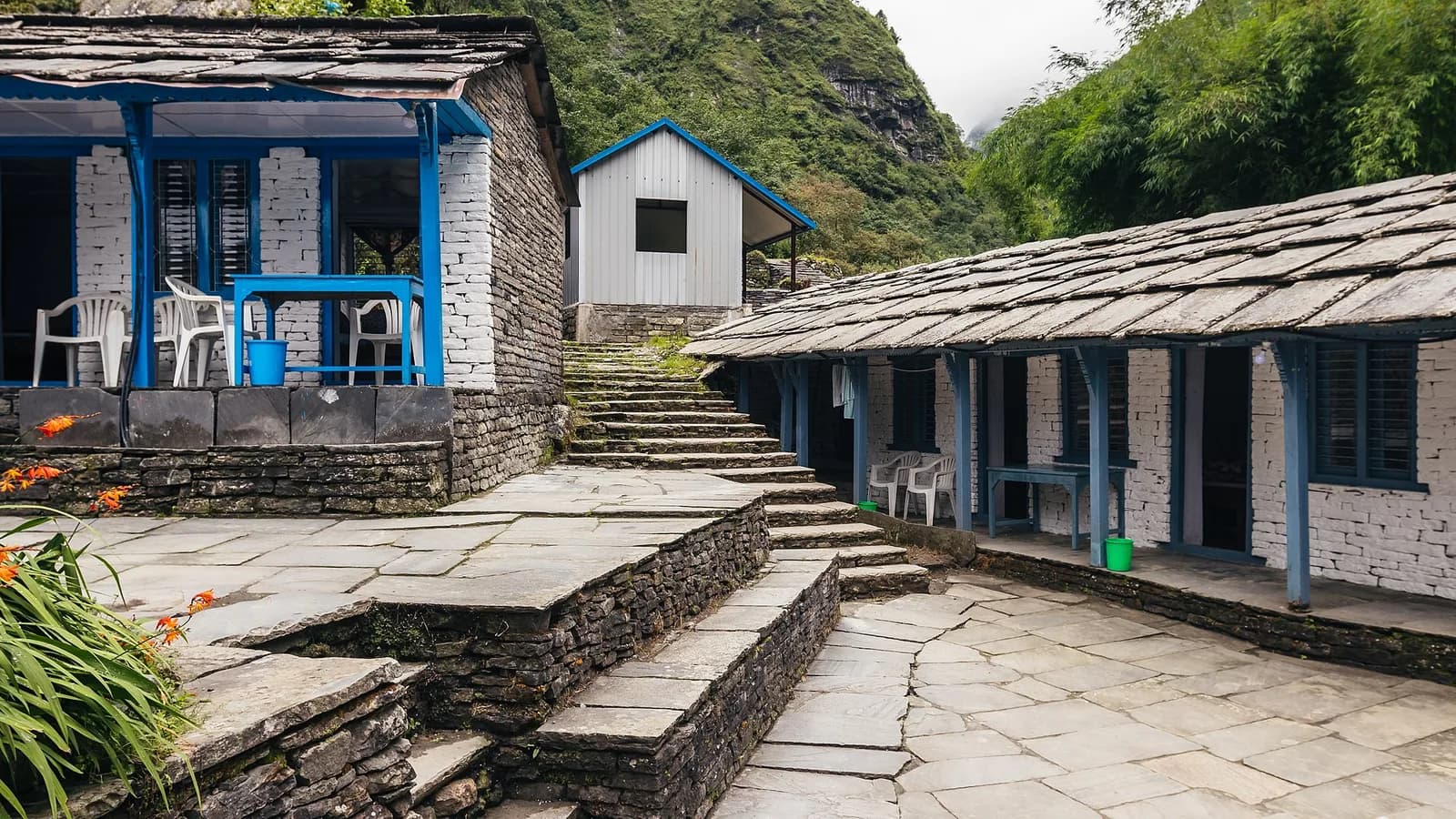
If you are planning your first trek in Nepal, you will read the phrase "teahouse trekking" everywhere, usually with no explanation of what a teahouse actually is. The short version: teahouse trekking means you walk from village to village each day and sleep in small family-run lodges along the way, instead of carrying a tent and cooking your own food. It is the standard way to trek the Annapurna, Everest, Langtang, and most other popular regions, and it is the single biggest reason trekking in Nepal is so accessible compared to mountain travel almost anywhere else on earth.
This guide explains how teahouses work in practice — booking, rooms, food, showers, wifi, money, etiquette — so you arrive knowing what you are walking into.
Key takeaways
- A teahouse is a basic family-run lodge offering a room, cooked meals, and a heated dining room; it is the norm on Annapurna, Everest, and Langtang.
- Rooms are cheap or near-free because owners earn from food — the unwritten rule is that you eat dinner and breakfast where you sleep.
- Booking is mostly first-come first-served; arrive by early afternoon, especially high up in peak season when beds run out.
- Prices climb with altitude because everything is carried up by porter or pack animal, so a snack at 5,000 metres is not a scam.
- Bring your own warm sleeping bag, a power bank, and cash; blankets, charging, hot showers, and wifi are all limited or paid extras.
- Independent trekkers commonly budget roughly USD 30 to 60 per day for food and lodging (as of June 2026), rising at higher altitudes.
What a teahouse actually is
A teahouse is a small lodge, usually run by one family, sitting along an established trekking trail. The name is historic: these places grew out of simple roadside stops that sold tea and snacks to traders and porters on Himalayan trade routes, then expanded into rooms once foreign trekkers started arriving in numbers from the 1970s onward.
A typical teahouse is a stone or timber building with a kitchen, a communal dining hall, shared bathrooms, and a row of plain twin bedrooms. The dining hall is the heart of the place — it usually has the only heat source in the building, a stove burning wood or dried yak dung, and it is where everyone gathers in the evening. You are not checking into a hotel. You are, in a real sense, a paying guest in someone's house.
The quality varies enormously. On lower, busier sections of the Annapurna and Everest trails you will find comfortable lodges with sprung beds, attached bathrooms, and menus running to fifty items. High up, or on quieter routes, a teahouse might be a cold stone room with a foam mattress and a squat toilet down the path. Both are "teahouses." Manage your expectations by altitude and remoteness, not by the word itself.
How teahouses differ from camping treks
Before teahouses dominated, most trekking in Nepal was done camping: a crew of porters, a cook, a guide, tents, kitchen kit, and food, all carried in. Camping still exists for very remote, restricted, or expedition-style routes where no lodges exist — but on the mainstream trails it has been almost entirely replaced.
| | Teahouse trek | Camping trek | |---|---|---| | Where you sleep | Family lodge bedroom | Your own tent | | Food | Cooked by the lodge | Cooked by a hired crew | | Pack weight | Light (day pack or one porter) | Heavy (full crew and gear) | | Cost | Lower | Higher | | Best for | Annapurna, Everest, Langtang | Remote, restricted, off-trail routes | | Social life | High — you meet other trekkers | Low — your own group only |
For almost every first-time trekker on a classic route, teahouse trekking is the right and obvious choice. It keeps your pack light, your costs down, and it puts money directly into local mountain households.
How booking and arriving works
There is no central booking system for teahouses, and on most routes you do not need one. The system is first-come, first-served. You walk, you arrive in a village, you find a lodge with a free room, you take it. If you are trekking with a guide, the guide or a porter will often walk ahead and secure a room at a place they know and trust.
A few practical rules make this painless:
- Arrive by early-to-mid afternoon. Walking starts early in the mountains for a reason. Reaching the next village by 2 to 3 pm means you get a choice of beds and the warmest spot near the stove.
- Do not push your luck high up in peak season. In October–November and March–April, the highest villages on the Everest and Annapurna routes genuinely fill up. From the upper villages onward, do not gamble on finding "something better" an hour further on — the next place may be full.
- If everything is full, lodges will often let you sleep on a bench or the floor of the heated dining hall. It is not glamorous, but you will not be left out in the cold.
The one rule: eat where you sleep
This is the most important piece of etiquette in the entire system, and the one most new trekkers miss. Teahouses make almost no money on the room. They make their living on food. That is why a bed can cost a couple of dollars or be thrown in free — the lodge expects you to eat dinner and breakfast there.
Taking a free or cheap room and then eating somewhere else leaves the family at a loss, and it is considered rude. The deal is simple and fair: sleep here, eat here. Honour it, tip the kitchen for good service, and you will be treated wonderfully. For the full mealtime ritual — greeting, ordering, refills, paying — keep a few simple Nepali phrases ready.
Food: dal bhat is the engine of the trail
Most teahouses run a surprisingly long menu — dal bhat, fried rice, noodles, momos, soups, pancakes, eggs, even pizza and apple pie at lower altitudes. The templates are remarkably similar lodge to lodge because trekking associations and a handful of shared cookbooks long ago standardised what mountain kitchens serve.
Two practical truths shape what you should actually order:
- Dal bhat is the only dish with free refills. Rice, lentil soup, and vegetable curry are topped up until you wave the cook away. Everything else is a single plate. On a budget, dal bhat is by far the most calories per rupee on the menu, which is exactly why porters and guides eat it twice a day.
- Vegetarian is the safe default at altitude. Meat has usually travelled for days, often unrefrigerated, carried up on someone's back. Above the mid-altitude villages many lodges do not serve fresh meat at all. Stick to dal bhat, momos, noodles, and eggs and your stomach will thank you.
Showers, charging, and wifi
These comforts exist, but they thin out as you climb. Treat everything below as "often available low down, scarce and pricey high up."
| Comfort | Lower altitude | Higher altitude | |---|---|---| | Hot shower | Common, paid (gas or solar bucket) | Rare, sometimes none | | Device charging | In dining hall, small fee | Limited, rationed, more expensive | | Wifi | Often available, paid, slow | Patchy to non-existent | | Heating | Dining-hall stove only | Dining-hall stove only |
A few hard-won tips: hot showers are gas-heated or solar, cost a few US dollars, and the gas ones are far more reliable than solar on a cloudy afternoon. Charging is usually a paid service in the common room — a 20,000mAh power bank carried from Kathmandu spares you the queues and the fees. Wifi is sold by voucher, runs on old routers, slows to nothing when a group logs on, and dies completely in a snowstorm. A local SIM is often more dependable low down; see the broader trekking packing guide for what is genuinely worth carrying.
Sleeping: bring your own bag
Teahouse bedrooms are simple by design: two single beds, foam mattresses, a pillow, a thin blanket, a small table, and a window that is often single-glazed plastic. There is no heating in the rooms. The walls are thin enough that you will hear your neighbours.
Lodges do provide blankets, but they are not enough on their own once you are above roughly 3,000 metres, and they are not washed often. Bring your own sleeping bag rated for real cold — a comfort rating around -10°C is sensible for the higher classic treks. A sleeping-bag liner adds warmth and a hygiene layer, and earplugs are worth their weight against thin walls and snorers. None of this is a luxury at altitude; it is basic comfort and, indirectly, better sleep means better acclimatisation.
What it costs
Teahouse trekking is cheap by global mountain-travel standards, but altitude inflates every line item. Prices rise as you climb for a completely legitimate reason: there are no roads up there. A bottle of Coke or a plate of noodles at a high village represents a long, steep carry on a porter's back or a mule's. These are not tourist scams, and you should not haggle over them; the rising prices simply reflect the cost of getting goods up the mountain.
As a rough planning figure, independent trekkers commonly spend somewhere around USD 30 to 60 per day on food and lodging combined (as of June 2026), with the upper end reflecting high-altitude prices, hot showers, charging, wifi, and the occasional dessert. On top of that sit one-off costs that are not per-day: trekking permits, any flights (a Lukla flight for Everest, for instance), and a guide or porter if you hire one. For the trip-total maths on specific routes, the Annapurna vs Everest comparison breaks down where the money actually goes.
Note that lodges almost never take cards. Carry enough Nepali rupees in cash for the whole trek, drawn before you leave the last town with a bank.
Which regions are teahouse-friendly
Teahouses line all the famous trails and many of the quieter ones. The classic teahouse routes include the Everest (Khumbu) region, the entire Annapurna range — circuit, Base Camp, and shorter loops — and the Langtang valley north of Kathmandu, which has rebuilt strongly since the 2015 earthquake. Even semi-remote routes like Manaslu now have a workable chain of lodges.
If you want to see how the system feels on a specific high-altitude trail in fine detail — daily prices, room arrangements, food, the social side of the dining hall — the dedicated Everest Base Camp teahouse guide walks the Khumbu route village by village.
A few things that catch people out
- Carry cash; lodges do not take cards. Draw rupees in the last town with reliable banking.
- Toilets are often shared and sometimes squat, more so as you go higher. A small head torch for night trips and your own toilet paper are both worth packing.
- It gets cold the moment the sun drops. The dining-hall stove is usually only lit in the evening, and rooms stay cold all night.
- Insurance matters more than comfort. Teahouse routes are accessible, not risk-free; proper cover with helicopter evacuation is non-negotiable at altitude.
- Tip the kitchen, not just the guide. A little generosity to the family cooking your dal bhat goes a long way and is warmly remembered.
Sources
- Tea Houses in Nepal: Everything to Know for Trekking — Full Time Explorer
- Teahouse Trekking in Nepal: All You Need To Know — kimkim
- Tea House vs Camping Trek in Nepal — Himalaya Guide Nepal
- Nepal Teahouses Explained: Expectations vs Reality — Hiking Nepal
- Teahouse Trekking in Nepal: Routes, Costs & Tips — Best Heritage Tour
Frequently asked questions
- What is a teahouse in Nepal?
- A teahouse is a simple family-run lodge on a trekking route that gives trekkers a basic room, cooked meals, and a warm dining room for the night.
- Do I need to book teahouses in advance?
- Usually no. Most teahouses work first-come first-served, though in peak season at high altitude a guide or porter may run ahead to hold a room.
- Why are teahouse rooms so cheap?
- Owners make their money on food, not beds, so they keep room rates very low and expect you to eat dinner and breakfast where you sleep.
- Do teahouses have hot showers and wifi?
- Lower-altitude teahouses often have paid hot showers and wifi, but both get scarce, slow, and expensive as you climb higher into the mountains.
- Do I need my own sleeping bag for a teahouse trek?
- Yes, bring a warm sleeping bag. Teahouses provide blankets but they are thin, not always clean, and rarely enough above 3,000 metres.
- How much does teahouse trekking cost per day?
- Independent trekkers commonly spend roughly USD 30 to 60 per day on food and lodging as of June 2026, with costs rising sharply at altitude.
- Is teahouse trekking safe for beginners?
- Yes, popular teahouse routes are well-marked and social, but you still need real altitude awareness, insurance, and sensible day-by-day pacing.
- Can vegetarians eat well on a teahouse trek?
- Very well. Dal bhat and most teahouse menus are vegetable-based, and meat is best avoided at altitude anyway for food-safety reasons.
Spotted an error in this post? Tell us or suggest a correction.
Related posts
ABC Trek: A Plain-English Guide to Annapurna Base Camp
The ABC trek (Annapurna Base Camp) explained — the route, how many days it takes, difficulty, the best seasons, and what daily trail life is really like.
Read postAma Dablam Climb: 2026 Expedition Guide (6,812m)
An Ama Dablam climb and expedition guide for 2026 — height, the Southwest Ridge route, camps, fixed ropes, difficulty, permits, cost and the best seasons.
Read postAnnapurna vs Manaslu: Which Trek Should You Choose?
An Annapurna vs Manaslu decision guide for trekkers — compare permits, crowds, difficulty, infrastructure and cost to pick the right Himalayan route.
Read postAsan Bazaar Kathmandu: Old Town Market Guide
A visitor guide to Asan bazaar, Kathmandu's oldest market — its six-road square, Annapurna Temple, what to buy, when to go, and how to get there.
Read postAyurveda Nepal: A Traveller's Guide to Healing
Ayurveda Nepal explained for tourists — the history, the doshas, treatments like Panchakarma and Shirodhara, where to go and how to choose a centre safely.
Read postBest Restaurants Pokhara Lakeside: Where to Eat
The best restaurants in Pokhara Lakeside — lakeside trout, wood-fired pizza, Tibetan momos and healthy cafes, with what to order and rough 2026 prices.
Read post