Annapurna Base Camp Trek Cost: The Honest 2026 Breakdown
What the Annapurna Base Camp trek cost really comes to in 2026 — permits, guide and porter fees, daily teahouse spend, and the line items quotes skip.
ABC is the cheapest big trek in Nepal — until you add the bits nobody quotes you.
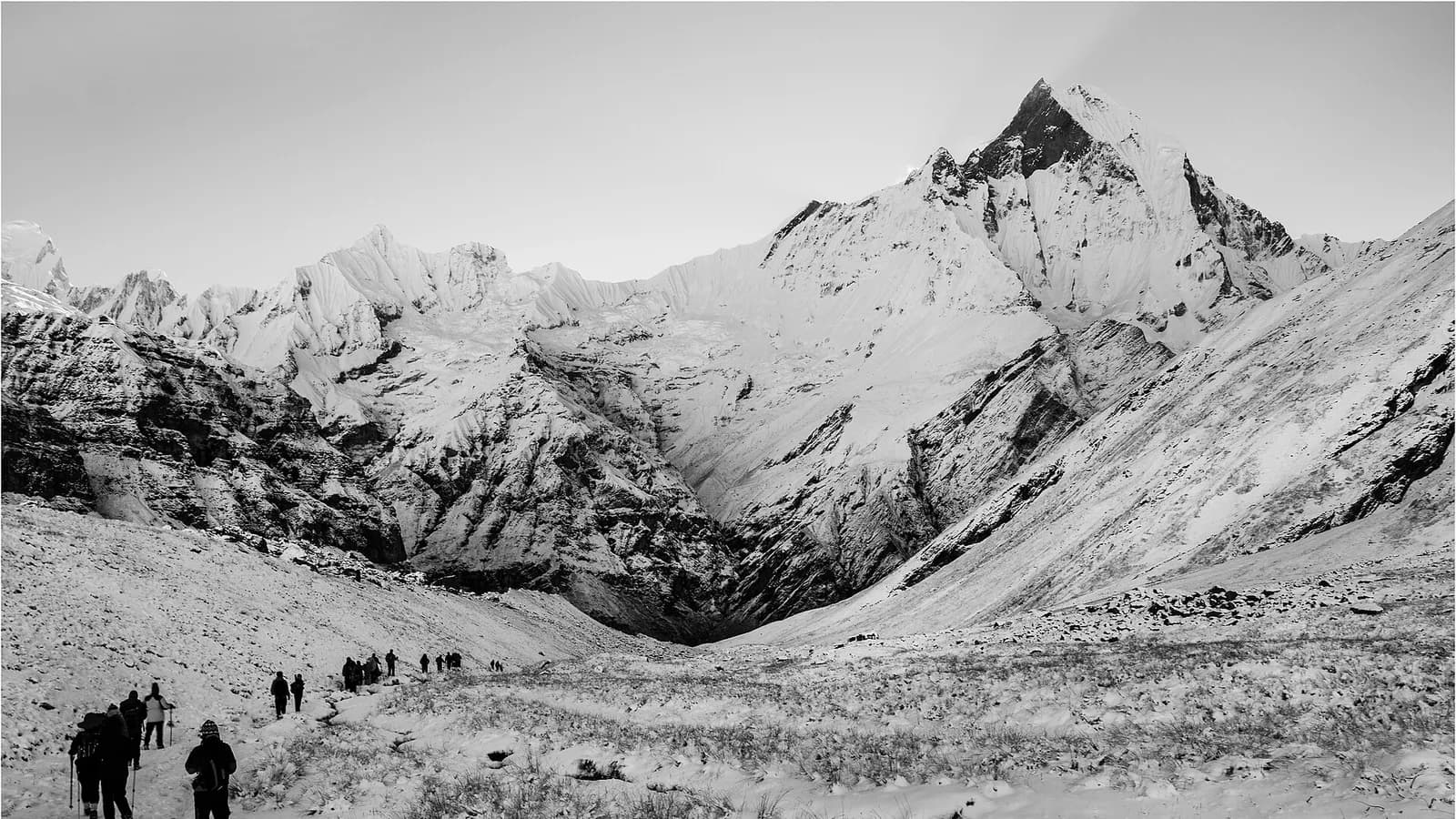
The Annapurna Base Camp trek cost has a reputation for being friendly to a tight budget, and that reputation is mostly deserved. There is no eye-watering mountain flight to pay for, the trail is dense with teahouses competing for your dinner order, and the route tops out at a manageable 4,130 metres. But the gap between the headline number an agency quotes and what actually leaves your wallet is wider than most first-timers expect. This guide breaks the trek into the buckets that genuinely move your total, with every fee stamped to mid-2026 so you can plan with real figures rather than guesses.
If you are still deciding between routes, our comparison of the Annapurna Circuit versus Base Camp covers which one suits your time and fitness before you start adding up rupees.
Key takeaways
- A budget trek with the now-mandatory guide typically lands around 600 to 900 US dollars all in from Pokhara (as of June 2026).
- The two required permits are ACAP (NPR 3,000) and a TIMS card (NPR 2,000) for non-SAARC foreigners — both arranged through a registered agency.
- ABC is usually cheaper than Everest Base Camp mainly because there is no Lukla flight; you reach the trail by road from Pokhara.
- A licensed guide is required on this route, so guide fees of roughly 30 to 50 US dollars a day are a fixed cost, not an optional one.
- Daily on-trail spending of 25 to 40 US dollars is where budgets quietly bleed, as food and extras climb with altitude.
- The biggest avoidable expense is an over-priced foreign-booked package that hides showers, charging, wifi and water behind a glossy "all-inclusive" label.
What drives the total
Four buckets account for nearly all of an ABC budget: getting to and from the trail, permits, on-trail daily spending, and the "everything else" pile of guide, insurance, tips and gear. Understanding which bucket each rupee falls into is what lets you cut costs without cutting safety. The two you should never trim are permits and insurance — everything else has room to flex.
The trek itself covers roughly 100 to 115 kilometres round trip depending on your exact route, over 7 to 12 trekking days. Longer itineraries cost more in food and lodging but buy you gentler acclimatisation and the famous Poon Hill sunrise. That single decision — short and direct versus long and scenic — is the first lever on your budget.
Getting to the trailhead (~$15–40)
This is where ABC wins decisively against the Everest region. There is no flight to a high-altitude airstrip. Instead you travel from Pokhara to a road-head such as Nayapul or Siwai by shared jeep, private vehicle or local bus, and start walking.
| Option | Rough cost | Notes | |---|---|---| | Local bus, Pokhara to trailhead | $3–6 | Cheapest, slow, crowded | | Seat in a shared jeep | $8–15 | The standard choice for most trekkers | | Private jeep (split between group) | $40–70 total | Fastest and most flexible |
To reach Pokhara in the first place, most travellers take the tourist coach from the capital. Our guide to the Kathmandu to Pokhara tourist bus covers fares and what to expect on that leg, which adds only a modest amount to the overall trip.
Permits in 2026 (~NPR 5,000 for foreigners)
ABC sits inside the Annapurna Conservation Area, so two documents are non-negotiable. Both are now issued through a government-registered trekking agency rather than over the counter as a true independent, because of the guide rule described below.
| Permit | Foreigner (non-SAARC) | SAARC national | |---|---|---| | ACAP (conservation area) | NPR 3,000 | NPR 1,000 | | TIMS card | NPR 2,000 | NPR 1,000 |
For a non-SAARC foreigner that totals NPR 5,000, very roughly 35 to 40 US dollars at mid-2026 exchange rates (as of June 2026). These fees are set by the authorities, so any quote charging dramatically more for "permits" deserves a question. Keep both documents on you — there are checkpoints on the trail where they are inspected.
The mandatory guide rule
Since 1 April 2023, Nepal has required a licensed guide for trekking on routes inside conservation and national park areas, and the Annapurna Sanctuary route to ABC is firmly on that list. The old free-independent-trekker TIMS category was closed at the same time. In practice this means your permits and your guide come bundled through one registered agency. Whatever your feelings about the rule, treat the guide fee as a fixed cost and choose a guide whose English and experience you are happy with.
On-trail daily spending (~$25–40/day)
This is the bucket that quietly inflates. Teahouse rooms are often cheap, sometimes just a few hundred rupees, on the unspoken condition that you eat dinner and breakfast where you sleep. The food, drinks and small comforts are where the day's real spend lives, and every price climbs the higher you go because everything has to be carried or muled up.
| Item | Lower trail (~2,000m) | Mid trail (~3,000m) | Near ABC (~4,000m) | |---|---|---|---| | Dal bhat (with refills) | lower | higher | highest | | Pot of tea | lower | higher | highest | | Hot shower | modest | higher | often gas-heated, pricier | | Device charging (per hour) | small fee | higher | highest | | Wifi voucher | small fee | higher | highest | | Bottled water | cheap | dearer | dearest |
I have deliberately not pinned exact rupee figures to each cell, because teahouse menus change and vary between villages — but the shape is reliable: budget 25 to 40 US dollars a day and you will be comfortable, with dal bhat as your best-value meal thanks to free refills. Two money-savers worth building in: bring a filter or purification tablets so you are not buying bottled water at altitude, and accept that hot showers and charging become luxuries the higher you climb.
Most teahouses above Chhomrong are cash only, and there are no ATMs once you leave the lowlands. Draw enough rupees in Pokhara before you set off — running short on the trail is a genuinely awkward problem with no easy fix.
The "everything else" bucket (~$300–700)
These items rarely appear in a casual mental estimate but together they often rival the rest of the trek combined.
- Guide: roughly $30–50/day and mandatory. Over a 7 to 10 day trek that is a meaningful, fixed sum.
- Porter (optional): about $22–25/day. The stone staircases between Chhomrong and Sinuwa are brutal on the knees; a porter is money well spent for many trekkers.
- Travel insurance with helicopter evacuation: do not skip this. Our explainer on trekking insurance and helicopter evacuation covers why medical-only cover is not enough at altitude.
- End-of-trek tips: a common guideline is around 10 to 15 percent of your crew's wages. See tipping trekking guides and porters for sensible amounts rather than awkward guesswork.
- Gear rental in Pokhara: a down jacket and sleeping bag can be hired cheaply for the trip if you did not pack for the cold.
- Acclimatisation and small health items: altitude medication is inexpensive at Pokhara pharmacies. ABC reaches 4,130 metres, so read our altitude sickness guide and build in the acclimatisation days rather than rushing.
What it all adds up to
Putting the buckets together gives three realistic tiers (all as of June 2026):
| Style | Typical all-in cost from Pokhara | What you get | |---|---|---| | Budget, guide-required | ~$600–900 | Permits, guide, basic teahouses, dal bhat diet, careful spending | | Mid-tier local package | ~$800–1,100 | Logistics handled, guide, porter, set lodging | | Foreign-booked package | $1,400+ | Convenience and a single payment, but watch what is excluded |
The budget tier assumes you arrange permits and a guide through a Pokhara agency, eat dal bhat, limit paid extras, and travel to the trailhead by shared jeep. The mid-tier package buys you one less logistical headache, which is fair value if your time is tight. The place it goes wrong is the expensive foreign-booked trip that quietly leaves showers, charging, wifi, water and tips off the inclusions list — so you pay a premium and then pay again on the mountain.
How to keep the cost down without cutting corners
The savings that matter are the ones that do not touch your safety. Carry a water filter instead of buying bottled water. Eat dal bhat for the free refills. Share a jeep to the trailhead. Rent bulky cold-weather gear in Pokhara rather than buying it for one trip. Arrange permits and your guide directly with a reputable Pokhara agency instead of a foreign middleman.
What you should never trim: the guide (it is required and a good one keeps you safe), the permits, the insurance with helicopter cover, and your acclimatisation days. If a quote looks suspiciously cheap, check whether it has skipped one of these — that is usually where the missing money hides.
If you are weighing ABC against other lower-cost options in the same region, the Mardi Himal trek is a shorter, quieter alternative that shares the same permit structure. And to pick the right season for clear mountain views and fair lodge prices, see our guide to the best time to visit Nepal.
A quick pre-trip money checklist
- Permits arranged through a registered agency: ACAP and TIMS
- A licensed guide booked (required) and a decision made on a porter
- Travel insurance that explicitly includes helicopter evacuation
- Enough rupees drawn in Pokhara for the whole trail — it is largely cash only
- A water filter or tablets to dodge bottled-water prices at altitude
- A few trail phrases in your pocket; our phrases every trekker should know earns warmer service at the lodges
ABC rewards trekkers who plan the small numbers as carefully as the big ones. Bring the right cash, the right cover and the right expectations, and it remains one of the best-value great walks in the Himalaya.
Sources
Frequently asked questions
- How much does the Annapurna Base Camp trek cost in 2026?
- A budget independent-style trek with a mandatory guide runs roughly 600 to 900 US dollars all in from Pokhara, covering permits, guide, food and lodging. A mid-tier agency package booked locally lands around 800 to 1,100 US dollars, and packages sold from abroad can reach 1,400 or more (as of June 2026).
- What permits do I need for Annapurna Base Camp and how much are they?
- You need two: the Annapurna Conservation Area Permit (ACAP) at NPR 3,000 for foreigners, and a TIMS card at NPR 2,000 for non-SAARC nationals. SAARC nationals pay NPR 1,000 for each (as of June 2026). Both are arranged through a registered agency.
- Do I need a guide for the Annapurna Base Camp trek?
- Yes. Since April 2023 Nepal requires a licensed guide for trekking routes inside conservation and national park areas, including ABC. Solo independent trekking on this route is no longer permitted, so a guide fee is now a fixed part of the budget.
- How many days does the Annapurna Base Camp trek take?
- Most itineraries run 7 to 12 trekking days, not counting travel to and from Pokhara. Shorter 7-day versions skip side trips, while 10 to 12 day plans add Ghorepani and Poon Hill for sunrise views and gentler acclimatisation.
- How much should I budget per day on the trail?
- Plan for about 25 to 40 US dollars a day for food, a bed, charging, hot showers and the odd treat. Meals climb with altitude, and extras like wifi, bottled water and device charging add up faster than the room rate.
- Is Annapurna Base Camp cheaper than Everest Base Camp?
- Usually yes. ABC has no expensive Lukla flight — you reach the trailhead by road from Pokhara — so transport costs a fraction of the Everest route. Permits and daily teahouse prices are also a little lower, making ABC one of the best-value major treks in Nepal.
- How much should I tip my guide and porter?
- A common guideline is around 10 to 15 percent of their total daily wages, paid at the end of the trek. For a week-long ABC trek that often works out to roughly 50 to 100 US dollars combined, though the amount is at your discretion and reflects service.
Spotted an error in this post? Tell us or suggest a correction.
Related posts
ABC Trek: A Plain-English Guide to Annapurna Base Camp
The ABC trek (Annapurna Base Camp) explained — the route, how many days it takes, difficulty, the best seasons, and what daily trail life is really like.
Read postAma Dablam Climb: 2026 Expedition Guide (6,812m)
An Ama Dablam climb and expedition guide for 2026 — height, the Southwest Ridge route, camps, fixed ropes, difficulty, permits, cost and the best seasons.
Read postAnnapurna vs Manaslu: Which Trek Should You Choose?
An Annapurna vs Manaslu decision guide for trekkers — compare permits, crowds, difficulty, infrastructure and cost to pick the right Himalayan route.
Read postAsan Bazaar Kathmandu: Old Town Market Guide
A visitor guide to Asan bazaar, Kathmandu's oldest market — its six-road square, Annapurna Temple, what to buy, when to go, and how to get there.
Read postAyurveda Nepal: A Traveller's Guide to Healing
Ayurveda Nepal explained for tourists — the history, the doshas, treatments like Panchakarma and Shirodhara, where to go and how to choose a centre safely.
Read postBest Restaurants Pokhara Lakeside: Where to Eat
The best restaurants in Pokhara Lakeside — lakeside trout, wood-fired pizza, Tibetan momos and healthy cafes, with what to order and rough 2026 prices.
Read post