Mardi Himal Trek — The 5-Day Hidden Gem Above Pokhara
The short, scenic alternative to Annapurna Base Camp — 5 days, low crowds, no high passes, and a viewpoint that rivals anything in the region.
Same massif, half the trekkers, two-thirds the days.
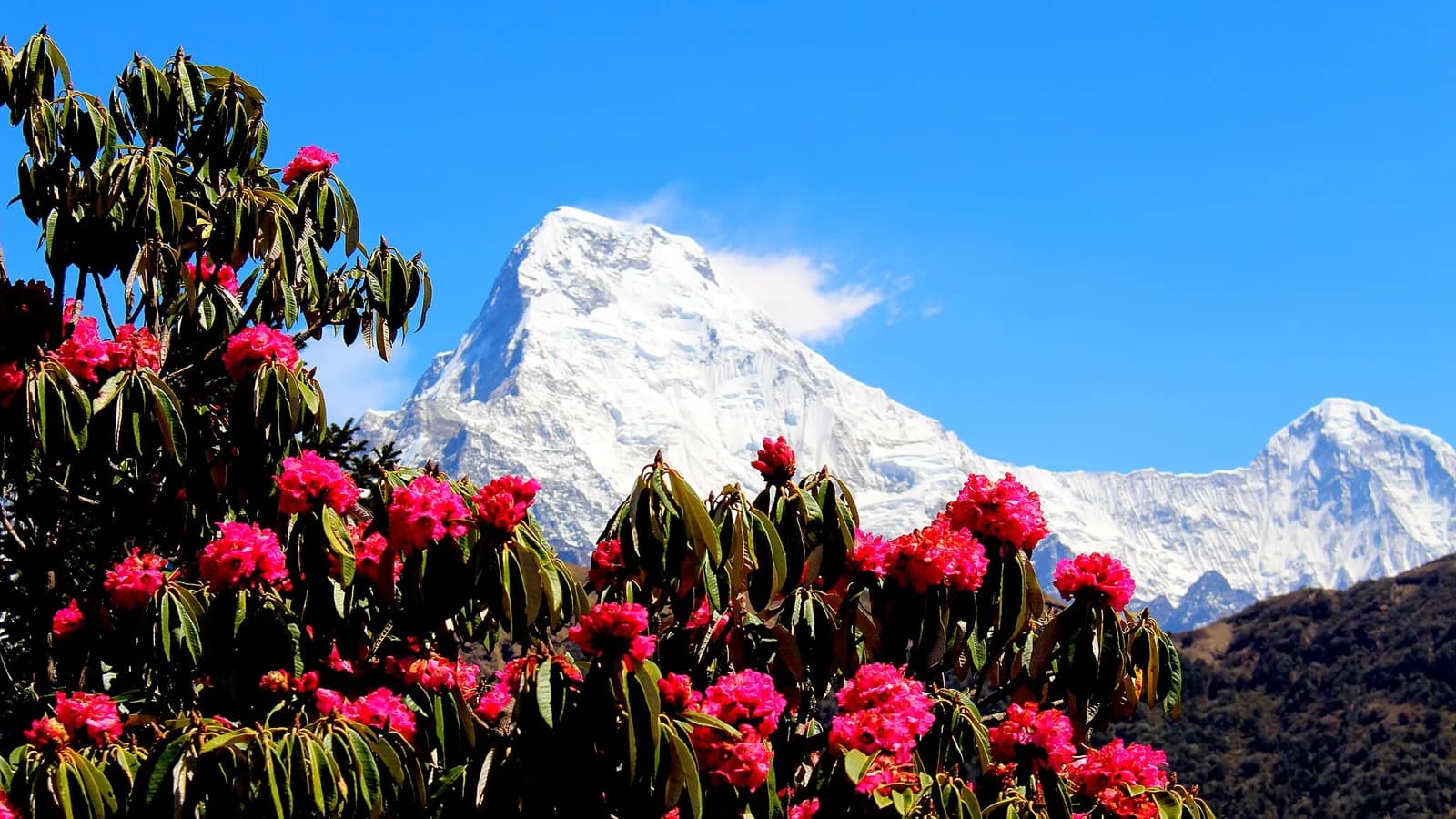
Mardi Himal sits on a ridge above the Modi Khola valley, looking straight up at Machhapuchhre (the unclimbed "Fishtail" peak) and across at the wall of the Annapurna sanctuary. It's been a "secret" trek for about ten years, and in 2026 the secret is mostly out — but compared to Annapurna Base Camp and Poon Hill, Mardi Himal remains genuinely quiet.
Here's why it's worth the 5 days, and what to expect.
The route in 5 days
Day 1: Pokhara → Pothana → Forest Camp (5–6 hours) Drive from Pokhara to Phedi (about 30 minutes). Walk up to Pothana, then through pine and rhododendron forest to Forest Camp at 2,520m. The forest sections are quietly beautiful — moss-draped trees, mist, very little sound.
Day 2: Forest Camp → Low Camp → High Camp (5–6 hours) The trail climbs through forest to Low Camp (3,150m), then continues to High Camp (3,580m). The forest opens to alpine meadow around Low Camp; from High Camp you're above the treeline with Machhapuchhre directly to the north.
Day 3: High Camp → Mardi Himal Viewpoint → High Camp (4–6 hours round trip) The early morning push to the viewpoint at 4,200m. You start in headlamp-darkness, the sun rises over the eastern ranges, and within a few hours you're standing on a narrow ridge looking at Machhapuchhre (6,993m), Annapurna South (7,219m), Hiunchuli, Annapurna I (8,091m), Annapurna Fang, and the entire Annapurna sanctuary spread below you. It's a 270° panorama that rivals anything you'll see on EBC or ABC.
Day 4: High Camp → Sidhing (5–6 hours) A long descent through forest and terraced fields to the village of Sidhing.
Day 5: Sidhing → Pokhara Jeep or bus back to Pokhara (3–4 hours).
What makes it different
Altitude is moderate. Top point is 4,200m. AMS risk is low. You can do this trek without any altitude prior experience and be fine.
Crowds are manageable. Even in peak October–November, you might share lodges with 15–25 other trekkers, not the 100+ you'd meet on ABC or EBC. Off-peak (December or February) you can sometimes have lodges almost to yourself.
Lodges are basic but cheap. Above Low Camp the lodges are small, often family-run by a single household. Rooms NPR 200–500, dal bhat NPR 500–700. The food is closer to the family's daily cooking than the multi-page tourist menu at EBC lodges.
The view is the trek. Most treks build to a single big-view day (ABC's sanctuary, EBC's base camp). Mardi Himal's viewpoint day is similarly the highlight, but the High Camp itself already has a panoramic view from the lodge — you're seeing the big peaks for two solid days.
Best season
Best: October–November (clear skies, cold but manageable nights at High Camp). Second-best: late February through April (rhododendrons in lower forest, slightly warmer). Avoid: June–August monsoon (the trail through forest gets leech-heavy).
The trek is high enough that December–January nights at High Camp drop below -10°C — possible if you have a serious sleeping bag, uncomfortable if you don't.
Permits
Same as the rest of the Annapurna region:
- ACAP entry: NPR 3,000 (~$22) — paid in Pokhara before starting
- TIMS card: NPR 2,000 (~$15) — same office in Pokhara
Both done in 20 minutes at the Nepal Tourism Board office in Pokhara. Bring passport and two photos.
Guide and porter
The 2023 guide rule applies. In practice, Mardi Himal is one of the easier treks to do with just a porter — the trail is well-marked, the lodges are visible from each other, and the route doesn't have ambiguous junctions.
Costs:
- Porter: $20–25/day
- Guide: $30–35/day
- Porter-guide combined: $25–30/day
For a 5-day trek, total guiding cost runs $100–175.
What to pack
The full trekking packing list applies but Mardi Himal is forgiving:
- Down jacket — High Camp nights are genuinely cold even in peak season
- Sleeping bag rated -10°C
- Headlamp + spare batteries (for the early viewpoint push)
- Trekking poles (the descent on day 4 is steep)
- Camera or phone with good optical zoom — the views warrant it
No need for technical gear, crampons, or anything beyond standard trekking kit.
Food and lodges
The lodges at Forest Camp, Low Camp, and High Camp are small. Menus are simpler than EBC — fewer items, less variety, but the dal bhat is often better because it's made for the family too.
A practical note: at High Camp, the dining room is the warmest spot in the lodge. Spend evenings there with a thermos of hot water and the trekkers you've been leapfrogging all day. The social texture is closer to old-school trekking than the more commercial atmosphere on EBC.
See the teahouse script for the ordering sequence.
How to combine it
Mardi Himal pairs well with two extensions:
- + Poon Hill (2 days): start at Nayapul instead of Phedi, walk up to Ghorepani, do Poon Hill sunrise, then traverse to Mardi Himal. Total 7–8 days.
- + ABC (5 days): from Sidhing, link back to the ABC trail at Chhomrong, walk up to Annapurna Base Camp, return via Jhinu Danda hot springs. Total 9–10 days.
Both extensions add significant variety. The ABC extension specifically gives you Mardi's quiet first half and ABC's iconic finish.
Pros and cons summary
Pros: Short (5 days), low altitude risk, low crowds, exceptional viewpoint, accessible from Pokhara, budget-friendly.
Cons: Less variety than longer treks (you're in similar forest/alpine terrain throughout), the viewpoint day requires early start in cold conditions, lodges are basic with fewer comforts than EBC.
Pre-trek checklist
- ACAP + TIMS in Pokhara (20 mins, NPR 5,000 total)
- Porter or porter-guide hired in Pokhara
- Down jacket + -10°C sleeping bag
- 15k NPR cash for 5 days of trekking
- The eight trail phrases for lodge interactions
Mardi Himal is the trek for the traveler who wants Annapurna's mountain wall without the commitment of a 14-day trek. The viewpoint at sunrise pays back the 5 days.
Spotted an error in this post? Tell us or suggest a correction.
Related posts
ABC Trek: A Plain-English Guide to Annapurna Base Camp
The ABC trek (Annapurna Base Camp) explained — the route, how many days it takes, difficulty, the best seasons, and what daily trail life is really like.
Read postAma Dablam Climb: 2026 Expedition Guide (6,812m)
An Ama Dablam climb and expedition guide for 2026 — height, the Southwest Ridge route, camps, fixed ropes, difficulty, permits, cost and the best seasons.
Read postAnnapurna vs Manaslu: Which Trek Should You Choose?
An Annapurna vs Manaslu decision guide for trekkers — compare permits, crowds, difficulty, infrastructure and cost to pick the right Himalayan route.
Read postAsan Bazaar Kathmandu: Old Town Market Guide
A visitor guide to Asan bazaar, Kathmandu's oldest market — its six-road square, Annapurna Temple, what to buy, when to go, and how to get there.
Read postAyurveda Nepal: A Traveller's Guide to Healing
Ayurveda Nepal explained for tourists — the history, the doshas, treatments like Panchakarma and Shirodhara, where to go and how to choose a centre safely.
Read postBest Restaurants Pokhara Lakeside: Where to Eat
The best restaurants in Pokhara Lakeside — lakeside trout, wood-fired pizza, Tibetan momos and healthy cafes, with what to order and rough 2026 prices.
Read post