Mountains in Nepal: 8 of the World's 10 Tallest Peaks
Mountains in Nepal include 8 of the world's 10 tallest — Everest, Kanchenjunga, Lhotse and more, plus the eight-thousanders and how to see them.
Eight of the ten highest mountains on Earth stand in one country the size of England — and you can walk to the foot of most of them.
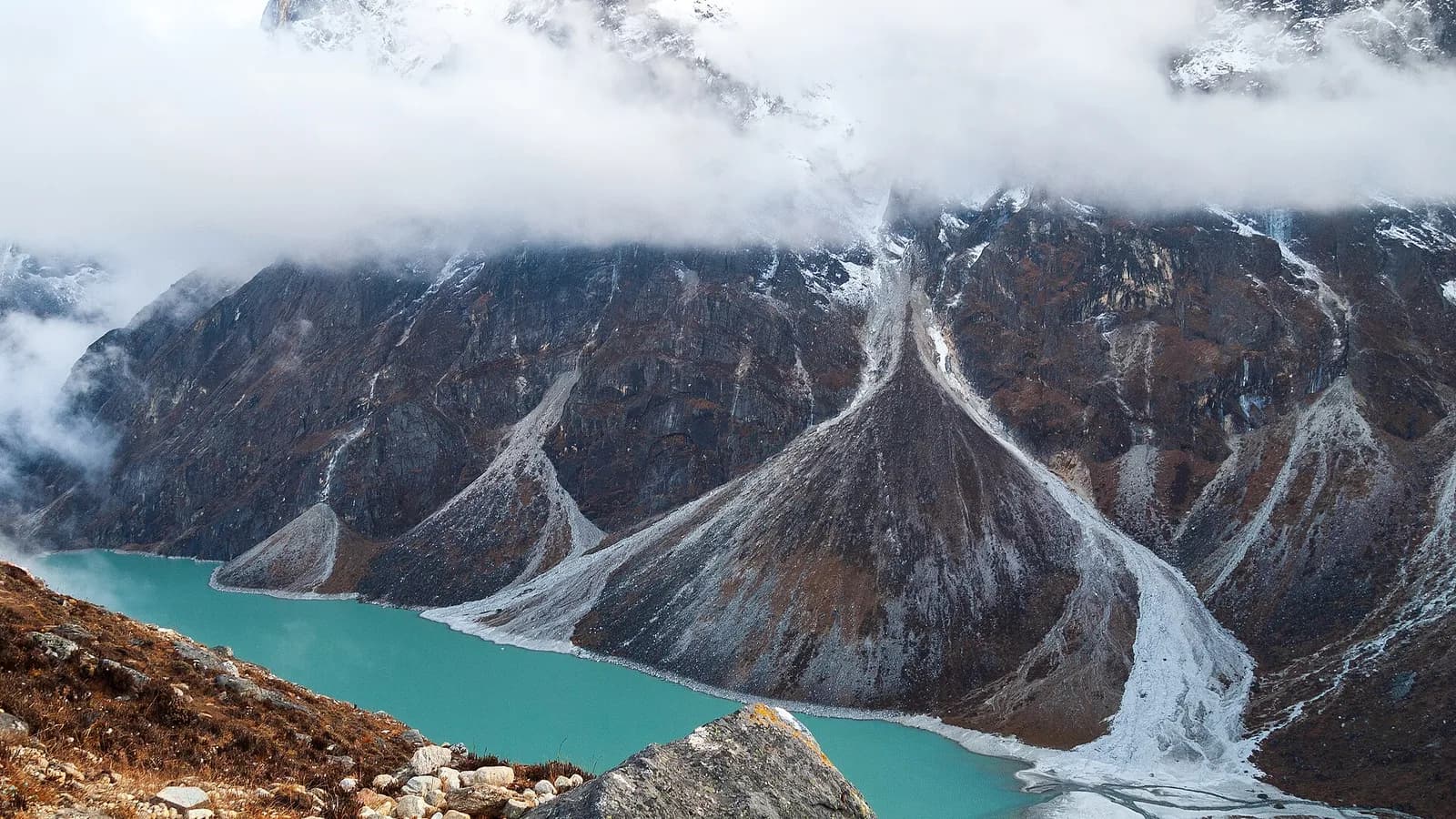
The mountains in Nepal are not just tall — they are, collectively, the highest concentration of high ground on the planet. Eight of the world's ten highest peaks rise along Nepal's northern frontier, including Everest, the highest of them all. Squeeze that into a country roughly the size of England and you have a place where the skyline itself is a world record, and where ordinary travellers can walk to the foot of summits that humans only first stood on in living memory.
This guide is the wide-angle view of Nepal's mountains: the eight-thousanders that make the country famous, the geological reason they are clustered here, the lower trekking peaks that climbers can actually attempt, and the realistic ways to see them. If your question is narrower — just the single tallest — our highest mountain in Nepal guide focuses on Everest alone. Here, we take in the whole range.
Key takeaways
- Nepal holds eight of the world's ten highest mountains and eight of the fourteen eight-thousanders.
- The eight are Everest, Kanchenjunga, Lhotse, Makalu, Cho Oyu, Dhaulagiri I, Manaslu and Annapurna I.
- Three — Dhaulagiri, Manaslu and Annapurna — lie entirely within Nepal; the rest share a border.
- The peaks exist because the Indian plate is colliding with the Eurasian plate, lifting the Himalaya to this day.
- You do not have to climb — the classic treks reach base camps and viewpoints; see explore mountains for the full ranked list.
Eight of the world's ten tallest
Start with the headline statistic, because it is genuinely staggering. Of the fourteen mountains on Earth that exceed 8,000 metres, eight rise wholly or partly in Nepal. Run down the global top ten and Nepal owns the list almost end to end — only K2 (8,611 m) and Nanga Parbat (8,125 m), both in Pakistan's Karakoram, interrupt the sequence.
| World rank | Mountain | Height | In Nepal? | |---|---|---|---| | 1 | Everest | 8,848.86 m | Yes (Nepal–China) | | 2 | K2 | 8,611 m | No (Pakistan–China) | | 3 | Kanchenjunga | 8,586 m | Yes (Nepal–India) | | 4 | Lhotse | 8,516 m | Yes (Nepal–China) | | 5 | Makalu | 8,485 m | Yes (Nepal–China) | | 6 | Cho Oyu | 8,188 m | Yes (Nepal–China) | | 7 | Dhaulagiri I | 8,167 m | Yes (Nepal) | | 8 | Manaslu | 8,163 m | Yes (Nepal) | | 9 | Nanga Parbat | 8,125 m | No (Pakistan) | | 10 | Annapurna I | 8,091 m | Yes (Nepal) |
Heights follow the standard surveyed figures; Everest uses the 2020 Nepal–China joint re-measurement of 8,848.86 m.
The data-rich explore mountains page charts all eight Nepali eight-thousanders by height, with first-ascent years and the regions you would trek to reach each one — a useful companion to the editorial overview here.
Why are Nepal's mountains so high?
The Himalaya are young, geologically speaking, and still growing. Around 50 million years ago the Indian tectonic plate began colliding with the Eurasian plate, and the seabed sediments caught between them were crumpled and thrust skyward into the highest mountain range on Earth. That collision has not stopped. The plates continue to converge, lifting the Himalaya by a few millimetres a year — a figure often cited as around 4 mm of vertical uplift annually for the Everest region, though erosion and earthquakes complicate the picture.
This is why the mountains in Nepal are concentrated along the northern border with Tibet: that frontier traces the crumple zone. It also explains the Himalayan ranges the peaks are grouped into — Mahalangur Himal around Everest, the Annapurna and Dhaulagiri Himals in the centre-west, the Kangchenjunga Himal in the far east. Each "Himal" is a sub-range, and most treks are built around one of them.
The eight-thousanders, one by one
Each of Nepal's giants has a character of its own. Here is the shape of the list, east to west and by reputation.
Everest (Sagarmatha) — 8,848.86 m
The highest mountain in Nepal and on Earth, on the Nepal–China border in the Mahalangur Himal. First climbed in 1953 by Edmund Hillary and Tenzing Norgay. Its Nepali name is Sagarmatha, and it anchors Sagarmatha National Park. The full story of its elevation is in our Mount Everest height explainer.
Kanchenjunga — 8,586 m
The world's third-highest and Nepal's second, on the eastern border with India. Sacred to local communities, who traditionally leave the true summit untrodden. It is the centrepiece of the remote Kanchenjunga trek.
Lhotse and Makalu — 8,516 m and 8,485 m
Lhotse is Everest's immediate neighbour, sharing the South Col route; Makalu, a near-perfect four-sided pyramid east of Everest, stands alone in its own conservation area. Both rise in the greater Everest region of Koshi Province.
Cho Oyu, Dhaulagiri I, Manaslu, Annapurna I
Cho Oyu (8,188 m) is widely considered the most accessible eight-thousander. Dhaulagiri I (8,167 m) is the highest peak lying entirely in Nepal. Manaslu (8,163 m), the "Mountain of the Spirit," anchors the increasingly popular Manaslu Circuit trek. And Annapurna I (8,091 m) holds a unique place in history as the first eight-thousander ever climbed, by a French team in 1950 — though it is also statistically one of the deadliest.
Trekking peaks: the mountains you can actually climb
The eight-thousanders are the realm of expedition mountaineers. But Nepal also offers dozens of lower trekking peaks — summits, mostly under 7,000 m, that fit climbers with basic skills and a Nepal Mountaineering Association permit. These are how many travellers get their first taste of standing on a Himalayan summit.
| Peak | Height | Why it's known | |---|---|---| | Machhapuchhre (Fishtail) | 6,993 m | Sacred and forbidden to climb | | Ama Dablam | 6,812 m | The "Matterhorn of the Himalaya" | | Mera Peak | 6,476 m | Highest permitted trekking peak | | Island Peak (Imja Tse) | 6,165 m | A popular first 6,000er | | Lobuche East | 6,119 m | Classic acclimatisation climb |
The standout is Machhapuchhre, the twin-pointed "Fishtail" that towers over Pokhara: it is closed to climbing because it is sacred to Shiva, and has never been officially summited. Among those you can climb, Ama Dablam is the photogenic landmark of the Everest trail, while Mera Peak and Island Peak are the popular introductions to high-altitude climbing. The explore mountains page lists the full set with permit notes.
Where the ranges are — and how to trek beneath them
For most visitors, "seeing the mountains in Nepal" means trekking through one of the great Himals rather than climbing anything. The country's classic trekking regions each sit beneath a cluster of giants:
- Everest / Khumbu (east) — Everest, Lhotse, Cho Oyu and Ama Dablam. The Everest Base Camp trek, the high Three Passes trek, and the lake-studded Gokyo Lakes trek.
- Annapurna (centre-west) — Annapurna, Dhaulagiri and Machhapuchhre, all reached from Pokhara. Compared in our Annapurna Circuit vs Base Camp guide.
- Manaslu (centre) — the Manaslu Circuit, a quieter alternative to Annapurna.
- Kanchenjunga (far east) — remote, committing, and gloriously empty.
Whichever you choose, the binding constraint is altitude, not technical difficulty. Read the altitude sickness guide before any high trek, and time your trip with our best time to visit Nepal advice — autumn and spring give the clearest mountain views.
Seeing the Himalaya without a multi-day trek
Not everyone has two weeks or the legs for a high pass. The mountains in Nepal are still within reach:
- From Pokhara, the Annapurna and Fishtail skyline reflects in Phewa Lake; see things to do in Pokhara.
- From hill viewpoints near Kathmandu, the eastern Himalaya appears on clear mornings.
- An Everest mountain flight cruises the entire high skyline at dawn, summit-level with your window.
- The short Everest View trek reaches famous Khumbu viewpoints in under a week.
If you are weighing Nepal's mountains against neighbouring high country, Nepal vs Tibet and Nepal vs Bhutan compare the experiences from the traveller's side.
The bottom line
The mountains in Nepal are the planet's headline act: eight of the ten highest peaks on Earth, born of a tectonic collision that is still lifting them, clustered along a single mountainous border. From Everest and Kanchenjunga down to the shapely trekking peaks like Ama Dablam and the forbidden Fishtail, they define the country's landscape, economy and identity. You can spend a fortune and risk your life climbing one — or you can lace up your boots, walk to a base camp, and look up. For most travellers, the second is the better mountain. Start your planning with best places to visit in Nepal and the data-rich explore mountains hub.
Sources
Frequently asked questions
- How many of the world's tallest mountains are in Nepal?
- Nepal contains eight of the world's ten highest mountains and eight of the fourteen peaks above 8,000 metres. Only K2 and Nanga Parbat, both in the Karakoram of Pakistan, break Nepal's run through the top ten.
- What are the eight-thousander mountains in Nepal?
- Nepal's eight eight-thousanders are Everest, Kanchenjunga, Lhotse, Makalu, Cho Oyu, Dhaulagiri I, Manaslu and Annapurna I. Three of them — Dhaulagiri, Manaslu and Annapurna — lie entirely within Nepal.
- What is the most famous mountain in Nepal?
- Mount Everest, called Sagarmatha in Nepali, is the most famous mountain in Nepal and the highest on Earth at 8,848.86 metres. Annapurna and the shapely Machhapuchhre (Fishtail) near Pokhara are also widely recognised.
- Why does Nepal have so many high mountains?
- Nepal sits on the collision zone where the Indian tectonic plate pushes into the Eurasian plate. That ongoing collision threw up the Himalaya and continues to lift the range by a few millimetres a year, concentrating the world's highest peaks along Nepal's northern border.
- What is a trekking peak in Nepal?
- A trekking peak is a lower summit, generally under about 7,000 metres, that climbers can attempt with a Nepal Mountaineering Association permit and basic mountaineering skills. Examples include Mera Peak, Island Peak and Ama Dablam.
- Can you climb Machhapuchhre, the Fishtail mountain?
- No. Machhapuchhre (6,993 m) near Pokhara is sacred to the god Shiva and closed to climbing. It has never been officially summited, which is part of why its twin-pointed Fishtail profile stays so pristine.
- Do you have to climb to see the mountains in Nepal?
- Not at all. The classic treks reach the base camps and viewpoints beneath the giants, and you can also see the Himalaya from Pokhara, from hill stations like Nagarkot, or from a scenic mountain flight out of Kathmandu.
- Which mountain in Nepal was climbed first?
- Annapurna I was the first eight-thousander ever climbed anywhere, summited by a French team in 1950 — three years before Everest. It remains one of the most dangerous of the high peaks.
Spotted an error in this post? Tell us or suggest a correction.
Related posts
ABC Trek: A Plain-English Guide to Annapurna Base Camp
The ABC trek (Annapurna Base Camp) explained — the route, how many days it takes, difficulty, the best seasons, and what daily trail life is really like.
Read postAma Dablam Climb: 2026 Expedition Guide (6,812m)
An Ama Dablam climb and expedition guide for 2026 — height, the Southwest Ridge route, camps, fixed ropes, difficulty, permits, cost and the best seasons.
Read postAnnapurna vs Manaslu: Which Trek Should You Choose?
An Annapurna vs Manaslu decision guide for trekkers — compare permits, crowds, difficulty, infrastructure and cost to pick the right Himalayan route.
Read postAsan Bazaar Kathmandu: Old Town Market Guide
A visitor guide to Asan bazaar, Kathmandu's oldest market — its six-road square, Annapurna Temple, what to buy, when to go, and how to get there.
Read postAyurveda Nepal: A Traveller's Guide to Healing
Ayurveda Nepal explained for tourists — the history, the doshas, treatments like Panchakarma and Shirodhara, where to go and how to choose a centre safely.
Read postBest Restaurants Pokhara Lakeside: Where to Eat
The best restaurants in Pokhara Lakeside — lakeside trout, wood-fired pizza, Tibetan momos and healthy cafes, with what to order and rough 2026 prices.
Read post