Highest Mountain in Nepal: Everest, and the 8000ers
The highest mountain in Nepal is Everest at 8,848.86 m — the world's highest peak. Plus Nepal's other seven eight-thousanders, names and how to see them.
The highest mountain in Nepal is also the highest point on the planet — and it shares the country with seven more of the world's tallest summits.
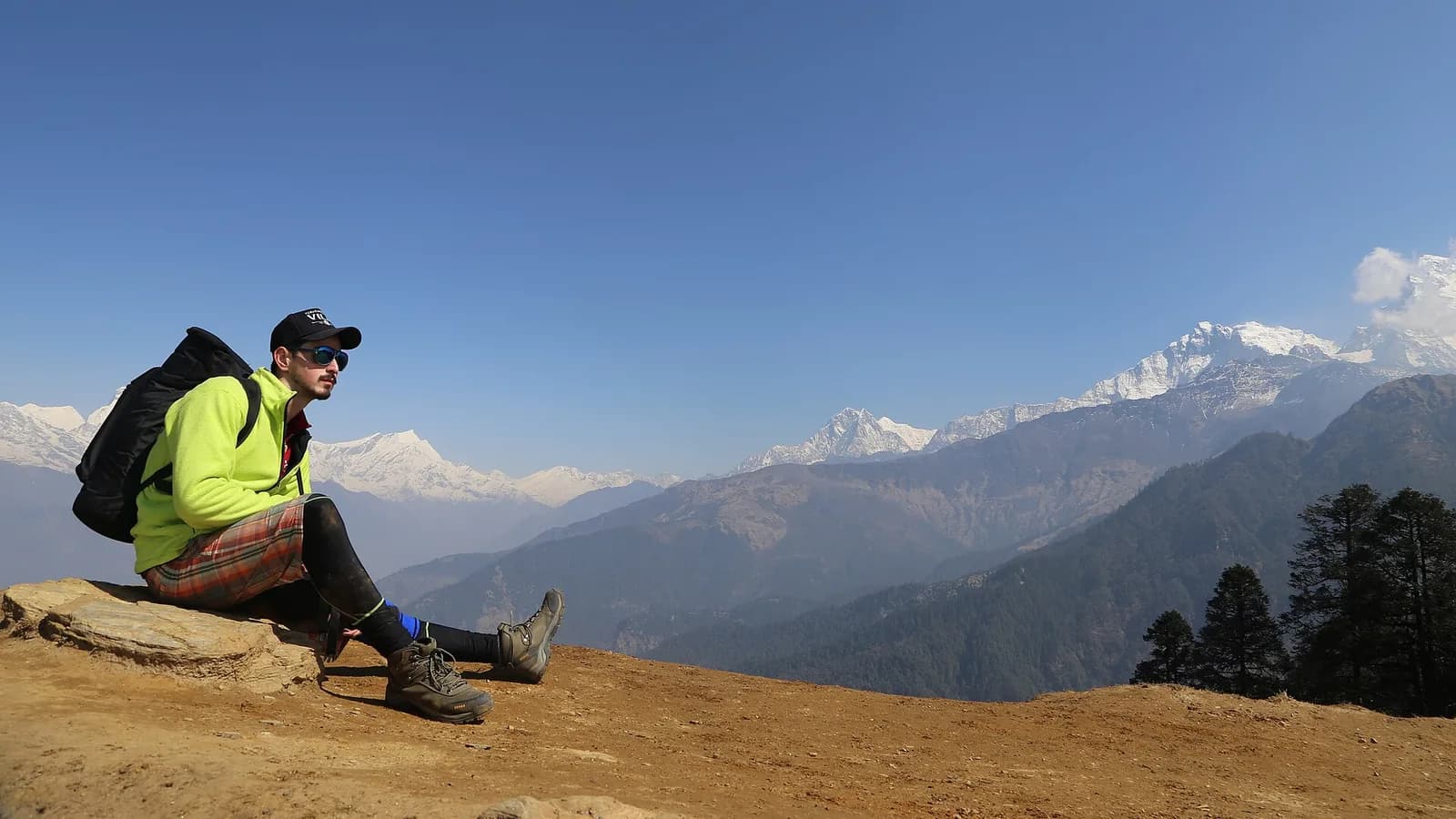
The highest mountain in Nepal is one of the few superlatives in geography that needs no qualification: it is Mount Everest, 8,848.86 metres above sea level, and it is not just the highest peak in Nepal but the highest point on the entire planet. What makes Nepal extraordinary is that Everest is not alone. The same small Himalayan country holds eight of the world's fourteen mountains above 8,000 metres — a concentration of high ground found nowhere else on Earth.
This guide answers the simple question first — what and how high is Nepal's highest mountain — and then widens the lens: the peak's names, where exactly it sits, the curious distinction between the highest mountain in Nepal and the highest one entirely inside Nepal, and how an ordinary traveller can stand in its shadow without ever roping up. For a deep dive into the elevation figure itself, our Mount Everest height explainer covers the survey science; this piece is the bigger picture.
Key takeaways
- The highest mountain in Nepal is Mount Everest (Sagarmatha) at 8,848.86 m (29,031.7 ft) — also the highest on Earth.
- That figure was jointly agreed by Nepal and China on 8 December 2020 and is now used by both countries.
- Everest sits on the Nepal–China border; the highest peak lying entirely within Nepal is Dhaulagiri I (8,167 m).
- Nepal contains eight of the world's fourteen eight-thousanders and eight of the ten highest mountains on Earth.
- You can see the mountain without climbing it — on the Everest Base Camp trek, the Everest View trek, or an Everest mountain flight.
How high is the highest mountain in Nepal?
Everest's official elevation is 8,848.86 metres, which works out to about 29,031.7 feet or roughly 8.85 kilometres. For most of the twentieth century the textbook figure was 8,848 m, derived from a Survey of India measurement in the 1950s. The number rose slightly — by 0.86 m — when Nepal and China announced a jointly agreed height on 8 December 2020, the product of a coordinated survey using satellite positioning, precise levelling and radar fired through the summit snow.
That 2020 figure matters because, for the first time, both countries that share the summit endorsed the same number. Nepal had long measured the snow height (the top of the ice cap, which is what climbers stand on); China had separately published a lower rock height of 8,844.43 m. The agreed 8,848.86 m is a snow height, and it is the figure you will now see on official maps and signs.
Is it really the highest in the world?
Yes — under the standard definition almost everyone means. Everest is the highest mountain above mean sea level. Two technical caveats are worth knowing for trivia's sake: measured base-to-summit, Hawaii's Mauna Kea is taller because most of it is underwater, and measured from the centre of the Earth, Ecuador's Chimborazo wins thanks to the equatorial bulge. By the conventional sea-level measure, though, Nepal's highest mountain is the planet's highest, full stop.
The names of the mountain
A peak this important has more than one name, and each tells you something.
- Sagarmatha (सगरमाथा) — the Nepali name, often translated as "the head in the great blue sky" or "forehead of the sky." It also lends its name to Sagarmatha National Park, the UNESCO-listed park that contains the mountain.
- Chomolungma (Qomolangma) — the Tibetan name, usually rendered "holy mother," far older than the English one.
- Everest — the English name, applied in the nineteenth century to honour Sir George Everest, a former Surveyor General of India who never saw the peak and reportedly objected to the honour.
Knowing the Nepali name is more than pedantry: on the trail, in permits and on signage you will encounter "Sagarmatha" far more often than "Everest." A handful of Nepali phrases every trekker should know goes a long way in the villages beneath it.
Where exactly is Nepal's highest mountain?
Everest rises in the Mahalangur Himal, the high sub-range of the Himalaya in north-eastern Nepal, directly on the border with the Tibet Autonomous Region of China. On the Nepali side it sits in the Solukhumbu District of Koshi Province, within Sagarmatha National Park and the homeland of the Sherpa people. The classic approach runs up the Dudh Koshi valley from the airstrip at Lukla, through Namche Bazaar, to Everest Base Camp at the foot of the Khumbu Icefall.
Because the summit lies on the frontier, climbers reach it from two sides: the South Col route from Nepal (pioneered in 1953) and the North Col route from Tibet. For trekkers, only the Nepali side offers the famous walk-in; the Everest Base Camp itinerary sets out that route day by day.
Highest in Nepal versus highest entirely inside Nepal
Here is a distinction that trips up a lot of quiz answers. Everest is the highest mountain in Nepal — but it is not the highest mountain that lies wholly within Nepal's borders, because the summit is shared with China.
The highest peak that sits entirely inside Nepal is Dhaulagiri I, at 8,167 metres, in the Dhaulagiri Himal of western Nepal. Its name means "White Mountain," and unlike Everest, Kanchenjunga, Lhotse, Makalu and Cho Oyu — all of which straddle a border — Dhaulagiri belongs to Nepal alone. Two more eight-thousanders, Manaslu (8,163 m) and Annapurna I (8,091 m), are also entirely Nepali.
| Distinction | Mountain | Height | |---|---|---| | Highest in Nepal | Mount Everest (border) | 8,848.86 m | | Highest entirely inside Nepal | Dhaulagiri I | 8,167 m | | First eight-thousander ever climbed | Annapurna I (1950) | 8,091 m |
Nepal's other giants: the eight-thousanders
Everest tops a remarkable list. Of the fourteen mountains on Earth above 8,000 metres, eight rise wholly or partly in Nepal — and eight of the world's ten highest peaks are Nepali. After Everest, the country's highest is Kanchenjunga (8,586 m), the world's third-highest, on the eastern border with India.
| Rank in Nepal | Mountain | Height | Notes | |---|---|---|---| | 1 | Everest (Sagarmatha) | 8,848.86 m | Highest on Earth | | 2 | Kanchenjunga | 8,586 m | 3rd-highest in the world | | 3 | Lhotse | 8,516 m | Everest's neighbour | | 4 | Makalu | 8,485 m | A four-sided pyramid | | 5 | Cho Oyu | 8,188 m | Most accessible 8,000er | | 6 | Dhaulagiri I | 8,167 m | Highest wholly in Nepal | | 7 | Manaslu | 8,163 m | "Mountain of the Spirit" | | 8 | Annapurna I | 8,091 m | First ever climbed, 1950 |
Heights follow the standard surveyed figures; Everest uses the 2020 joint re-measurement.
This is only the headline list. For the full picture — including the famous trekking peaks like Ama Dablam and Mera that ordinary climbers can attempt — see our companion overview of mountains in Nepal and the data-rich explore mountains page, which charts all eight by height. The two articles take deliberately different angles: this one is about the single highest summit; that one surveys the whole range.
A short climbing history of the summit
The race to the top of Nepal's highest mountain shaped twentieth-century exploration.
- 1953 — Edmund Hillary of New Zealand and Tenzing Norgay, a Sherpa, made the first confirmed summit via the South Col from Nepal.
- 1978 — Reinhold Messner and Peter Habeler reached the top without supplementary oxygen, long thought impossible.
- Today — hundreds summit each season in good years, though the mountain remains lethal; our guides to the Everest death zone and how many people die on Everest cover the sobering side, while Everest summit success rates and how much it costs to climb Everest cover the practicalities.
For the overwhelming majority of visitors, of course, the goal is not the summit but the view — and that is far more attainable.
How to see Nepal's highest mountain (without climbing it)
You do not need to be a mountaineer to stand before Everest. Three routes suit very different time budgets:
Trek to Base Camp
The classic two-week pilgrimage walks through Sagarmatha National Park to Everest Base Camp (5,364 m) and the Kala Patthar viewpoint, which gives the best ground-level look at the summit. Plan it with our EBC itinerary and EBC cost guide, and read the altitude sickness guide before you go — the thin air, not the mountain, is the real hazard.
Walk the Everest View trek
Short on time? The Everest View trek reaches the famous viewpoints around Namche and Tengboche in under a week, without the punishing altitude of Base Camp.
Fly past the summit
For those who cannot trek at all, an Everest mountain flight from Kathmandu cruises the Himalayan skyline at dawn, bringing the summit level with your window. It is the fastest way to lay eyes on the highest mountain in Nepal.
Where the highest mountain fits in a trip
Most travellers fold a mountain experience into a broader Nepal itinerary. If you are still deciding whether the country is for you, is Nepal worth visiting and our best time to visit Nepal guide set expectations, while the two-week Nepal itinerary shows how to combine the high Himalaya with the Kathmandu Valley and Pokhara. And if you are weighing the Everest region against neighbouring high country, Nepal vs Tibet compares the two sides of the same mountains.
The bottom line
The highest mountain in Nepal is Mount Everest, 8,848.86 metres of rock, ice and history on the border with China — and simultaneously the highest point on Earth. But the deeper story is that Nepal hosts eight of the planet's fourteen highest peaks, from Kanchenjunga in the east to Dhaulagiri and Annapurna in the west, the latter two among the giants that belong to Nepal alone. Whether you trek to Base Camp, walk the shorter view routes, or simply fly past at sunrise, standing in the presence of the world's highest summit is one of travel's genuine thrills — and you do not have to climb a single metre of it to feel the scale.
Sources
Frequently asked questions
- What is the highest mountain in Nepal?
- The highest mountain in Nepal is Mount Everest, known in Nepali as Sagarmatha, at 8,848.86 metres (29,031.7 feet). It straddles the border with China and is also the highest mountain on Earth above sea level.
- How tall is the highest mountain in Nepal?
- Everest stands 8,848.86 metres tall, which is about 29,031.7 feet or roughly 8.85 kilometres. This figure was jointly announced by Nepal and China on 8 December 2020 after a coordinated survey, and both countries now use it.
- Is the highest mountain in Nepal the same as the highest in the world?
- Yes. Mount Everest is both the highest mountain in Nepal and the highest mountain on Earth measured above sea level. No other country contains a higher summit.
- What is the highest mountain entirely inside Nepal?
- Dhaulagiri I, at 8,167 metres, is the highest peak that lies wholly within Nepal's borders. Everest, Kanchenjunga, Lhotse and others sit on the border with China or India.
- How many eight-thousanders does Nepal have?
- Eight of the world's fourteen mountains above 8,000 metres rise wholly or partly in Nepal: Everest, Kanchenjunga, Lhotse, Makalu, Cho Oyu, Dhaulagiri I, Manaslu and Annapurna I.
- What is the Nepali name for Mount Everest?
- In Nepali the mountain is Sagarmatha, often glossed as the head in the great blue sky. In Tibet it is Chomolungma or Qomolangma, usually translated as holy mother. The English name honours surveyor Sir George Everest.
- Can tourists see Nepal's highest mountain without climbing it?
- Yes. You can view Everest on the Everest Base Camp trek, the shorter Everest View trek, or a scenic mountain flight from Kathmandu that brings the summit to your window without any climbing.
- Which is the second-highest mountain in Nepal?
- Kanchenjunga, at 8,586 metres, is the second-highest in Nepal and the third-highest in the world. It sits on the eastern border with India and is sacred to local communities.
Spotted an error in this post? Tell us or suggest a correction.
Related posts
ABC Trek: A Plain-English Guide to Annapurna Base Camp
The ABC trek (Annapurna Base Camp) explained — the route, how many days it takes, difficulty, the best seasons, and what daily trail life is really like.
Read postAma Dablam Climb: 2026 Expedition Guide (6,812m)
An Ama Dablam climb and expedition guide for 2026 — height, the Southwest Ridge route, camps, fixed ropes, difficulty, permits, cost and the best seasons.
Read postAnnapurna vs Manaslu: Which Trek Should You Choose?
An Annapurna vs Manaslu decision guide for trekkers — compare permits, crowds, difficulty, infrastructure and cost to pick the right Himalayan route.
Read postAsan Bazaar Kathmandu: Old Town Market Guide
A visitor guide to Asan bazaar, Kathmandu's oldest market — its six-road square, Annapurna Temple, what to buy, when to go, and how to get there.
Read postAyurveda Nepal: A Traveller's Guide to Healing
Ayurveda Nepal explained for tourists — the history, the doshas, treatments like Panchakarma and Shirodhara, where to go and how to choose a centre safely.
Read postBest Restaurants Pokhara Lakeside: Where to Eat
The best restaurants in Pokhara Lakeside — lakeside trout, wood-fired pizza, Tibetan momos and healthy cafes, with what to order and rough 2026 prices.
Read post