Mount Everest Height: 8,848.86 m and How It's Measured
Mount Everest height is 8,848.86 m (29,031.7 ft) — the 2020 Nepal-China figure, how surveyors measured it, the rock-vs-snow debate, and why it grows.
It took satellites, a gravity meter, radar through the summit snow, and two governments finally agreeing — to settle a number to the centimetre.
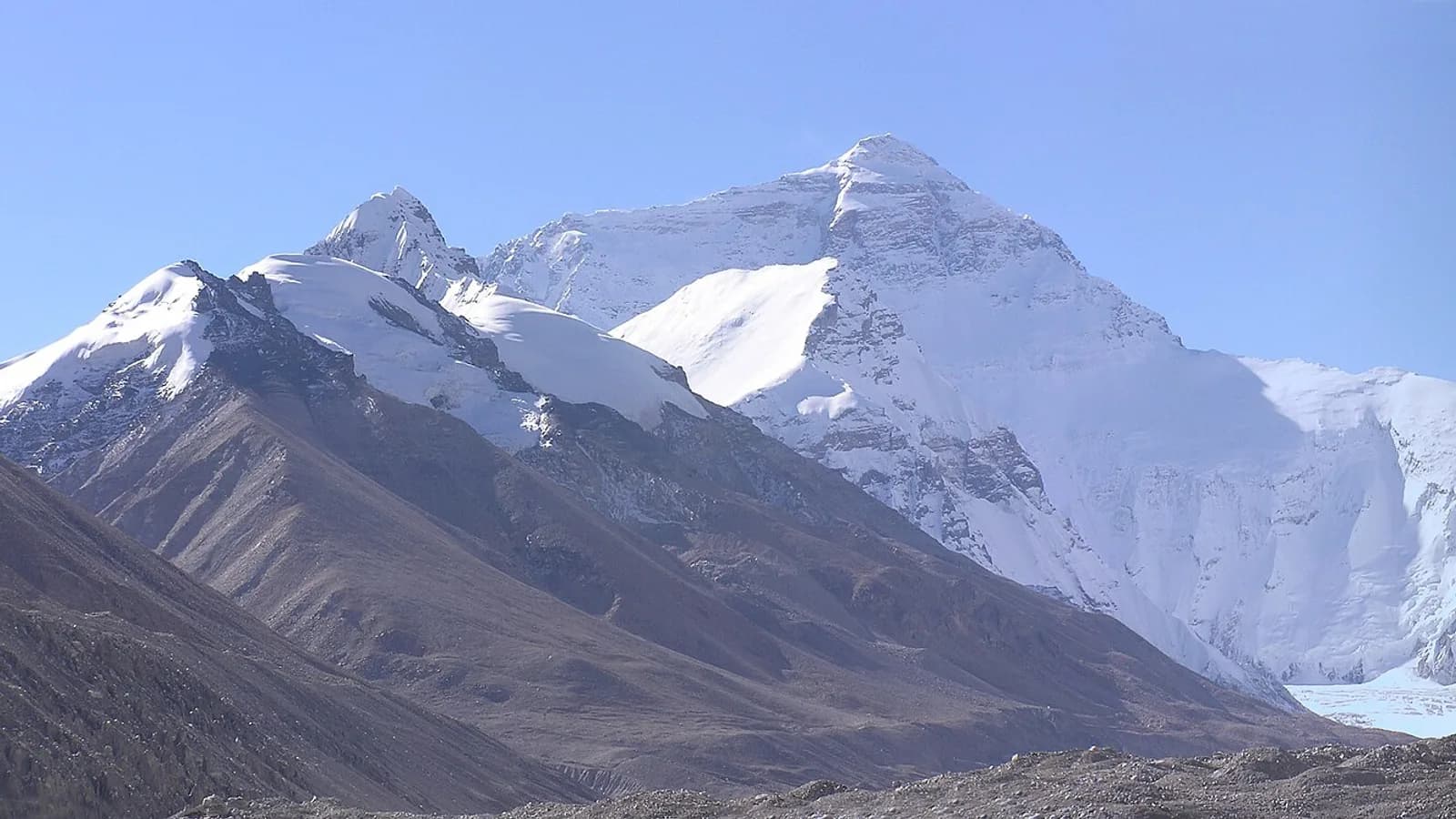
The Mount Everest height is one of the most quoted numbers in geography, and for most of the last century different countries quoted it differently. Since 8 December 2020 there has finally been a single agreed figure: 8,848.86 metres, or about 29,031.7 feet. Getting to that number took satellites, a gravity meter, radar fired through the summit snow, decades of surveying tradition, and — perhaps hardest of all — two neighbouring governments agreeing in public.
This guide explains what the official height is, how surveyors actually measure a peak no instrument can simply sit on top of, why the figure has crept upward over time, and the long-running argument over whether you measure to the rock or to the snow. The mountain itself is the centrepiece of Sagarmatha National Park and the goal of the Everest Base Camp trek; this piece is about the number on the summit, and the surprising amount of science behind it.
Key takeaways
- Everest's official height is 8,848.86 m (29,031.7 ft), jointly announced by Nepal and China on 8 December 2020.
- That figure is 0.86 m higher than Nepal's previous 8,848 m, which came from a 1950s Survey of India measurement.
- The 2020 survey used five techniques: precise levelling, trigonometric levelling, a gravity survey, GNSS satellite positioning at the summit, and ground-penetrating radar for snow depth.
- The official figure is the snow height; China's 2005 rock height beneath was 8,844.43 m.
- Tectonic uplift nudges the Himalaya up by a few millimetres a year, so Everest is, very slowly, still rising.
The official height: 8,848.86 metres
On 8 December 2020, Nepal's then foreign minister Pradeep Gyawali and his Chinese counterpart Wang Yi jointly announced the new official elevation of 8,848.86 m. In feet that is 29,031.7, commonly rounded to 29,032; in kilometres, about 8.85. The announcement mattered because, for the first time, both countries that share the summit endorsed the same number.
Sushil Dangol, a coordinator at Nepal's Survey Department, said the margin of error in the new measurement was within centimetres — a remarkable claim for the top of the planet, and a measure of how far surveying has come since the mountain was first measured by telescope from the plains of India.
The names behind the number
Before going further, the mountain's other names are worth knowing. In Nepal it is Sagarmatha, often translated as "the head in the great blue sky." In Tibet it is Chomolungma (Qomolangma), usually rendered "holy mother." The English name honours Sir George Everest, a nineteenth-century Surveyor General of India — though he never saw the peak that bears his name and reportedly objected to the honour.
Why the figure changed in 2020
For decades, two slightly different heights circulated, and the disagreement was both technical and political.
Nepal's long-standing 8,848 m
Nepal used 8,848 m (29,028 ft), a figure originating from the Survey of India between 1952 and 1954 using trigonometric methods. That number, rounded from a precise 8,847.73 m, became the textbook height for generations.
China's rock-height measurements
China, measuring the rock summit beneath the snow, published lower figures — most notably 8,844.43 m from its 2005 survey, which used ice-penetrating radar to strip away the snow cap. The two countries were, in effect, measuring two different things and reporting two different numbers.
The earthquake that forced the question
The catastrophic April 2015 earthquake, which devastated parts of Nepal and reshaped slopes across the Himalaya, raised a pointed scientific question: had the summit moved? The uncertainty gave both governments a reason to act, and the result was the coordinated survey whose answer, 8,848.86 m, finally reconciled the two traditions into a single agreed snow height.
How you actually measure the top of the world
You cannot rest a measuring instrument on Everest's summit and read off an altitude — there is nothing beneath it to measure against except an imaginary surface called mean sea level, extended in theory beneath the continents. The 2020 survey reached its centimetre-level figure by combining five distinct methods.
1. Precise levelling
Surveyors carried elevation references step by step from the southern plains of Nepal up to control points near the mountain, using precise optical levelling — the same painstaking technique, refined, that the British used in the nineteenth century.
2. Trigonometric levelling
Between fixed control points, surveyors measured angles and distances to triangulate heights across terrain too steep and too high for direct levelling, building a chain of measurements toward the summit.
3. Gravity survey
Mean sea level is not a smooth sphere; gravity varies from place to place, warping the reference surface (the geoid) against which height is defined. A gravity survey models that local distortion so the summit elevation is measured against the correct sea-level datum rather than an idealised one.
4. GNSS satellite positioning
A surveyor placed a GNSS (satellite navigation) receiver on the actual summit, recording its position for over an hour by timing signals from orbiting satellites. This fixes the summit's three-dimensional location with great precision — the modern descendant of the 1999 American expedition that first anchored a GPS unit into Everest's high bedrock.
5. Ground-penetrating radar
Because the official height is the snow surface, the team used ground-penetrating radar to measure how deep the snow and ice cap sits above the rock — the data that lets surveyors report a snow height and, if needed, calculate the rock height beneath it.
Stitched together, these five datasets yield a single elevation above mean sea level, with the centimetre-level confidence the Survey Department described.
Rock height versus snow height
The most persistent source of confusion about Everest's elevation is what, exactly, is being measured at the top.
| Measurement | Figure | What it measures | |---|---|---| | Official snow height (2020) | 8,848.86 m | Top of the snow and ice cap | | Chinese rock height (2005) | 8,844.43 m | Rock summit beneath the snow |
The internationally accepted figure has always followed the snow height — the surface climbers actually stand on. China's separate rock height is the lower number you will occasionally see cited, and the roughly four-metre gap between them is simply the depth of the summit snow. Neither is "wrong"; they answer different questions. When someone quotes Everest at 8,848.86 m, they mean the snow.
A short history of measuring Everest
The 2020 figure is only the latest in a long line, and the trend is a quiet testament to surveying skill.
| Year | Height | Source / method | |---|---|---| | 1856 | 8,840 m (29,002 ft) | Great Trigonometrical Survey; Andrew Waugh, "Peak XV" | | 1954 | 8,848 m (29,028 ft) | Survey of India, triangulation (snow) | | 1999 | ~8,850 m (29,035 ft) rock | American expedition, GPS into bedrock | | 2005 | 8,844.43 m rock | China, ice-penetrating radar | | 2020 | 8,848.86 m (29,031.7 ft) snow | Nepal-China joint survey |
What stands out is the 1856 figure. Working from telescopes on the plains of India, with hand calculations corrected for refraction, temperature and the curvature of the Earth, the Great Trigonometrical Survey landed within a handful of metres of a number that would take satellites and radar to refine. It remains one of the great feats of nineteenth-century science.
Is Everest still growing?
Yes — though not in any way you would notice. Everest sits where the Indian tectonic plate is driving into the Eurasian plate, the same collision that threw up the entire Himalaya. That ongoing push lifts the range upward by a few millimetres a year, with a figure of around 4 mm vertically often cited, alongside slow horizontal movement.
The reality is messier than a single number suggests. Uplift competes with erosion, major earthquakes can jolt the summit up or down, and the snow cap's depth varies. The net effect is real but glacially slow: the mountain you would climb today is, to any practical measure, the same height as the one in the 2020 survey.
How Everest compares — and the "tallest" technicality
Everest is the highest mountain above sea level, which is the standard almost everyone means by "tallest." But two technicalities are worth knowing:
- Measured base to summit, Hawaii's Mauna Kea is taller, because most of it lies underwater.
- Measured from the centre of the Earth, Ecuador's Chimborazo wins, because the planet bulges at the equator and Chimborazo sits almost on it.
Under the conventional sea-level definition, though, Everest holds the crown unambiguously at 8,848.86 m — far above the second-highest, K2.
For most travellers the number is something to admire from a distance rather than from the summit. You can take in the peak on the Everest Base Camp trek, the gentler Everest View trek, or even a scenic mountain flight that brings the summit to your window without a single step of climbing.
The bottom line
The Mount Everest height is 8,848.86 metres (29,031.7 ft), agreed by Nepal and China in 2020 and measured to the centimetre with a combination of levelling, satellites, gravity modelling and radar. It is a snow height, it has crept up over the decades partly through better instruments and partly through real tectonic uplift, and it represents the moment two countries finally settled a number the whole world could share. The next time you see it quoted, you will know exactly what those digits after the decimal point cost to pin down.
Sources
- Kathmandu Post — 8,848.86 metres: It's official, Mount Everest is taller (8 Dec 2020): https://kathmandupost.com/national/2020/12/08/it-s-official-mount-everest-is-8-848-86-metres-tall
- CNN — Mount Everest: China and Nepal agree on height after years of dispute: https://www.cnn.com/travel/article/mount-everest-height-intl-hnk-scli
- NPR — Everest Gets A Growth Spurt As China, Nepal Revise Official Elevation Upward: https://www.npr.org/2020/12/08/944152693/everest-gets-a-growth-spurt-as-china-nepal-revise-official-elevation-upward
- Wikipedia — Mount Everest (height and survey history): https://en.wikipedia.org/wiki/Mount_Everest
- National Geographic — How do you measure Everest? It's complicated by frostbite, and politics: https://www.nationalgeographic.com/science/article/remeasuring-mount-everest-the-worlds-tallest-mountain
Frequently asked questions
- What is the height of Mount Everest?
- Mount Everest's official height is 8,848.86 metres, which is about 29,031.7 feet or roughly 8.85 kilometres. This figure was jointly announced by Nepal and China on 8 December 2020 after a coordinated survey, and it is the number now used by both countries.
- Why did Everest's official height change in 2020?
- Nepal had long used 8,848 m, derived from a 1950s Survey of India measurement, while China had published a slightly lower rock height. A 2015 earthquake raised questions about whether the summit had shifted, so the two countries ran a joint survey and agreed on 8,848.86 m, about 0.86 m higher than Nepal's previous figure.
- How is the height of Mount Everest measured?
- The 2020 survey combined five techniques: precise levelling from the plains, trigonometric levelling between control points, a gravity survey to model the local geoid, GNSS satellite positioning at the summit, and ground-penetrating radar to measure snow depth. Together these fix the summit's elevation above mean sea level to within centimetres.
- Is Everest's height measured to the rock or the snow?
- The official 8,848.86 m is the snow height — the top of the snow and ice cap. China's 2005 survey separately measured the rock height beneath as 8,844.43 m. The internationally accepted figure follows the long tradition of measuring to the snow surface, which is what climbers actually stand on.
- Is Mount Everest getting taller?
- Slowly, yes. The collision of the Indian and Eurasian tectonic plates pushes the Himalaya upward by a few millimetres a year, often cited as around 4 mm vertically, though erosion, earthquakes and measurement uncertainty complicate the picture. Any growth is far too small to notice in a human lifetime.
- Is Everest the tallest mountain in the world?
- Everest is the highest mountain above sea level, which is the standard most people mean. Measured base to summit, Hawaii's Mauna Kea is taller, and measured from the Earth's centre, Ecuador's Chimborazo wins because of the equatorial bulge. Everest holds the title under the conventional sea-level definition.
- What are the Nepali and Tibetan names for Everest?
- In Nepal the mountain is Sagarmatha, often glossed as the head in the great blue sky, and in Tibet it is Chomolungma or Qomolangma, usually translated as holy mother. The English name honours Sir George Everest, a former Surveyor General of India, and was applied in the nineteenth century.
- How tall is Everest in feet and kilometres?
- At 8,848.86 metres, Everest stands about 29,031.7 feet tall and roughly 8.85 kilometres above sea level. You will sometimes see it rounded to 29,032 feet or 8,849 metres, both of which come from the same 2020 official measurement.
Spotted an error in this post? Tell us or suggest a correction.
Related posts
ABC Trek: A Plain-English Guide to Annapurna Base Camp
The ABC trek (Annapurna Base Camp) explained — the route, how many days it takes, difficulty, the best seasons, and what daily trail life is really like.
Read postAma Dablam Climb: 2026 Expedition Guide (6,812m)
An Ama Dablam climb and expedition guide for 2026 — height, the Southwest Ridge route, camps, fixed ropes, difficulty, permits, cost and the best seasons.
Read postAnnapurna vs Manaslu: Which Trek Should You Choose?
An Annapurna vs Manaslu decision guide for trekkers — compare permits, crowds, difficulty, infrastructure and cost to pick the right Himalayan route.
Read postAsan Bazaar Kathmandu: Old Town Market Guide
A visitor guide to Asan bazaar, Kathmandu's oldest market — its six-road square, Annapurna Temple, what to buy, when to go, and how to get there.
Read postAyurveda Nepal: A Traveller's Guide to Healing
Ayurveda Nepal explained for tourists — the history, the doshas, treatments like Panchakarma and Shirodhara, where to go and how to choose a centre safely.
Read postBest Restaurants Pokhara Lakeside: Where to Eat
The best restaurants in Pokhara Lakeside — lakeside trout, wood-fired pizza, Tibetan momos and healthy cafes, with what to order and rough 2026 prices.
Read post