Mera Peak Climbing: Nepal's Highest Trekking Peak (6,476m)
A Mera Peak climbing guide for 2026 — Nepal's highest trekking peak: height, route, itinerary, difficulty, NMA permit cost and the best seasons.
At 6,476 metres, Mera is the highest trekking peak in Nepal — non-technical, but a serious altitude challenge with five eight-thousanders from the top.
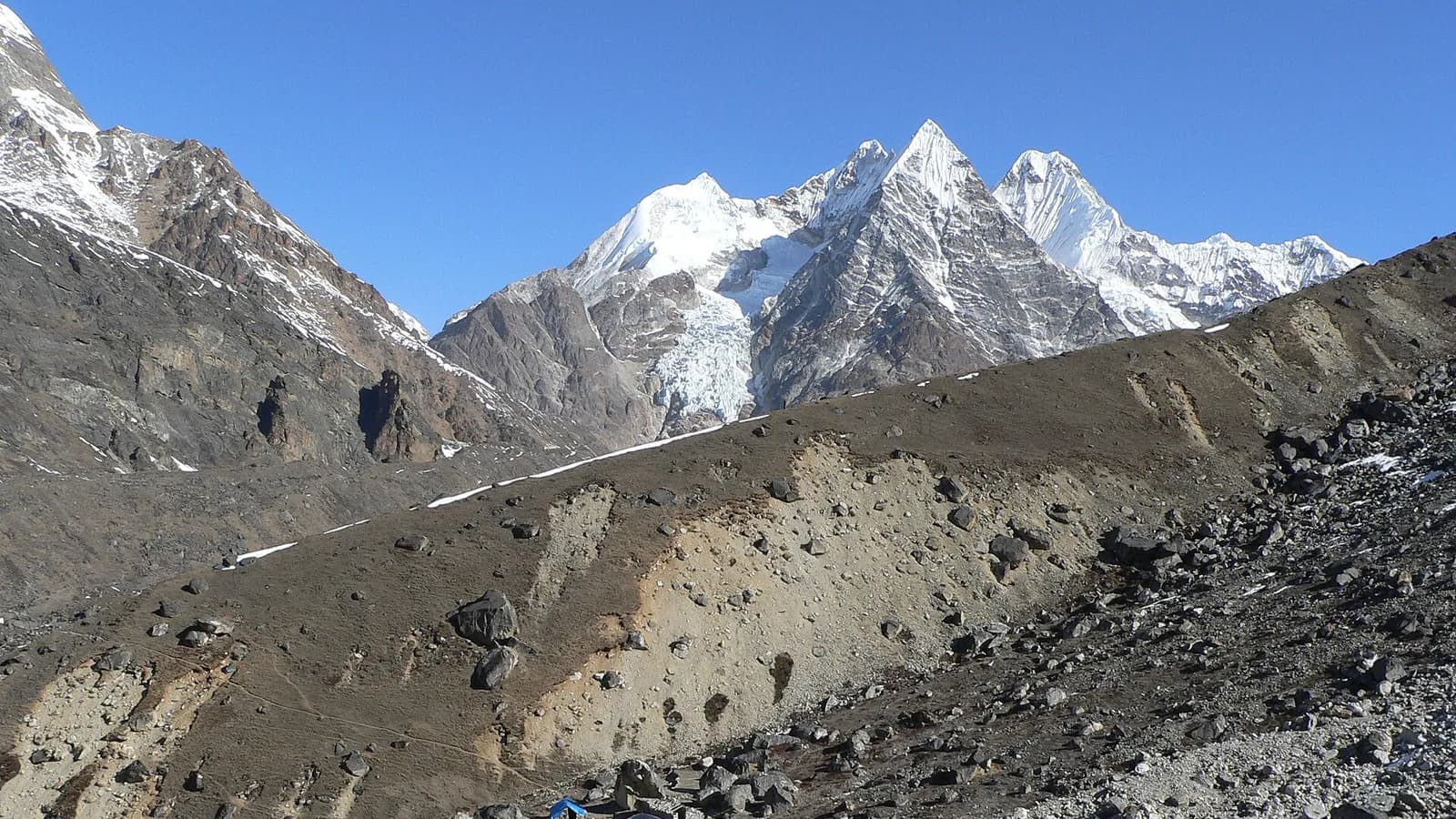
The Mera Peak climb is the answer for trekkers who want to stand on a real Himalayan summit without learning to be a technical mountaineer first. At 6,476 metres (21,247 feet), Mera is the highest trekking peak in Nepal, yet the standard route asks for endurance and good acclimatisation rather than rock-and-ice skill. The reward at the top is one of the finest viewpoints in the country — five of the world's 8,000-metre peaks lined up across the sky. This guide covers the true height, the route through the wild Hinku Valley, a realistic itinerary, the honest difficulty, the NMA permit and costs, and the best seasons, all stamped to mid-2026.
If you are mapping out a bigger climbing trip, our guides to Island Peak and the technical Ama Dablam expedition make natural companion reads — Mera and Island Peak are the two classic trekking peaks, while Ama Dablam is the technical step up.
Key takeaways
- Mera Peak's main summit (Mera North) is 6,476 metres (21,247 feet) — the highest trekking peak in Nepal.
- It is non-technical, graded around PD, so the challenge is altitude and endurance, not climbing skill.
- Expect 18 to 21 days door to door, with a long, deliberate acclimatisation walk through the Hinku Valley.
- The NMA climbing permit is USD 350 in spring and USD 175 in autumn/winter/summer, under the rates effective 1 September 2025 (as of June 2026).
- Guided packages typically cost about USD 1,800–3,500 per person (as of June 2026).
- The summit gives a view of five 8,000-metre peaks — Everest, Kanchenjunga, Lhotse, Makalu and Cho Oyu.
The mountain: height and summits
Mera Peak rises in the remote Hinku Valley, south of the main Everest region, in the Mahalangur section of the Himalaya. It has three distinct tops, and knowing the difference matters when you read itineraries:
| Summit | Approx. altitude | Notes | |---|---|---| | Mera North | 6,476 m | The main, highest summit | | Mera Central | ~6,461 m | Slightly lower; sometimes climbed | | Mera South | ~6,065 m | The lowest of the three |
The figure you should trust for the true high point is 6,476 metres. You will still see an older height of 6,654 metres floating around online, but that number comes from historical confusion with a neighbouring peak and overstates Mera's true elevation. Mera Central was first reached on 20 May 1953 by Jimmy Roberts and Sen Tenzing, names woven through the early history of Nepali mountaineering.
Because 6,476 metres is the highest of Nepal's officially classified trekking peaks, Mera carries a special draw: a legitimate, high Himalayan summit that a fit and determined trekker, properly acclimatised, can realistically reach.
How hard is Mera Peak, really?
This is the heart of Mera's appeal and its biggest misunderstanding. Technically, the standard route is easy — graded around PD (Peu Difficile), near the gentle end of the alpine scale. There is no hard rock climbing, no vertical ice, and no knife-edge exposed ridge on the normal line. Much of the upper mountain is a long glacier walk in crampons.
The difficulty is altitude and endurance. You spend many days getting higher, you sleep at a high camp where the air holds little oxygen, and summit day is long — commonly eight to twelve hours of cold, slow climbing from high camp to the top and back, starting before dawn. There is a short, slightly steeper pull near the very summit, and you move roped on the glacier with an ice axe, but the test is your lungs and your stamina, not your technical climbing.
| Aspect | Mera Peak | |---|---| | Technical grade | Around PD (alpine) — non-technical | | Main challenge | Altitude, cold and endurance | | Summit day | Roughly 8–12 hours from high camp | | Skills needed | Crampons, ice axe, walking roped on glacier | | Good for | A first 6,000-metre Himalayan summit |
Because the real enemy is altitude, the single most important thing you can do is acclimatise patiently and recognise trouble early. Read our altitude sickness guide for Nepal treks before you go, and treat every rest day as non-negotiable — at 6,476 metres there is no shortcut around your body's need to adjust.
The route and a realistic itinerary
Mera's route is as much about the journey in as the summit. Unlike the busy Everest trail, the approach climbs through the wild, lightly trekked Hinku Valley, crossing forested ridges before breaking out into high alpine country and the glaciers below the peak.
A typical plan looks like this, though operators vary the villages and rest days:
| Phase | Stage | Approx. high point | Notes | |---|---|---|---| | 1 | Fly to Lukla, trek into the Hinku Valley | building gradually | Forested, quiet trail | | 2 | Continue up the valley with acclimatisation | ~4,000–5,000 m | The crucial slow gain | | 3 | Reach Mera Base Camp | ~5,300 m | Below the glacier | | 4 | Move to Mera High Camp | ~5,800 m | Short, cold night before the push | | 5 | Summit day and return | 6,476 m | Pre-dawn start, long day | | 6 | Descend and trek out to Lukla | — | Back down the valley |
Most full itineraries run 18 to 21 days, and that length is a feature, not padding. The long approach is precisely what builds the acclimatisation that makes a safe, successful summit possible. Faster trips exist, but they raise your altitude risk sharply.
Mera Base Camp and High Camp
Two high points on the mountain shape the summit push. Mera Base Camp, around 5,300 metres, sits below the glacier and is where the climbing preparation begins in earnest. Mera High Camp, around 5,800 metres, is a stark, exposed spot from which most teams launch their summit attempt in the small hours. Nights at High Camp are bitterly cold and short on sleep, so much of your summit success is decided by how well you have rested and acclimatised on the way up.
Permits and the guide rule
Mera is a Nepal Mountaineering Association (NMA) trekking peak, which means a different permit system from the expedition peaks. The NMA revised its trekking-peak fees effective 1 September 2025, and those rates apply now.
| Permit / fee | Amount (as of June 2026) | Notes | |---|---|---| | NMA climbing permit (spring) | USD 350 per person | Effective 1 Sep 2025 | | NMA climbing permit (autumn/winter/summer) | USD 175 per person | Lower off-season rate | | Local area / municipality permit | Varies by route | Makalu Barun or Khumbu side | | NMA garbage deposit | USD 500 (team level) | Handled by your operator |
Watch out for older pages quoting the pre-September-2025 figures of USD 250 in spring and USD 125 in autumn — those are now out of date. Since 1 April 2023, Nepal has required a licensed guide, arranged through a registered agency, for trekking inside its national park and conservation areas, and a guided climb is in any case the only sensible way to attempt a 6,476-metre peak. For how Nepal's broader permit landscape works, our Everest Base Camp permits explainer is a useful primer even though Mera's exact permits differ.
What climbing Mera Peak costs
Costs vary with how you book, but the structure is predictable. A guided Mera Peak package commonly runs from roughly USD 1,800 to USD 3,500 per person (as of June 2026), depending on the operator, group size, guide-to-client ratio, and how much camping support and equipment is included.
On top of the package, budget for:
- The NMA climbing permit (USD 350 in spring as of June 2026) and area permits.
- Personal climbing gear — crampons, ice axe, harness, boots, warm layers — bought or hired.
- Travel insurance that genuinely covers high-altitude climbing and helicopter rescue.
- Domestic flights to and from Lukla, the most weather-exposed link.
On the trail, the familiar mountain economics apply, and our teahouse food and accommodation guide is a good reference for how lodge prices climb with altitude, though the Hinku Valley is quieter and more basic than the Everest trail. Carry enough rupees from Kathmandu, as mountain ATMs are unreliable.
Do not economise on travel insurance. A high-altitude climb that tops out above 6,400 metres needs a policy covering both the altitude and the mountaineering, with helicopter evacuation — our guide to trekking insurance with helicopter evacuation explains exactly what to check.
When to climb Mera Peak
Mera has the same two prime windows as most of the high Himalaya.
- Spring (roughly mid-March to May) is warmer, with gradually improving conditions and longer days. It is a popular climbing window.
- Autumn (roughly October to November) brings the crisp, settled, post-monsoon skies that give the sharpest views — and from Mera's summit, the view is the whole point.
Both seasons offer the most stable weather and the best chance of the clear summit morning that reveals five 8,000-metre peaks. The monsoon (June to August) brings cloud, rain and heavy snow on the glacier, and deep winter is brutally cold and rarely climbed commercially. For a wider seasonal picture across the country, see our guide to the best time to visit Nepal.
Is it right for you?
Choose Mera Peak if you are fit, patient with acclimatisation, and you want the genuine experience of a high Himalayan summit without first becoming a technical climber. It is the highest trekking peak in Nepal and a brilliant first 6,000-metre objective — the difficulty is the altitude and the long summit day, not the climbing itself. If you want steep rock and ice and fixed-rope work, look instead at our Island Peak and Ama Dablam guides. But for the summit view alone — Everest, Kanchenjunga, Lhotse, Makalu and Cho Oyu in one sweep — Mera is one of the most rewarding peaks a determined trekker can climb. A few Nepali phrases every trekker should know will make the long Hinku Valley evenings warmer, too.
Sources
- Mera Peak — Wikipedia
- Nepal Trekking Peak Permit Fees 2026 update — Himalayan Immersion Treks
- Permit Fees of Nepal Mountaineering Association (NMA) Peaks — Seven Summit Treks
- A guide to climbing Mera Peak, Nepal's highest trekking summit — Much Better Adventures
- Mera Peak facts — Langtang Treks Nepal
- New trekking guide rules (2023) — Much Better Adventures
Frequently asked questions
- How high is Mera Peak?
- Mera Peak's main summit, Mera North, stands at 6,476 metres (21,247 feet), which makes it the highest trekking peak in Nepal. It has three tops in total — Mera North at 6,476 metres, Mera Central at about 6,461 metres and Mera South at about 6,065 metres. An older, inflated figure of 6,654 metres is still seen online but reflects historical confusion with a neighbouring peak.
- Is Mera Peak the highest trekking peak in Nepal?
- Yes. At 6,476 metres, Mera Peak is the highest of the peaks Nepal classifies as trekking peaks, administered by the Nepal Mountaineering Association. That status is why it is so popular: it offers a genuine 6,000-metre Himalayan summit without the technical demands of an expedition peak like Ama Dablam.
- Is Mera Peak technically difficult to climb?
- No, not technically. Mera is graded around PD (Peu Difficile) in the alpine system — there is no hard rock climbing, no vertical ice and no badly exposed ridge on the standard route. The real challenge is altitude and endurance. Summit day is long, cold and high, and you use crampons, an ice axe and a rope on the glacier, but the movement itself is straightforward.
- How many days does climbing Mera Peak take?
- Most Mera Peak itineraries run about 18 to 21 days, including the trek in through the Hinku Valley and several built-in acclimatisation days. The long, gradual approach is deliberate: it is what gives your body time to adjust before the high camp and summit push.
- What permit do I need for Mera Peak?
- Mera is a Nepal Mountaineering Association trekking peak, so you need an NMA climbing permit — USD 350 per person in spring and USD 175 in autumn, winter and summer under the rates effective 1 September 2025 (as of June 2026). You also need the relevant local area permit for the Makalu Barun or Khumbu region your route passes through, plus a registered guide.
- How much does climbing Mera Peak cost?
- Guided Mera Peak packages commonly run from roughly USD 1,800 to USD 3,500 per person depending on operator, group size and inclusions (as of June 2026). On top of the package you have the NMA climbing permit (USD 350 in spring as of June 2026), area permits, insurance and personal climbing gear or its hire.
- Do you need mountaineering experience for Mera Peak?
- Not extensive technical experience, which is part of the appeal — Mera is often a first 6,000-metre peak. But you do need strong fitness, good acclimatisation discipline and basic competence with crampons, an ice axe and walking roped on a glacier. Many operators give a short training session before the climb.
- When is the best time to climb Mera Peak?
- Spring (roughly mid-March to May) and autumn (roughly October to November) are the prime windows, with the most stable weather and clearest mountain views. Autumn brings crisp post-monsoon skies, while spring is warmer. The monsoon and deep winter are generally avoided for the climb.
Spotted an error in this post? Tell us or suggest a correction.
Related posts
ABC Trek: A Plain-English Guide to Annapurna Base Camp
The ABC trek (Annapurna Base Camp) explained — the route, how many days it takes, difficulty, the best seasons, and what daily trail life is really like.
Read postAma Dablam Climb: 2026 Expedition Guide (6,812m)
An Ama Dablam climb and expedition guide for 2026 — height, the Southwest Ridge route, camps, fixed ropes, difficulty, permits, cost and the best seasons.
Read postAnnapurna vs Manaslu: Which Trek Should You Choose?
An Annapurna vs Manaslu decision guide for trekkers — compare permits, crowds, difficulty, infrastructure and cost to pick the right Himalayan route.
Read postAsan Bazaar Kathmandu: Old Town Market Guide
A visitor guide to Asan bazaar, Kathmandu's oldest market — its six-road square, Annapurna Temple, what to buy, when to go, and how to get there.
Read postAyurveda Nepal: A Traveller's Guide to Healing
Ayurveda Nepal explained for tourists — the history, the doshas, treatments like Panchakarma and Shirodhara, where to go and how to choose a centre safely.
Read postBest Restaurants Pokhara Lakeside: Where to Eat
The best restaurants in Pokhara Lakeside — lakeside trout, wood-fired pizza, Tibetan momos and healthy cafes, with what to order and rough 2026 prices.
Read post