TIMS Card Nepal: What It Is and When You Need It (2026)
A plain guide to the TIMS card Nepal trekkers need in 2026 — what it costs, who it covers, where it is required, and where it has been replaced.
It is not a ticket to the mountains — it is the form that tells rescuers you went up them.
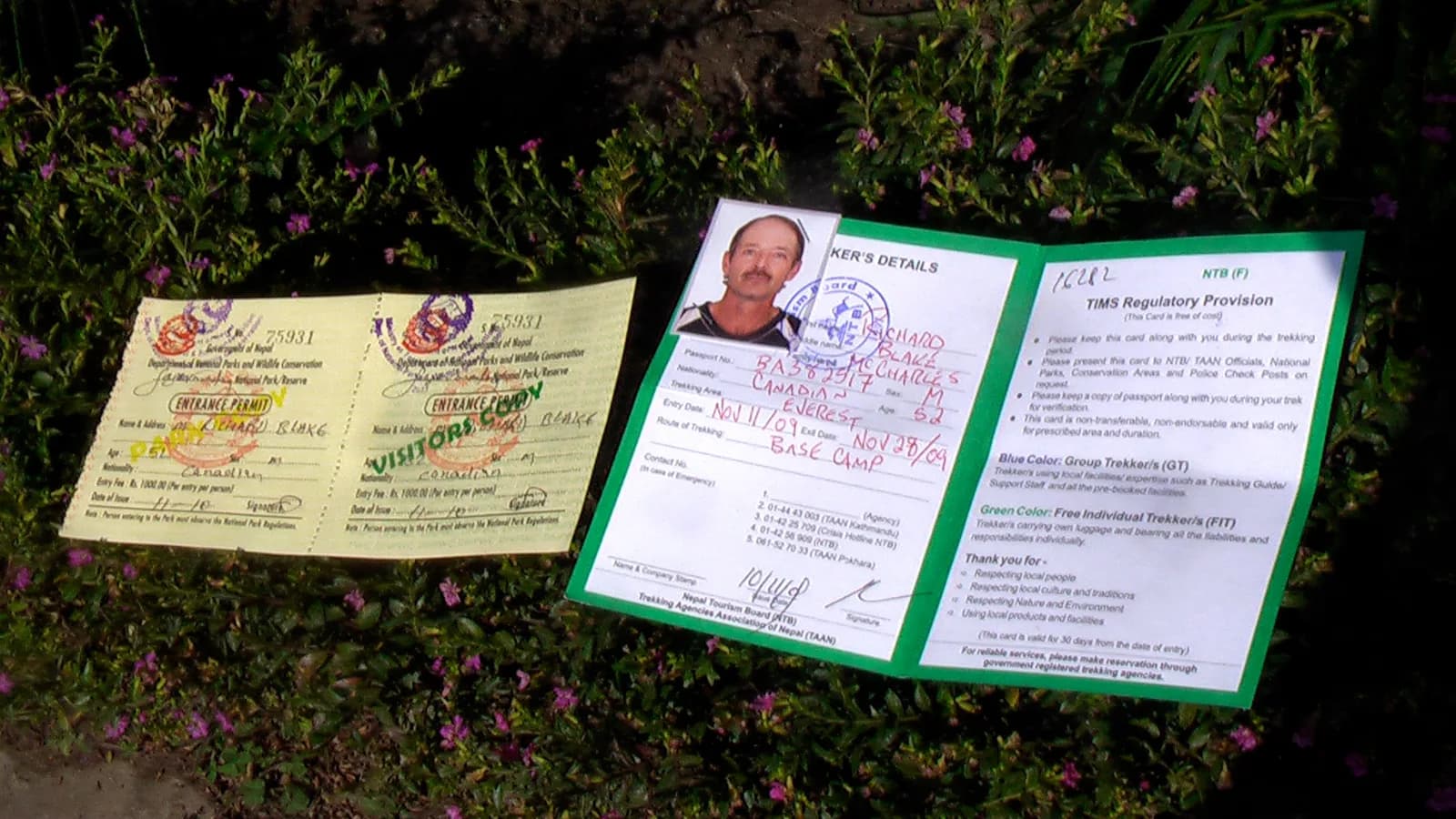
If you are planning a trek in Nepal, you will keep running into four letters: TIMS. The TIMS card Nepal authorities ask trekkers to carry is not a park ticket and not a visa — it is a registration document that puts your name, route, and emergency contact into a shared database. The idea is simple: if something goes wrong on the trail, rescuers should be able to find out who is up there and where they were heading.
The catch is that the rules have shifted a lot since 2023, and a large share of the trekking-agency pages you will find online are out of date. Some treks still need a TIMS card. Some famous ones no longer do. This guide explains what the card is, what it costs in 2026, where it is still required, and where a local permit has quietly taken its place.
Key takeaways
- TIMS stands for Trekkers' Information Management System — a registration card, not an entry ticket.
- The Nepal Tourism Board lists the fee as NPR 1,000 for SAARC nationals and NPR 2,000 for other foreigners (as of June 2026).
- In most TIMS areas you must trek with a guide from a registered agency, and that agency files the card for you.
- The card is now generated through an online e-TIMS system with a QR code, rather than a paper card you buy at a counter.
- Everest / Khumbu no longer uses TIMS — a local municipality permit plus the Sagarmatha National Park permit replace it.
- TIMS is always separate from national-park and conservation-area entry fees; budget for both.
What the TIMS card actually is
TIMS is run jointly by the Nepal Tourism Board (NTB) and the Trekking Agencies' Association of Nepal (TAAN). The card records who you are, the route you intend to walk, when you start, and who to contact in an emergency. That information goes into a central database that two groups rely on: rescue coordinators, who need to know how many people are inside a trekking area after an earthquake, avalanche, or storm; and tourism planners, who use the numbers to track where trekkers actually go.
The system has been around longer than most visitors realise. TIMS came into effect on 1 January 2008, and NTB and TAAN signed a memorandum on 18 March 2010 to relaunch it in a new format from 1 April 2010. For years there were two flavours of card — one for organised groups and one for free individual trekkers (FITs) — which is why older articles talk about "blue" and "green" cards. That distinction matters less now, because the independent-trekker path has largely closed (more on that below).
The important mental model: a TIMS card is the paperwork that says the authorities know you are on this trail. It does not, by itself, grant you entry to any national park or conservation area. Those charge their own fees.
How much a TIMS card costs in 2026
Here is where you have to be careful with sources. Many blogs still quote a tangle of group-versus-individual prices from the old two-card era. The current Nepal Tourism Board page lists a simpler structure.
| Applicant | TIMS fee (as of June 2026) | Approx. USD | |---|---|---| | SAARC nationals (South Asian countries) | NPR 1,000 | about USD 7–8 | | Other foreign nationals | NPR 2,000 | about USD 15 |
USD figures are rough conversions and move with the exchange rate — treat them as a ballpark, not a quote.
A few notes on those numbers:
- It is per trekker. Each person in a group needs their own card and pays the fee.
- It is normally paid online. The e-TIMS system accepts digital payment (through services such as ConnectIPS / nepalpay) and generates a QR-coded card per trekker.
- The historical "FIT" rate was higher. When independent trekking was allowed, free individual trekkers paid more than group trekkers. Because solo foreign trekking is no longer permitted in most TIMS areas, that higher independent rate is largely academic now.
If a price you see online looks very different from the table above, check the date on the article. Fees do get revised, and a 2019 figure is not a 2026 figure.
Who needs a TIMS card — and who does not
This is the part that trips people up. TIMS is not required for every trek in Nepal, and the list of where it applies has been edited.
Treks that still use TIMS
The Nepal Tourism Board still applies TIMS to a long list of mainstream routes — on the order of thirty-plus named trails across regions such as Annapurna, Langtang, Manaslu's surrounding trails, and others. If you are walking a popular conservation-area trek, assume TIMS applies unless you have confirmed otherwise for that specific route.
For these, the card sits alongside a regional entry permit. On the Annapurna Circuit, for example, you pay the Annapurna Conservation Area Project (ACAP) entry fee and carry TIMS as well. The Langtang trek pairs TIMS with the Langtang National Park entry permit.
Treks where TIMS has been replaced
The headline change is Everest. The Khumbu region dropped the TIMS requirement: trekkers now pay a Khumbu Pasang Lhamu Rural Municipality permit (a local fee, checked near Monjo) plus the Sagarmatha National Park entry permit. There is no TIMS card for Everest Base Camp anymore. We cover that permit stack in detail in Everest Base Camp permits for 2026 — if a booking page still lists TIMS for EBC, it is out of date.
Restricted areas: a different system entirely
Some regions use Restricted Area Permits (RAPs) instead of, or on top of, the normal arrangement. Upper Mustang, Upper Dolpo, and similar border-sensitive zones require an agency-arranged RAP that is far more expensive and comes with its own rules. Do not assume a single TIMS card covers a restricted trek — it does not.
| Region | TIMS status (2026) | What you pay instead / alongside | |---|---|---| | Annapurna (ACAP) | TIMS applies | TIMS + ACAP entry | | Langtang | TIMS applies | TIMS + Langtang NP entry | | Everest / Khumbu | Not required | Local municipality permit + Sagarmatha NP | | Manaslu | Restricted | Restricted Area Permit + MCAP (+ TIMS on linked sections) | | Upper Mustang | Restricted | Restricted Area Permit (agency only) + ACAP |
When in doubt, confirm the current requirement for your exact route with a registered trekking agency before you pay anyone.
How to get a TIMS card
For most trekkers in 2026, the honest answer is: you do not get it yourself — your agency does.
The agency route (the normal one)
Because a licensed guide from a registered company is mandatory in most TIMS areas, the same company handles your card. You hand over:
- Your passport details (and usually a scan or copy)
- Passport-sized photos
- Your trekking route and dates
- Emergency contact and travel-insurance information
The agency files this through the e-TIMS system, pays the fee, and gives you a QR-coded card. This is bundled into the cost of an organised trek, so you may not even see it as a separate line on a well-run invoice.
Doing it in person
TIMS can also be issued at the Nepal Tourism Board office in Kathmandu (Pradarshani Marg, near Bhrikutimandap) and at TAAN offices, including in Pokhara. Even there, the registered-agency and guide requirements still shape who can actually obtain one for a given route.
What about solo and independent trekkers?
This is the biggest practical shift. For most TIMS-area treks, foreign trekkers can no longer go solo — a guide is required, and the old free-individual-trekker card is effectively off the table. If your heart is set on walking independently, read is solo trekking allowed in Nepal first, because the answer depends heavily on the region and has tightened in recent years.
Why the system exists (and why it is worth doing properly)
It is easy to see TIMS as one more fee in an already long list. The reasoning behind it is genuinely about safety. Before a central record existed, rescue teams searching for a missing or injured trekker often had no reliable way to know who was on a trail or where they had planned to go. The database is meant to fix exactly that — to give responders a starting list of names and routes when a flood, landslide, avalanche, or sudden storm hits a popular area.
The secondary purpose is statistics and oversight: counting trekkers per region helps with planning and with clamping down on unregistered, off-the-books operators. Whether the system achieves all of that perfectly is debated, but the intent — somebody official knows you are up there — is a reasonable thing to want backing you on a remote trail.
That is also why it pairs naturally with the rest of your safety prep. A TIMS record is only as useful as the insurance behind it, so make sure your policy covers high-altitude trekking and, ideally, helicopter evacuation.
Common mistakes and misunderstandings
A handful of errors come up again and again:
- Trusting an old blog over the current rules. The single most common mistake. If an article does not say what year it is describing, distrust the prices and the requirement list.
- Assuming TIMS covers park fees. It never has. Conservation-area and national-park entry permits are separate charges.
- Paying for TIMS on an Everest trek. You should not be — the Khumbu region replaced it. Question any EBC invoice that still lists it.
- Expecting to buy one solo at a counter on the trail. In most areas you need a guide and a registered agency, arranged before you start walking.
- Losing the QR card or receipt. Keep digital and paper copies; checkpoints may ask to see it.
Quick planning checklist
Before you set off:
- Confirm whether your specific route needs TIMS — or a local permit, or a Restricted Area Permit instead.
- Budget TIMS plus the relevant park or conservation entry fee, not one or the other.
- Sort your guide and agency early — in most areas they are mandatory and they file the card.
- Carry the right documents: passport, photos, insurance details, emergency contact.
- Keep copies of the QR card and any receipts for checkpoints.
A little Nepali goes a long way at those checkpoints and teahouses, too — a few phrases every trekker should know make the whole process friendlier. And if you have not locked down your entry yet, start with the Nepal visa on arrival basics.
Sources
Frequently asked questions
- What is a TIMS card in Nepal?
- TIMS stands for Trekkers' Information Management System. It is a registration card that logs your identity, route, and emergency contact in a shared database used for search-and-rescue and tourism statistics.
- How much does a TIMS card cost in 2026?
- The Nepal Tourism Board lists NPR 1,000 for SAARC nationals and NPR 2,000 for other foreigners (as of June 2026), normally paid online when your agency files the application.
- Do I still need a TIMS card for Everest Base Camp?
- No. The Khumbu region dropped the TIMS requirement; a local Khumbu Pasang Lhamu Rural Municipality permit plus the Sagarmatha National Park entry permit replace it.
- Can I get a TIMS card as a solo trekker?
- In practice no. In most TIMS areas you must trek with a guide from a registered agency, and that agency files the card on your behalf rather than you buying one independently.
- Where do I get a TIMS card?
- Your registered trekking agency files it online through the e-TIMS system, or it can be issued at the Nepal Tourism Board office in Kathmandu and TAAN offices.
- What documents do I need for a TIMS card?
- Typically your passport details, passport-sized photos, your trekking route and dates, and emergency-contact and insurance information given to the agency.
- Is the TIMS card the same as a national park permit?
- No. TIMS is a separate trekker-registration document; national parks and conservation areas such as ACAP charge their own entry permits on top of it.
- What happens if I trek without a required TIMS card?
- Checkpoints can turn you back or fine you, and without a record in the system you are harder to locate if a rescue is ever needed.
Spotted an error in this post? Tell us or suggest a correction.
Related posts
ABC Trek: A Plain-English Guide to Annapurna Base Camp
The ABC trek (Annapurna Base Camp) explained — the route, how many days it takes, difficulty, the best seasons, and what daily trail life is really like.
Read postAma Dablam Climb: 2026 Expedition Guide (6,812m)
An Ama Dablam climb and expedition guide for 2026 — height, the Southwest Ridge route, camps, fixed ropes, difficulty, permits, cost and the best seasons.
Read postAnnapurna vs Manaslu: Which Trek Should You Choose?
An Annapurna vs Manaslu decision guide for trekkers — compare permits, crowds, difficulty, infrastructure and cost to pick the right Himalayan route.
Read postAsan Bazaar Kathmandu: Old Town Market Guide
A visitor guide to Asan bazaar, Kathmandu's oldest market — its six-road square, Annapurna Temple, what to buy, when to go, and how to get there.
Read postAyurveda Nepal: A Traveller's Guide to Healing
Ayurveda Nepal explained for tourists — the history, the doshas, treatments like Panchakarma and Shirodhara, where to go and how to choose a centre safely.
Read postBest Restaurants Pokhara Lakeside: Where to Eat
The best restaurants in Pokhara Lakeside — lakeside trout, wood-fired pizza, Tibetan momos and healthy cafes, with what to order and rough 2026 prices.
Read post