Nepal Religion: Is Nepal a Hindu Country? (2026)
Nepal religion explained: 81% Hindu, 8% Buddhist, plus Islam and Kirat. Is Nepal a Hindu country? Why it's a secular state, and how faith shapes life.
Nepal was the world's only Hindu kingdom until 2008 — and is now a secular republic where four in five people are still Hindu.
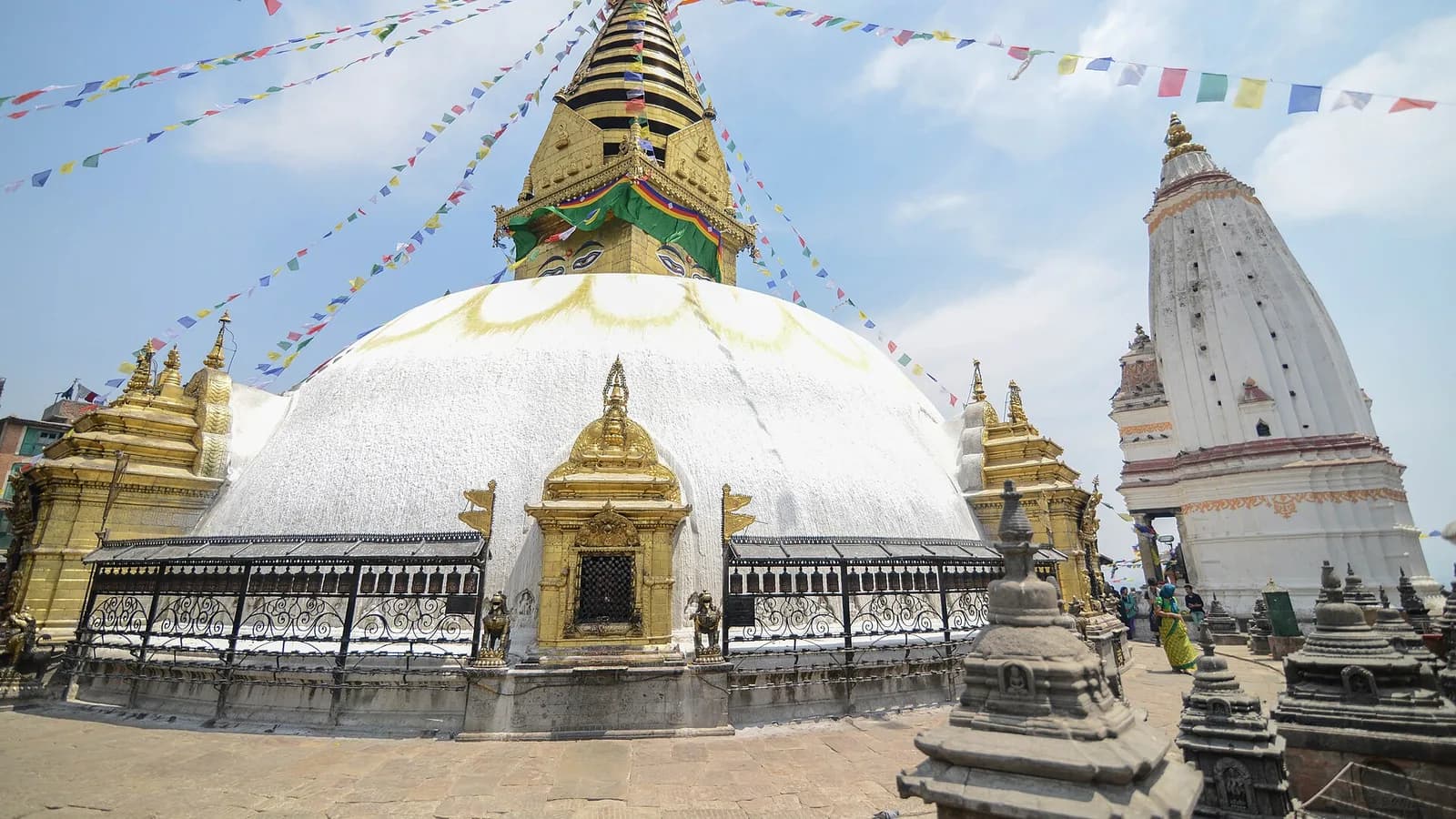
Ask whether Nepal is a Hindu country and the honest answer is: yes and no. By population, overwhelmingly yes — more than four in five Nepalis are Hindu, the highest proportion of any country on Earth, and Nepal was for centuries the world's only official Hindu kingdom. By law, no — since the monarchy fell, Nepal has been a secular republic that guarantees freedom of religion to all. The gap between those two facts, and what fills it, is the real story of religion in Nepal.
This guide explains the country's religious make-up using the 2021 census, traces how Nepal went from Hindu kingdom to secular state, and unpacks the remarkable way Hinduism and Buddhism intertwine here. For the Buddhist side in depth, see our dedicated guide to Buddhism in Nepal; this piece is the whole religious landscape, with Hinduism at its centre.
Key takeaways
- Nepal is 81.19% Hindu (2021 census) — a Hindu-majority country, but officially a secular state.
- Buddhism is second at 8.21%, followed by Islam (5.09%) and the indigenous Kirat faith (3.17%).
- Nepal was the world's only Hindu kingdom until secularism was declared in 2006 and the monarchy abolished in 2008.
- The 2015 constitution enshrines secularism while pledging to protect the sanatana (age-old) religion and culture.
- Hinduism and Buddhism are deeply blended, sharing temples, deities and festivals across the Kathmandu Valley.
The numbers: religion in Nepal by the 2021 census
Nepal's official religious breakdown comes from the National Population and Housing Census 2021, conducted by the Central Bureau of Statistics. It confirms a Hindu-majority country with significant minorities:
| Religion | Share (2021) | Approx. followers | |---|---|---| | Hinduism | 81.19% | 23.7 million | | Buddhism | 8.21% | 2.4 million | | Islam | 5.09% | 1.5 million | | Kirat | 3.17% | 0.9 million | | Christianity | 1.76% | 0.5 million | | Prakriti | 0.35% | 102,000 | | Bon | 0.23% | 67,000 | | Others | ~0.65% | — |
Figures from the 2021 National Census; smaller communities include Jainism, Sikhism and the Bahai faith.
Two trends stand out from the census. Compared with a decade earlier, the Hindu and Buddhist shares slipped slightly, while Islam, the Kirat faith and Christianity grew — Christianity from a very small base, making it one of the faster-growing affiliations. But the headline is unchanged: Hinduism remains dominant by a wide margin, and the explore facts page keeps the country's core demographics in one place.
What is the Kirat religion?
One entry surprises many visitors: Kirat (Kiratism), the indigenous animist-shamanic faith of the Kirati peoples — the Rai and Limbu communities of the eastern hills. At over 3% it outnumbers Christianity, and it reflects Nepal's layer of indigenous belief that predates both Hinduism and Buddhism. Likewise Prakriti (nature worship) and Bon (a pre-Buddhist Tibetan tradition) appear in the census, underlining just how plural the country is beneath the Hindu majority.
Is Nepal a Hindu country? The honest answer
So, is Nepal a Hindu country? It depends entirely on whether you mean culturally or constitutionally.
- Culturally and demographically — yes. With 81% of the population Hindu, Hinduism saturates daily life, the calendar, the festivals, the food taboos and the architecture. No country has a higher Hindu proportion.
- Constitutionally — no. Since 2015 Nepal has been a secular republic, and Hinduism is not the state religion. Citizens are free to follow, or not follow, any faith.
This is a genuine change, not a technicality. Until the late 2000s Nepal's constitution described it as a Hindu kingdom, and the king was regarded by many as an incarnation of the god Vishnu. That era is over — but the cultural weight of Hinduism remains, which is why the question keeps being asked.
From Hindu kingdom to secular republic
Nepal's shift from official Hindu state to secular republic happened in a rapid sequence tied to the end of the monarchy:
| Year | What happened | |---|---| | Pre-2006 | Nepal is the world's only official Hindu kingdom | | May 2006 | Parliament declares Nepal a secular state | | 2007 | The interim constitution confirms secularism | | 2008 | The monarchy is abolished; Nepal becomes a federal republic | | 2015 | The permanent constitution enshrines a secular state |
The 2006 declaration came amid the political movement that ended both the civil conflict and royal rule. Stripping the state of its Hindu designation was symbolically huge: it severed the ancient link between the crown, Hinduism and national identity. The transformation into a federal republic of seven provinces followed, and you can trace the wider arc on the explore history page.
A particular kind of secularism
Nepal's secularism is not the strict church-state separation of, say, France. The constitution defines it in a distinctly Nepali way: it guarantees religious and cultural freedom while committing the state to protect the sanatana (eternal, age-old) religion and culture handed down from time immemorial. Critics and supporters read that clause differently — some see it as quietly privileging Hindu tradition — and a vocal minority still campaigns for the restoration of a Hindu state. For now, secular-but-protective is the constitutional compromise.
Hinduism and Buddhism: not a rivalry
The single most important thing to understand about religion in Nepal is that the line between Hinduism and Buddhism is genuinely blurred, and by design rather than confusion. The two faiths have coexisted in the Kathmandu Valley for over a millennium and grew together into a shared religious culture.
- Sites like Swayambhunath hold shrines venerated by both Hindus and Buddhists.
- Many Hindus regard the Buddha as an avatar of Vishnu; many Buddhists adopt fierce Hindu deities as protectors.
- The indigenous Newar people of the valley routinely worship at both Hindu and Buddhist temples.
- Major festivals are often celebrated across both communities.
This syncretism is why a single temple may belong to neither faith exclusively, and why the Buddhism in Nepal story cannot be told in isolation from Hinduism. Nepal is also, of course, the birthplace of the Buddha at Lumbini — a fact that sits comfortably alongside its Hindu majority.
A land of pilgrimage and sacred geography
Hinduism in Nepal is not only a matter of numbers; it is written into the landscape. The country sits at the heart of a sacred geography that draws pilgrims from across South Asia, and several of Hinduism's most revered sites are Nepali. Pashupatinath, on the banks of the Bagmati river in Kathmandu, is one of the holiest Shiva temples in the entire Hindu world, and its cremation ghats make it a place of profound significance for death and rebirth. In the far west and the high Himalaya, Muktinath is a rare shrine sacred to Hindus and Buddhists alike, while Janakpur in the Madhesh plains is venerated as the birthplace of the goddess Sita and a centre of the Ramayana tradition.
This sacred map overlaps with the political one of Nepal's provinces: Bagmati holds Pashupatinath and the temple-dense Kathmandu Valley, Madhesh holds Janakpur, Gandaki holds Muktinath. For the traveller, it means religion is rarely confined to a single building — it threads through whole regions, river valleys and mountain passes. Our overview of Nepal's temples maps the most significant sites, and our notes on whether Nepal is safe cover the practicalities of visiting active places of worship as an outsider.
Religious harmony — and its limits
Nepal is widely, and largely accurately, described as a place of religious tolerance. Centuries of Hindu-Buddhist coexistence set a template of mutual accommodation that extends to the Muslim communities of the Terai and the Christian minority of the hills. Communal religious violence is rare, and the everyday picture is one of shared festivals and easy crossing between traditions.
That said, secularism has limits worth knowing. The constitution and criminal code prohibit religious conversion carried out through inducement or coercion, and proselytising can fall foul of the law — a provision that the Christian minority in particular has criticised. A vocal political current also continues to campaign for the restoration of a Hindu state, making religion a live issue in Nepali politics rather than a settled one. None of this affects ordinary visitors, who are free to observe, photograph respectfully and join in festivals; it simply reflects that the balance between a secular state and a Hindu-majority society is still being negotiated.
How religion shapes daily life and the calendar
For a visitor, religion is not abstract in Nepal — it is the texture of everyday life. The national animal is the cow, sacred in Hinduism and protected by law. The day is punctuated by puja (worship) at household and street shrines. And the calendar is built around an extraordinary density of festivals:
- Dashain — the great Hindu festival of the year, honouring the goddess Durga; see our Dashain guide for tourists.
- Tihar — the five-day festival of lights, second only to Dashain; covered in our Tihar festival guide.
- Holi — the spring festival of colours, with its own Nepali twist.
- Indra Jatra and others — living street festivals of the Kathmandu Valley; see Indra Jatra.
Religion also governs etiquette at the sites you will visit. Before entering any temple, read our temple etiquette guide for tourists — removing shoes, dressing modestly, walking clockwise around stupas, and respecting areas reserved for Hindus only.
Where to experience Nepal's religions
You do not have to go far to encounter living faith in Nepal. The Kathmandu Valley alone packs in the country's holiest sites:
- Pashupatinath — the most sacred Hindu temple in Nepal, on the Bagmati river; our Pashupatinath guide for foreigners explains what you can and cannot see, and the Maha Shivaratri festival there.
- Boudhanath and Swayambhunath — the great Buddhist stupas; see the Boudhanath visitor guide and the Swayambhunath "Monkey Temple" guide.
- Muktinath — a rare site sacred to both Hindus and Buddhists in the high Himalaya; see Muktinath temple.
- Lumbini — the Buddha's birthplace in the southern Terai.
For the wider context of the country's temples and sacred architecture, our overview of Nepal's temples is the place to start.
The bottom line
So, is Nepal a Hindu country? Culturally, profoundly so — at 81% Hindu it is the most Hindu nation on Earth, and Hinduism colours its festivals, its food, its law and its art. Constitutionally, no longer — Nepal has been a secular republic since the monarchy fell in 2008, guaranteeing freedom of faith to its Buddhist, Muslim, Kirat and Christian minorities while pledging to protect its age-old traditions. The result is a country where four faiths share the same valleys, where Hindu and Buddhist gods share the same shrines, and where being a "Hindu country" and a "secular state" turn out, in the Nepali way, to be perfectly compatible.
Sources
Frequently asked questions
- Is Nepal a Hindu country?
- Nepal is a Hindu-majority country but not officially a Hindu state. About 81% of the population is Hindu, yet the 2015 constitution defines Nepal as a secular republic with freedom of religion for all faiths.
- What is the main religion of Nepal?
- Hinduism is the main religion of Nepal, practised by 81.19% of the population in the 2021 census. Buddhism is second at 8.21%, followed by Islam, the Kirat faith and Christianity.
- Was Nepal ever the only Hindu kingdom in the world?
- Yes. Until the monarchy was abolished, Nepal was widely described as the world's only Hindu kingdom. Parliament declared the country secular in 2006, the change was fixed in the interim constitution of 2007, and the monarchy ended in 2008.
- When did Nepal become a secular state?
- Nepal's parliament declared it a secular state in May 2006, the interim constitution confirmed this in 2007, the monarchy was abolished in 2008, and the permanent 2015 constitution enshrined secularism.
- What religions are practised in Nepal?
- Hinduism, Buddhism, Islam, the indigenous Kirat religion, Christianity, plus smaller communities following Prakriti nature worship, Bon, Jainism, Sikhism and the Bahai faith, according to the 2021 census.
- Are Hinduism and Buddhism mixed in Nepal?
- Deeply. The two faiths have shared the Kathmandu Valley for over a thousand years, often sharing temples, deities and festivals. Many Nepalis worship at both Hindu and Buddhist shrines without contradiction.
- What does it mean that Nepal's constitution calls the country secular?
- Nepal's constitution defines secularism unusually: it guarantees freedom of religion while pledging to protect the sanatana, or age-old, religion and culture handed down from ancient times — language that reflects Hinduism's deep roots.
- Where can tourists experience religion in Nepal?
- At sites like Pashupatinath (Hindu), Boudhanath and Swayambhunath (Buddhist) in Kathmandu, Lumbini (the Buddha's birthplace), and during major festivals such as Dashain, Tihar and Holi.
Spotted an error in this post? Tell us or suggest a correction.
Related posts
ABC Trek: A Plain-English Guide to Annapurna Base Camp
The ABC trek (Annapurna Base Camp) explained — the route, how many days it takes, difficulty, the best seasons, and what daily trail life is really like.
Read postAma Dablam Climb: 2026 Expedition Guide (6,812m)
An Ama Dablam climb and expedition guide for 2026 — height, the Southwest Ridge route, camps, fixed ropes, difficulty, permits, cost and the best seasons.
Read postAnnapurna vs Manaslu: Which Trek Should You Choose?
An Annapurna vs Manaslu decision guide for trekkers — compare permits, crowds, difficulty, infrastructure and cost to pick the right Himalayan route.
Read postAsan Bazaar Kathmandu: Old Town Market Guide
A visitor guide to Asan bazaar, Kathmandu's oldest market — its six-road square, Annapurna Temple, what to buy, when to go, and how to get there.
Read postAyurveda Nepal: A Traveller's Guide to Healing
Ayurveda Nepal explained for tourists — the history, the doshas, treatments like Panchakarma and Shirodhara, where to go and how to choose a centre safely.
Read postBest Restaurants Pokhara Lakeside: Where to Eat
The best restaurants in Pokhara Lakeside — lakeside trout, wood-fired pizza, Tibetan momos and healthy cafes, with what to order and rough 2026 prices.
Read post