Tihar — Nepal's Festival of Lights (and Dogs, Crows, Cows)
Five days of oil lamps, marigold garlands, and the strangest part — animal worship days. The most photogenic festival in Nepal, explained.
Tihar is Diwali's gentler cousin — slower, more local, and obsessed with crows.
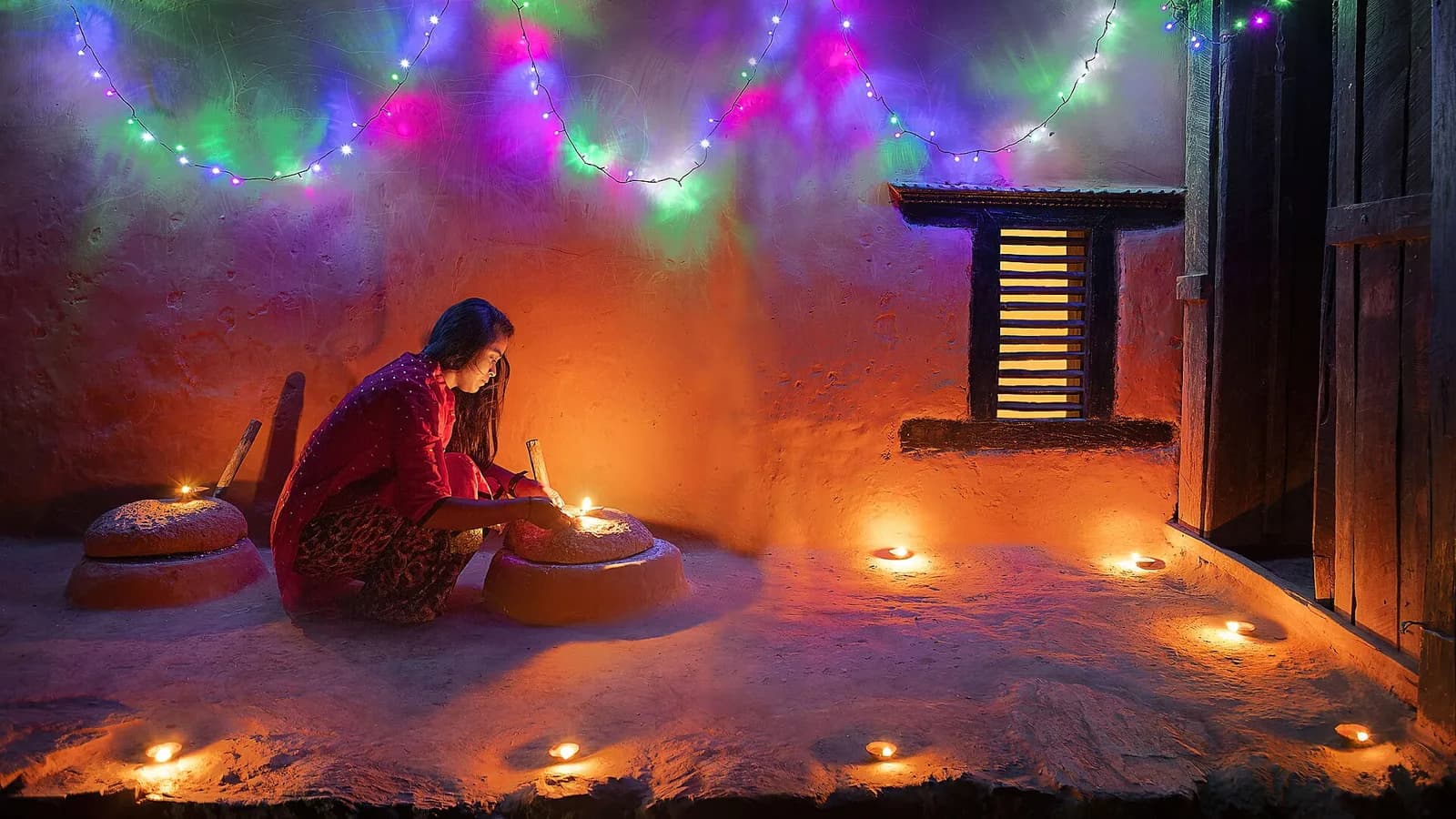
Tihar is Nepal's second-biggest festival, falling about two weeks after Dashain. Where Dashain is family-focused and inward, Tihar is outward — houses lit, streets garlanded, public spaces glowing. For travelers who time it right, Tihar is the most visually beautiful week in the Nepali calendar.
It's also weirder than most tourist guides admit.
When Tihar falls
Same lunar logic as Dashain — dates shift each year. Tihar always lands 14-15 days after the end of Dashain:
- 2024: October 31-November 4
- 2025: October 20-24
- 2026: October 28-November 1 (projected)
The five days have distinct themes. They're celebrated nationwide, but Kathmandu Valley, Pokhara, and Bhaktapur are the most visually striking.
Day 1: Kaag Tihar — worship of crows
Crows are believed to be messengers of Yama, the god of death. On day 1, families place small offerings of rice on rooftops for the crows. It's the strangest of the five days to a foreigner — your first thought is "wait, they're feeding crows on purpose?" and the answer is yes, with religious solemnity.
You'll see the offerings on every rooftop in the morning. By afternoon, the crows have collected them.
Day 2: Kukur Tihar — worship of dogs
Dogs are honored as the loyal protectors of homes (and as Yama's companions). On day 2, both household and street dogs receive a red tika on the forehead, a marigold garland around the neck, and a special meal.
This is the day that goes viral on social media every year. Photos of every dog in Kathmandu wearing a garland and a tika dot is the festival's most photogenic moment. Even street dogs that get no other attention all year are blessed and fed.
If you have any sentimentality toward animals, this day will get you.
Day 3: Laxmi Puja — worship of cows + the goddess Laxmi
Cows are worshipped in the morning (garlands, tika, food). In the evening, the biggest event of Tihar happens: Laxmi Puja.
Families clean their homes, light oil lamps (diyas) along their doorways, windowsills, and rooftops, and welcome the goddess Laxmi (prosperity) into the house. The entire Kathmandu Valley glows. Marigold garlands hang from every doorway. Colorful rangoli patterns are drawn at entrances. Walking through old Kathmandu, Patan, or Bhaktapur this evening is like walking through a slow, warm fire.
This is the photo day. This is the day for being outside after sunset.
Day 4: Govardhan Puja / Maha Puja
A complicated day with multiple regional variations. Most Newars (the indigenous Kathmandu Valley people) celebrate Mha Puja — a "worship of the self," where each person performs a small ritual honoring their own body and life. It's introspective and beautiful, mostly done at home.
Some families also worship oxen (Govardhan Puja), particularly in agricultural communities.
Day 5: Bhai Tika — the brother-sister blessing day
Sisters give tika (a multicolored mark, more elaborate than the Dashain tika) to their brothers, who give gifts in return. The bond between siblings is the focus.
If you don't have a Nepali sibling, you'll see Bhai Tika happening in homes but won't participate. Many Nepali friends will "adopt" a foreign brother or sister for the day — accept any such invitation; it's a meaningful gesture.
What you'll see in Kathmandu
- Days 3-4 evening: oil lamps and candles in every window, marigold garlands along every doorway, the sound of religious music (especially the Tihar-specific song "Deusi-Bhailo") in the streets
- Children and teenagers going door-to-door singing Deusi-Bhailo songs in exchange for small gifts of money or sweets — like organized caroling
- Marigold flowers everywhere — grown specifically for this week, sold in bulk in the days leading up
- Fireworks at night — less than Indian Diwali but still significant
- Card-playing in homes — Tihar is traditionally when families play cards together
Tihar vs Indian Diwali — the differences
Both festivals worship Laxmi. Both light lamps. Both happen at the same time of year. But Tihar is 5 days vs Diwali's 5 days but with different daily themes, Tihar emphasizes animal worship (no Diwali equivalent), and Tihar's Deusi-Bhailo singing tradition is unique to Nepal.
Indian Diwali is louder, more firework-heavy, and more commercialized. Nepali Tihar is slower, more local, and more contemplative. Many travelers who've experienced both prefer Tihar.
Best places to see Tihar
- Patan (Lalitpur) — the most photogenic. The old Newari houses with their carved wood balconies look astonishing lit by oil lamps. Patan Durbar Square is exceptional on day 3 evening.
- Bhaktapur — same Newari architecture, smaller scale, slower atmosphere
- Kathmandu's old city (Asan, Indra Chowk, Durbar Square) — the chaos and density mean the lights are everywhere
- Pokhara Lakeside — quieter, more concentrated to the main strip
- Smaller villages — if you're outside Kathmandu, the village Tihar is more intimate
The visit etiquette
If you're invited into a Nepali home during Tihar:
- Remove your shoes at the door
- Accept the small mouthful of sel roti (Tihar's traditional doughnut-like bread) or sweets offered
- The host will offer to give you tika — accept; don't wipe it off until the next morning
- Use namaste on arrival and "Subha Tihar" (Happy Tihar) as a greeting
- A small gift (chocolate, fruit) is appropriate but not required
Pre-trip checklist
- Check the exact 2026 dates
- Book hotels with rooftop or balcony access for the evening lamp views
- Bring a camera with decent low-light performance (or know your phone's night mode)
- Skip restaurants on day 3 evening — go walk the streets instead
- Learn "Subha Tihar" and the basic Nepali greetings
- Pet street dogs gently on Kukur Tihar — they're being celebrated and most are receptive
Tihar is the festival that converts skeptics. The first time you walk through Patan on Laxmi Puja evening, you understand why Nepalis call this their favorite week of the year.
Spotted an error in this post? Tell us or suggest a correction.
Related posts
ABC Trek: A Plain-English Guide to Annapurna Base Camp
The ABC trek (Annapurna Base Camp) explained — the route, how many days it takes, difficulty, the best seasons, and what daily trail life is really like.
Read postAma Dablam Climb: 2026 Expedition Guide (6,812m)
An Ama Dablam climb and expedition guide for 2026 — height, the Southwest Ridge route, camps, fixed ropes, difficulty, permits, cost and the best seasons.
Read postAnnapurna vs Manaslu: Which Trek Should You Choose?
An Annapurna vs Manaslu decision guide for trekkers — compare permits, crowds, difficulty, infrastructure and cost to pick the right Himalayan route.
Read postAsan Bazaar Kathmandu: Old Town Market Guide
A visitor guide to Asan bazaar, Kathmandu's oldest market — its six-road square, Annapurna Temple, what to buy, when to go, and how to get there.
Read postAyurveda Nepal: A Traveller's Guide to Healing
Ayurveda Nepal explained for tourists — the history, the doshas, treatments like Panchakarma and Shirodhara, where to go and how to choose a centre safely.
Read postBest Restaurants Pokhara Lakeside: Where to Eat
The best restaurants in Pokhara Lakeside — lakeside trout, wood-fired pizza, Tibetan momos and healthy cafes, with what to order and rough 2026 prices.
Read post