Buddhism in Nepal — A Traveler's Guide to Its Roots
Buddhism in Nepal began at Lumbini and split into three living traditions. Where to see it, what it means, and how to visit with respect.
In Nepal, the Buddha was born — and the religion that followed never stopped being lived.
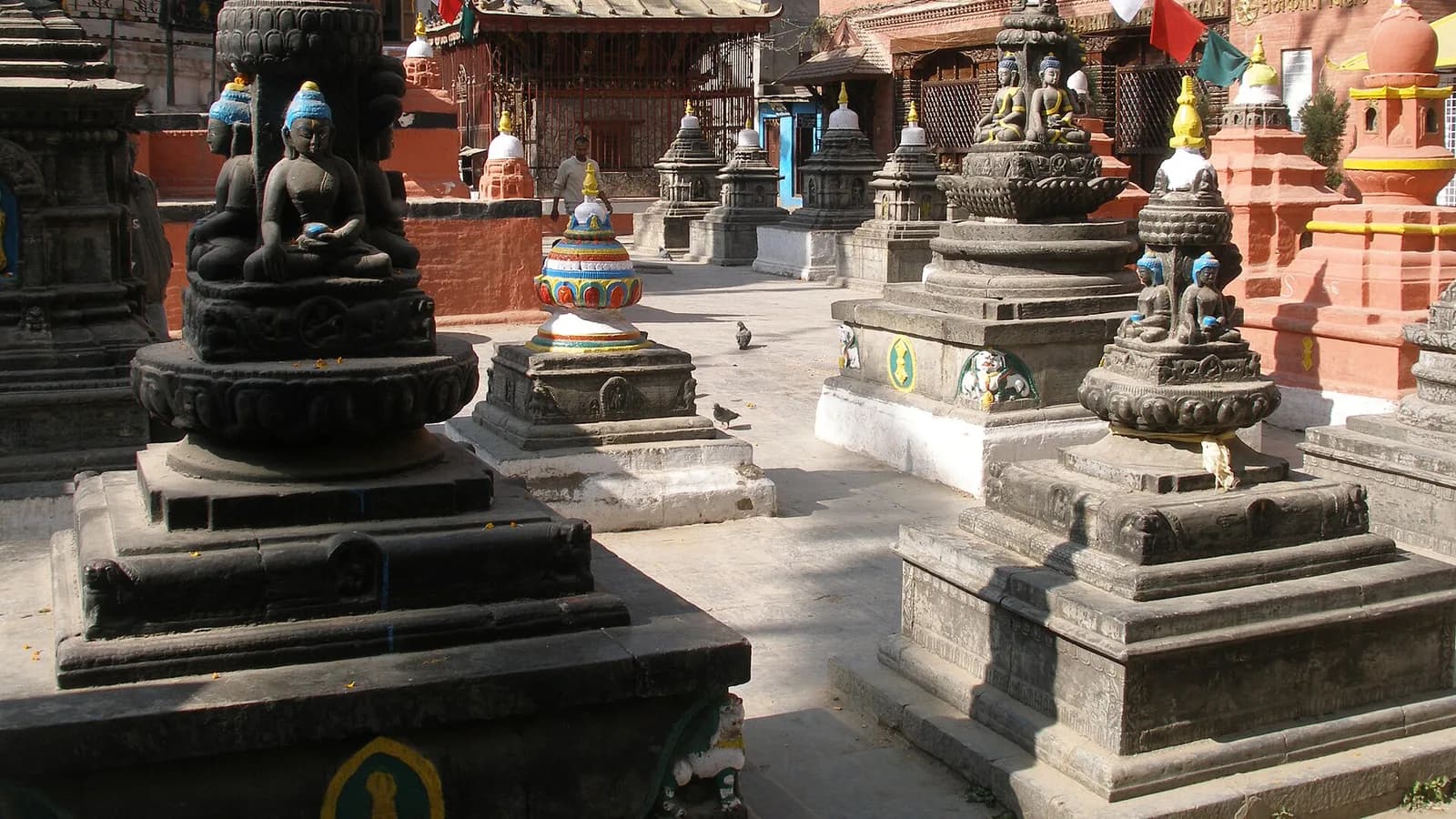
Buddhism in Nepal is not a museum exhibit or a tourist add-on — it is a living religion that began here, splintered into distinct traditions, and still shapes daily life from the Terai plains to the high Himalaya. Nepal is the birthplace of Siddhartha Gautama, the historical Buddha, and walking the country today you encounter Buddhism as architecture, as ritual, as the maroon robes of monks circling a stupa at dawn, and as a quiet thread woven through Hindu festivals and family shrines.
For visitors, understanding Buddhism in Nepal unlocks the meaning behind some of the country's most photographed places — the all-seeing eyes of Boudhanath, the prayer flags strung across mountain passes, the garden at Lumbini where it all began. This guide explains the history, the three main traditions you will actually encounter, the sites worth your time, and how to visit them with the respect they deserve.
Key takeaways
- The historical Buddha was born at Lumbini in southern Nepal, marked by an Ashoka pillar erected in the 3rd century BCE.
- Buddhism is Nepal's second-largest religion, about 8.2% of the population in the 2021 census.
- Three living traditions coexist: Newar Vajrayana, Tibetan/Himalayan Buddhism, and a modern Theravada revival.
- Newar Buddhism of the Kathmandu Valley is the oldest surviving Vajrayana tradition — older than Tibetan Buddhism.
- Buddhism and Hinduism are deeply intertwined in Nepal, sharing sites, deities and festivals.
- The most accessible places to experience it are Boudhanath, Swayambhunath and Lumbini.
Where it began: Lumbini and the Buddha's birth
Around the 6th century BCE, in a garden at Lumbini in what is now Nepal's Rupandehi District, Queen Maya Devi is said to have given birth to the prince who would become the Buddha. Lumbini is not a legend pinned to an approximate location — it is one of the best-attested ancient sites in the Buddhist world, thanks to a stone pillar.
In the 3rd century BCE, the Mauryan emperor Ashoka, a convert to Buddhism after the brutal Kalinga war, made a pilgrimage to Lumbini and erected a commemorative pillar there. Its Brahmi-script inscription records that the king visited because "here the Buddha was born," and even notes a tax reduction granted to the village. That pillar still stands beside the Maya Devi Temple, and it is the reason scholars can speak with confidence about Lumbini as the birthplace. UNESCO inscribed Lumbini as a World Heritage Site in 1997.
If you are weighing whether the long trip south is worth it, our honest assessment in is Lumbini worth visiting lays out who should go and who should skip it. The short version: for travelers with a genuine interest in Buddhism, standing beside the Ashoka pillar at dawn is quietly profound.
A short history of Buddhism in Nepal
Buddhism's story in Nepal stretches across more than two millennia, rising and receding with the dynasties that ruled the Kathmandu Valley.
| Period | Roughly | What happened | |---|---|---| | Buddha's birth | 6th century BCE | Siddhartha Gautama born at Lumbini | | Ashoka | 3rd century BCE | Emperor Ashoka's pillar marks Lumbini; missionaries spread the dharma | | Licchavi | c. 400–750 CE | Hinduism and Buddhism both flourish; kings honor both faiths | | Malla | c. 1200–1769 | Golden age of Hindu-Buddhist syncretism; Newar art and architecture peak | | Rana rule | 1846–1951 | Theravada monks revive the faith but are banished in 1926 and 1944 | | Modern | 1951–today | Religious freedom expands; Nepal becomes a secular state in 2008 |
The Licchavi and Malla centuries were when much of what tourists admire today took shape — the layered pagodas, the bronze-casting tradition, the festivals that blur the line between Hindu and Buddhist. During the autocratic Rana period, a Theravada revival movement faced suppression, with monks expelled from the country in 1926 and again in 1944. After the Ranas fell in 1951, religious life opened up, and in the decades since Nepal has shifted from an officially Hindu kingdom to a secular republic.
The three living traditions
What makes Buddhism in Nepal unusual is that three distinct streams flow side by side. Knowing which one you are looking at changes how you read a monastery, a robe color, or a ritual.
Newar Vajrayana
The indigenous Newar people of the Kathmandu Valley practice a form of Vajrayana (tantric) Buddhism that is, by scholarly consensus, the oldest surviving Vajrayana tradition in the world — older than Tibetan Buddhism. It is also the only Vajrayana tradition whose scriptures are preserved in Sanskrit rather than Tibetan or other languages.
Newar Buddhism looks different from what many visitors expect. Rather than celibate monks in monasteries, its priesthood is hereditary and non-celibate: the Vajracharya priests perform rituals for the community, while the Shakya caste largely serve their own families. It absorbed elements of Hindu practice over centuries, so a Newar Buddhist may honor deities a Westerner would file under "Hindu." This tradition gave Nepal its famous paubha scroll paintings and the ornate Ranjana script you will see lettered on temple banners.
Tibetan and Himalayan Buddhism
In the high country — Solu-Khumbu, Mustang, Manang, Dolpo and the valleys near Tibet — Buddhism takes its Tibetan form, brought and sustained by communities such as the Sherpa, Tamang and Gurung. Trekkers encounter this tradition constantly: prayer flags on passes, mani walls carved with mantras, gompas (monasteries) perched above villages, and the spinning of prayer wheels.
The Tibetan presence in Kathmandu itself grew sharply after the 1959 uprising in Tibet, when refugees settled around Boudhanath. That diaspora built more than 50 monasteries in the Boudha area alone, turning it into the beating heart of Tibetan Buddhism in exile. If you trek, our notes on the Langtang valley after the earthquake and the high passes pass through deeply Buddhist landscapes.
The Theravada revival
The third stream is the youngest: a 20th-century revival of Theravada Buddhism, the older "elder teaching" school dominant in Sri Lanka, Thailand and Myanmar. Suppressed under the Ranas, it re-rooted after 1951 and today runs vihara monasteries and meditation centers, particularly serving lay practitioners interested in insight meditation. At Lumbini's monastic zone you can see Theravada monasteries built by Buddhist nations sitting beside Tibetan and East Asian ones — three traditions in one park.
Buddhism and Hinduism: not a rivalry
One thing surprises nearly every first-time visitor: in Nepal, the line between Buddhism and Hinduism is genuinely blurry, and that is by design rather than confusion. The two faiths have shared the Kathmandu Valley for over a thousand years and developed a syncretism you can see at the sites themselves.
- At Swayambhunath, a Buddhist stupa, Hindus and Buddhists both venerate the goddess Harati, and shrines to Hindu deities sit within the complex.
- The bodhisattva Avalokiteshvara (Padmapani) is identified by many Nepalis with Lokeshwor, a form linked to Vishnu.
- Many Hindus regard the Buddha as an avatar of Vishnu, while Buddhists adopt fierce Hindu figures like Mahakala as dharma protectors.
- Newars routinely worship at both Hindu and Buddhist temples, and many festivals are celebrated across both communities.
This is why a single temple may be "owned" by neither faith exclusively, and why you should default to the more conservative etiquette when a site is shared. Our Nepal temple etiquette guide covers the practical rules for navigating these spaces.
Where to experience Buddhism in Nepal
You do not need to trek for two weeks to encounter living Buddhism. Several of the most significant sites are within or near Kathmandu.
Boudhanath
The largest stupa in the Kathmandu Valley and one of the largest in the world, Boudhanath is the spiritual center of Tibetan Buddhism in Nepal. Pilgrims circle it clockwise spinning prayer wheels, butter lamps glow at dusk, and dozens of monasteries ring the plaza. It became a UNESCO World Heritage Site in 1979. Plan your visit with our Boudhanath stupa visitor guide.
Swayambhunath
Perched on a hilltop west of the city, Swayambhunath — nicknamed the "Monkey Temple" — is among the oldest religious sites in the valley and a perfect example of Hindu-Buddhist syncretism. The famous Buddha eyes gaze out in four directions from its spire. See the Swayambhunath guide for the climb and what to look for.
Lumbini
The birthplace itself, in the southern Terai, anchored by the Maya Devi Temple, the Ashoka pillar, a sacred pond, and a monastic zone where Buddhist nations have each built a monastery. It rewards travelers who arrive knowing it is a contemplative place, not a spectacle.
Namo Buddha and the trekking trails
Beyond the famous trio, Namo Buddha (a hilltop stupa southeast of the valley tied to a Jataka tale of the Buddha's compassion) and the countless gompas along Himalayan trekking routes offer quieter encounters. In Pokhara, the World Peace Pagoda is a modern Buddhist stupa with a lake-and-mountain view.
Festivals: when Buddhism comes alive
Timing your visit to a Buddhist festival transforms the experience from sightseeing into participation.
- Buddha Jayanti (Buddha Purnima) — the Buddha's birth, enlightenment and death, marked on the full moon of the Nepali month around April–May. Boudhanath and Swayambhunath fill with pilgrims, lamps and processions.
- Losar (Tibetan New Year) — usually February, this is the great Tibetan festival, centered on Boudhanath, Swayambhunath and the refugee settlements, with masked dances, feasting and color. There are actually several Losars (Gyalpo, Tamu, Sonam) tied to different communities.
- Saga Dawa — a sacred Tibetan month (around May–June) when merit-making peaks and tens of thousands of butter lamps are lit.
For a broader festival overview, our guides to Indra Jatra in Kathmandu and the Tihar festival of lights show how religious celebration shapes the Nepali calendar — and how Buddhist and Hindu festivities often overlap.
Visiting respectfully: the essentials
Buddhist sites in Nepal are active places of worship, and a little awareness goes a long way.
- Remove your shoes before entering monastery shrine rooms and where signs indicate.
- Walk clockwise around stupas, chortens and mani walls — never counter-clockwise.
- Spin prayer wheels gently with your right hand, in the clockwise direction.
- Dress modestly: shoulders and knees covered.
- Photography: generally fine outdoors, but ask before photographing monks at prayer or inside shrine rooms, and avoid flash near old murals.
- Do not point your feet at altars, statues or monks; tuck them under you when seated.
- Pass mani walls and chortens on the left (keeping the structure to your right) as you walk.
These overlap heavily with general temple etiquette, covered in depth in our temple etiquette guide. A handful of phrases also helps — our Nepali phrases every trekker should know includes greetings that work warmly in monastery towns.
A simple itinerary for the Buddhism-curious
If you want to encounter all three traditions on one trip, here is a realistic shape:
| Day | Focus | Tradition | |---|---|---| | 1 | Boudhanath at dawn and dusk | Tibetan | | 2 | Swayambhunath and a Newar bahal courtyard | Newar / syncretic | | 3 | Patan's Golden Temple and museums | Newar Vajrayana | | 4–5 | Fly south to Lumbini's sacred garden | Theravada + pan-Buddhist |
The Newar Buddhist courtyards (bahals and bahis) hidden through the old cities of Kathmandu, Patan and Bhaktapur are easy to miss but reward the curious — Patan's Golden Temple (Hiranya Varna Mahavihar) is a working Newar Buddhist monastery open to visitors.
Sources
Frequently asked questions
- Was the Buddha born in Nepal or India?
- The historical Buddha was born at Lumbini in present-day southern Nepal, confirmed by an Ashoka pillar inscription on the site.
- What percentage of Nepal is Buddhist?
- About 8.2 percent of Nepal identified as Buddhist in the 2021 census, making it the second-largest religion after Hinduism.
- What kind of Buddhism is practiced in Nepal?
- Three living traditions: Newar Vajrayana in the Kathmandu Valley, Tibetan Buddhism in the Himalaya, and a modern Theravada revival.
- Can tourists visit Buddhist temples and monasteries in Nepal?
- Yes. Stupas, monasteries and Lumbini welcome respectful visitors. Remove shoes, dress modestly and walk clockwise around stupas.
- Is Newar Buddhism older than Tibetan Buddhism?
- Yes. Newar Vajrayana of the Kathmandu Valley is the oldest surviving Vajrayana tradition and predates Tibetan Buddhism.
- What is the most important Buddhist site near Kathmandu?
- Boudhanath, the largest stupa in the valley and the spiritual heart of the Tibetan community, alongside the hilltop Swayambhunath.
- Do Hindus and Buddhists share temples in Nepal?
- Often, yes. Sites like Swayambhunath hold shrines to both faiths, and many Newars worship in Hindu and Buddhist temples alike.
Spotted an error in this post? Tell us or suggest a correction.
Related posts
ABC Trek: A Plain-English Guide to Annapurna Base Camp
The ABC trek (Annapurna Base Camp) explained — the route, how many days it takes, difficulty, the best seasons, and what daily trail life is really like.
Read postAma Dablam Climb: 2026 Expedition Guide (6,812m)
An Ama Dablam climb and expedition guide for 2026 — height, the Southwest Ridge route, camps, fixed ropes, difficulty, permits, cost and the best seasons.
Read postAnnapurna vs Manaslu: Which Trek Should You Choose?
An Annapurna vs Manaslu decision guide for trekkers — compare permits, crowds, difficulty, infrastructure and cost to pick the right Himalayan route.
Read postAsan Bazaar Kathmandu: Old Town Market Guide
A visitor guide to Asan bazaar, Kathmandu's oldest market — its six-road square, Annapurna Temple, what to buy, when to go, and how to get there.
Read postAyurveda Nepal: A Traveller's Guide to Healing
Ayurveda Nepal explained for tourists — the history, the doshas, treatments like Panchakarma and Shirodhara, where to go and how to choose a centre safely.
Read postBest Restaurants Pokhara Lakeside: Where to Eat
The best restaurants in Pokhara Lakeside — lakeside trout, wood-fired pizza, Tibetan momos and healthy cafes, with what to order and rough 2026 prices.
Read post