The Himalayas: A Traveller's Guide to the Range
The Himalayas explained for travellers — how the range formed, its highest peaks, the rivers it feeds, and the best ways to see it from Nepal.
A 2,400-kilometre wall of rock and ice, still rising a few millimetres every year — and Nepal sits right in the middle of it.
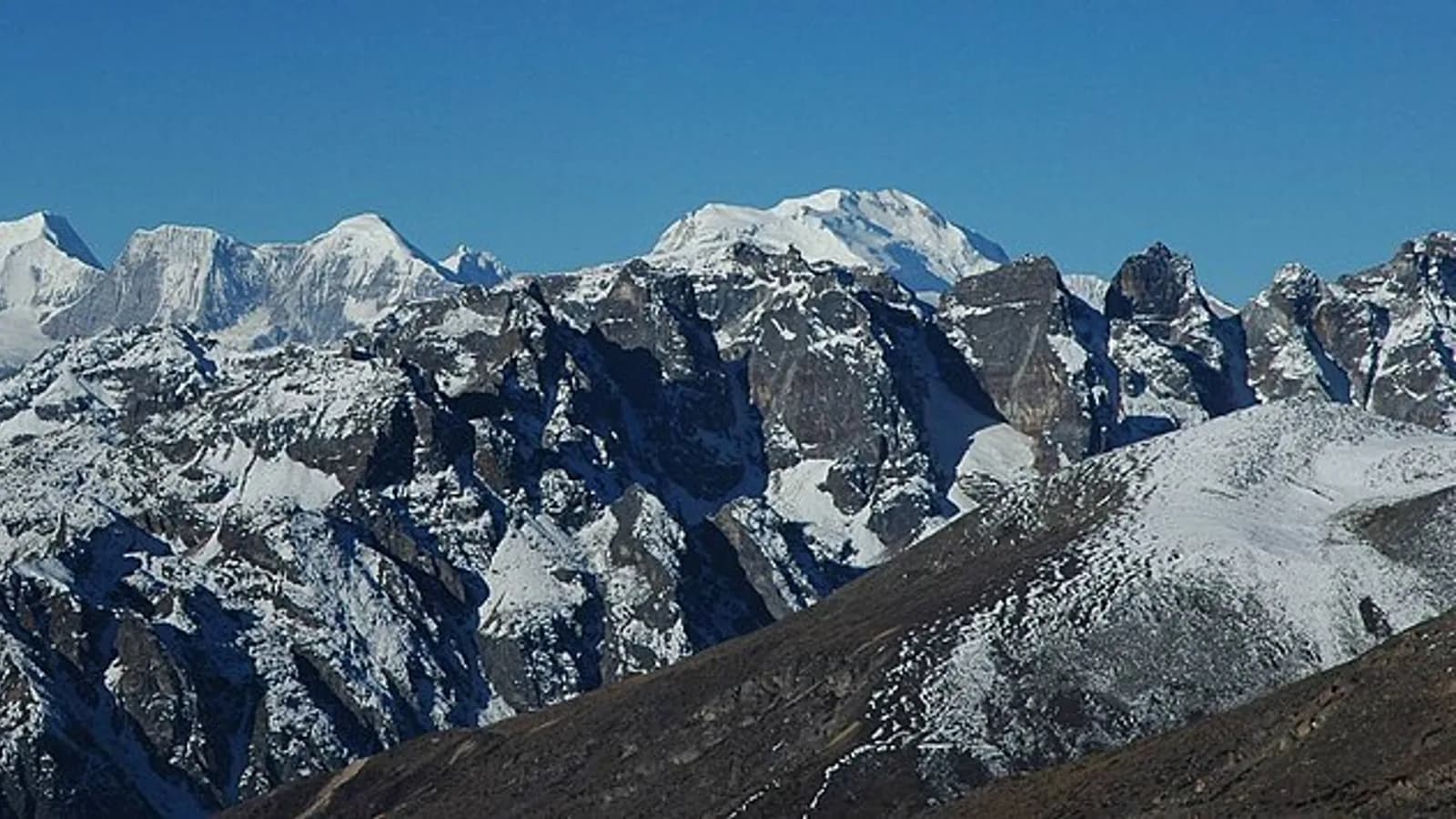
The Himalayas are the highest mountain range on Earth, a 2,400-kilometre arc of rock and ice that curves across South Asia and separates the Indian subcontinent from the Tibetan Plateau. They hold every one of the world's tallest peaks, feed the rivers that water nearly half of Asia, and shape the weather, culture and travel of a whole region. For visitors to Nepal, the Himalayas are not a distant abstraction — they are the skyline you wake up to, the reason the trekking trails exist, and the backdrop to almost every famous photograph of the country.
This guide is the wide-angle introduction: where the range sits, how it was built, which peaks make it famous, why its ice matters far beyond the mountains, and how an ordinary traveller can actually stand in front of it. If you want the single tallest summit, our highest mountain in Nepal guide focuses on Everest alone; for Nepal's own slice of the range, see mountains in Nepal.
Key takeaways
- The Himalayas stretch roughly 2,400 km across five countries: India, Nepal, Bhutan, Pakistan and China.
- They formed where the Indian plate collided with the Eurasian plate around 50 million years ago, and are still rising.
- The range holds more than 110 peaks above 7,300 m, including Mount Everest (8,848.86 m), the highest on Earth.
- Eight of the world's ten highest mountains line Nepal's northern border.
- Himalayan snow and ice feed at least ten major Asian rivers, supplying water to nearly two billion people downstream.
- You do not have to be a climber — hill viewpoints, mountain flights and teahouse treks all bring the range within reach.
Where the Himalayas are
The Himalayas run in a long arc along the northern edge of the Indian subcontinent. According to Britannica, the range stretches more or less uninterrupted for about 2,500 km (around 1,550 miles) from Nanga Parbat in the Pakistani-administered part of Kashmir in the west to Namcha Barwa in the Tibet Autonomous Region of China in the east.
Five countries share the mountains. India, Nepal and Bhutan have sovereignty over most of the range, while Pakistan and China occupy significant parts. Nepal occupies a central stretch and, crucially for travellers, contains the highest concentration of giant peaks.
The three bands of the range
Geographers usually describe the Himalayas as three roughly parallel sub-ranges that rise like steps from the plains:
| Band | Rough character | What you notice | |---|---|---| | Siwaliks (Outer) | Low foothills | Forested ridges nearest the plains | | Lesser Himalayas | Mid-elevation | Terraced hills, towns, hill stations | | Greater (High) Himalayas | The high crest | The snow peaks and eight-thousanders |
In Nepal you travel through all three: arriving in the lowland Terai, climbing into the mid-hills where Kathmandu and Pokhara sit, and finally reaching the high country on a trek.
How the Himalayas were formed
The Himalayas exist because of one of the slowest, most violent collisions in geology. Around 50 million years ago, the Indian continental plate — which had broken off the ancient supercontinent of Gondwana and drifted north — rammed into the Eurasian plate. The ocean floor between them subducted, sliding down into the mantle, but India's continental crust was too thick and buoyant to follow it.
As geophysicist Peter Molnar has put it, most of the Himalayas are slices of rock that were once the upper part of India's crust, sheared off and stacked into sheets as the plate was forced against Eurasia. The result is the wall of mountains we see today.
Still rising, still moving
The collision has not stopped. The range is commonly described as rising by about 5 mm a year, which keeps it geologically active and prone to large earthquakes — Nepal's devastating 2015 quake was a direct consequence of these forces. Scientists studying the range have even found evidence that parts of the Himalaya rise and subside in cycles as rivers carve away rock beneath them, a process National Geographic has described as the mountains effectively "breathing." For the human story of one of those earthquakes, see our Nepal earthquake guide.
The highest mountains on Earth
No range comes close to the Himalayas for sheer height. Britannica notes the range includes more than 110 peaks rising above 7,300 m (24,000 ft). The crowning summit is Mount Everest, known as Sagarmatha in Nepali and Qomolangma in Tibetan. After a long dispute over its exact figure, Nepal and China jointly announced a revised official height of 8,848.86 m on 8 December 2020, based on fresh GPS and survey work from teams that reached the summit.
Everest is only the headline. Of the fourteen mountains on Earth above 8,000 m — the so-called eight-thousanders — eight rise wholly or partly along Nepal's border. Run down the global top ten and Nepal owns most of it; only K2 and Nanga Parbat, both in Pakistan's Karakoram, interrupt the sequence.
| World rank | Mountain | Height | Country | |---|---|---|---| | 1 | Everest | 8,848.86 m | Nepal–China | | 2 | K2 | 8,611 m | Pakistan–China | | 3 | Kanchenjunga | 8,586 m | Nepal–India | | 4 | Lhotse | 8,516 m | Nepal–China | | 5 | Makalu | 8,485 m | Nepal–China | | 6 | Cho Oyu | 8,188 m | Nepal–China | | 7 | Dhaulagiri I | 8,167 m | Nepal | | 8 | Manaslu | 8,163 m | Nepal |
Nepal's expanding count of eight-thousanders
The familiar global list names fourteen eight-thousanders. In early 2025, however, Nepal's Department of Tourism announced it would officially recognise six additional peaks above 8,000 m — subsidiary summits such as Yalung Kang and Kangchenjunga Central and South — raising the country's own tally to fourteen, as reported by the Kathmandu Post (February 2025). These are secondary points along existing massifs rather than newly discovered mountains, and at the time of the announcement they were not yet on the global UIAA list; Nepal said it would submit them for international recognition. Treat the "fourteen in Nepal" figure as Nepal's national count, distinct from the long-standing global fourteen.
A water tower for half of Asia
The Himalayas matter to far more people than the climbers and trekkers who visit them. Together with the neighbouring Hindu Kush and Karakoram, the range stores the largest body of ice outside the polar regions — by ICIMOD's inventory, over 60,000 glaciers spread across tens of thousands of square kilometres.
That ice is the source of at least ten major Asian river systems, including the Ganges, Indus, Brahmaputra, Mekong, Yangtze and Yellow rivers. ICIMOD estimates that nearly two billion people downstream depend in some way on water flowing from these "water towers," which is why events in the high mountains ripple across the continent. Nepal's own great rivers — fed by this snow and ice — also power the country's white-water rafting and much of its hydropower.
The glaciers are shrinking
The Himalayan ice is in measurable retreat. A landmark 2023 ICIMOD report found that glaciers across the Hindu Kush Himalaya disappeared about 65 percent faster in 2011–2020 than in the previous decade, and warned that the region could lose a large share of its glacial volume by 2100 on current emissions paths. Record-low snowfall in 2023 and 2024 added to concerns about water security. For a closer look at what this means on the ground, see our guides to Himalayan glacier melt and climate change in Nepal.
How travellers can experience the Himalayas
You do not need ropes, oxygen or mountaineering experience to stand face to face with the Himalayas. Nepal offers a whole spectrum of ways to see the range, from a one-hour flight to a multi-week walk.
View it from the hills
Some of the best panoramas come without any climbing at all. Hill towns put the high peaks on the horizon at sunrise and sunset:
- Nagarkot sunrise — a ridge near Kathmandu with a long Himalayan skyline on clear mornings.
- Sarangkot sunrise — above Pokhara, looking onto the Annapurna and Machhapuchhre peaks.
- A scenic Everest mountain flight — a short morning flight from Kathmandu that runs along the high peaks.
Walk into the range
Trekking is the classic way to get among the mountains, and Nepal's teahouse system means you can do it without carrying a tent or cooking gear. Trails range from gentle hill walks to high base-camp routes. Start with our overview of Nepal trekking, then look at popular options like the Everest Base Camp trek or the Annapurna Base Camp route. For the full ranked list of summits and where to glimpse each one, our explore mountains page is the place to browse.
Go prepared
Altitude is the single biggest practical challenge in the high Himalayas. Thin air can affect anyone above roughly 2,500–3,000 m regardless of fitness, so build in time to acclimatise and learn the warning signs before you go high — our altitude sickness guide covers the essentials. The best visibility generally comes in the clear post-monsoon and spring windows; see best time to trek in Nepal to plan around the weather.
Sources
- Himalayas — Britannica
- Himalayas — Wikipedia
- The Himalayas — This Dynamic Earth, USGS
- The Himalaya 'breathes,' with mountains growing and shrinking in cycles — National Geographic
- Mount Everest gets growth spurt as China, Nepal revise elevation — NPR
- Nepal adds six new 8000ers, raising its official tally to 14 — Kathmandu Post
- Hindu Kush Himalaya glaciers losing ice at double the rate since 2000 — ICIMOD
- Himalayan glaciers may lose 75 percent of ice by 2100 — Al Jazeera
Frequently asked questions
- Where are the Himalayas located?
- The Himalayas form an arc across South Asia, running roughly 2,400 kilometres from Pakistan in the west to the eastern edge of the Tibet Autonomous Region of China. The range crosses five countries, with India, Nepal and Bhutan holding most of it and Pakistan and China occupying parts.
- How were the Himalayas formed?
- They rose where the Indian tectonic plate collided with the Eurasian plate, a process that began around 50 million years ago. Because India's crust was too thick and buoyant to slide under, the rock piled up into the world's highest mountains, and the collision is still lifting the range today.
- Are the Himalayas still growing?
- Yes. The plate collision continues, and the range is generally estimated to rise by around 5 millimetres a year, though erosion, earthquakes and glacial movement complicate the picture so the net change varies by location.
- How many of the world's highest mountains are in the Himalayas?
- The Himalayas contain the highest mountains on Earth, including more than 110 peaks above 7,300 metres. All ten of the world's highest summits sit in the wider Himalaya and neighbouring Karakoram, and eight of the top ten rise along Nepal's northern border.
- What is the difference between the Himalayas and Mount Everest?
- The Himalayas are the entire mountain range stretching across South Asia, while Mount Everest is a single peak within it. Everest, called Sagarmatha in Nepali, is the highest point in the range and on Earth at 8,848.86 metres.
- Which rivers come from the Himalayas?
- Meltwater and snow from the Hindu Kush Himalaya feed at least ten major Asian river systems, including the Ganges, Indus, Brahmaputra, Mekong, Yangtze and Yellow rivers. Hundreds of millions of people downstream depend on this water, which is why the range is called a 'water tower' of Asia.
- Can ordinary travellers see the Himalayas without climbing?
- Absolutely. In Nepal you can view the range from hill towns like Nagarkot and Sarangkot, from a scenic mountain flight out of Kathmandu, or on teahouse treks that reach viewpoints and base camps without any technical climbing.
- Are the Himalayan glaciers melting?
- Yes. Research by ICIMOD found that glaciers across the Hindu Kush Himalaya disappeared about 65 percent faster in 2011 to 2020 than in the previous decade, and could lose a large share of their volume this century on current emissions trends.
Spotted an error in this post? Tell us or suggest a correction.
Related posts
ABC Trek: A Plain-English Guide to Annapurna Base Camp
The ABC trek (Annapurna Base Camp) explained — the route, how many days it takes, difficulty, the best seasons, and what daily trail life is really like.
Read postAma Dablam Climb: 2026 Expedition Guide (6,812m)
An Ama Dablam climb and expedition guide for 2026 — height, the Southwest Ridge route, camps, fixed ropes, difficulty, permits, cost and the best seasons.
Read postAnnapurna vs Manaslu: Which Trek Should You Choose?
An Annapurna vs Manaslu decision guide for trekkers — compare permits, crowds, difficulty, infrastructure and cost to pick the right Himalayan route.
Read postAsan Bazaar Kathmandu: Old Town Market Guide
A visitor guide to Asan bazaar, Kathmandu's oldest market — its six-road square, Annapurna Temple, what to buy, when to go, and how to get there.
Read postAyurveda Nepal: A Traveller's Guide to Healing
Ayurveda Nepal explained for tourists — the history, the doshas, treatments like Panchakarma and Shirodhara, where to go and how to choose a centre safely.
Read postBest Restaurants Pokhara Lakeside: Where to Eat
The best restaurants in Pokhara Lakeside — lakeside trout, wood-fired pizza, Tibetan momos and healthy cafes, with what to order and rough 2026 prices.
Read post