Nepal Earthquake: A Traveler's Guide to the Risk
What every visitor should know about the Nepal earthquake risk — the 2015 Gorkha quake, recent activity, building codes, and how to stay safe.
Nepal sits where two continents collide. Understanding that geology — and respecting it — makes you a calmer, better-prepared traveler.
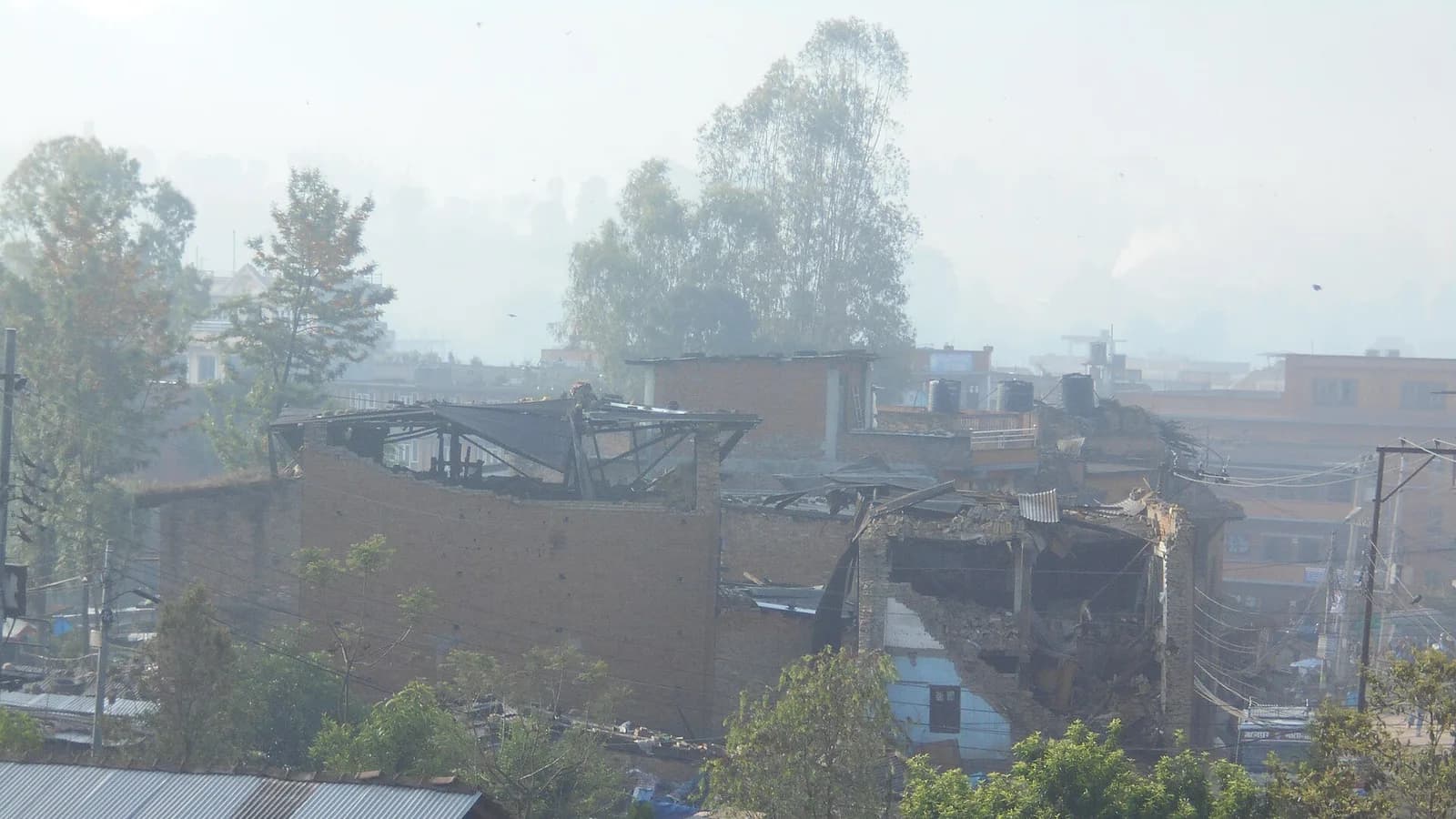
Few travelers think about plate tectonics when they book a trip, but in Nepal the ground itself is part of the story. The country straddles the boundary where the Indian plate grinds beneath the Tibetan plateau — the same slow-motion collision that pushed up the Himalaya and that makes a Nepal earthquake one of the defining natural hazards of the region. This guide explains the geology in plain terms, looks at the major 2015 quake and recent activity, and gives practical, calm advice so you can travel well-informed rather than worried.
Key takeaways
- Nepal lies on an active continental collision zone; earthquakes are a permanent feature of the geology, not a one-off event.
- The magnitude 7.8 Gorkha earthquake of 25 April 2015 was the most destructive in modern Nepali history, killing roughly 9,000 people across the region.
- A magnitude 7.1 quake struck just across the border in Tibet on 7 January 2025; it was felt in Nepal but caused only minor damage and injuries there.
- Most damaged heritage monuments have been rebuilt — Bhaktapur, Patan, and much of Kathmandu Durbar Square are largely restored.
- Western Nepal is watched closely as a high-hazard zone, though research shows major quakes there occur at random intervals, not on a predictable clock.
- For an ordinary visit the day-to-day risk is very low; simple preparedness and travel insurance are the right level of response.
Why Nepal shakes: the geology in plain terms
Nepal sits at the front line of one of Earth's largest ongoing collisions. The Indian tectonic plate is pushing northward into the Eurasian plate at roughly the speed your fingernails grow. Because India is sliding underneath Tibet, enormous strain builds along a stack of faults beneath the foothills — the Main Frontal Thrust, the Main Boundary Thrust, and the Main Central Thrust, plus many smaller local faults.
That strain does not release smoothly. It locks for decades or centuries, then slips suddenly — and a sudden slip is an earthquake. The very same process that raised the mountains you came to see is what produces the shaking. You cannot have the Himalaya without the seismicity; they are two faces of the same geological coin.
This also explains why the hazard never really goes away. After a big quake the strain begins accumulating again immediately. Monitoring data from Nepal's National Earthquake Monitoring and Research Center record hundreds of magnitude-4-or-greater events in the years since 2015 — most far too small to notice, but a constant reminder that the system is alive.
The 2015 Gorkha earthquake
On 25 April 2015, a magnitude 7.8 earthquake struck with its epicenter near Barpak in Gorkha District, about 85 km northwest of central Kathmandu, at a shallow depth of around 8 km. It is usually called the Gorkha earthquake after that district.
The human toll was severe. Around 8,900 people were killed and more than 21,000 injured across Nepal and neighboring areas of India, China, and Bangladesh. An estimated eight million people — close to a third of Nepal's population — were affected in some way. More than 500,000 houses were destroyed and another roughly 269,000 damaged. Economic losses were estimated at about USD 9.4 billion (as of 2015), a figure close to half of Nepal's annual economic output at the time.
The disaster also struck the mountains. In the Langtang valley, an avalanche triggered by the quake buried the main village; only a handful of the people there that day survived. That valley has since reopened, and trekking there now directly supports the families who rebuilt it.
Recovery and rebuilding
Recovery was slow at first — a common pattern after mega-disasters, where bureaucracy, land disputes, and the sheer scale of need delay aid. Surveys in the first couple of years found that only a small fraction of reconstruction funds had reached households. Over the following years the picture improved markedly: the broader economy recovered within a few years, the large majority of displaced families returned to permanent homes, and major infrastructure was repaired over roughly half a decade.
For travelers, the most visible legacy is the heritage rebuilding, covered below. The short version: Nepal is not a country frozen in ruins. It is a country that absorbed a major blow and rebuilt.
Recent seismic activity (2024-2026)
Nepal remains active, and a cluster of events around the start of 2025 brought renewed attention.
| Event | Date | Magnitude | Notes | | --- | --- | --- | --- | | Tibet (Tingri) earthquake | 7 Jan 2025 | ~7.1 (USGS) | Epicenter across the border near Shigatse; felt strongly in Nepal | | Western Nepal swarm | Dec 2024 - Jan 2025 | Several M4+ | Cluster of smaller quakes, mostly in the west | | Gorkha earthquake (reference) | 25 Apr 2015 | 7.8 | Most destructive in modern Nepali history |
The 7 January 2025 earthquake was centered in Tingri County in Tibet, in the Shigatse area not far from the China-Nepal border and the northern flank of the Everest massif. Reported death tolls in Tibet ranged from official figures around 126 up to higher estimates from other sources, with hundreds injured and more than 1,000 houses damaged on the Tibetan side. In Nepal itself the effects were comparatively minor — around a dozen people injured and limited damage — though the shaking was widely felt and climbers near Everest reported avalanches.
Separately, over a few weeks spanning late December 2024 into January 2025, monitoring recorded a series of magnitude-4-and-above events concentrated in western Nepal. None were individually destructive, but the clustering prompted seismologists to repeat a long-standing message: western Nepal is a place to take preparedness seriously.
How worried should a traveler actually be?
Here is the honest framing. Over a human lifetime, a major Himalayan earthquake is close to a certainty somewhere along the range. But on any given two- or three-week trip, the probability that you personally experience a damaging quake is very small. Millions of people visit Nepal safely every year.
The right response is not anxiety; it is the same calm preparedness you would apply to altitude, road travel, or weather. If you would like a broader picture of conditions on the ground, our guides on whether Nepal is safe to travel right now and the current Nepal travel advisory put earthquake risk alongside the other practical factors visitors weigh.
It is also worth separating the two kinds of risk. The headline event — a great earthquake — is rare and unpredictable. The everyday reality — frequent tiny tremors you will probably never feel — is harmless. Both are normal for a country sitting on a continental suture.
The western Nepal "seismic gap"
You may read that western Nepal is overdue for a great earthquake. The reasoning is that the last truly massive rupture along the frontal fault in that region is usually dated to 1505, leaving centuries of accumulated strain — what geologists call a seismic gap.
Recent science has refined this picture in an important way. Lake-sediment studies, which read layers of earthquake-disturbed mud going back millennia, found evidence that several significant earthquakes did strike western Nepal after 1505 — with events identified in years such as 1632, 1696, 1731, 1761, and 1902. Crucially, the same research found that big quakes do not follow a regular timetable. Statistically their timing looks random, which means the popular idea that a great quake is "due" on a fixed schedule is not well supported.
The practical takeaway is reassuring in one sense and sobering in another: no one can tell you a major western-Nepal earthquake is imminent, but no one can rule it out either. That is exactly why experts frame it as a permanent hazard that calls for permanent preparedness, rather than a countdown.
Heritage sites: what's been rebuilt
The 2015 quake damaged or destroyed hundreds of heritage structures, including monuments in the UNESCO-listed Kathmandu Valley. The reconstruction since then has been one of the country's quiet success stories.
| Site | Status for visitors | | --- | --- | | Bhaktapur Durbar Square | Largely restored; among the most complete recoveries | | Patan Durbar Square | Largely recovered, with ongoing minor repairs | | Kathmandu Durbar Square | Mostly repaired; several landmark temples reopened in recent years |
By official counts, the large majority of the roughly 920 damaged heritage sites have been reconstructed. Bhaktapur Durbar Square is often singled out as a standout restoration. Kathmandu Durbar Square is mostly repaired, with several signature temples reopened over the past few years, though you may still see scaffolding around a structure here and there. For visitors this is essentially invisible in terms of enjoyment — the squares are open, atmospheric, and very much alive.
Building codes and modern construction
Kathmandu's vulnerability is partly geological. The valley sits on soft former lake-bed sediment, which can amplify shaking far more than solid rock — a major reason the city ranks so poorly in comparative studies of earthquake exposure for large urban populations.
Nepal's main engineering response is the Nepal National Building Code. Its seismic provisions, updated in a 2020 edition, are built around life safety: the aim is that in a major earthquake a building may be damaged but should not collapse, giving occupants time to get out. Newer, code-compliant construction — including many hotels and guesthouses built or rebuilt after 2015 — is markedly safer than older masonry. Enforcement is improving but remains uneven, and a great deal of the existing building stock predates modern standards. If you have a choice, newer, well-built accommodation in an open area is the safer option.
How to stay safe: practical steps for visitors
You do not need special equipment, just awareness. A little planning goes a long way, and most of it overlaps with sensible general travel safety.
Before and during your trip
- Register and share your plans. Leave your itinerary with someone at home and, where available, register with your government's traveler program. Note your embassy's contact details.
- Get the right insurance. Choose a policy covering natural disasters, emergency medical care, and — if you trek — helicopter evacuation.
- Scout open space. Wherever you are staying, mentally note the nearest open area clear of buildings, walls, trees, and power lines.
- Keep essentials handy. A charged phone, a copy of your passport, some cash, and a small flashlight cover most short-term needs.
If the ground starts shaking
- Indoors: Drop to the floor, cover your head and neck, and hold on — ideally under sturdy furniture or against an interior wall. Do not try to run outside during the shaking, when falling debris is most dangerous.
- In a narrow lane or courtyard: Shelter in a strong doorway to avoid falling objects, then move to open ground once the shaking stops.
- Outdoors: Move to an open space away from buildings, walls, bridges, and power lines, and stay there until the shaking ends.
- After: Expect aftershocks, avoid damaged buildings, and follow instructions from local authorities and your accommodation.
None of this should overshadow your trip. Think of it the way you think of knowing where the exits are on a plane — quietly reassuring, rarely needed.
A note on the wider Himalaya
Earthquakes are one of several natural forces shaping the region. The same tectonics that drive seismicity also interact with the high-mountain environment, where a changing climate is altering glaciers and slope stability. For most travelers these are background facts rather than trip-changers, but they are part of understanding Nepal as a living, dynamic landscape rather than a static postcard.
The mountains are not going anywhere — and neither, realistically, is the seismic risk. Travel with both in mind, and Nepal rewards you with some of the most extraordinary scenery and culture on Earth.
Sources
- April 2015 Nepal earthquake — Wikipedia
- Nepal earthquake of 2015 — Britannica
- 2025 Tibet earthquake — Wikipedia
- Strong earthquake kills dozens in region of Tibet near Mount Everest — NPR
- Western Nepal at high risk as experts warn of major quake — The Rising Nepal
- Potentially large post-1505 AD earthquakes in western Nepal revealed by a lake sediment record — Nature Communications
- Western Nepal's earthquakes are random; permanent risk demands better preparedness — The Farsight Nepal
- An Expert Guide to Surviving an Earthquake in Nepal — World Nomads
- Overview of NBC 105:2020 — Nepal Seismic Code
- Quake-damaged heritage reconstruction on, albeit slowly — The Rising Nepal
- Nepal's heritage sites on shaky ground after devastating quake — UNESCO
- National Earthquake Monitoring and Research Center, Nepal
Frequently asked questions
- Is it safe to travel to Nepal given the earthquake risk?
- Yes. Millions visit Nepal every year and a damaging earthquake on any given day is extremely unlikely. The risk is real over a lifetime, but for a normal trip it is comparable to other natural hazards travelers routinely accept, and basic awareness is enough.
- When was the last major earthquake in Nepal?
- The last catastrophic quake inside Nepal was the magnitude 7.8 Gorkha earthquake on 25 April 2015. A magnitude 7.1 quake struck just across the border in Tibet on 7 January 2025, which was felt in Nepal but caused only minor damage and injuries there.
- Did the 2015 earthquake damage Nepal's tourist sites permanently?
- No. Most of the affected UNESCO heritage monuments have been rebuilt. By official counts the large majority of damaged heritage structures have been reconstructed, and squares like Bhaktapur and Patan are largely restored, though some repairs continue.
- What should I do if an earthquake happens while I am in Nepal?
- If you are indoors, drop, cover your head and neck, and hold on under sturdy furniture; do not run outside mid-shaking. If you are outdoors, move to an open space away from buildings, walls, and power lines. Only move once the shaking stops.
- Are buildings in Kathmandu earthquake-resistant now?
- Newer construction is built to the Nepal National Building Code, whose 2020 seismic edition aims to prevent collapse and protect life in a major quake. Enforcement is improving but uneven, and many older buildings predate modern standards.
- Which part of Nepal has the highest earthquake risk right now?
- Seismologists pay close attention to western Nepal, a segment of the Himalayan fault that has not produced a great earthquake in a very long time. Research shows the timing of major quakes there is essentially random, so the area is treated as a permanent, not predictable, hazard.
- Should I buy travel insurance that covers earthquakes and evacuation?
- Yes, it is sensible. Choose a policy that covers natural disasters, emergency medical care, and helicopter evacuation if you plan to trek, and keep your embassy contact and itinerary registered with someone at home.
Spotted an error in this post? Tell us or suggest a correction.
Related posts
Everest Helicopter Tour: Cost, Landing & 2026 Guide
Everest helicopter tour from Kathmandu — cost, the Kala Patthar landing rules, Hotel Everest View breakfast, weight limits, best season and safety.
Read postAsan Bazaar Kathmandu: Old Town Market Guide
A visitor guide to Asan bazaar, Kathmandu's oldest market — its six-road square, Annapurna Temple, what to buy, when to go, and how to get there.
Read postHow to Choose the Best Trekking Agency in Nepal (2026)
A practical buyer's guide to choosing a trekking agency in Nepal: TAAN registration, the licences to check, fair pricing, and the red flags to avoid.
Read postNepal 30 Day Visa: Cost, Rules, and Who It Suits
A focused guide to the Nepal 30 day visa — the USD 50 fee, multiple-entry rules, when to pick it over 15 or 90 days, and how to extend.
Read postNepal e-Visa: Online Application, ETA, and What to Expect
How the Nepal e-visa and ETA system actually works in 2026 — what you can do online, what still happens at the airport, fees, and documents.
Read postABC Trek: A Plain-English Guide to Annapurna Base Camp
The ABC trek (Annapurna Base Camp) explained — the route, how many days it takes, difficulty, the best seasons, and what daily trail life is really like.
Read post