Himalayan Tahr: Nepal's Cliff-Dwelling Wild Goat
A trekker's guide to the Himalayan tahr in Nepal: where to see this wild goat, its alpine habitat, conservation status, and the Everest trail's most-spotted mammal.
A shaggy, copper-maned wild goat that grazes near-vertical cliffs above the tree line — and the one large mammal most Everest trekkers actually see.
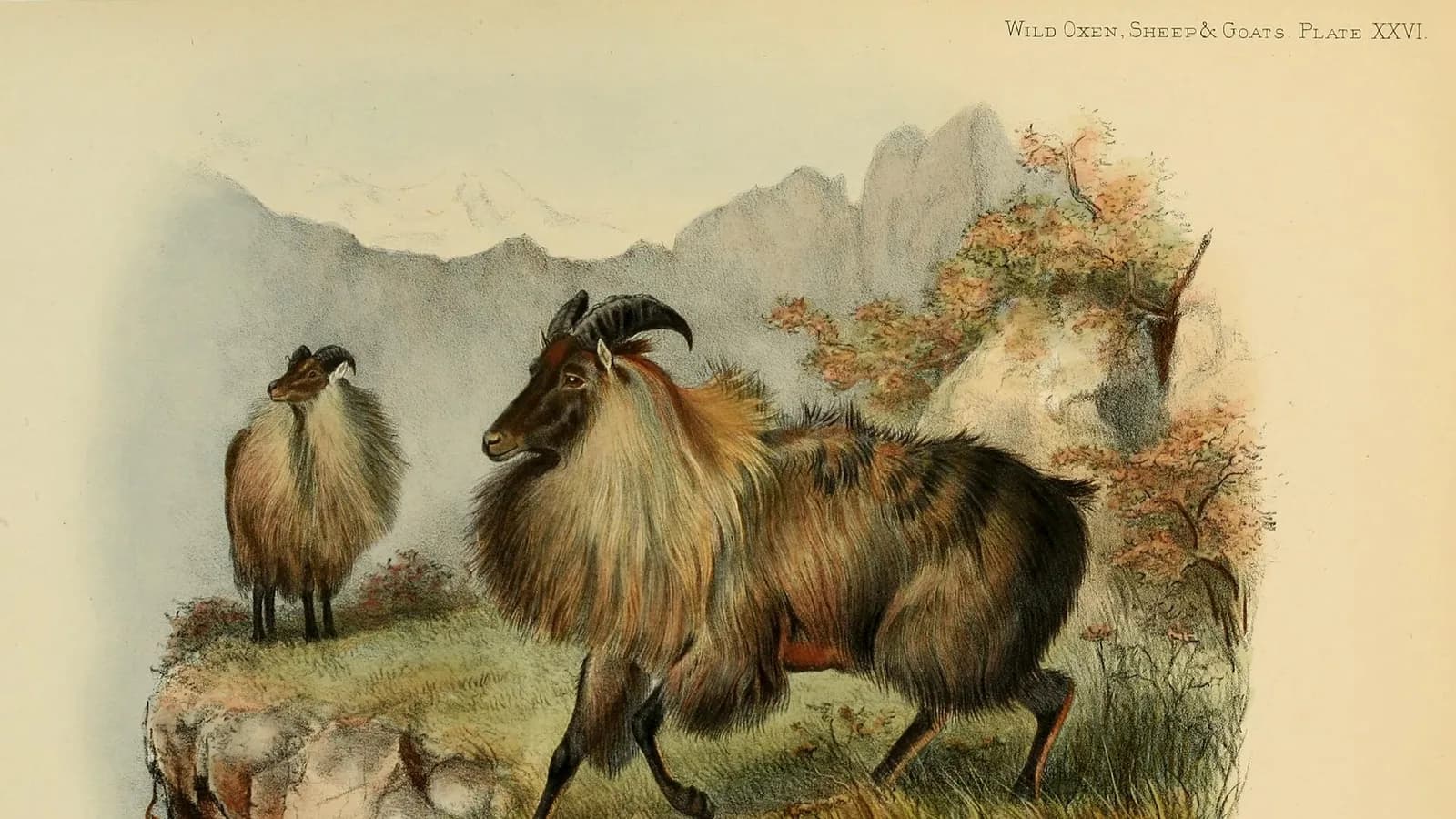
If you trek in Nepal's high country and see one large wild mammal, it will most likely be the Himalayan tahr — a stocky, shaggy wild goat that grazes the steep cliffs above the tree line. On the Everest trail in particular, tahr are common and surprisingly relaxed around people, which makes them the one big animal most trekkers can count on photographing. This guide covers what the Himalayan tahr actually is, where to find it, how it survives on near-vertical rock, its conservation status, and how it fits into the snow leopard's world and Nepal's one legal hunting reserve.
Key takeaways
- The tahr is a true wild goat (Hemitragus jemlahicus), native to Nepal, India, Bhutan, and southern Tibet, living on steep slopes roughly between 2,500 and 5,000 m.
- The Everest region is the best place to see one: inside Sagarmatha National Park, tahr are common and often unafraid of trekkers, especially near Namche, Dole, and Pangboche.
- Males are unmistakable in winter, with a long copper mane over the neck and shoulders; females are smaller and plainer.
- It is listed as Near Threatened on the IUCN Red List, with a declining trend driven by hunting, habitat loss, and livestock competition.
- The snow leopard is its main predator, so healthy tahr herds underpin a much rarer cat you will almost never see.
- Spring and autumn give the best sightings, when weather is stable and animals come lower to feed and breed.
Meet the Himalayan tahr
The Himalayan tahr is a large, even-toed ungulate — and, despite an old reputation as something more exotic, modern analysis confirms it is simply a wild goat. It has a small head, pointed ears, large eyes, and short horns that curve backward to a maximum of about 46 cm (18 in).
The species is strongly sexually dimorphic, meaning males and females look quite different:
- Males are heavy and dark, averaging around 73 kg (161 lb). In their dense winter coat they grow a long, shaggy mane of reddish to dark-brown hair around the neck and shoulders that runs down the front legs — the feature that makes a big billy unmistakable on a ridgeline.
- Females are noticeably smaller, averaging around 36 kg (79 lb), paler, and with shorter horns.
Tahr are gregarious, living in all-male and all-female herds that can number up to around 80 animals, and they are most active in the early morning and late afternoon. They are herbivores, grazing mostly on grasses — by some estimates up to three-quarters of the diet — and browsing leaves, shrubs, and the odd fruit, leaning on woodier plants when grass runs short.
Built for the cliffs
What sets the tahr apart is how it moves. Its hooves have a rubbery, flexible core that grips smooth rock, rimmed with harder keratin for durability. The result is an animal that can graze and flee across steep, often near-vertical rock faces where predators and competitors cannot easily follow. If you watch a herd long enough on the Everest trail, you will see them drift across a slope you would not dream of crossing without a rope.
Where to see Himalayan tahr in Nepal
Tahr occupy high-altitude alpine and subalpine ground, generally on slopes from about 2,500 to 5,000 m, favouring rocky cliffs and using grasslands, shrublands, and rhododendron-fir forest edges as well. In Nepal they are spread across several protected areas, but your odds of an actual sighting are far higher in some than others.
| Area | Status for tahr | Notes for visitors | |---|---|---| | Sagarmatha (Everest) National Park | Common; the classic place to see them | Frequently seen near Namche, Dole, Pangboche, Somare; often relaxed around people | | Langtang National Park | Present | North of Kathmandu; tahr studied here for decades | | Makalu Barun National Park | Present | Remote eastern habitat | | Annapurna region | Present, with notable numbers | Pairs naturally with the Annapurna trekking trails | | Dhorpatan Hunting Reserve | Present; the only legal hunting area | Western Nepal; trophy hunting under quota |
The Everest trail: the easy win
For most travellers, the Everest Base Camp trek is the realistic way to see a Himalayan tahr in the wild. Tahr are described as the most commonly seen large mammal on that route, typically between roughly 2,800 and 4,200 m, and they often gather in groups near villages such as Pangboche, Dole, Somare, and Namche Bazaar. Crucially, they tend to be fairly unafraid of humans on these busy trails, so close, unhurried observation and photography are genuinely possible — a rarity among Himalayan wildlife.
If you want the full picture of that walk, see our guides to the Everest Base Camp trek and to Sagarmatha National Park, the high-altitude park the tahr shares with musk deer, the Himalayan monal, and the elusive snow leopard.
Tahr, blue sheep, and the snow leopard
Two wild ungulates dominate Nepal's high alpine zone, and trekkers often confuse them. It is worth keeping them straight:
- Himalayan tahr — a true goat: dark, shaggy, maned males, short backward-curving horns, fond of steep cliffs and forest edges.
- Blue sheep (bharal) — greyer and more sheep-like, with horns that flare outward, preferring more open alpine slopes.
Both are central to the diet of the snow leopard, the ghost of the high Himalaya. Snow leopards haunt the ridges and valleys above roughly 4,500 m, and while your chances of seeing one are slim to none, a strong tahr and blue sheep population is precisely what keeps the cat on the mountain. In that sense the humble tahr is a keystone of the alpine food web. The same forests and slopes shelter other rare species too — see our pieces on the red panda in Nepal and the country's wider national parks for the bigger ecological picture.
Behaviour and the rut
Tahr are polygynous: males compete hard for access to females. Younger males tend to roam and mate opportunistically when the big males are absent, while mature males over about four years old invest in ritual displays and fighting to win mating rights. This makes the breeding season, or rut, the most dramatic time to watch them, as heavy males posture and clash on the slopes.
The rut falls in the colder months, which neatly overlaps with the autumn trekking season — another reason a spring or autumn trek is the sweet spot. The animals are also at their most photogenic then, with males in full winter coat and mane. Day to day, herds graze in the cool hours and rest up on inaccessible ledges through the middle of the day, so an early start gives you the best viewing.
Conservation status and threats
The Himalayan tahr is listed as Near Threatened on the IUCN Red List. That is a step below endangered, but the trend is the worry: the population is declining. The pressures are familiar across Himalayan wildlife:
- Hunting, both illegal and, in one place, regulated.
- Habitat loss and degradation as high pastures are altered.
- Competition with domestic livestock, which graze the same alpine meadows and can crowd tahr off the best feed; livestock conflict has been documented inside Sagarmatha National Park itself.
The encouraging counterpoint is that inside Nepal's well-managed national parks, tahr remain reasonably common and reasonably tolerant of people. Population estimates compiled across the range put roughly a thousand animals across Sagarmatha, Makalu Barun, and Langtang combined, with several hundred more in the Annapurna region and a few hundred in Dhorpatan. Those are approximate figures from research surveys rather than a precise census, but they show the species is hanging on in its strongholds.
Why protecting tahr matters
Because the tahr is core prey for the snow leopard, protecting it is not only about one wild goat. A slope full of healthy tahr is the foundation that lets a far rarer predator survive, alongside the musk deer, Himalayan black bear, and pheasants that share the habitat. Guard the grazing and you guard the whole high-altitude community.
Dhorpatan: Nepal's one legal hunting reserve
Nepal allows trophy hunting in exactly one location — the Dhorpatan Hunting Reserve, spread across the Rukum, Baglung, and Myagdi districts in the west and covering roughly 1,325 sq km of alpine meadow, subalpine forest, and cliff, from about 2,850 m to over 7,000 m. The only two species for which trophy permits may be issued there are the Himalayan tahr and the blue sheep.
The system is meant to be tightly controlled: the government issues a limited number of permits each year based on wildlife surveys, every expedition is licensed and monitored, and hunting anywhere outside Dhorpatan is illegal. The stated logic is conservation funding and population management. However, the model is genuinely debated — published research on Dhorpatan has flagged a steep decline in the reserve's blue sheep over recent decades and questioned whether current trophy-hunting practice is ecologically and socially sustainable. Travellers do not need to take a side to be aware that this is a live conservation argument, not a settled one.
For most visitors, of course, the point is watching tahr, not hunting them — and for that the protected national parks, not Dhorpatan, are the destination.
Best time to go
Tahr can be seen year-round in their range, but the shoulder seasons that suit Himalayan trekking also suit wildlife watching:
| Season | Months | Tahr-watching notes | |---|---|---| | Spring | March to May | Stable weather, animals active and feeding; classic trekking window | | Autumn | September to November | Clear skies, the rut brings drama, males in full mane | | Winter | December to February | Cold and high passes tough, but animals lower down and rut activity possible | | Monsoon | June to August | Rain, cloud, and leeches lower down make it the least pleasant time |
Whatever the month, look in the early morning and late afternoon, scan steep rocky slopes and the edges between forest and open ground, and bring a zoom lens or binoculars. For the broader seasonal picture across the country, see our guide to the best time to visit Nepal, and for other high-altitude trails where tahr live, our Langtang trek, Annapurna Base Camp, and Dolpo trek guides.
How to watch tahr responsibly
- Keep your distance. Even relaxed tahr deserve space; never crowd a herd for a photo.
- Stay quiet and let them move first. Sudden noise or pursuit stresses the animals and ruins it for the next group.
- Never feed them. Food handouts change wild behaviour and are bad for the animal.
- Use a zoom, not your feet. Binoculars and a long lens get you the view without the disturbance.
- Stick to the trail. Off-trail scrambling tramples fragile alpine vegetation that tahr depend on.
- Respect park rules. Sagarmatha and the other parks have regulations for good reasons; follow your guide.
A few useful Nepali words
- Jharal — a common Nepali name for the Himalayan tahr
- Pahad — "mountain / hill"
- Ban — "forest"
- Bistarai — "slowly / quietly"
- Dhanyabaad — "thank you" (to your guide and hosts)
Our Nepali phrases every trekker should know covers more language for the trail and the teahouse.
Final word
The Himalayan tahr will never have the fame of the snow leopard or the rhino, but for trekkers it offers something better: a real, reliable encounter with a large wild animal in spectacular country. Walk the Everest trail in spring or autumn, scan the cliffs near Namche or Pangboche in the cool of the morning, and you stand a strong chance of watching a copper-maned billy pick its way across rock you could never cross. Keep your distance, leave the slope as you found it, and you become a small part of why these wild goats — and the great cat that depends on them — still have a mountain to live on.
Sources
- Himalayan tahr — Wikipedia (taxonomy, description, range, IUCN status)
- Himalayan Tahr — Animalia.bio (diet, behaviour, herd size, hooves)
- GRID-Arendal — Himalayan Tahr in Sagarmatha National Park, Nepal
- Status, Distribution and Potential Habitat of Himalayan Tahr and Conflict Areas with Livestock in Sagarmatha National Park (ResearchGate)
- The ecology and feeding behaviour of the Himalayan Tahr in the Langtang Valley, Nepal (IUCN Library)
- Footprint Adventure — Wildlife on the Everest Base Camp trek (tahr near Namche, Pangboche, Dole)
- Footprint Adventure — Dhorpatan Hunting Reserve, Nepal's only hunting reserve
- Is trophy hunting of bharal and Himalayan tahr contributing to their conservation in Nepal? (Italian Journal of Mammalogy)
- Exploring sustainability in trophy hunting practices at Dhorpatan Hunting Reserve, Nepal (ScienceDirect)
Frequently asked questions
- What is a Himalayan tahr?
- The Himalayan tahr (Hemitragus jemlahicus) is a large wild goat native to the Himalaya, including Nepal, northern India, western Bhutan, and southern Tibet. Males are stocky and dark, weighing roughly 73 kg on average, with a striking copper-coloured mane around the neck and shoulders in winter; females are smaller, around 36 kg, and paler. Both sexes carry short, backward-curving horns up to about 46 cm long. Tahr are superb climbers, grazing on steep, rocky slopes above the tree line, and are most active in the early morning and late afternoon.
- Where can I see Himalayan tahr in Nepal?
- The single best place for trekkers is the Everest region inside Sagarmatha National Park, where tahr are common and fairly relaxed around people. Herds are regularly seen on the cliffs and slopes around Namche Bazaar, Dole, Pangboche, and Somare. They also live in Langtang and Makalu Barun National Parks, the Annapurna region, and the Dhorpatan Hunting Reserve. Spring and autumn give the most reliable sightings, when the weather is stable and animals descend to feed and breed.
- Is the Himalayan tahr endangered?
- The Himalayan tahr is listed as Near Threatened on the IUCN Red List, meaning it is not yet endangered but its population is declining. The main pressures are hunting, habitat loss and degradation, and competition with domestic livestock for grazing. Inside Nepal's national parks the species is generally well protected and reasonably common, so a trek there gives good odds of seeing one even though the wider trend is downward.
- What is the difference between a Himalayan tahr and a blue sheep?
- They are different animals that share the high country. The Himalayan tahr is a true wild goat, dark and shaggy with a thick mane on the males and short curving horns, favouring steep cliffs and the forest edge from roughly 2,500 to 5,000 m. The blue sheep, or bharal, is greyer and more sheep-like, with outward-flaring horns, and tends to prefer more open alpine slopes. Both are prey for the snow leopard, and both are the only two species legally hunted at Dhorpatan.
- Are Himalayan tahr dangerous to trekkers?
- No. Himalayan tahr are wary grazing animals with no interest in people and they are not aggressive toward humans. On busy trails like the Everest route they often tolerate trekkers at surprisingly close range, which makes for excellent photography. The sensible etiquette is simply to keep your distance, stay quiet, never feed or chase them, and let them move off on their own terms.
- What do Himalayan tahr eat?
- Himalayan tahr are herbivores and mostly grazers. Grasses make up the bulk of their diet — by some accounts as much as three-quarters of it — and they also browse leaves, shrubs, and the occasional fruit, taking more woody plants when grass is scarce. Their rubbery, grippy hooves let them feed on near-vertical rock and steep alpine meadows that few other large animals can reach, which is a big part of how they avoid competition and predators.
- What animals hunt the Himalayan tahr?
- The main natural predator of the Himalayan tahr is the snow leopard, which shares the same high, rugged terrain. Young, old, or injured tahr are the most vulnerable. Snow leopards are extremely elusive and rarely seen by trekkers, but a healthy tahr and blue sheep population is exactly what supports them, which is one reason protecting these wild goats matters for the wider ecosystem.
- Can you legally hunt Himalayan tahr in Nepal?
- Only in one place and under strict control. The Dhorpatan Hunting Reserve in western Nepal is the country's only legal hunting area, and the Himalayan tahr and blue sheep are the two species for which trophy permits may be issued. The government sets small annual quotas based on wildlife surveys, and hunting anywhere outside Dhorpatan is prohibited. Researchers have raised concerns about whether current quotas are sustainable, so the system remains debated.
Spotted an error in this post? Tell us or suggest a correction.
Related posts
One-Horned Rhino in Nepal: Where to See Them in Chitwan
See the greater one-horned rhino in Nepal. Chitwan holds 694 of the country's 752 rhinos — where, when, and how to spot them on safari in 2026.
Read postABC Trek: A Plain-English Guide to Annapurna Base Camp
The ABC trek (Annapurna Base Camp) explained — the route, how many days it takes, difficulty, the best seasons, and what daily trail life is really like.
Read postAma Dablam Climb: 2026 Expedition Guide (6,812m)
An Ama Dablam climb and expedition guide for 2026 — height, the Southwest Ridge route, camps, fixed ropes, difficulty, permits, cost and the best seasons.
Read postAnnapurna vs Manaslu: Which Trek Should You Choose?
An Annapurna vs Manaslu decision guide for trekkers — compare permits, crowds, difficulty, infrastructure and cost to pick the right Himalayan route.
Read postHow to Choose the Best Trekking Agency in Nepal (2026)
A practical buyer's guide to choosing a trekking agency in Nepal: TAAN registration, the licences to check, fair pricing, and the red flags to avoid.
Read postChitwan Jungle Resort: How to Choose Where to Stay
A Chitwan jungle resort guide for tourists — Sauraha vs Meghauli, resort types, what packages include, and how to book the right base for your safari.
Read post