The Tihar Festival Explained — Meaning and Five Days
What is the Tihar festival? A clear guide to the meaning, mythology, and five days of rituals behind Nepal's festival of lights, animals, and siblings.
Five days that honour a crow, a dog, a cow, an ox, the goddess of fortune — and, on the last day, a brother.
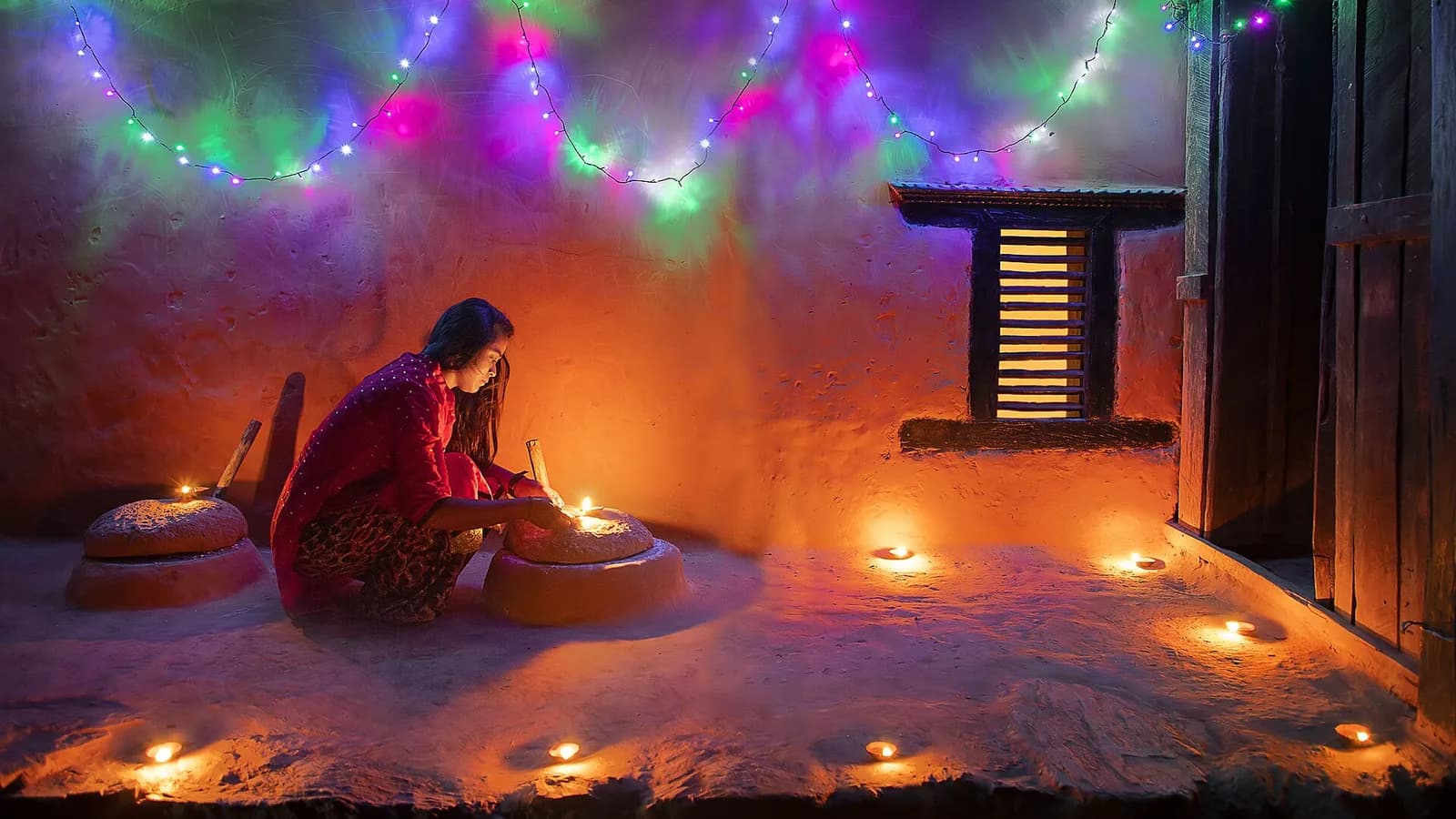
If Nepal's autumn has a glowing second act, the Tihar festival is it. Coming about two weeks after the country's biggest holiday, Dashain, Tihar is the festival of lights — five days of oil lamps, marigold garlands, and rangoli patterns that turn ordinary doorways into shrines. But its real character lies in what those five days actually honour: a crow, a dog, a cow, an ox, the goddess of fortune, and, on the final day, the bond between siblings. This guide explains what Tihar is — the meaning behind the name, the mythology that frames it, and a plain walk through the rituals that give each day its purpose.
It pairs with our on-the-ground Tihar festival of lights guide, which covers what the week feels like as a visitor — where to be after dark, what you will see, and how to behave if you are invited in. Think of this page as the "what and why," and that one as the "what it's like."
Key takeaways
- Tihar is Nepal's five-day festival of lights, the second-biggest celebration after Dashain.
- It is also called Yamapanchak — the "five days of Yama," the god of death — and Swanti among the Newar people.
- Its central evening, Lakshmi Puja, welcomes the goddess of wealth into lamp-lit homes.
- Three days honour animals — crows, dogs, and cows — plus oxen on the fourth.
- The festival closes with Bhai Tika, the sister-brother blessing day, rooted in the Yama and Yamuna legend.
- It runs in the lunar month of Kartik (October–November), with dates that shift each year.
What Tihar actually celebrates
At its heart, Tihar is a celebration of light overcoming darkness and of harmony between the divine, the human, the animal, and the natural worlds. Where Dashain looks inward to family and the goddess Durga, Tihar looks outward and downward — to the creatures that share daily life, and to the goddess who brings fortune into the home.
The emotional and visual peak is the worship of Lakshmi (Laxmi), the goddess of wealth and prosperity. On the central night, families clean their houses end to end, line every doorway, windowsill, and rooftop with small oil lamps called diyo, draw coloured rangoli patterns at their entrances, and leave the lamps burning to guide the goddess inside. The light is not decoration for its own sake; it is an invitation. A well-lit, freshly cleaned home is one Lakshmi is believed to favour.
Surrounding that core is the festival's most distinctive idea: that animals deserve a place in the celebration too. Across its days, Tihar honours the crow, the dog, the cow, and the ox — not as pets or property, but as beings worthy of garlands, food, and a forehead mark. The thread running through all of it is reverence: for prosperity, for loyalty, and for the quiet web of relationships that holds ordinary life together.
The names you will hear
Tihar travels under several names, and each tells you something about the festival. Yamapanchak means the "five days of Yama," tying the whole sequence to the Hindu god of death. Deepawali (or Diwali) is the older, pan-South-Asian name meaning "a row of lamps," and you will hear it especially in Nepal's southern Madhesh region. Among the Newar people of the Kathmandu Valley, the festival is Swanti, and its days carry their own meaning, including the Newar new year. We unpack the India comparison in our guide to Deepawali in Nepal.
The Yama and Yamuna legend
The most-told story behind Tihar — and the reason for the name Yamapanchak — concerns Yama, the god of death, and his sister Yamuna. In the legend, the two had been parted for a long time, and Yamuna longed to see her brother. To reassure her, Yama is said to have sent a crow as a messenger, then other creatures, before finally visiting in person.
When he arrived, Yamuna welcomed him with garlands, a forehead tika, and protective rituals, and prayed for his long life. Moved by her devotion, Yama granted a boon: any brother who receives such blessings from his sister on this day would be protected and long-lived. That moment is remembered as the origin of Bhai Tika, Tihar's final and most tender day. The legend also helps explain why the festival's earlier days honour the very creatures associated with Yama's realm — the crow as his messenger, the dog as his companion and guardian of the afterlife.
The five days, one by one
Tihar's five days are not interchangeable. Each has its own focus, building from the animal days toward Lakshmi Puja and closing on the sibling bond.
Day 1 — Kaag Tihar (the crow)
The festival opens with Kaag Tihar, honouring the crow. Regarded as a messenger of Yama, the crow is offered grains, seeds, and sweets left out on rooftops and by doorways in the morning. The gesture is partly an appeal — to keep grief and death at bay for the year ahead — and partly a recognition that even the humblest, least-loved birds have a place in the order of things.
Day 2 — Kukur Tihar (the dog)
The second day, Kukur Tihar, is the one the world knows. Dogs — household pets, working dogs, and street strays alike — are given a red tika on the forehead, a marigold garland around the neck, and a special meal, honoured as loyal guardians and as companions of Yama. It is the most photographed day of the festival, and the most moving for many visitors, because the affection extends even to animals that receive no other attention all year. We cover it in depth in our Kukur Tihar guide.
Day 3 — Gai Tihar and Lakshmi Puja (the cow, then the goddess)
The third day has two halves. In the morning comes Gai Tihar, honouring the cow, which holds a sacred and maternal place in Hinduism and is valued for the milk, ghee, and sustenance it provides; cows are garlanded, marked, and fed. Then, in the evening, the festival reaches its peak with Lakshmi Puja. This is the night the lamps come out in force, the rangoli is drawn, and the goddess of wealth is welcomed in. Walking through an old lamp-lit quarter on this evening is the visual high point of the entire Nepali year.
Day 4 — Goru Tihar and Mha Puja (the ox, and the self)
The fourth day carries several layers. As Goru Tihar, it honours the ox, vital to farming life. In agricultural communities it also includes Govardhan Puja. Among the Newar, the day is Mha Puja — a remarkable "worship of the self," in which each person performs a ritual honouring their own body and life, purifying and empowering the soul for the year ahead. Mha Puja coincides with Nepal Sambat, the traditional Newar lunar new year, and people exchange new-year greetings of Nhu Daya Bhintuna.
Day 5 — Bhai Tika (the sibling bond)
Tihar closes with Bhai Tika, the day that brings the Yama and Yamuna legend full circle. Sisters apply a distinctive seven-coloured tika — the saptarangi tika — to their brothers' foreheads, drape them in makhamali (globe amaranth) garlands, and pray for their long life and protection. Brothers, in turn, offer gifts and their own blessings. It is warm, elaborate, and unmistakably the emotional heart of the festival.
The symbols at the centre
A handful of objects and sounds carry the meaning of the whole festival, and you will encounter them everywhere during Tihar week.
| Symbol | What it is | What it means | | --- | --- | --- | | Diyo | Small clay oil lamp | Light that guides Lakshmi into the home | | Rangoli | Coloured pattern at the doorway | A welcome mark for the goddess of fortune | | Marigold garland | Strings of sayapatri flowers | Honour and blessing, draped on animals and doorways | | Saptarangi tika | Seven-coloured forehead mark | A sister's protection and blessing on Bhai Tika | | Makhamali garland | Globe-amaranth flower garland | A long-lasting bloom given to brothers |
Two of these deserve a closer look, because they are the sights that define Tihar in memory.
Light: the diyo and the rangoli
The image most associated with Tihar is the row of oil lamps flickering along a windowsill at dusk, mirrored by the colour-filled rangoli at the threshold below. Together they perform the festival's central act — turning a home into something a goddess would want to enter. It is why the festival is simply called the "festival of lights," and why the Lakshmi Puja evening is the night to be outdoors.
Sound: Deusi and Bhailo
Threading through the festival is Deusi-Bhailo, a door-to-door singing tradition unique to Nepal. Groups of children and young people — historically Bhailo sung by girls on Lakshmi Puja night and Deusi by boys the next evening — move from house to house in festive dress, singing blessings to the accompaniment of the madal drum and harmonium. In return they receive fruit, sweets, money, and especially sel roti, the ring-shaped festive bread. More than entertainment, Deusi-Bhailo knits neighbourhoods together and keeps folk songs alive, giving Tihar a communal soundtrack that sets it apart from other festivals of lights.
How Tihar fits the festival year
Tihar does not stand alone. It is the brighter, more outward second half of Nepal's great autumn pairing with Dashain, the fifteen-day family festival that precedes it by about two weeks — explained in our companion piece on the Dashain festival's meaning and rituals. Where Dashain is inward, solemn, and built around the goddess Durga and the blessing of tika and jamara, Tihar is luminous, communal, and built around Lakshmi, animals, and siblings. Together they form the spine of the Nepali festive calendar.
Elsewhere in that calendar sit very different celebrations — the irreverent cow procession of Gai Jatra, the women's festival of Teej, and the spring colours of Holi — each with its own character. Tihar's particular gift is its gentleness: a festival that finds room in its rituals for a stray dog and a crow as readily as for a goddess.
When Tihar falls
Like the rest of the South Asian festival calendar, Tihar runs on the lunar calendar, so it does not keep a fixed Western date. It falls in the lunar month of Kartik, generally in October or November, roughly two weeks after Dashain. Its pivotal evening, Lakshmi Puja, is tied to the new-moon night of Kartik — the darkest night of the month, chosen so the lamps shine brightest.
In 2025, Tihar's central days fell in late October (Lakshmi Puja around 20 October, Bhai Tika a few days later), and in 2026 the festival is projected to land in late October or early November. Because the lunar drift means the dates move each year, the practical rule for a visitor is simple: confirm the exact dates for your travel year rather than assuming. The same lunar logic governs Dashain, explained in our note on when Dashain falls.
| Detail | What to know | | --- | --- | | Other names | Yamapanchak, Swanti, Deepawali, Diwali | | Lunar month | Kartik | | Western window | October to November | | Core evening | Lakshmi Puja, on the Kartik new moon | | Length | Five days | | Timing vs Dashain | About two weeks after Dashain | | Date stability | Shifts each year — always verify |
The short version
The Tihar festival is Nepal's luminous celebration of light, fortune, and the bonds that hold life together. Framed by the legend of Yama and his sister, it honours crows, dogs, cows, and oxen across its days, welcomes the goddess Lakshmi on its central lamp-lit night, and closes on the tender ritual of Bhai Tika. Understand those threads — the lights, the animals, the goddess, and the siblings — and you understand Tihar. To see how it all plays out for someone actually in Nepal during the festival, read our full Tihar festival of lights guide next.
Sources
Frequently asked questions
- What is the Tihar festival?
- Tihar is Nepal's five-day festival of lights, the country's second-biggest celebration after Dashain. It honours the goddess Lakshmi and a series of animals tied to Yama, the god of death, and it ends with Bhai Tika, a day devoted to the bond between brothers and sisters.
- What does the Tihar festival celebrate?
- Tihar celebrates light over darkness and the harmony between gods, humans, animals, and nature. Its central evening welcomes Lakshmi, the goddess of wealth, into lamp-lit homes, while separate days honour crows, dogs, cows, and oxen, and the final day celebrates the sibling bond.
- Why is Tihar called Yamapanchak?
- Yamapanchak means the five days of Yama, the Hindu god of death. The name links the festival to a legend in which Yama's sister Yamuna performed protective rituals for his long life, and several of Tihar's days honour creatures regarded as Yama's messengers or companions.
- What are the five days of Tihar?
- Day one is Kaag Tihar for crows, day two is Kukur Tihar for dogs, day three is Gai Tihar and Lakshmi Puja for cows and the goddess of fortune, day four is Goru Tihar and Mha Puja for oxen and the self, and day five is Bhai Tika for the sibling bond.
- What is Bhai Tika in Tihar?
- Bhai Tika is Tihar's final day, when sisters apply a seven-coloured tika to their brothers' foreheads, drape them in makhamali garlands, and pray for their long life, while brothers offer gifts in return. The custom traces back to the legend of Yama and his sister Yamuna.
- What is the difference between Tihar and Deepawali?
- They are the same autumn festival of lights under different names. Nepalis most often say Tihar, while Deepawali and Diwali are the more widely known Indian names. Nepal's version keeps several unique traditions, including the animal days and the door-to-door singing of Deusi-Bhailo.
- What is Mha Puja during Tihar?
- Mha Puja is a worship of the self performed by the Newar people of the Kathmandu Valley on the fourth day of Tihar. It purifies and empowers the soul for the year ahead and coincides with Nepal Sambat, the traditional Newar lunar new year.
- When is the Tihar festival celebrated?
- Tihar falls in the lunar month of Kartik, usually in October or November, about two weeks after Dashain. Because it follows the lunar calendar, the exact dates shift every year, so it is best to confirm them for your specific travel year.
Related posts
The Dashain Festival Explained — Meaning and Rituals
What is the Dashain festival? A clear guide to the meaning, mythology, and day-by-day rituals of Nepal's biggest Hindu celebration of good over evil.
Read postDeepawali in Nepal — How Tihar Differs From Indian Diwali
Deepawali in Nepal is celebrated as Tihar, a five-day festival of lights. How it compares to Indian Diwali, from animal worship to Deusi-Bhailo singing.
Read postThe Dog Festival of Nepal: A Short Visitor's Guide
The dog festival of Nepal, Kukur Tihar, is the viral day when every dog gets a garland and a tika. A quick guide to what it is and where to see it.
Read post