The Dog Festival of Nepal: A Short Visitor's Guide
The dog festival of Nepal, Kukur Tihar, is the viral day when every dog gets a garland and a tika. A quick guide to what it is and where to see it.
The photos that go viral every autumn are real: a whole country garlanding its dogs.
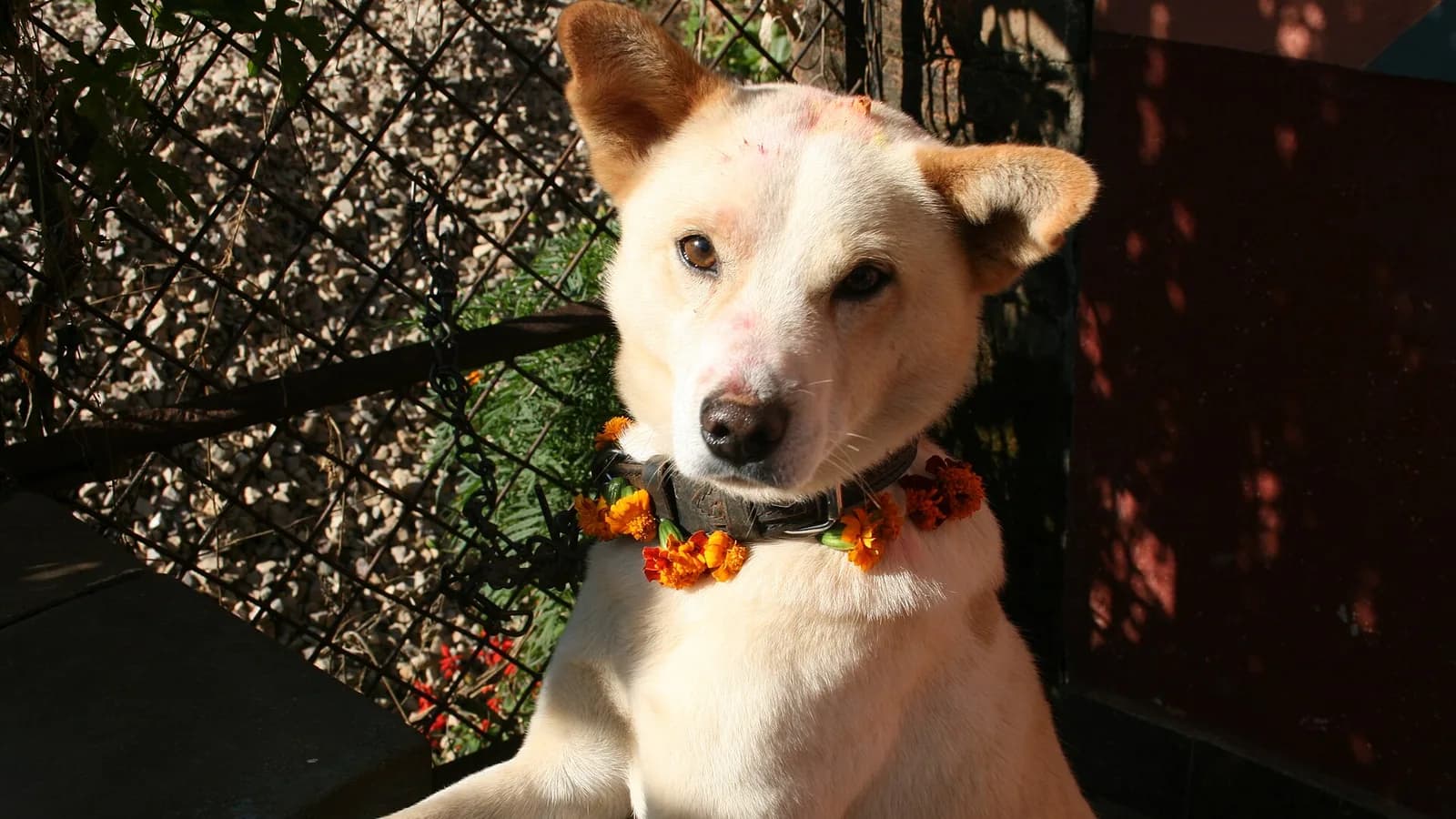
If you have ever seen a photo of a street dog in a marigold garland with a red dot on its forehead, looking faintly bemused, you have met the dog festival of Nepal. Its real name is Kukur Tihar, and far from being a one-off stunt for the camera, it is a genuine national tradition observed across the country every autumn. This is a short guide to what it is and where to catch it. For the full mythology, the rituals, and the calendar in depth, see our complete guide to Kukur Tihar.
Key takeaways
- The "dog festival of Nepal" is Kukur Tihar, the second day of the five-day Tihar festival.
- Every dog — pet, working dog, or stray — gets a tika, a marigold garland, and a good meal.
- The tradition honours dogs as loyal guardians and as messengers of Yama, the god of death.
- It is celebrated nationwide, including by the Nepal Police with their service dogs.
- It falls in October or November; the lunar date shifts yearly, so confirm before travelling.
So what actually is it?
Kukur Tihar is the dogs' day within Tihar, Nepal's festival of lights. On the morning of the festival's second day, dogs are honoured with three things: a red tika on the forehead, a garland of orange marigolds around the neck, and a special meal of meat, milk, eggs, or treats. The animal is, for one day, treated as sacred.
The belief behind it runs deep in Hindu tradition — dogs are seen as faithful guardians and as Yama's companions on the journey after death — and it is reinforced by a famous tale from the Mahabharata in which a dog follows the hero Yudhishthira to the very gates of heaven. We unpack all of that in the main Kukur Tihar guide; here, the point is simpler: the festival is real, it is sincere, and it includes every dog, even the ones nobody owns.
Where to see the dog festival
Because it happens in homes and streets everywhere, you do not need to go anywhere special. But some places make it easy.
| Where | What you'll see | | --- | --- | | Any Kathmandu neighbourhood | Garlanded street dogs and pets dozing in the sun | | Nepal Police Dog Training School | A formal ceremony honouring service dogs, with demonstrations and medals | | Patan and Bhaktapur old towns | Dogs garlanded amid the wider Tihar lights and decorations | | Pokhara Lakeside | A quieter, concentrated version along the main strip |
The single most striking organised event is the Nepal Police ceremony, where the force garlands its working dogs and stages obedience displays — proof that the day's respect reaches from the household pet all the way to the bomb-detection K9. The Nepal Army holds a similar event with its own canine unit. If you want a guaranteed, organised spectacle rather than chance street encounters, these ceremonies are the answer, and they tend to be covered in the local press each year.
Why the dog festival went global
Of all Nepal's festivals, this is the one most likely to have reached you before you ever thought about visiting. Every autumn, images of garlanded Nepali dogs circulate worldwide, shared by animal lovers who are charmed — and often astonished — that an entire country sets aside a holy day for dogs. The festival has been featured by international outlets and adopted as an inspiration by animal-welfare groups well beyond Nepal's borders.
Part of the appeal is how it inverts the usual relationship. In much of the world, street dogs are a problem to be managed. In Nepal on this day, they are deities to be honoured. That single reversal — the lowliest street animal raised, for a day, to the level of a god — is what gives the festival its emotional punch and its viral reach. It is also a genuine window into a worldview in which animals occupy a meaningful place in the religious order, rather than sitting outside it.
The street-dog dimension
The most quietly moving part of the dog festival is what it does for Nepal's street dogs. Kathmandu, like many South Asian cities, has a large population of free-roaming dogs that go largely unnoticed the rest of the year. On Kukur Tihar, residents seek them out — the dog that sleeps outside the shop, the pack near the temple steps — and give them the same tika, garland, and meal as any pet.
For visitors, this is often the day's lasting image: an ordinary, slightly mangy street dog, suddenly resplendent in marigolds, being fed by hand by a stranger. Several Nepali and international animal charities use the occasion to run vaccination and feeding drives, folding modern welfare into the ancient ritual. If the plight of street animals elsewhere has ever bothered you, this day is a balm.
When it happens
Tihar follows the lunar calendar and lands in October or November, about two weeks after Dashain. Kukur Tihar is always the second day, the morning after the crow-worship day of Kaag Tihar and the morning before the great Laxmi Puja evening, when the whole valley fills with oil lamps. Because the date moves each year, confirm it with the Nepal Tourism Board or a Nepali patro (calendar) rather than trusting any fixed date. Our best time to visit Nepal guide explains why this post-monsoon autumn window is also the clearest, most pleasant season to be in the country — and our Nepal weather by month overview covers what to expect on the ground.
Because the dog festival sits inside the larger five-day Tihar, timing a trip to catch it means you also catch the rest: the cows, the self-worship of Mha Puja, and the brother-sister blessings of Bhai Tika. It is an efficient festival to plan around — one well-timed week delivers all of it.
How it differs from Diwali elsewhere
Visitors who know India's Diwali are sometimes surprised that Nepal's festival of lights has a dedicated dog day at all, because there is no direct equivalent across the border. Both festivals fall at the same time of year, both worship the goddess Laxmi, and both light lamps — but Nepal's Tihar structures its five days around the worship of different beings, and the second of those is given entirely to dogs (the first goes to crows, the third to cows). That animal-worship sequence is distinctively Nepali. So while the broader celebration rhymes with Diwali, the dog festival itself is one of the things that makes Tihar unmistakably its own. Our look at Tihar versus Indian Diwali and the wider Tihar guide draw out more of those differences.
Dogs in everyday Nepali life
The festival makes more sense once you notice the place dogs already hold in Nepali life the rest of the year. Guard dogs watch over homes, shops, and farms; community dogs are loosely looked after by whole neighbourhoods; and the dog's role as a protector is woven into religious belief, not just sentiment. Kukur Tihar does not invent a relationship for one day — it formalises and celebrates one that already exists. That continuity is why the day feels sincere rather than staged: people are honouring animals they genuinely live alongside. For broader cultural background, our overview of Nepal's religion explains how Hindu and Buddhist belief shape daily life in ways that include the animal world.
How to enjoy it without intruding
- Pet garlanded street dogs gently — most are calm and used to attention on this day — and wash your hands after.
- Ask before touching a family's pet, which is being worshipped as a deity for the day.
- Keep photography of indoor rituals discreet and ask first; wide street shots of garlanded dogs are welcome. See our festival etiquette notes.
- Say "Subha Tihar" — a few Nepali phrases make every encounter warmer.
That is the short version. For the deeper story — the two dogs of Yama, the Mahabharata, Bhairava's hound, and a day-by-day breakdown of the whole festival — head to our full guide to Kukur Tihar.
Sources
Frequently asked questions
- What is the dog festival of Nepal called?
- It is called Kukur Tihar, which means dog festival, and it is the second day of the larger five-day Tihar festival of lights.
- Why does Nepal have a festival for dogs?
- Hindu tradition treats dogs as messengers of Yama, the god of death, and as loyal guardians, so a full day is set aside each year to thank them.
- Is the dog festival real or a social media exaggeration?
- It is entirely real; the viral photos of garlanded, tika-marked dogs are ordinary scenes across Nepal on the second day of Tihar.
- Where can tourists see the dog festival?
- Anywhere in Nepal, since it happens in homes and streets nationwide, though Kathmandu's neighbourhoods and the Nepal Police canine ceremony are the most visible spots.
- Do stray dogs take part in the dog festival?
- Yes, and that is the most touching part; street dogs are sought out, garlanded, and fed alongside pets and working dogs.
Related posts
Kukur Tihar: Nepal's Dog Festival, Explained (2026)
Kukur Tihar is Nepal's dog festival — the day every dog gets a tika, a marigold garland, and a feast. What it means, when it falls, and why.
Read postTihar — Nepal's Festival of Lights (and Dogs, Crows, Cows)
Five days of oil lamps, marigold garlands, and the strangest part — animal worship days. The most photogenic festival in Nepal, explained.
Read postDeepawali in Nepal — How Tihar Differs From Indian Diwali
Deepawali in Nepal is celebrated as Tihar, a five-day festival of lights. How it compares to Indian Diwali, from animal worship to Deusi-Bhailo singing.
Read post