Kukur Tihar: Nepal's Dog Festival, Explained (2026)
Kukur Tihar is Nepal's dog festival — the day every dog gets a tika, a marigold garland, and a feast. What it means, when it falls, and why.
For one day a year, every dog in Nepal — pet, police K9, or street stray — is honoured as a god.
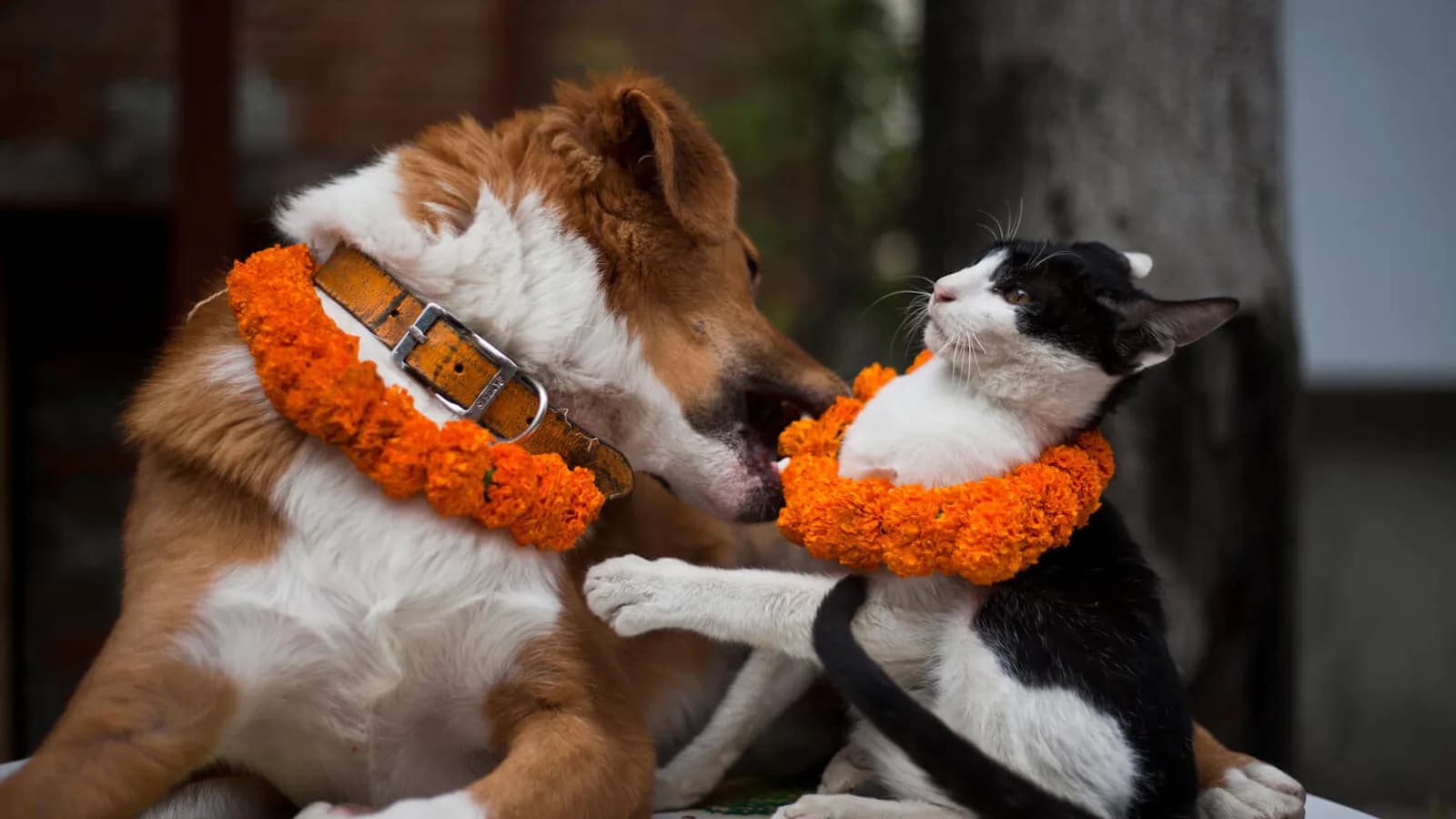
Kukur Tihar is the day Nepal stops to thank its dogs. On the second day of the five-day Tihar festival, households across the country mark a red tika on the forehead of every dog they can reach — the family pet, the neighbour's guard dog, even the scruffy stray that sleeps in the lane — drape a marigold garland around its neck, and set down a plate of good food. For one day, the dog is not an animal but a deity. It is one of the most photographed, most internationally beloved traditions in the entire Hindu world, and once you understand the belief behind it, it is hard not to be moved.
This guide explains what Kukur Tihar actually means, where it sits in the Tihar calendar, the mythology that gives the dog its sacred status, and how to witness the day respectfully if your trip to Nepal happens to coincide with it.
Key takeaways
- Kukur Tihar is the second day of the five-day Tihar festival, also called the Festival of Lights.
- Every dog — pet, working dog, or street stray — receives a red tika, a marigold garland, and a special meal.
- Dogs are honoured because Hindu tradition treats them as messengers of Yama, the god of death, and as loyal guardians.
- The belief is reinforced by the Mahabharata, in which a dog accompanies Yudhishthira to the gates of heaven.
- The festival is celebrated nationwide, from family homes to the Nepal Police and Nepal Army canine units.
- Tihar shifts each year on the lunar calendar, usually landing in October or November — always confirm the date.
What Kukur Tihar is
The name is plain: kukur means "dog" and tihar is the festival. Kukur Tihar is therefore, quite literally, the dogs' day. It is the second of Tihar's five days, each of which honours a different being — crows, dogs, cows, the self, and finally the bond between brothers and sisters.
On this one morning, the relationship between humans and dogs is formally celebrated. The dog is thanked for its loyalty, its watchfulness, and its companionship, and is treated for a day with the reverence usually reserved for the gods. Crucially, this is not limited to pampered pets. Street dogs, which receive little attention the rest of the year, are sought out, garlanded, and fed. So are the country's working dogs. That universality — the idea that every dog deserves honour — is what gives the day its emotional weight.
Where it falls in the five days of Tihar
Tihar is a sequence, and Kukur Tihar makes most sense in context. Here is the full arc.
| Day | Name | Honours | | --- | --- | --- | | 1 | Kaag Tihar | Crows, the messengers of Yama | | 2 | Kukur Tihar | Dogs, for loyalty and protection | | 3 | Laxmi Puja (Gai Tihar) | Cows in the morning, the goddess Laxmi at night | | 4 | Govardhan Puja / Mha Puja | Oxen, or the self (Newar tradition) | | 5 | Bhai Tika | The bond between brothers and sisters |
So Kukur Tihar sits between the crow day and the great Laxmi Puja evening, when the whole Kathmandu Valley fills with oil lamps. For the full sweep of the festival and the best places to experience each night, see our Tihar Festival of Lights guide.
The three rituals: tika, garland, and feast
What you actually see on Kukur Tihar comes down to three simple, repeated acts performed on dog after dog.
The tika
A red tika is pressed onto the dog's forehead, between the eyes. It is usually made from vermilion or coloured powder mixed with rice and yoghurt. The mark is the same blessing humans receive during the festival — a symbol of honour, sanctity, and protection. On a dog, it transforms an ordinary animal into a sacred one for the day.
The garland
A garland of marigolds — the bright orange sayapatri flowers that flood the markets in the run-up to Tihar — is looped around the dog's neck. Marigolds are the signature flower of the entire festival, strung into the garlands that hang from doorways, temples, and now, every willing dog.
The feast
Finally, the dog is offered a generous meal. This can be anything good: meat, milk, eggs, commercial dog food, and often traditional Nepali treats such as sel roti, the festival's ring-shaped rice bread. The point is abundance — the dog should be indulged.
Performed across an entire country, the cumulative effect is extraordinary. Walk through Kathmandu on Kukur Tihar and you will pass dog after dog with an orange garland and a red dot, dozing contentedly in the sun.
Why dogs? The mythology behind the day
The reverence is not sentimental invention; it is rooted in Hindu scripture and belief. Three threads come together.
Dogs as the messengers of Yama
In Hindu tradition, the dog is closely tied to Yama, the god of death. Yama is said to keep two dogs — Shyama and Sharvara — who guard the gates of his realm. Because the dog is believed to accompany a soul on its final journey, honouring dogs is a way of honouring Yama himself, and of approaching death without fear. This same logic explains why the day before, Kaag Tihar, honours crows: they too are seen as Yama's messengers.
The dog of the Mahabharata
The most beloved story comes from the epic Mahabharata. As the Pandava king Yudhishthira makes his final journey toward heaven, his companions fall away one by one until only a single dog remains at his side. At the gates, the god Indra welcomes Yudhishthira but tells him the dog cannot enter. Yudhishthira refuses — he will not abandon a loyal creature that has stayed with him to the end, even for paradise. At that moment the dog reveals itself to be Yama (or, in some tellings, the god Dharma in disguise), and Yudhishthira's loyalty wins him entry to heaven. The tale enshrines the dog as a symbol of faithfulness and righteousness.
The companion of Bhairava
Dogs are also linked to Bhairava, the fierce form of Shiva, who is depicted with a dog as his attendant or vahana (vehicle). This association with one of the most powerful deities in the Kathmandu Valley further cements the dog's sacred standing. You will encounter Bhairava again at Kathmandu Durbar Square, in the towering Kal Bhairav statue that anchors the old royal square.
Taken together, these beliefs frame the dog not as a mere pet but as a guardian that stands at the threshold between life and death — which is why a day is set aside to thank it.
Kukur Tihar beyond the home: police and army dogs
One of the most public expressions of Kukur Tihar happens not in homes but in uniform. The Nepal Police hold a formal ceremony at their Central Police Dog Training School, where handlers garland and apply tika to the force's service dogs, feed them special meals, and stage obedience and agility demonstrations. The best-performing dogs are awarded medals and prizes. The Nepal Army marks the day with its own canine units in much the same way.
These ceremonies have become a reliable highlight in Nepali and international media each year — images of working German Shepherds and Belgian Malinois sitting patiently under marigold garlands, honoured for a service they perform all year round. It is a reminder that the festival's respect extends to every category of dog, from the household pet to the bomb-detection K9.
When is Kukur Tihar?
Like all major Nepali festivals, Tihar follows the lunar calendar, so its Western date shifts every year. It generally falls in October or November, roughly two weeks after Dashain, Nepal's biggest festival. Kukur Tihar is always the festival's second day.
| Year | Tihar (approximate) | | --- | --- | | 2024 | Late Oct – early Nov | | 2025 | Around 20–24 October | | 2026 | Late October – early November (projected) |
Because the lunar date can drift, do not lock travel plans to any fixed future date — including ours. Confirm the year's Tihar dates with the Nepal Tourism Board or a reliable Nepali patro (calendar) before booking. Our guide to the best time to visit Nepal explains why the post-monsoon autumn window, when Tihar falls, is also the country's finest travel season.
How to experience Kukur Tihar respectfully
Kukur Tihar is a joy to witness, and as a visitor you are welcome to share in it — with a little care.
- Admire street dogs gently. Most garlanded strays are relaxed and used to attention on this day. A gentle pat is fine, but do not crowd or startle a dog, and wash your hands afterward.
- Ask before touching a pet. A family's dog is being worshipped; treat it as you would a shrine. A smile and a gesture toward the dog will usually earn a nod.
- Photograph the dogs, not into people's homes. Wide shots of garlanded dogs in the street are lovely and welcome. Be discreet around family rituals indoors, and ask first. Our temple and festival etiquette guide covers the general principles.
- Do not feed dogs anything harmful. If you want to treat a street dog, plain cooked food is safer than sweets or spiced human snacks.
- Bring a few words. "Subha Tihar" (Happy Tihar) goes a long way. A handful of basic Nepali phrases will warm any interaction during the festival.
Why Kukur Tihar resonates with visitors
There are flashier festivals in Nepal, but few land as directly in the heart as this one. The sight of an entire nation pausing to garland its dogs — including the overlooked strays — collapses the distance between the sacred and the everyday. It says something about a culture's values that it sets aside a holy day not for a king or a hero but for the most ordinary, faithful animal in the street.
If your trip touches late October or November, build a morning around it. You do not need a ticket, a guide, or a special location. Just walk through any Nepali neighbourhood and look down: a red dot, a ring of orange marigolds, and a contented dog in the sun. For the wider festival that surrounds it — the oil lamps, the cows, the brother-sister blessings — read on in our full Tihar guide, and for a complementary short take, see our piece on the dog festival of Nepal.
Sources
- Kukur Tihar — Wikipedia
- Kukur Tihar: Nepal's Festival Honoring Dogs — Nepal Tourism Board
- Kukur Tihar: Nepal's celebration of loyalty and love for dogs — Nepal News
- Nepal Police celebrates Kukur Tihar with service dogs — Khabarhub
- In Nepal, all good dogs are worshipped — NBC News
- Tihar (festival) — Wikipedia
Frequently asked questions
- What is Kukur Tihar?
- Kukur Tihar is the second day of Nepal's five-day Tihar festival, on which dogs are honoured with a forehead tika, a marigold garland, and a special meal to thank them for their loyalty and protection.
- Which day of Tihar is Kukur Tihar?
- It is the second day of the five-day festival, falling the day after Kaag Tihar, the crow-worship day, and the day before the main Laxmi Puja evening.
- Why do Nepalis worship dogs on this day?
- In Hindu belief dogs are messengers of Yama, the god of death, and loyal guardians, so honouring them is a way to thank Yama and to recognise the dog's faithfulness to humans.
- Are street dogs included in Kukur Tihar?
- Yes. Stray and street dogs are garlanded and fed alongside household pets, which is one of the most moving parts of the day for visitors who see it.
- When is Kukur Tihar in 2026?
- Tihar is projected to fall in late October or early November 2026, so Kukur Tihar would land on the festival's second day; always confirm the exact lunar date before you travel.
- Can tourists join Kukur Tihar?
- Yes, respectfully. You can gently pet and admire garlanded dogs in the street, but ask before touching a pet at someone's home and never disturb a dog that is being worshipped.
Related posts
The Dog Festival of Nepal: A Short Visitor's Guide
The dog festival of Nepal, Kukur Tihar, is the viral day when every dog gets a garland and a tika. A quick guide to what it is and where to see it.
Read postTihar — Nepal's Festival of Lights (and Dogs, Crows, Cows)
Five days of oil lamps, marigold garlands, and the strangest part — animal worship days. The most photogenic festival in Nepal, explained.
Read postDeepawali in Nepal — How Tihar Differs From Indian Diwali
Deepawali in Nepal is celebrated as Tihar, a five-day festival of lights. How it compares to Indian Diwali, from animal worship to Deusi-Bhailo singing.
Read post