Where Is Nepal? Location, Neighbours and Map Explained
Where is Nepal? A clear guide to Nepal's location in South Asia, its borders with India and China, coordinates, and how to find it on a map.
Nepal is a thin rectangle wedged between India and Tibet — small on the map, but it holds most of the planet's tallest mountains.
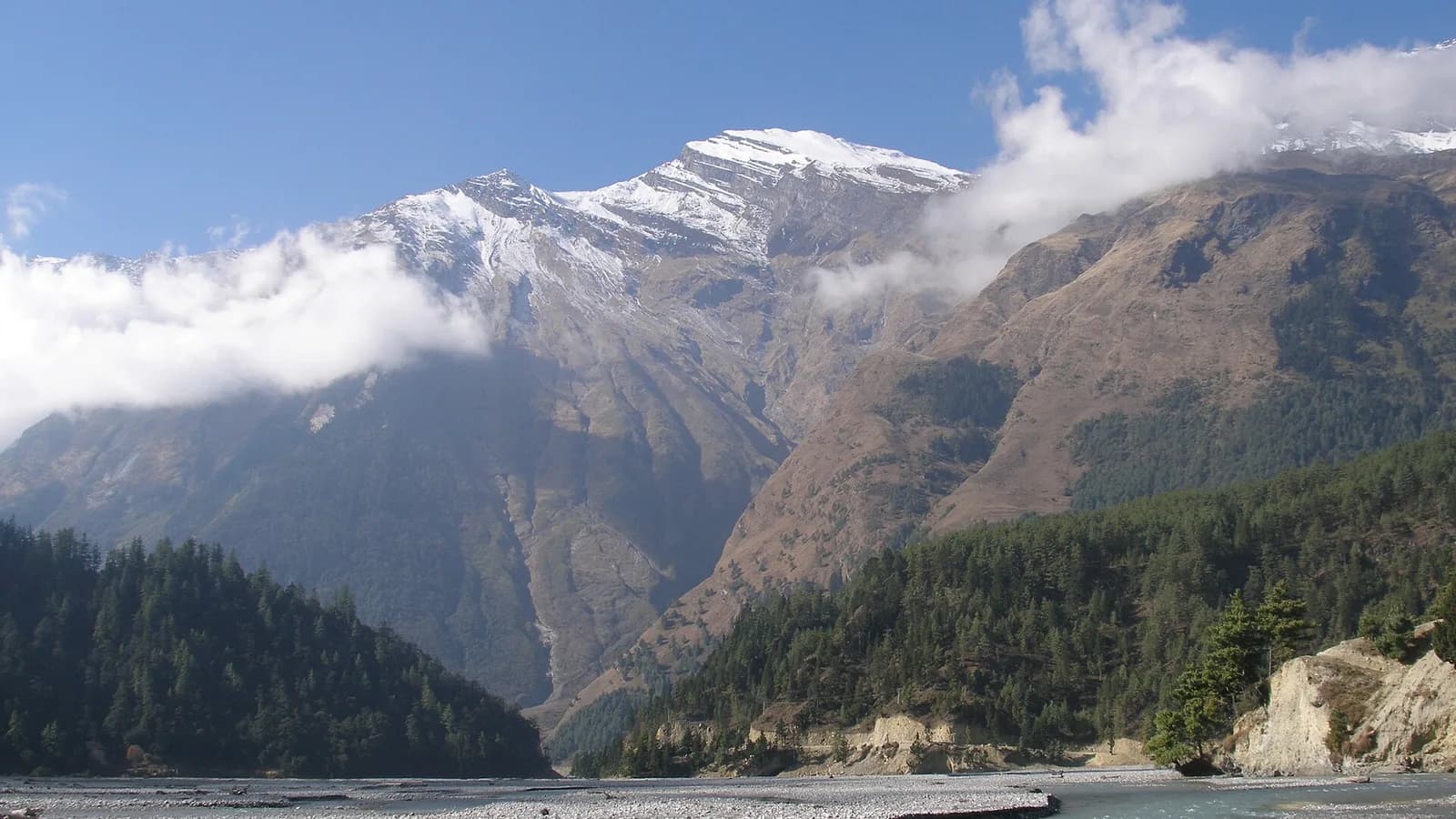
If you are wondering where Nepal is, the short answer is that it sits in South Asia, locked between two giants: India to the south and the Tibet Autonomous Region of China to the north. Nepal is a long, narrow country draped across the central Himalayas, which is why a place so modest in size holds eight of the world's ten highest mountains, including Mount Everest. This guide pins down exactly where Nepal lies, which countries it touches, how to find it on a map, and why its position has shaped its entire history.
Key takeaways
- Nepal is a landlocked country in South Asia, between latitudes 26°N and 31°N and longitudes 80°E and 89°E.
- It borders only two countries: China (Tibet) to the north and India to the south, east and west.
- Nepal has no coastline; the nearest sea is the Bay of Bengal, reached through India.
- The country is roughly 800 km long and 200 km wide, running along the spine of the Himalayas.
- Its capital and largest city is Kathmandu, set in a valley in the central hills.
- Nepal is a fully independent country, never part of India or China and never colonised.
Nepal's location in South Asia
Nepal lies in the northern part of South Asia, the region that also contains India, Pakistan, Bangladesh, Sri Lanka, Bhutan and the Maldives. On a world map, look for the great wall of the Himalayas separating the Indian subcontinent from the Tibetan Plateau — Nepal occupies a long stretch of that frontier.
The country sits between roughly 26° and 31° North latitude and 80° and 89° East longitude. That places it at about the same latitude as Florida or Egypt, which surprises people who expect a Himalayan nation to be cold year-round. In fact, Nepal's southern plains are hot and subtropical; the famous cold belongs to the high mountains in the north. If you are planning a trip, our guide to the best time to visit Nepal explains how that range of climates plays out month by month.
A buffer between two powers
For most of its history, Nepal's position has defined its politics. Squeezed between Imperial (and later British) India and the Chinese empire in Tibet, Nepal survived as a buffer state — independent, but always conscious of its two enormous neighbours. That balancing act continues today, and it is one reason Nepal is so distinct culturally from both India and China despite borrowing from each.
Which countries border Nepal?
Nepal touches just two countries, but the way it touches them is unusual.
| Neighbour | Direction | Nature of the border | |---|---|---| | China (Tibet Autonomous Region) | North | High Himalayan crest; few, high-altitude crossings | | India | South, east and west | Long, mostly open border across plains and hills |
To the north, the border with China runs along the highest part of the Himalayas. The frontier literally passes over the summit of Mount Everest, which Nepal and China share. Crossings here are few, high, and often remote.
To the south, east and west, India wraps around Nepal on three sides. This border is largely open: citizens of both countries can cross freely without visas, and the frontier cuts through farmland and towns rather than mountains. That openness is exactly why travellers so often ask whether Nepal is in India — the two are deeply intertwined, yet remain separate sovereign states.
Notably, Nepal does not share a border with Bhutan or Bangladesh, even though they are close. A thin strip of Indian territory, the Siliguri Corridor, separates Nepal from both.
How to find Nepal on a map
If you are scanning a world map, here is the quickest way to locate Nepal:
- Find India — the large, diamond-shaped country in South Asia.
- Look at India's northern edge, where it meets the Himalayas.
- Nepal is the long, rectangular country tucked into that northern border, roughly in the centre, north of the Indian cities of Lucknow and Patna.
- Directly north of Nepal lies the Tibetan Plateau (China).
On a globe, Nepal sits in the Northern and Eastern hemispheres. Its rough centre point is near 28°N, 84°E. The capital, Kathmandu, lies at about 27.7°N, 85.3°E.
Nepal's shape and dimensions
Nepal is often described as roughly rectangular, stretched east to west. It runs about 800 kilometres (500 miles) long and around 200 kilometres (120 miles) wide, though the width varies. That compact footprint packs in an astonishing range of terrain — from near sea-level jungle to the roof of the world. For the full breakdown of how much ground that covers, see our companion piece on Nepal's area and size.
The three belts: from jungle to the roof of the world
One reason Nepal's location is so remarkable is that the land rises dramatically as you travel north. Geographers split the country into three parallel belts running east to west.
1. The Terai (southern plains)
Along the Indian border lies the Terai, a flat, fertile strip that is part of the Gangetic plain. It is low (dropping to around 60 metres above sea level), hot, and home to much of Nepal's farmland, population and wildlife. The national parks here shelter rhinos and tigers — a world away from the snow peaks. Our overview of Nepal's national parks covers this subtropical south.
2. The Hills (middle belt)
North of the Terai, the land buckles into the Hill region, a band of ridges and valleys between roughly 700 and 4,000 metres. This is the cultural heartland of Nepal, and it holds the Kathmandu Valley and the lakeside city of Pokhara. The climate here is temperate and pleasant, which is why most of Nepal's famous towns and temples sit in this zone.
3. The Mountains (northern Himalayas)
Finally comes the Mountain belt, the high Himalayas along the Chinese border. This is where Nepal earns its reputation: eight of the ten tallest mountains on Earth stand here, crowned by Mount Everest at 8,848.86 metres. If the sheer scale of that figure interests you, we break it down in our guide to Mount Everest's height.
Nepal's place in the wider region
It helps to fix Nepal against the places around it. Here is how it relates to its South Asian neighbours.
| Place | Direction from Nepal | Relationship | |---|---|---| | India | South, east, west | Shares Nepal's longest, open border | | Tibet / China | North | High-Himalaya border along the crest | | Bhutan | East (not touching) | Separated by India's Siliguri Corridor | | Bangladesh | Southeast (not touching) | Separated by a thin strip of India | | Kathmandu | — | Capital, central hills, ~27.7°N, 85.3°E |
The key surprise for many people is that Nepal and Bhutan do not share a border, despite both being small Himalayan kingdoms-turned-states often mentioned together. The same goes for Bangladesh. India's narrow Siliguri Corridor — sometimes called the "Chicken's Neck" — slips between them. If you are weighing those two Himalayan options, our Nepal vs Bhutan comparison covers the differences.
Nepal's nearest major seaport is Kolkata (Calcutta) in eastern India, on the Bay of Bengal. Because Nepal is landlocked, most of its sea-borne trade has historically routed through there — a reminder of how much its geography ties it to India in practice, even as it remains fully independent.
Time zone and a few orienting details
A small but memorable quirk of Nepal's location: it runs on Nepal Standard Time, UTC+5:45. That oddball 45-minute offset — fifteen minutes ahead of India — is one of only a handful like it on Earth, and it is set deliberately to keep Nepal on its own clock. The reference meridian runs near Gauri Shankar, a Himalayan peak. It is the kind of detail that captures Nepal neatly: defined by its mountains, and quietly insistent on standing apart from its larger neighbour.
Why Nepal's location matters for travellers
Nepal's position does more than fill in a quiz answer — it shapes how you experience the country.
- It is landlocked, so almost every international visitor arrives by air into Kathmandu, or overland from India.
- The altitude range is extreme. You can be sweating in the jungle and shivering on a glacier in the same week, so packing for Nepal means packing for several climates at once.
- The open Indian border makes combined Nepal-and-India trips easy, and the two destinations are natural rivals for a traveller's time. We compare them directly in Nepal vs India travel.
- Its Himalayan setting is the whole draw. The same mountains that isolate Nepal are what people fly across the planet to see.
So, where is Nepal? It is a slender Himalayan country in South Asia, held between India and Tibet, with no sea of its own but more high mountains than almost anywhere on Earth. Small on the map, enormous in elevation — that contrast is the first thing to understand about the place, and the reason it has fascinated travellers for as long as the borders have existed.
Sources
Frequently asked questions
- Where is Nepal located?
- Nepal is a landlocked country in South Asia, sitting along the central Himalayas between India and the Tibet Autonomous Region of China. It lies roughly between 26 and 31 degrees north and 80 and 89 degrees east.
- Which countries border Nepal?
- Nepal borders just two countries. China (the Tibet Autonomous Region) lies to the north along the high Himalayas, while India wraps around Nepal to the south, east and west.
- Is Nepal part of India or China?
- Neither. Nepal is a fully independent sovereign country and has never been part of India or China. It was never colonised and has its own government, currency and flag.
- Is Nepal in India?
- No. Nepal is a separate country that shares a long open border with India, which is why the two are often confused. You still cross an international frontier to travel between them.
- Does Nepal have a coastline?
- No. Nepal is landlocked, with no sea access. The nearest ocean is the Bay of Bengal, and the closest major port for Nepali trade is Kolkata in India.
- What continent is Nepal in?
- Nepal is in Asia, specifically the region known as South Asia. It is grouped with neighbours such as India, Bangladesh, Pakistan, Sri Lanka and Bhutan.
- What is the capital of Nepal?
- Kathmandu is the capital of Nepal and also its largest city. It sits in a bowl-shaped valley in the central hills, at roughly 1,400 metres above sea level.
Spotted an error in this post? Tell us or suggest a correction.
Related posts
ABC Trek: A Plain-English Guide to Annapurna Base Camp
The ABC trek (Annapurna Base Camp) explained — the route, how many days it takes, difficulty, the best seasons, and what daily trail life is really like.
Read postAma Dablam Climb: 2026 Expedition Guide (6,812m)
An Ama Dablam climb and expedition guide for 2026 — height, the Southwest Ridge route, camps, fixed ropes, difficulty, permits, cost and the best seasons.
Read postAnnapurna vs Manaslu: Which Trek Should You Choose?
An Annapurna vs Manaslu decision guide for trekkers — compare permits, crowds, difficulty, infrastructure and cost to pick the right Himalayan route.
Read postAsan Bazaar Kathmandu: Old Town Market Guide
A visitor guide to Asan bazaar, Kathmandu's oldest market — its six-road square, Annapurna Temple, what to buy, when to go, and how to get there.
Read postAyurveda Nepal: A Traveller's Guide to Healing
Ayurveda Nepal explained for tourists — the history, the doshas, treatments like Panchakarma and Shirodhara, where to go and how to choose a centre safely.
Read postBest Restaurants Pokhara Lakeside: Where to Eat
The best restaurants in Pokhara Lakeside — lakeside trout, wood-fired pizza, Tibetan momos and healthy cafes, with what to order and rough 2026 prices.
Read post