How Big Is Nepal? Nepal's Area and Size Explained
How big is Nepal? Nepal's area is about 147,516 sq km. See size comparisons, dimensions, and how a small country fits the world's tallest mountains.
Nepal is about the size of the US state of Iowa — yet it stacks the planet's eight tallest mountains into that space.
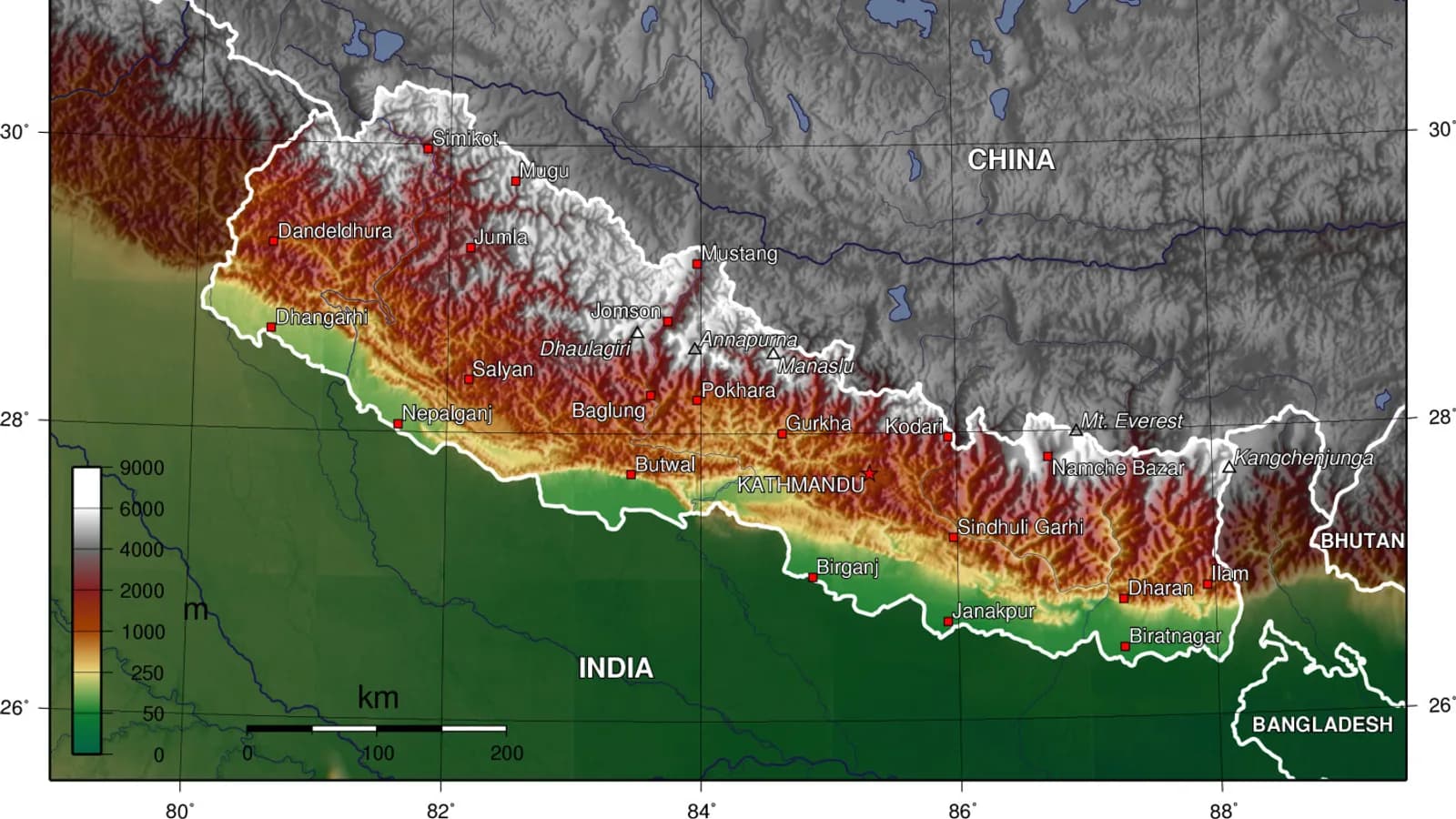
People are often surprised by how big Nepal is — or rather, how small. Nepal's area is about 147,516 square kilometres (roughly 56,956 square miles), which makes it a modest country, comparable to Bangladesh or the US state of Iowa. Yet packed into that compact rectangle are eight of the ten highest mountains on Earth. This guide gives you Nepal's size in plain numbers, useful comparisons, and the reason you will sometimes see two slightly different area figures quoted.
Key takeaways
- Nepal's total area is about 147,516 sq km (≈ 56,956 sq mi); an older figure of 147,181 sq km is also common.
- That ranks Nepal roughly 93rd–95th in the world by area — small, but not tiny.
- Nepal is similar in size to Bangladesh, Tajikistan, or the US state of Iowa.
- The country stretches about 800 km east–west and 200 km north–south.
- It is only about 1.5% the size of the USA and around 4–5% the size of India.
- Despite its size, Nepal contains eight of the world's ten tallest mountains.
Nepal's total area in numbers
The figure you will see most often today is 147,516 square kilometres, equal to about 56,956 square miles. For a sense of scale, that is land you could drive across, west to east, in a long day on a good road — except Nepal does not have a fast road running its full length, because the terrain refuses to cooperate.
A few ways to hold the number in your head:
- About 147,500 sq km, or roughly the area of a square 384 km on each side.
- Around 0.1% of the planet's total land area.
- Home to roughly 29–30 million people (per the 2021 census), which we cover in our guide to Nepal's population.
Why two different figures?
If you dig around, you will find Nepal's area quoted as both 147,181 sq km and 147,516 sq km. Both are "correct" in context:
- 147,181 sq km is the long-established figure used for decades in encyclopaedias and official summaries.
- 147,516 sq km reflects Nepal's 2020 revised political map, which incorporated the disputed Kalapani–Limpiyadhura area in the far northwest. The larger number includes that claimed territory.
The difference — about 335 sq km — is small, and for everyday purposes either figure tells the same story: Nepal is a compact country. When precision matters, 147,516 sq km is the current government-aligned figure.
How big is Nepal compared to other places?
Raw square kilometres are hard to picture, so comparisons help.
Versus its neighbours
| Country | Approx. area (sq km) | Nepal's size relative to it | |---|---|---| | China | 9,600,000 | ~1.5% | | India | 3,287,000 | ~4.5% | | Bangladesh | 148,000 | ~99% (almost identical) | | Bhutan | 38,400 | Nepal is ~3.8× bigger | | Sri Lanka | 65,600 | Nepal is ~2.2× bigger |
The headline is that Nepal is dwarfed by its two neighbours, India and China, yet it is comfortably larger than several other South Asian states. It is almost exactly the same size as Bangladesh, though Bangladesh holds more than five times as many people. If you are weighing a regional trip, our comparisons of Nepal vs India and Nepal vs Bhutan put these neighbours side by side.
Versus US states and other countries
For readers who think in American terms, Nepal is roughly the size of Iowa or Arkansas, and a little larger than New York State. Set against the whole United States, Nepal is only about 1.5% of its area. In European terms, Nepal is bigger than Greece and close to Bangladesh or Tajikistan. By global ranking it lands around 94th out of the world's countries — firmly in the small-to-middle band.
The dimensions: long, narrow and steep
Nepal is shaped like a stretched rectangle, much longer than it is wide.
- Length (east–west): about 800 kilometres (500 miles).
- Width (north–south): about 200 kilometres (120 miles), and narrower in places.
What makes those dimensions extraordinary is the vertical axis. In that ~200 km of width, the land climbs from the Terai plains — as low as about 60 metres above sea level near the Indian border — to the summit of Mount Everest at 8,848.86 metres. Few places on Earth gain so much altitude over so little horizontal distance. We unpack that figure in our guide to Mount Everest's height, and the broader setting in where Nepal is located.
Area split across three belts
Nepal's land area is shared unevenly between its three geographic regions, running parallel from south to north:
| Belt | Character | Share of land (approx.) | |---|---|---| | Terai (plains) | Flat, fertile, subtropical | ~17% | | Hills (middle) | Ridges and valleys, temperate | ~68% | | Mountains (high Himalaya) | Snow, ice, sparse settlement | ~15% |
So the hills make up the bulk of Nepal's territory, even though the mountains get all the attention and the Terai holds much of the farmland and wildlife. The high mountain belt, despite its fame, is a relatively thin sliver of the total area. The contrast in how that land is used shows up vividly in our roundup of the best places to visit in Nepal.
Where Nepal ranks in the world
By area, Nepal sits around 94th out of the world's roughly 195 countries — squarely in the small-to-middle band. To make that ranking tangible, here is where it falls among a familiar set of countries.
| Country | Approx. area (sq km) | Bigger or smaller than Nepal? | |---|---|---| | Bangladesh | 148,000 | Marginally bigger | | Nepal | 147,516 | — | | Greece | 132,000 | Smaller | | England | 130,000 | Smaller | | North Korea | 120,500 | Smaller | | Iceland | 103,000 | Smaller |
So Nepal is a touch larger than Greece or England, and noticeably bigger than countries we think of as mid-sized. It is "small" only when measured against the continental giants next door. Within Asia specifically, Nepal ranks around the middle of the pack — far behind India and China, but ahead of most island and Gulf states.
Land and water
Nearly all of Nepal's area is land. Unlike countries dominated by lakes or coastline, Nepal is landlocked and overwhelmingly solid ground, with only a small fraction given over to rivers and lakes. Its rivers, though — fed by Himalayan snowmelt — are powerful and numerous, carving the deep valleys that make overland travel so slow. Famous lakes such as Phewa in Pokhara and Rara in the far west are scenic highlights rather than significant contributors to the total area. You can see how these waters shape a trip in our guide to things to do in Pokhara.
Because there is no coast, the entire 147,516 sq km is interior territory. That single fact — no sea — colours everything about Nepal's size: there are no beaches to expand the map, no maritime zone, just a dense, vertical block of mountains, hills and plains.
Nepal's size in everyday terms
To bring the number fully down to earth:
- Driving Nepal's roughly 800 km length in a straight line would be comparable to driving from London to the south of France — except no straight road exists, so it takes far longer.
- The whole country would fit inside the US state of Iowa with room to spare, yet Iowa is famously flat and Nepal famously is not.
- Nepal's 147,516 sq km holds about 29–30 million people, giving a density (covered in our Nepal population guide) far higher in the plains than in the empty high mountains.
Why a small country feels so vast
Travellers routinely underestimate how long it takes to get around Nepal. On paper the distances are short; in reality, the terrain stretches them. A journey that looks like 200 km on a map can take a full day, because roads switchback up and down ridges rather than running straight.
This is the paradox of Nepal's size. By area, it is a small country you could fit into a mid-sized US state. By experience, it feels enormous, because every kilometre is folded, climbed and dropped. That is also why an itinerary here fills up fast — see how we budget the time in our two-week Nepal itinerary.
So, how big is Nepal? About 147,516 square kilometres — a compact, Iowa-sized country that happens to contain the tallest terrain on the planet. Modest on the map, immense underfoot.
Sources
Frequently asked questions
- How big is Nepal?
- Nepal covers about 147,516 square kilometres (around 56,956 square miles). It is a fairly small country by global standards, ranking roughly 93rd to 95th in the world by land area.
- What is the total area of Nepal?
- Nepal's total area is most often given as 147,516 square kilometres. An older, widely quoted figure of 147,181 square kilometres is also still seen in many references.
- Is Nepal a small or large country?
- Nepal is a small-to-medium country. It is far smaller than India or China, similar in size to Bangladesh or the US state of Iowa, but bigger than countries like Greece or Bhutan.
- How does Nepal compare in size to a US state?
- Nepal is close in area to Iowa or Arkansas, and a little larger than New York State. It is roughly 1.5 percent of the total area of the United States.
- How long and wide is Nepal?
- Nepal is roughly 800 kilometres long from east to west and about 200 kilometres wide from north to south, though the width varies along its length.
- Why are there two different area figures for Nepal?
- The older figure of 147,181 sq km predates a 2020 map update. Nepal's revised political map added disputed northwestern territory, and the larger 147,516 sq km figure reflects that claim.
- How big is Nepal compared to India?
- Nepal is tiny next to India. India covers over 3.2 million square kilometres, so Nepal is only about 4 to 5 percent of India's size despite sharing a long border.
Spotted an error in this post? Tell us or suggest a correction.
Related posts
ABC Trek: A Plain-English Guide to Annapurna Base Camp
The ABC trek (Annapurna Base Camp) explained — the route, how many days it takes, difficulty, the best seasons, and what daily trail life is really like.
Read postAma Dablam Climb: 2026 Expedition Guide (6,812m)
An Ama Dablam climb and expedition guide for 2026 — height, the Southwest Ridge route, camps, fixed ropes, difficulty, permits, cost and the best seasons.
Read postAnnapurna vs Manaslu: Which Trek Should You Choose?
An Annapurna vs Manaslu decision guide for trekkers — compare permits, crowds, difficulty, infrastructure and cost to pick the right Himalayan route.
Read postAsan Bazaar Kathmandu: Old Town Market Guide
A visitor guide to Asan bazaar, Kathmandu's oldest market — its six-road square, Annapurna Temple, what to buy, when to go, and how to get there.
Read postAyurveda Nepal: A Traveller's Guide to Healing
Ayurveda Nepal explained for tourists — the history, the doshas, treatments like Panchakarma and Shirodhara, where to go and how to choose a centre safely.
Read postBest Restaurants Pokhara Lakeside: Where to Eat
The best restaurants in Pokhara Lakeside — lakeside trout, wood-fired pizza, Tibetan momos and healthy cafes, with what to order and rough 2026 prices.
Read post