Nepal Monarchy: History of the Shah Dynasty to 2008
A clear, sourced history of the Nepal monarchy — from the Shah dynasty and unification under Prithvi Narayan Shah to the abolition of the monarchy in 2008.
For 240 years a single royal line sat at the centre of Nepal's story — until, in 2008, the country quietly closed the book on kingship.
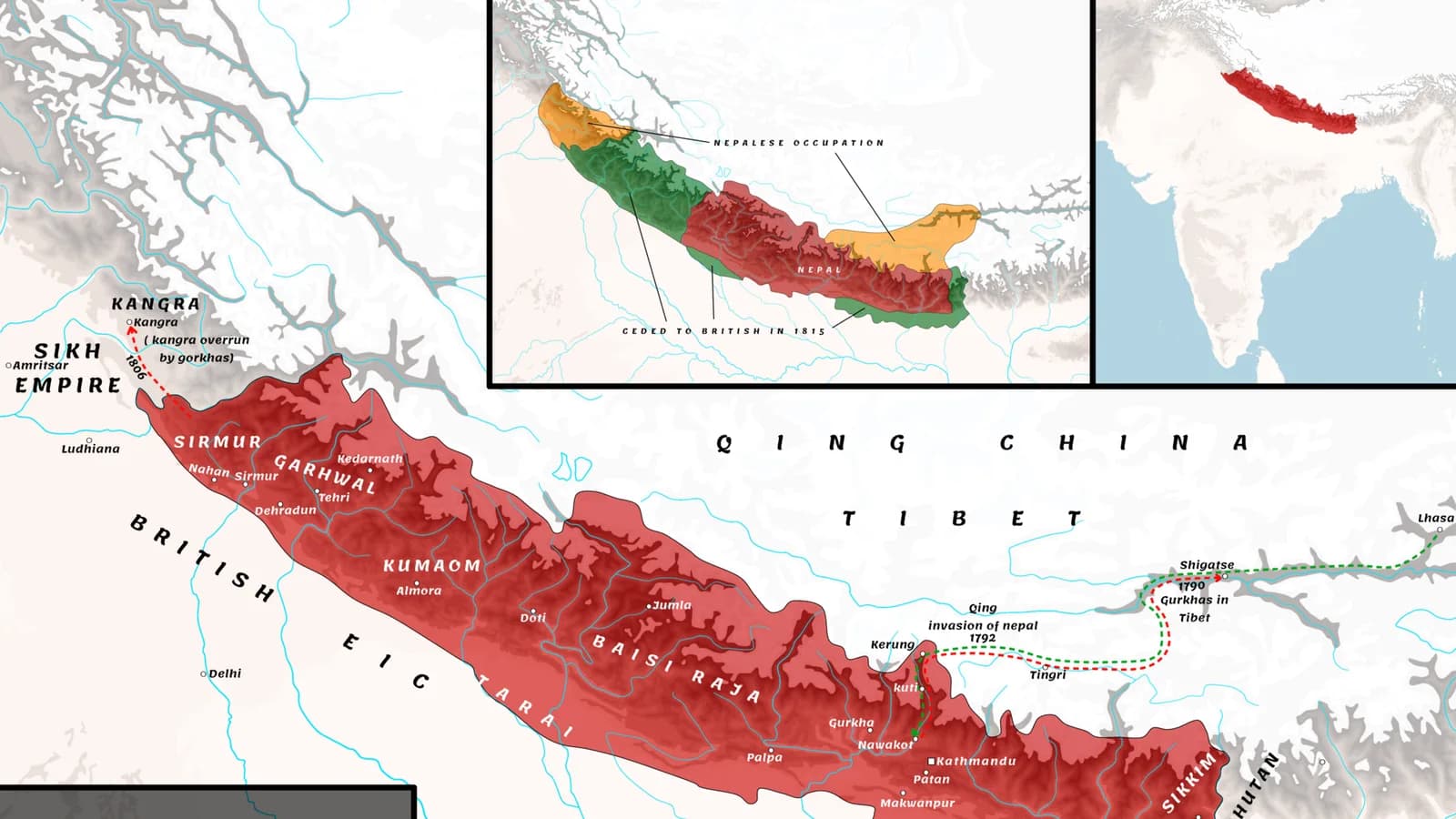
The Nepal monarchy is one of South Asia's longest royal stories — a single dynasty, the House of Shah, that sat at the centre of national life for roughly 240 years before the country became a republic in 2008. From the hill warriors who unified dozens of tiny states into a Himalayan kingdom, through a century in which the kings were sidelined by their own prime ministers, to a palace massacre and a peaceful vote that ended kingship altogether, the history of the Nepali monarchy is dramatic, contested, and central to understanding modern Nepal. This guide traces that arc in plain, sourced terms.
Key takeaways
- The Shah dynasty ruled unified Nepal for about 240 years, from 1768 to 28 May 2008.
- Prithvi Narayan Shah of Gorkha unified the country, conquering the Kathmandu Valley in 1768–1769.
- From 1846 to 1951 the Rana family ruled as hereditary prime ministers, reducing the kings to figureheads.
- The 1990 People's Movement turned absolute monarchy into a constitutional monarchy with multiparty democracy.
- The 2001 royal massacre and King Gyanendra's 2005 power grab fatally weakened the crown.
- The monarchy was abolished on 28 May 2008 by a Constituent Assembly vote of 560 to 4.
The origins: Gorkha and the House of Shah
The royal line that would one day rule all of Nepal began modestly, in a small hill kingdom called Gorkha in the central Himalayan foothills. The Shah dynasty — also known as the Shahs of Gorkha — was founded by Dravya Shah in 1559, when he took control of Gorkha. For the next two centuries the Shah kings ruled this single principality, one of dozens of small, often warring states scattered across the hills, the Kathmandu Valley, and the lowland Terai.
The territory we now call Nepal was then politically fragmented. The fertile Kathmandu Valley alone was divided among three rival Malla kingdoms — Kathmandu, Patan (Lalitpur), and Bhaktapur — whose art and architecture still define the valley's heritage. You can still walk through the surviving royal squares of that era at Kathmandu Durbar Square and its neighbours, which predate the Shah conquest.
Prithvi Narayan Shah and the unification of Nepal
The transformation from hill kingdom to nation came under one ambitious ruler: Prithvi Narayan Shah, who became king of Gorkha in 1743. Over several decades he pursued a long military and diplomatic campaign to absorb his neighbours, and the date most commonly given for the founding of modern Nepal is 25 September 1768.
His decisive prize was the Kathmandu Valley. Gorkha forces took Kathmandu and Patan in 1768 and Bhaktapur in 1769, ending Malla rule and establishing the valley as the heart of the new state. The unification continued under his successors, eventually producing a kingdom that, at its height, stretched far beyond Nepal's present borders. The martial reputation forged in this era is the same one the world later came to know through the Gurkha soldiers, whose name derives directly from Gorkha. The expanding state's collision with the British East India Company in the Anglo-Nepalese War (1814–1816) ultimately fixed Nepal's modern frontiers.
The Rana century: kings without power
For a dynasty so foundational, the Shah kings spent a remarkable stretch of their history almost powerless. In 1846, an army commander named Jung Bahadur Rana seized control after a violent palace episode known as the Kot massacre, made himself prime minister, and turned that office into a hereditary position held by his family.
For more than a century — from 1846 until 1951 — Nepal was effectively run by the Rana prime ministers, while the Shah monarch remained on the throne as a ceremonial figurehead with little real authority. The Ranas kept the country largely closed to the outside world. This arrangement ended only in 1951, when a popular movement backed by India and the Nepali Congress restored real power to the crown under King Tribhuvan, ending Rana rule. It was during the turmoil of this transition, in November 1950, that the infant Gyanendra — later the last king — was briefly proclaimed monarch as a three-year-old while Tribhuvan was in exile in India, an episode that lasted only a few months.
The Panchayat era and absolute monarchy
The return of royal power did not immediately produce lasting democracy. After a brief experiment with elected government, King Mahendra (who reigned from 1955 to 1972) dismissed the elected administration and, in 1960–1961, introduced the Panchayat system — a party-less framework that concentrated authority in the palace and banned political parties.
Under Mahendra and then his son King Birendra (who succeeded in 1972), Nepal was governed as an absolute monarchy dressed in the language of "party-less democracy." The Panchayat decades shaped much of the modern state's institutions, but pressure for genuine multiparty politics steadily built through the 1970s and 1980s.
1990: from absolute to constitutional monarchy
That pressure broke into the open in the 1990 People's Movement, known in Nepali as Jana Andolan. A coalition of the Nepali Congress and leftist parties led weeks of mass protest demanding an end to the Panchayat system. In April 1990, King Birendra relented: he lifted the ban on political parties and accepted a new constitution.
The result was a fundamental shift. Nepal became a constitutional monarchy with a multiparty parliament, in which the king reigned but elected governments ruled. For the first time, the Shah crown was bound by a democratic constitution rather than standing above it. This is the system many visitors picture when they think of a "king of Nepal" — a head of state alongside an elected prime minister, a setup explored further in our overview of Nepali culture and national identity.
The Maoist war and the 2001 royal massacre
The 1990s democracy was soon tested by conflict. From 1996, the Communist Party of Nepal (Maoist) launched an armed insurgency — a civil war that lasted a decade and cost thousands of lives. Against this unstable backdrop came the single most shocking event in the monarchy's history.
On the night of 1 June 2001, at the Narayanhiti Palace in Kathmandu, nine members of the royal family were killed, including King Birendra and Queen Aishwarya. An official inquiry named Crown Prince Dipendra as the perpetrator; Dipendra, gravely wounded, was technically proclaimed king while in a coma and died on 4 June 2001 without ever regaining consciousness. With the direct line gone, Birendra's brother Gyanendra was proclaimed king. The massacre profoundly shook public faith in the institution, and many historians regard it as the turning point from which the monarchy never recovered.
Gyanendra, the 2006 movement, and the end of the throne
King Gyanendra inherited a crown weakened by tragedy and a country still at war. In February 2005, he dismissed the elected government, declared a state of emergency, and assumed direct power — a decision that backfired badly. His power grab pushed the mainstream parties into an alliance with the Maoist rebels against the palace.
In April 2006, that alliance produced the second People's Movement (Jana Andolan II): weeks of mass protest that forced Gyanendra to reinstate parliament and surrender his direct rule. The reinstated parliament moved quickly to strip the crown of most of its powers. Later that year, the Comprehensive Peace Accord (November 2006) formally ended the Maoist war, and an interim constitution took effect in January 2007.
The final step was democratic. Elections to a Constituent Assembly were held on 10 April 2008, giving the new body a mandate to decide the country's future shape. At its very first session, on 28 May 2008, the assembly voted to abolish the monarchy and declare Nepal a federal democratic republic. The vote was 560 in favour to 4 against. Gyanendra accepted the decision without resistance and left the Narayanhiti Palace on 11 June 2008, which was subsequently turned into a museum. The wider political story of Nepal's republic continues today, including the upheavals covered in our piece on the September 2025 protests.
Why the monarchy still matters in Nepal
Although Nepal has now been a republic for well over a decade, the monarchy remains a live thread in national life. Royalist sentiment has resurfaced periodically, and debates about the country's Hindu identity — Nepal was once the world's only Hindu kingdom — still echo in politics, a theme we examine in is Nepal a Hindu country. Traces of the royal past are visible everywhere a traveller looks: in the old palace squares, in the museum that was once Narayanhiti, and in living traditions such as the Living Goddess Kumari, whose blessing kings once sought.
It is worth remembering, too, that the Nepali monarchy was never only a political institution. For most of its history the king was also a religious figure — Nepal was long the world's only Hindu kingdom, and the monarch was popularly venerated as a manifestation of the god Vishnu. That sacred role helps explain both the depth of loyalty the crown once commanded and the intensity of the debates that surrounded its end. The country's relationship with Hindu identity outlasted the throne, as our piece on Nepali culture and national traditions makes clear.
For visitors and curious readers, the short version is this: a single dynasty built and ruled Nepal for nearly two and a half centuries, was twice eclipsed — first by its own prime ministers, then by its own people — and finally gave way to a republic through a vote rather than a revolution. If you want the most-asked specifics in isolation, see our focused guides on the king of Nepal and on exactly when Nepal abolished the monarchy. That long, layered story is one of the keys to understanding the country you see today.
Sources
Frequently asked questions
- How long did the Nepal monarchy last?
- The Shah dynasty ruled the unified Kingdom of Nepal for about 240 years, from the conquest of the Kathmandu Valley in 1768 until the monarchy was abolished on 28 May 2008. The wider Shah line dates back to the Gorkha kingdom founded in 1559.
- Who founded the Nepali monarchy?
- The Shah dynasty was founded by Dravya Shah, who established the hill kingdom of Gorkha in 1559. The modern unified kingdom was created by his descendant Prithvi Narayan Shah in the 18th century.
- Who was Prithvi Narayan Shah?
- Prithvi Narayan Shah was the king of Gorkha who unified dozens of small states into modern Nepal. His forces conquered the three Malla kingdoms of the Kathmandu Valley in 1768 and 1769, and he is regarded as the founder of the nation.
- What was the Rana period?
- From 1846 to 1951 the Rana family held the office of prime minister as a hereditary post and ruled Nepal directly. During this era the Shah kings were reduced to figureheads with little real power.
- Who was the last king of Nepal?
- Gyanendra Bir Bikram Shah was the last king of Nepal. He reigned from 2001 until the monarchy was formally abolished on 28 May 2008, after which he left the royal palace and became a private citizen.
- When was the monarchy abolished in Nepal?
- Nepal's Constituent Assembly voted to abolish the monarchy and declare a federal democratic republic at its first session on 28 May 2008. The vote was 560 in favour to 4 against.
Related posts
King of Nepal: The Shah Kings and the Last Monarch
Who was the king of Nepal? A short, sourced guide to the Shah kings, the last king Gyanendra, and how royal rule ended in 2008.
Read postWhen Did Nepal Abolish the Monarchy? (28 May 2008)
Nepal abolished the monarchy on 28 May 2008. A short, sourced answer explaining the vote, the date, and the events that ended 240 years of royal rule.
Read postThe 2001 Nepal Royal Massacre: A Factual Account
A respectful, well-documented account of the 2001 Nepal royal massacre at Narayanhiti Palace — what happened, the official inquiry, and the aftermath.
Read post