Annapurna Helicopter Tour: Cost & 2026 Guide
Annapurna helicopter tour from Pokhara to Annapurna Base Camp — cost, flight time, the landing, weight limits, best season and how it compares to trekking.
Twenty minutes after lifting off from Pokhara, the Annapurna Sanctuary opens around you and you step out into a ring of giants.
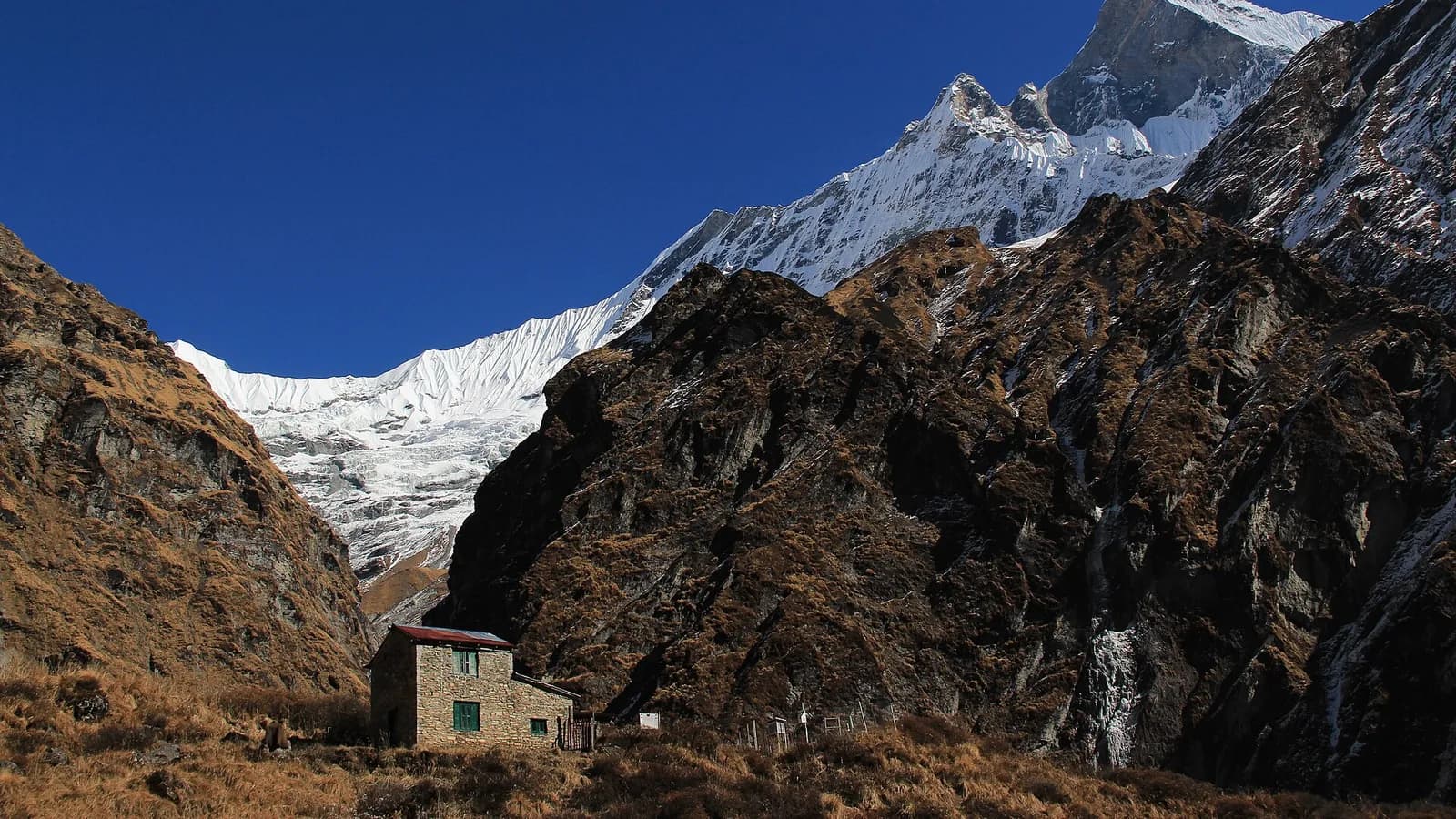
The Annapurna helicopter tour is Pokhara's answer to the long walk into the mountains. Where the classic Annapurna Base Camp trek takes a week or more of climbing through villages, forest and bamboo to reach the great natural amphitheatre of the Sanctuary, the helicopter does it in about an hour: a 20-minute flight from Pokhara, a landing at Annapurna Base Camp ringed by some of the world's most beautiful peaks, and back in time for a late breakfast by the lake. It is shorter, cheaper and gentler on the body than its Everest helicopter tour cousin, and — importantly — it still usually lands you right in the heart of the mountains.
This guide covers what the tour involves, what it costs, the flight and the landing, the weight rules, the best season, and how it stacks up against trekking. Prices and rules move, so treat the numbers as a guide, note the date, and confirm with your operator before paying.
Key takeaways
- An Annapurna helicopter tour flies from Pokhara into the Annapurna Sanctuary and usually lands at Annapurna Base Camp (about 4,130 m) before returning.
- It is short — often around 1 to 1.5 hours total from Pokhara, with roughly 20 minutes flying each way and 20–30 minutes on the ground.
- Shared seats commonly cost around USD 500–600 per person (as of mid-2026) from Pokhara — cheaper than the Everest tour; a private charter runs to a couple of thousand US dollars.
- The lower altitude (around 4,130 m versus 5,000-plus for Everest) makes the experience gentler, though rapid ascent still warrants care.
- Spring and autumn give the clearest skies; early-morning slots beat the cloud.
- Best launched from Pokhara, which sits close to the range; starting from Kathmandu is longer and pricier.
What the Annapurna helicopter tour involves
The day is refreshingly simple. You are collected from your Lakeside hotel and taken to Pokhara's domestic airport, where you check in, pass security, and — crucially — are weighed with your gear for safe load planning, before a short safety briefing from the captain. Then you lift off.
Within about 20 minutes the helicopter sweeps up into the Annapurna Sanctuary, the high glacial basin walled by peaks, and sets down at Annapurna Base Camp (around 4,130 m). You step out into a natural amphitheatre: Annapurna I (8,091 m), the world's tenth-highest mountain, along with Annapurna South, Hiunchuli, Gangapurna and — unmistakable above the lake on the flight in — the sharp twin summit of Machhapuchhre, the "Fishtail", sacred and never climbed. On a clear morning you may also pick out Dhaulagiri, Nilgiri, Manaslu and Lamjung Himal across the horizon. After 20 to 30 minutes for photographs and simply standing among the peaks, you fly back to Pokhara.
It is the climax of a famous trek, served in a single morning. For travellers who are short on time, who cannot walk to altitude, or who simply want the aerial angle on a landscape they may also be trekking, that is a powerful proposition. Our things to do in Pokhara guide shows how naturally it slots into a relaxed Lakeside stay.
The landing: a key contrast with Everest
One of the strongest reasons to consider the Annapurna tour specifically is the landing. On the Everest side, tourist landings at the high Kala Patthar viewpoint have been restricted in recent years on safety and environmental grounds, so many Everest tours now overfly the best vantage points rather than setting down at them. By contrast, the Annapurna tour typically still lands at Base Camp itself, putting your boots on the ground in the middle of the Sanctuary.
A fair caveat: helicopter flying inside the Annapurna Conservation Area is regulated, and over the years there has been scrutiny of flights into sensitive base-camp areas. Conditions on the day, weather and any operator-specific arrangements all matter. So while the landing is the norm, you should still confirm with your operator exactly where the aircraft will set down — the same sensible question you would ask anywhere in Nepal's mountains.
How the weight limit shapes the flight
As with any high-altitude helicopter trip, lift falls away in thin air, so weight governs everything. A helicopter typically carries up to five passengers, with a total payload limit in the region of a few hundred kilograms, and operators weigh everyone with their gear before departure. Because Annapurna Base Camp sits around 4,130 m — lower than the Everest tour's high points — the margins are a little more forgiving, but the principle is the same.
Practical implications:
- Travel light. A jacket, sunglasses, a camera and small personal items are all you need on board.
- Expect to be weighed. It is routine and applies to everyone.
- Group splits are possible. Depending on numbers and conditions, the operator may manage loads across the group; trust their judgement.
What it costs and what is included
Pricing is fairly consistent across Pokhara operators but varies with group size, season and fuel, so compare a couple and focus on the shape of it.
| Option | What you get | Typical price (as of mid-2026) | |---|---|---| | Shared / seat-in (from Pokhara) | One seat on a shared aircraft | Around USD 500–600 per person | | Private charter (from Pokhara) | The whole helicopter for your group | Around a couple of thousand US dollars | | From Kathmandu | Longer trip via the Pokhara area | Markedly higher again | | ACAP permit & airport tax | Conservation entry and local fees | Charged separately |
The headline figure to remember is that the Annapurna tour is substantially cheaper than the Everest equivalent, largely because the flight is so much shorter and Pokhara sits right beside the range. Shared seats are the budget route but depend on the operator filling the aircraft; a private charter buys certainty and a flexible date. On top of the fare, expect the Annapurna Conservation Area Project (ACAP) permit and airport tax to be charged separately, so always ask for an itemised, all-in quote.
To set this against the rest of a trip, our Nepal trip cost and Nepal travel budget guides give context, and the ATM withdrawal guide helps you have the right funds on hand.
Best season and time of day
The flying calendar follows Nepal's wider seasons. Spring (roughly March to May) and autumn (roughly late September to November) are the prime windows: stable air, clean post-monsoon or pre-monsoon skies, and the peaks at their crispest. The summer monsoon (around June to August) brings rain, haze and frequent cancellations, so if your trip falls then, treat the tour as a hopeful maybe and keep spare days.
Within a good day, fly early. Mornings are clearest; by late morning, cloud builds over the Sanctuary and can swallow the view. Our best time to visit Nepal and Sarangkot sunrise guides cover the local rhythm of clear mornings in the Pokhara valley.
Safety and altitude
The flying itself is routine for the experienced Pokhara operators who run these trips daily in season. The thing to respect is the rapid ascent. Going from Pokhara — a lakeside town under 900 m — to over 4,000 m in 20 minutes gives the body no time to adjust, and a short spell that high can bring mild altitude symptoms: a headache, light-headedness, mild nausea or breathlessness. Because ground time is brief, most people feel fine, and the lower altitude compared with the Everest tour helps, but it is not nothing.
Sensible steps:
- Avoid a heavy meal beforehand and stay hydrated.
- Move slowly at Base Camp; do not rush about or exert yourself.
- Declare any heart or lung conditions to your operator in advance.
- Trust the weather call — a good operator delays or cancels rather than push marginal conditions.
For the bigger picture on altitude, our altitude sickness guide explains the symptoms and responses, and because any high-altitude day carries a small chance of needing a medical lift, the guide to trekking insurance and helicopter evacuation is worth a read to check your policy's altitude clause.
Helicopter tour or trek?
These are different experiences, not rivals.
- Choose the helicopter if you are short on time, cannot or do not want to walk to altitude, or want a spectacular one-morning overview of the Sanctuary.
- Choose the trek if you have a week or more and want the immersion — the villages, the forests, the slow reveal of the mountains, and the satisfaction of arriving on foot.
If the full trek is more than you have time for, there are gentler ground options in the same region: the short, scenic Ghandruk village walk, the quieter Mardi Himal trek, or the Khopra Ridge trek. And many travellers combine modes — trekking part of the way and using a flight to compress the rest.
How to choose an operator
Most Annapurna helicopter tours sell out of Pokhara, and quality varies. Look for:
- An itemised quote stating the price, inclusions, the fees charged separately, and the intended landing point.
- A clear weather and refund policy, with the decision made on the day rather than pressured from a desk.
- Transparency on weight and group logistics.
- Recent reviews, ideally referencing 2025 or 2026 flights, that show how cancellations were handled.
If a quote is far below everyone else's, ask what is missing. Our guide to common tourist scams in Nepal helps you read a hard sell, and the paragliding Pokhara guide applies the same operator-vetting logic to Pokhara's other great aerial adventure.
Pre-trip checklist
- Start from Pokhara where possible for the shortest, cheapest flight.
- Book early in your stay to allow for weather days.
- Confirm the landing point and get an itemised, all-in quote.
- Aim for spring or autumn and an early-morning slot.
- Travel light, expect to be weighed, and eat light before flying.
- Check your insurance covers high-altitude flights.
For travellers who want the heart of the Annapurnas without the week of walking, this tour is hard to beat: a short, gentle, well-priced flight that still sets you down among the giants. Pick a clear morning, confirm the details, and let the Sanctuary open around you.
Sources
- Annapurna Base Camp Helicopter Tour, Pokhara — Cost 2026 — Nepal Helicopters
- Annapurna Base Camp Helicopter Tour With Landing, Cost 2026, 2027 — Nepal Trek Adventures
- Annapurna Base Camp Helicopter Tour: Complete 2026 Guide — Flight Everest
- Illegal helicopter flights unchecked in Annapurna Conservation Area Project — The Kathmandu Post
- Annapurna Trekking Permits 2026: ACAP, TIMS & RAP Guide — Nepal Hiking Team
Frequently asked questions
- What is an Annapurna helicopter tour?
- It is a short scenic helicopter trip that flies from Pokhara into the Annapurna Sanctuary, lands at Annapurna Base Camp at around 4,130 metres, and returns the same morning. You spend a brief spell on the ground ringed by peaks such as Annapurna I, Annapurna South, Hiunchuli and the sacred fishtail summit of Machhapuchhre, then fly back to Pokhara. It packs the climax of a multi-day trek into roughly an hour.
- How much does an Annapurna helicopter tour cost?
- On a shared seat-in basis from Pokhara it commonly runs in the region of USD 500 to 600 per person as of mid-2026, which makes it noticeably cheaper than the equivalent Everest tour. A private charter of the whole aircraft from Pokhara is higher, often around a couple of thousand US dollars, and starting from Kathmandu costs considerably more again. Conservation-area permits and airport taxes may be charged separately, so confirm the all-in figure.
- How long is the Annapurna helicopter tour?
- From Pokhara the whole experience is short, often around 1 to 1.5 hours in total. The flight up to Annapurna Base Camp takes roughly 20 minutes, you typically get around 20 to 30 minutes on the ground for photos and the view, and the return is another 20 minutes or so. Starting from Kathmandu instead adds the transfer flights to Pokhara and back, stretching the day to about three hours.
- Where does the Annapurna helicopter tour land?
- Most tours land at Annapurna Base Camp itself, at about 4,130 metres, in the heart of the Annapurna Sanctuary. This is a key difference from the Everest tour, where high-altitude tourist landings have been restricted. That said, helicopter flying inside the conservation area is regulated, conditions on the day matter, and exact landing arrangements can vary, so confirm with your operator when you book.
- Is the Annapurna helicopter tour safe and will I get altitude sickness?
- The flying is routine for experienced Pokhara-based operators, and because Annapurna Base Camp sits around 4,130 metres rather than above 5,000, the altitude is gentler than the Everest tour. Even so, the ascent is rapid and a short spell that high can bring mild headache, dizziness or breathlessness in some people. As ground time is brief, serious problems are uncommon, but move slowly, stay hydrated and avoid a heavy meal beforehand.
- What is the best time of year for the Annapurna helicopter tour?
- Spring, roughly March to May, and autumn, roughly late September to November, give the clearest skies and the most reliable flying, with stable air and sharp mountain views. Early-morning departures are best because cloud tends to build over the range later in the day. The summer monsoon, around June to August, brings rain, haze and frequent cancellations, so plan around it.
- How does the Annapurna helicopter tour compare to the trek?
- The Annapurna Base Camp trek normally takes a week or more of walking through villages, forests and rhododendron to reach the sanctuary, while the helicopter delivers the same final amphitheatre of peaks in about an hour. The trek offers immersion, fitness and the journey itself; the helicopter offers speed and access for those short on time or unable to walk to altitude. Many travellers value them as different experiences rather than substitutes.
- Can the Annapurna helicopter tour depart from Kathmandu?
- Yes, it can be arranged from Kathmandu, but it is built around Pokhara, which sits much closer to the Annapurna range. From Kathmandu the helicopter must first cover the distance to the Pokhara area, so the day is longer and the cost markedly higher, and shared departures are harder to fill. If you are already in or heading to Pokhara, starting there is cheaper and simpler.
Related posts
Annapurna Base Camp Helicopter Tour: Which Option?
An Annapurna Base Camp helicopter tour can be a seat-in landing flight, a private charter, or a trek-up fly-down combo. Here is how to pick the right one.
Read postAnnapurna: A Traveler's Guide to Nepal's Famous Massif
What Annapurna means, the peaks in the massif, the treks around it, and the permits you need. A plain-English guide to Nepal's most famous mountain range.
Read postEverest Helicopter Tour: Cost, Landing & 2026 Guide
Everest helicopter tour from Kathmandu — cost, the Kala Patthar landing rules, Hotel Everest View breakfast, weight limits, best season and safety.
Read post