The Yak in Nepal: A Trekker's Guide to Himalayan Yaks
What every traveller should know about the yak in Nepal - where to see them, yak vs nak vs dzo, yak cheese, and trail safety in the Himalaya.
Above 3,000 metres, the yak is the engine, the dairy and the heartbeat of mountain life.
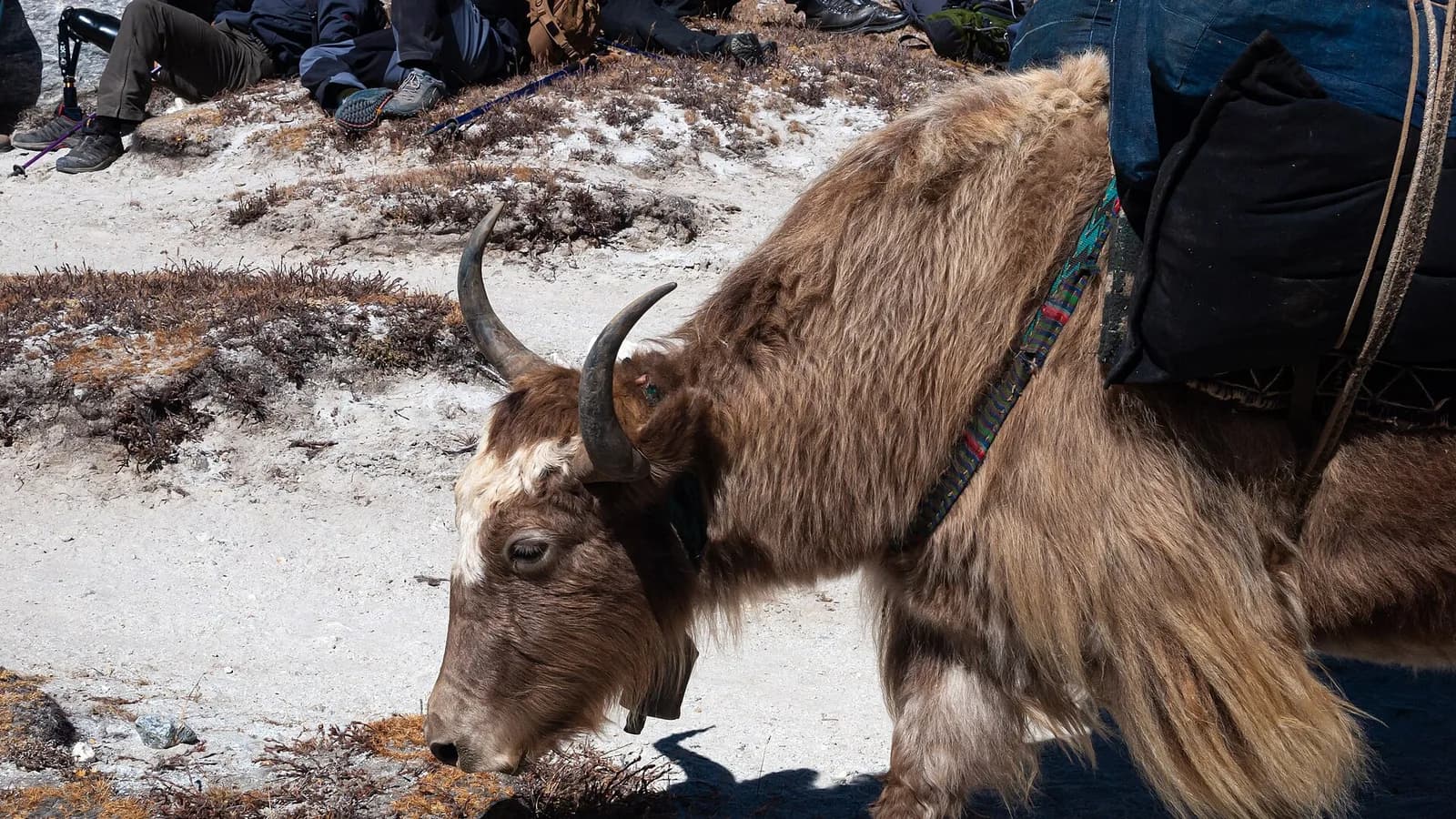
The yak is the unmistakable animal of high Nepal: a shaggy, horned, surprisingly nimble member of the cattle family that thrives where almost nothing else can. If you trek to Everest Base Camp, cross a high Annapurna pass, or wander into Upper Mustang or Dolpo, the yak in Nepal is impossible to miss - hauling cargo over icy passes, grazing on thin alpine meadows, and supplying the milk, butter and cheese that keep mountain households running. This guide covers what these animals actually are, where to find them, how to behave around them, and why their future is suddenly uncertain.
Key takeaways
- A yak is a high-altitude member of the cattle family; in Nepal the male is a "yak" and the female is a "nak" (or "dri"), and only the nak gives milk.
- Yaks are grazed at roughly 3,000-5,000 m across about 28 mountain districts and can climb far higher, so the Everest and Gokyo trails are the easiest places to see them.
- A "dzo" is a yak-cow hybrid that copes better at lower elevations and is calmer to handle - you will see these on mid-altitude trails too.
- On the trail, yaks are working animals: give them space, step to the inside (uphill) edge to let them pass, and never crowd a mother with a calf.
- Nak milk makes chhurpi, the famously hard Himalayan cheese, plus butter and salty butter tea - buying some directly supports herding families.
- Nepal's yak numbers and herder households are in long-term decline due to climate change and social change, so yak culture is genuinely under pressure.
What exactly is a yak?
Yaks are long-haired, horned bovines built for cold and altitude. The domestic Himalayan animal is Bos grunniens ("grunting ox"), while the rarer wild yak is Bos mutus. Their bodies are tuned for thin air: compared with lowland cattle they have larger lungs and hearts and carry more oxygen in their blood, partly because they keep a foetal form of haemoglobin throughout life. A thick double coat and a low metabolism for the cold do the rest.
Domestic yaks are smaller than their wild relatives. Males commonly weigh roughly 600-1,100 lb (about 270-500 kg) and stand around 44-54 inches at the shoulder; females are lighter and shorter. Despite the bulk, they are remarkably sure-footed on loose, steep ground - which is exactly why they remain the pack animal of choice high above the road network.
How high can they go?
Yaks are reared on pastures and meadows at about 3,000-5,000 m (roughly 9,800-16,400 ft) and can ascend to around 6,100 m (about 20,000 ft). Just as important, they do not do well for long below about 3,000 m - the heat and lower altitude stress them. That single fact shapes where you will and will not meet a yak in Nepal, and it is why herders move animals up and down the mountain with the seasons. For more on the thin-air environment they live in, see our guide to altitude sickness in Nepal.
Yak, nak and dzo: getting the names right
One of the most common traveller mix-ups is calling every shaggy mountain bovine a "yak." In Nepal the terminology is more precise:
| Term | What it means | | --- | --- | | Yak | The male animal | | Nak (or dri) | The female - the one that gives milk | | Dzo | Male hybrid of a yak and a lowland cow | | Dzomo / chauri | Female yak-cow hybrid |
Hybrids exist for a practical reason. A dzo or chauri is generally easier to manage than a pure yak and tolerates lower elevations better, so herders use them as flexible, hardy work and dairy animals on mid-altitude trails. So when you photograph "a yak" near a village at 2,800 m, there is a good chance you are actually looking at a dzo. And because only naks and chauris lactate, the "yak cheese" sold on the trail is, strictly speaking, nak or chauri cheese.
Where to see yaks in Nepal
The reliable rule is altitude: get above about 3,000 m on a trekking route through mountain districts and you will likely meet yaks. The single best region is the Everest (Khumbu) area.
The Everest and Gokyo trails
Trekkers regularly see yaks grazing and working around Namche Bazaar, Dingboche and Lobuche on the way to Everest Base Camp. The parallel Gokyo Lakes trek passes Sherpa settlements such as Dole and Machhermo, where stone houses, prayer flags and yak pastures line the trail. In spring and autumn - the main trekking seasons - herders move animals between pastures, so you can sometimes see sizeable herds on the move. Yak culture here is closely tied to the wider Sherpa world; our piece on the Sherpa people gives that context.
Beyond Everest
Yaks are not an Everest exclusive. You will also find them on the higher sections of the Annapurna Circuit and the Manaslu Circuit, and across the trans-Himalayan landscapes of Upper Mustang and Dolpo, where herding is a centuries-old way of life. In all, yaks are kept across roughly 28 northern mountain districts of Nepal.
Best time of day
For both photography and calm encounters, early morning and late afternoon are ideal: the light is soft and animals are often grazing rather than hauling loads. Aim to watch from a respectful distance rather than chasing a close-up.
Yaks as the engine of mountain life
Above the last drivable road, the yak is infrastructure. A single animal can carry up to about 100 kg (220 lb) across snow-covered passes and exposed paths, ferrying food, fuel, building materials and trekkers' gear to lodges, villages and monasteries. Much of what you eat and sleep under at a high teahouse arrived on a yak's back.
Beyond transport, yaks (through their naks) provide a dairy economy: milk, butter, and cheese, plus dung that is dried and burned as fuel where firewood is scarce, and wool and hides for ropes, bags and clothing. In short, the animal underwrites both the local diet and a large part of the trekking supply chain.
Yak dairy: chhurpi, butter and butter tea
Nak milk is notably rich - around 7 percent fat, against roughly 3-4 percent for cow milk - which makes it excellent for cheese.
Chhurpi, the famous hard cheese
The headline product is chhurpi, a traditional cheese eaten across Nepal, Bhutan, Tibet and parts of northeast India. It comes in two main forms:
- Hard chhurpi: milk is set into curd, left a couple of days, then sliced and dried in the sun (or low oven) for months until it is as hard as chalk. It is chewed slowly as a long-lasting trail snack or ground into soups, and well-made hard chhurpi can keep for years.
- Soft chhurpi: fresher, mild, slightly tangy and creamier, closer to a European-style cheese.
Nutritionally it is high in protein and calcium and contains conjugated linoleic acid (CLA). Interestingly, Nepal was an early pioneer of commercial yak cheese in Asia - for a time it was effectively the only country producing it. If you want to try it, our guide to what to eat in Nepal and the round-up of best things to buy in Nepal point you in the right direction.
Butter and butter tea
Nak butter is the other staple. It is churned into the salty, calorie-dense butter tea that fuels long days at altitude and is also offered in monasteries as butter lamps. If you have tried Nepal's milky masala chiya on the trail, butter tea is its high-mountain cousin - savoury rather than sweet, and an acquired taste for many visitors.
Trail etiquette and safety around yaks
Yaks look placid and photogenic, but they are large, heavy and occasionally unpredictable - and the trail is their workplace. A few simple rules keep everyone safe:
- Yield on narrow trails. When a yak (or donkey) train approaches, step to the inside/uphill edge and stop. Guides have no shortage of stories about trekkers being nudged off a ledge by a passing animal - the drop side is the wrong side to stand on.
- Clear the bridges. Wait for suspension bridges to be empty of yak and donkey trains before you cross; a swaying bridge full of livestock is no place to meet one head-on.
- Keep your distance, especially from calves. Naks with young can be protective. Do not crowd, corner or surprise them.
- Ask before touching. Yaks are working animals, not petting-zoo attractions. If you really want a close photo or contact, check with the herder first.
This fits the wider trekking etiquette in Nepal of giving way, going slowly and respecting the people whose livelihood the trail represents.
A culture under pressure
The yak's future in Nepal is genuinely uncertain. National agricultural census figures show the herd shrinking - reported as a fall from around 53,000 to about 48,000 in just a few years - with fewer than roughly 10,000 households still rearing yaks for a living. Longer term, numbers are far below the levels of earlier decades.
Why? Reporting from the high districts points to a convergence of pressures:
- Climate change: warmer temperatures and erratic snowfall are degrading alpine pastures, so animals produce less milk and meat.
- Economics and labour: herding is costly and labour-intensive, local markets for yak produce are thin, and young people are leaving for towns or overseas work.
- Disease and isolation: outbreaks can be devastating when the nearest vet is days away on foot, and herders describe inbreeding and low insurance payouts as compounding problems.
In places like Dolpo and Mustang, families that once kept dozens of animals now report keeping only a handful, or selling up entirely. Because yak herding is woven into festivals, food, trade and identity, its decline is also a cultural loss - which ties into Nepal's broader climate-change story. For travellers, the takeaway is simple: meeting a working yak high in the Himalaya is a privilege, and a small, fair purchase of local cheese or a night in a herder-run lodge puts money straight into the communities keeping the tradition alive.
Sources
- Yak - Wikipedia
- Chhurpi - Wikipedia
- Himalayan Yaks - The Complete Trekker's Guide to Nepal (Explore Himalaya)
- Where & How to See Yaks in Nepal During Trekking (Best Heritage Tour)
- All About Yak Cheese: The Hidden Dairy Food of Nepal Trek (Himalayan Masters)
- Climate change, socioeconomic shifts threaten Nepal's yak herding traditions (Mongabay)
- Climate change tests Nepal's wild and domesticated yaks (Mongabay)
- In Nepal, when yaks go, so does culture (Global Voices)
- Hiking Safety Tips for Nepal's Best Treks (Trains, Planes and Tuk-Tuks)
Frequently asked questions
- What is the difference between a yak and a nak in Nepal?
- In Nepal a yak is the male animal and a nak (also called dri by Sherpas) is the female. Only the nak gives milk, so the cheese and butter you buy on the trail technically come from naks, not yaks.
- What is a dzo?
- A dzo is a hybrid of a yak and a lowland cow. The males are called dzo and the females dzomo or chauri. Hybrids are calmer to handle and cope better at lower elevations, so you often see them below the true yak zone.
- Where can I see yaks while trekking in Nepal?
- Yaks live above roughly 3,000 metres, so the Everest region around Namche Bazaar, Dingboche and Lobuche is the classic place to see them, along with the Gokyo trail, the higher Annapurna and Manaslu routes, Upper Mustang and Dolpo.
- Are yaks dangerous to trekkers?
- Yaks are usually placid but they are large, heavy and can be unpredictable, especially mothers with calves. On narrow trails always step to the uphill (inside) edge and let a yak train pass, and never crowd or try to pet one without asking the herder.
- What is yak cheese or chhurpi?
- Chhurpi is a traditional Himalayan cheese made from nak milk. The hard version is dried for months until it is rock solid and can be chewed slowly for hours, while the soft version is fresh, mild and slightly tangy.
- Can you drink yak milk?
- Yes - nak milk is rich, with a fat content of around 7 percent, much higher than cow milk. In the mountains it is usually turned into butter, cheese or churned into salty butter tea rather than drunk plain.
- Why is Nepal's yak population declining?
- Herder numbers are falling because of climate change, warmer pastures, rising costs, animal disease, inbreeding and young people leaving the mountains for towns and overseas work. National census figures show yak numbers have dropped over recent decades.
- Is it ethical to ride or photograph yaks?
- Yaks in Nepal are working pack and dairy animals rather than tourist rides, so the respectful thing is to photograph them from a sensible distance and ask the herder before getting close. A small purchase of local cheese supports herding families directly.
Related posts
Musk Deer in Nepal: The Himalayas' Shy Tusked Ghost
A trekker's guide to the musk deer in Nepal: where it lives, why it has fangs, its endangered status, and how to spot one ethically in the high forests.
Read postHimalayan Tahr: Nepal's Cliff-Dwelling Wild Goat
A trekker's guide to the Himalayan tahr in Nepal: where to see this wild goat, its alpine habitat, conservation status, and the Everest trail's most-spotted mammal.
Read postNepal National Bird: The Himalayan Monal (Danphe)
Meet the Nepal national bird, the Himalayan Monal or Danphe: facts, where to spot it on the trail, and why this dazzling pheasant matters.
Read post