Pikey Peak Trek: The Quiet Solu Window onto Everest
A practical guide to the Pikey Peak trek (~4,065m) in lower Solu — route, duration, difficulty, best season, permits and how to reach the Dhap road head.
One ridge, one cold dawn, and eight of the world's tallest mountains lined up across the horizon — Everest among them.
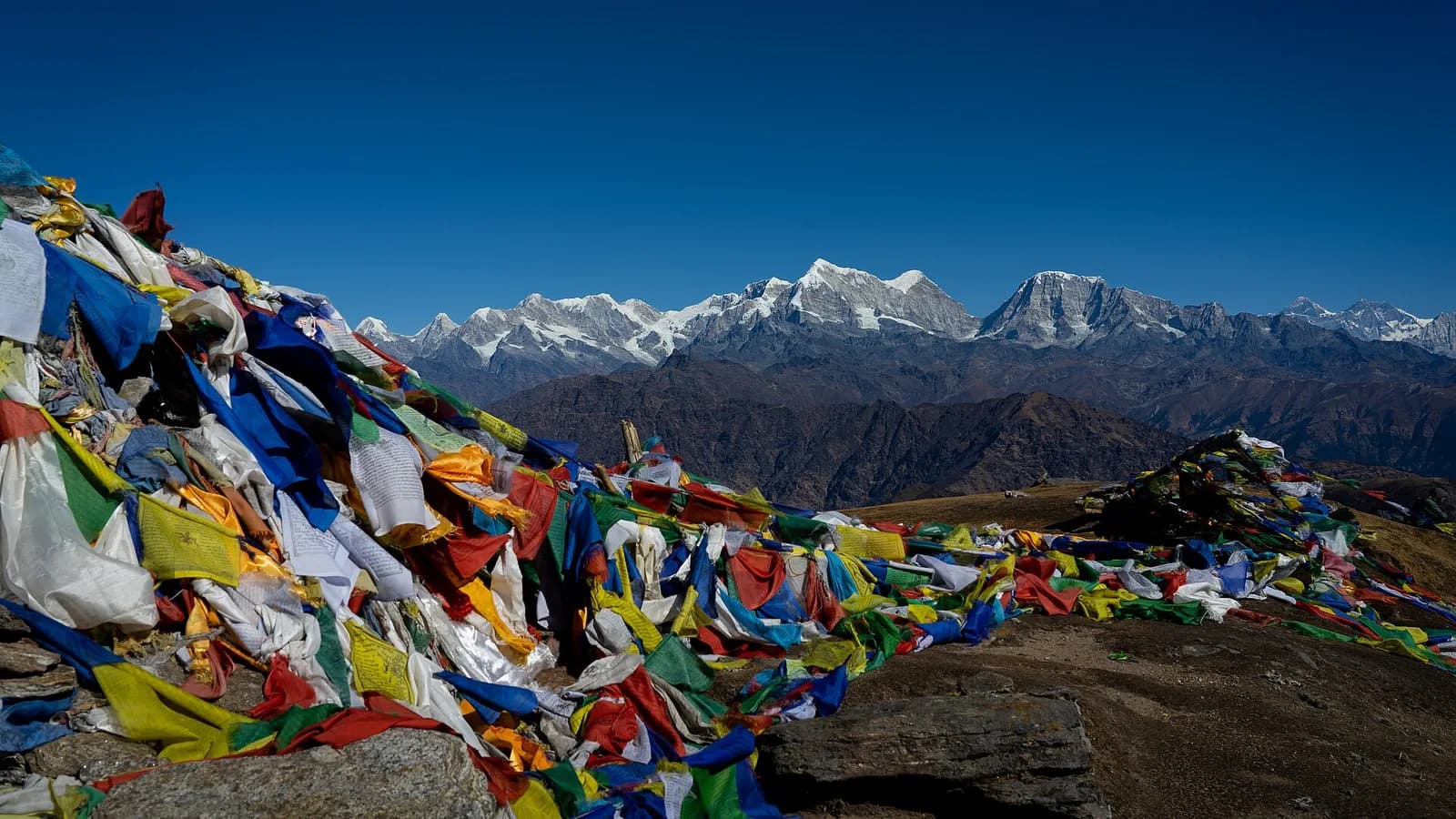
If your idea of the Everest region is a conga line of trekkers on the Lukla trail, Pikey Peak is the antidote. This modest summit in lower Solu, just south of the famous Khumbu, gives you one of the widest Himalayan panoramas in Nepal — Everest included — without the altitude, the crowds, or the expensive mountain flight. It is the trek for people who want big mountains and quiet trails in the same week, and it carries a famous endorsement: Sir Edmund Hillary, the first man atop Everest, is widely reported to have called the view from Pikey one of his favourites in the whole Himalaya.
What makes Pikey special is the geometry. From a ridge at around 4,065m you look across an unbroken sweep of giants, and crucially Everest is not hidden behind its neighbours the way it can be from some Khumbu viewpoints. Add Sherpa villages, working monasteries, yak pastures and a cheese factory or two, and you have a short trek that punches far above its altitude.
Key takeaways
- Pikey Peak (~4,065m) is a lower Solu viewpoint in the southern Everest region — a fraction of the height of Everest Base Camp but with a wider mountain panorama.
- Eight-thousanders on show: on a clear morning the ridge lines up Everest, Lhotse, Makalu, Cho Oyu and Kanchenjunga alongside Numbur, Gaurishankar and Thamserku.
- Duration: roughly 4–6 walking days, most commonly a 5-day route, plus a long jeep day at each end.
- Difficulty: moderate and beginner-friendly, with no technical sections and a low altitude-sickness risk.
- Best season: autumn (Oct–Nov) for clarity, spring (Mar–Apr) for warmth and rhododendrons.
- Access: a long jeep ride to the Dhap road head from Kathmandu, or fly to Phaplu and drive in.
- Permits: Gaurishankar Conservation Area permit plus a TIMS card; confirm current fees with the Nepal Tourism Board.
The route and a typical itinerary
There is no single fixed Pikey Peak itinerary — operators string together villages on the Dhap, Jiri and Phaplu side of the ridge in slightly different orders. The most popular version is a point-to-point walk that drives in to Dhap, climbs over the summit, then descends to the larger Sherpa centre of Junbesi before exiting via Phaplu or Salleri. Here is how that commonly breaks down.
Day 1 — Kathmandu to Dhap, then walk to Jhapre. A long jeep day (a full 7–8 hours, the second half on rough, dusty road) brings you to Dhap, the road head at roughly 2,850m. From here it is a short half-day walk through farmland to Jhapre (~2,920m), a village already dotted with Buddhist gompas, chortens and prayer flags that announce you are entering Sherpa country.
Day 2 — Jhapre to Pikey Base Camp. A steady ridge climb through pine and rhododendron forest, past mani stones and yak pasture, to Pikey Base Camp at around 3,640m. Some base-camp lodges have a small cheese factory — a Solu speciality dating to Swiss dairy projects of the mid-20th century. This is your one night at altitude, which helps you acclimatise before the summit.
Day 3 — Summit at dawn, then down to Junbesi. The big day. A pre-dawn start gets you onto the Pikey Peak summit (~4,065m) for sunrise, when the light hits the eastern Himalaya and the full panorama opens up. After the summit you drop steeply, often via the Lamjura area, into the timeline-rich Sherpa valley of Junbesi (~2,700m), passing chortens and an old monastery on the way down.
Day 4 — Junbesi to Phaplu / Salleri. A gentler walking day through forest, river crossings and farming hamlets such as Salung, with parting glimpses of Everest and Makalu, down toward Phaplu and the district centre of Salleri (~2,400m).
Day 5 — Drive back to Kathmandu. Another long jeep day out, often routed past Jiri — the historic Everest trailhead used before Lukla had an airstrip. Trekkers who fly in to Phaplu can shorten both the in and out days considerably.
Shorter and longer variants exist: some people do an out-and-back from Dhap in as little as 3–4 days, while others add the classic Jiri-to-Junbesi section to make a longer, more historic crossing. For a sense of how Pikey compares with Nepal's other classic routes, our trekking overview and best treks for beginners guides are good starting points.
Difficulty and fitness
Pikey is consistently graded moderate, and it is one of the genuinely approachable Himalayan viewpoint treks. There is no technical climbing, no high pass to cross and no glacier travel — the summit is reached on a walking trail. Daily walking is in the region of 5–7 hours on forest paths and ridgelines, with a few sustained uphill stretches and one steep, cold pre-dawn push to the top.
The biggest single factor in its favour is altitude. You sleep no higher than about 3,640m and top out near 4,065m, so the serious altitude problems that shadow higher treks are far less likely here. That said, altitude sickness can affect anyone above roughly 2,500–3,000m, so walk at a steady pace, hydrate well, and read our altitude-sickness guide before you go. Compared with the Khumbu's flagship route, Pikey is dramatically easier — see Everest vs Annapurna difficulty and Annapurna Circuit vs Base Camp to place it on the spectrum.
Fitness-wise, if you can comfortably manage a full day's hill walk with several hundred metres of ascent at home, you have a solid base. A few weeks of regular cardio beforehand makes the summit morning far more enjoyable than survivable.
Best season
The two prime windows are the same as for most of Nepal. Autumn, roughly October into November, follows the monsoon and tends to deliver the cleanest, most stable air — which on a view-centric trek like this is the whole point. Spring, around March to April, brings milder days and the rhododendron forests of the lower ridge into flower, though haze can build as the season warms.
Winter (December to February) is feasible because the altitude is modest, but expect bitterly cold nights at base camp and the real chance of snow on the summit ridge; pack accordingly. Monsoon (June to August) brings cloud, leeches and obscured views, so it is the least rewarding time for a trek whose entire reward is the panorama. For the full picture, see our best season to trek in Nepal breakdown.
Permits and rules
Most Pikey Peak routes pass through the Gaurishankar Conservation Area, so the main permit you need is the Gaurishankar Conservation Area Permit (GCAP). On top of that you carry the standard TIMS card (Trekkers' Information Management System), which all foreign trekkers are expected to hold. If your particular route brushes the boundary of Sagarmatha National Park on the Everest side, a national-park permit may also apply.
Fees change from year to year, so I am deliberately not quoting numbers here — confirm the current rates with the Nepal Tourism Board (NTB) or a registered agency before you travel rather than relying on an old blog figure. Conservation permits are typically arranged in Kathmandu through the NTB office or the National Trust for Nature Conservation; a registered trekking agency will usually handle the whole bundle for you. Our permits hub explains how the Nepali permit system works in general.
One rule worth flagging: Nepal now generally requires foreign trekkers to use a licensed guide on conservation-area and national-park routes, and Pikey falls under that. Beyond the legal point, a guide is genuinely useful here because the area sees few visitors, the jeep logistics are fiddly, and signage is sparse. If you are weighing it up, read do I need a guide to trek in Nepal.
The highlights
The summit dawn is the headline, but the trek's character comes from the lower ridge. You walk through living Sherpa and Tamang villages where Tibetan Buddhism is woven into daily life — mani walls, carved stones, fluttering prayer flags and quiet gompas mark almost every rise. Junbesi, in particular, is a handsome Sherpa settlement with an old monastery and a sense of being firmly in the cultural orbit of the high Khumbu without the trekker traffic.
Then there is the panorama itself. On a clear morning the Pikey ridge offers an unusually generous line-up: Everest, Lhotse, Makalu, Cho Oyu and Kanchenjunga among the eight-thousanders, with Numbur, Gaurishankar, Thamserku and other handsome peaks filling in the foreground. Because the viewpoint is set back to the south, Everest reads clearly rather than being part-screened by closer summits — which is exactly why it earned its Hillary-era reputation.
Practical pleasures round it out: teahouse rooms and dal bhat in villages that feel genuinely local, the occasional ridge-top cheese factory, and trails empty enough that you often have a viewpoint to yourself. If teahouse logistics are new to you, our teahouse trekking guide covers food, beds and etiquette, and learning a few trekking phrases in Nepali goes a long way in villages this far off the tourist circuit.
How to get there
Access is the one genuinely involved part of Pikey, and it is worth understanding before you book.
By road via Dhap (the usual way). From Kathmandu it is a long jeep day — commonly cited as 7–8 hours — east toward the Solu hills, ending at the Dhap road head above 2,800m. The first stretch is sealed highway; the final hours are rough, dusty and slow, so a sturdy 4WD and an early start matter. This is the most common and most affordable approach, and it is what most 4–6 day itineraries assume.
By air via Phaplu. A short scheduled flight from Kathmandu to Phaplu (a fraction of an hour in the air) lets you start much closer to the trail and cuts the brutal road time in half. It costs more and is weather-dependent like all Nepali mountain flights, but it is a good option if your schedule is tight or you would rather not spend two full days in a jeep.
The Jiri angle. The return drive is often routed past Jiri, the original gateway to Everest used by expeditions before the Lukla airstrip existed. Strong walkers sometimes link Pikey with the historic Jiri-to-Junbesi trail for a longer, low-altitude crossing that channels the spirit of the early Everest approaches.
Whichever way you come in, Pikey Peak rewards the effort with a rare combination: a true Everest-region experience, a world-class panorama, modest altitude and almost no crowds. For a first big-mountain view in Nepal — or a quiet second helping after the busier classics — it is hard to beat.
Sources
Frequently asked questions
- How high is Pikey Peak and how does that compare to Everest Base Camp?
- The Pikey Peak summit sits at roughly 4,065m. That is well below Everest Base Camp (about 5,364m) and even below the Kala Patthar viewpoint, so the altitude-sickness risk is much lower while the Everest view is arguably wider and clearer.
- How many days does the Pikey Peak trek take?
- Most itineraries run 4 to 6 days of walking once you reach the trailhead, with a long jeep day at each end. A common version is a 5-day loop from Dhap over the summit to Junbesi and out via Phaplu or Salleri.
- Is the Pikey Peak trek hard?
- It is graded moderate and is one of the more beginner-friendly Himalayan viewpoint treks. There is no technical ground, daily walking is around 5 to 7 hours, and the modest altitude means most reasonably fit travellers manage it comfortably.
- What permits do I need for Pikey Peak?
- Most routes pass through the Gaurishankar Conservation Area, so you need that area permit plus the standard TIMS card. Routes that touch the Everest national-park boundary may also need the Sagarmatha permit. Confirm current fees with the Nepal Tourism Board.
- When is the best time to trek Pikey Peak?
- Autumn (roughly October to November) gives the clearest mountain views, and spring (March to April) brings warmer days and rhododendron bloom. Winter is doable for the hardy, with cold nights and possible snow on the summit ridge.
- Do I need a guide for Pikey Peak?
- Nepal now generally requires foreign trekkers to use a licensed guide on conservation-area routes like this one. A guide also helps with the rough jeep logistics and finding teahouses in this lightly visited area.
- How do I get to the Pikey Peak trailhead?
- The usual start is a long jeep ride from Kathmandu to Dhap (a full day, partly on rough road). You can also fly to Phaplu and drive in, which shortens the road time considerably.
Spotted an error in this post? Tell us or suggest a correction.
Related posts
Panchase Trek: A Sacred Forest Ridge above Phewa Lake
A practical guide to the Panchase trek (~2,517m) south-west of Pokhara — route, duration, easy-to-moderate grade, best season, ACAP permit and how to start.
Read postChisapani to Nagarkot Trek: The Valley-Rim Walk That Teaches You Nepal
A practical guide to the Chisapani–Nagarkot trek through Shivapuri Nagarjun National Park — route, 2–3 day itinerary, difficulty, season and park entry.
Read postDhampus & Australian Camp Trek: The Easiest Real Himalaya near Pokhara
A practical guide to the Dhampus and Australian Camp trek near Pokhara — short route, low altitude, big Annapurna views, best season and the ACAP permit.
Read post