Nepali Masks: Lakhe, Bhairav and Newar Mask Guide
A traveller's guide to Nepali masks — the Lakhe, Bhairav and Mahakali dance masks, how they are made in Bhaktapur and Thimi, and where to see and buy them.
A Nepali mask is rarely just a wall ornament. Many are living deities — carved, worshipped, danced, and in some places burned and remade every single year.
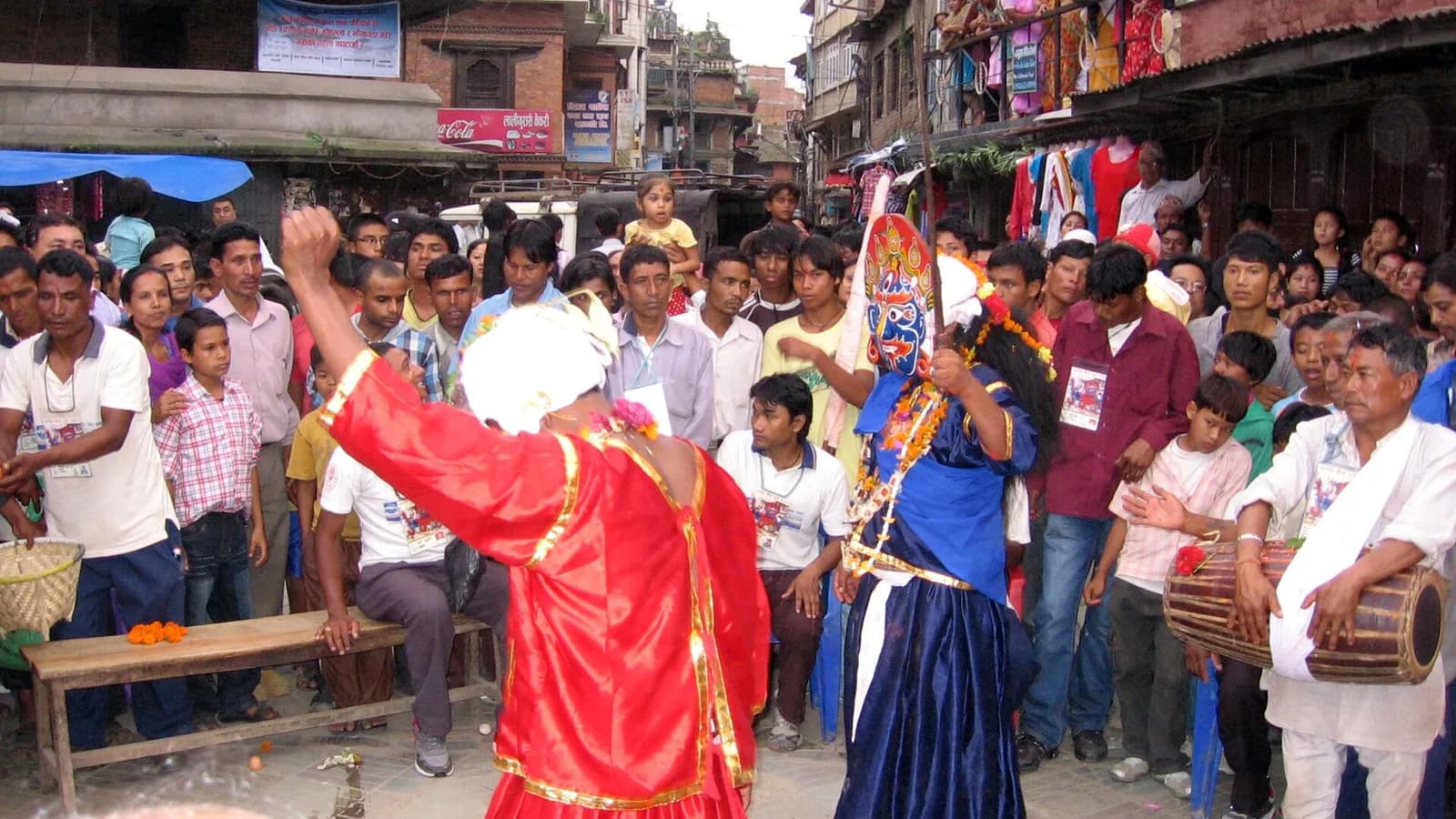
A Nepali mask is one of the most striking things you can carry home from Kathmandu — and one of the most misunderstood. To a visitor it can look like simple folk art on a Thamel shop wall. In the old Newar towns of the Kathmandu Valley, though, many masks are something closer to a living deity: carved or moulded to strict religious rules, worshipped, danced through the streets, and in some places ceremonially burned and remade every year. This guide explains the main kinds of Nepali masks, how and where they are made, the festivals where they come alive, and what to know before you buy one.
This is a culture-and-craft piece, so the focus is on understanding what you are looking at rather than chasing exact prices. Where money or dates matter, treat the figures as a guide and confirm locally — festival timings in particular follow the lunar calendar and shift each year.
Key takeaways
- Most famous Nepali masks belong to the Newar culture of the Kathmandu Valley, where painted ritual masks are broadly called khwapa and the dances pyakhan.
- The standout characters are the red Lakhe demon, the fierce Bhairav (a form of Shiva), and the Mahakali and Devi goddess masks.
- Traditional masks are built from clay, Nepali paper, jute and cotton over a mould in Bhaktapur and Thimi; fine metal masks come from Patan.
- In parts of Bhaktapur, old masks are cremated and their ashes mixed into next year's masks — the deity is housed temporarily, not permanently.
- The great showcase is Indra Jatra in Kathmandu in September; buy only modern reproductions, as genuine antiques cannot legally leave Nepal.
A living tradition, not wall decoration
The first thing to understand is that, in their original context, these are not ornaments. A ritual Newar mask is consecrated and treated as a vessel a god can enter during a dance. The masked dances themselves are called pyakhan in Nepal Bhasa (the Newar language), and many trace back to the medieval Malla kings. Tradition credits King Jayasthiti Malla, who ruled in the late 14th century, with shaping dance-dramas drawn from the goddess scriptures, and the Mahakali dance is said to have been performed by royalty in public.
That sacred status is why behaviour around masks can be careful and rule-bound. The performers are usually drawn from specific families and communities, the dances happen at fixed points in the year, and the masks are not casually handled. For a traveller, the practical takeaway is respect: photograph performances from a sensible distance, do not touch ritual masks in temples or during processions, and remember that what looks like theatre is, for many, worship.
It is also worth separating two streams you will see side by side in Kathmandu. Newar masks belong to the Hindu and local-deity dances of the valley towns and are a distinct tradition with their own look. The Tibetan-style masks sold near Boudhanath and in Buddhist shops belong to a different world — the monastic Cham dances of Tibetan Buddhism. Both are "Nepali masks" in the sense that you can buy them in Nepal, but they are not the same craft.
The main characters
A handful of figures dominate the masked dances, and once you can name them the festivals make far more sense.
Lakhe — the red demon of the streets
The Lakhe is probably the most recognisable Nepali mask: a broad red face with bulging eyes, fangs and a vast mane of hair. The most famous is the Majipa Lakhe, who dances through Kathmandu during Indra Jatra. The full headgear is heavy — commonly cited at around 15 kilograms — and the dancer moves in sudden, charging bursts to drumming. Although Lakhe looks like a man-eating demon, in the city's tradition he is a guardian who protects the community, and his appearance is one of the highlights of the festival.
Bhairav — the fierce face of Shiva
Bhairav (also spelled Bhairab) is a terrifying form of the god Shiva and a guardian of the Kathmandu Valley. His masks are among the largest and most powerful you will see. The colossal gilded Sweta (Seto) Bhairav mask at Hanuman Dhoka in Kathmandu Durbar Square is normally hidden behind a wooden lattice and revealed only during Indra Jatra; it is traditionally dated to the reign of Rana Bahadur Shah in the late 18th century. A second great mask, Akash Bhairav, presides over Indra Chowk nearby. During the festival, rice beer is famously channelled out through the mouth of the Seto Bhairav and caught by the crowd as a blessing.
Mahakali, Devi and the goddess dances
Beyond the demons and Bhairavs are the goddess dances. The Mahakali pyakhan of Bhaktapur dramatises the goddess defeating demons, and related dances such as the Nava Durga (nine Durgas) cycle feature a whole troupe of masked deities who move between shrines and neighbourhoods across the festival season. These masks follow especially strict iconography — each goddess has her own fixed colours, ornaments and crown.
A quick character guide
| Mask | Identity | Where you are likely to meet it | | --- | --- | --- | | Lakhe | Protective demon spirit | Indra Jatra street dances, Kathmandu | | Bhairav | Fierce form of Shiva, valley guardian | Hanuman Dhoka and Indra Chowk during Indra Jatra | | Mahakali / Devi | Warrior goddess(es) | Mask dances in Bhaktapur and Thimi | | Nava Durga | Troupe of nine goddesses | Seasonal dances around Bhaktapur |
How a Nepali mask is made
The craft is concentrated in Bhaktapur and neighbouring Thimi (Madhyapur Thimi), with metal masks a specialty of Patan. Most ritual masks are not carved from wood at all — they are built up from clay and paper.
Clay, paper and jute
The traditional method starts with a low-relief mould of the deity's face. A paste is prepared from clay mixed with locally made Nepali paper, jute and cotton, bound with a flour-and-glue mixture. The maker presses this over the mould, often with a cloth in between, so it takes on every contour, then leaves the form to dry for several days before lifting it off. The dried mask is sealed and then painted. Crucially, the painting is not freehand invention: for ritual masks the proportions, colours, symbols and crown of each god are fixed, and painters work from reference pattern-books to get every deity exactly right.
Who makes them
The makers are traditionally Newar craft communities. In Thimi and parts of Bhaktapur, the Chitrakar (painter caste) families are the classic mask makers, and in some traditions a painter passes through a religious initiation before making sacred masks. In Bhaktapur, the Jyapu (farmer–potter) community has also long made masks, while in Patan the Shakya metalworkers produce fine cast and hammered masks. It is genuinely local knowledge, handed down within families.
The burning cycle
One of the most remarkable details is that, in parts of Bhaktapur, ritual masks are not meant to last. A mask is treated as a temporary residence for the deity during the festival. When the cycle ends, the old masks are ceremonially cremated, and the ashes are folded into the clay of the next year's masks. Each new mask therefore carries a physical thread back to the ones before it — a renewable, living object rather than a museum piece.
Reading the colours
Because the iconography is fixed, the colours carry meaning rather than being decorative choices. In the Newar tradition the broad associations run roughly like this.
| Colour | Common association | | --- | --- | | Black | Demons and dark forces | | Blood-red | Anger, power, greed | | Green | Nobility | | Blue | Hindu gods (hence many Bhairavs) |
Use this as a rough decoder, not an exact code — different sources and different deities vary — but it explains why the most fearsome Bhairav masks tend to be deep blue, and why Lakhe is red.
Where to see masked dances
The masks truly make sense in motion. If you can time a visit to a festival, do.
- Indra Jatra (Kathmandu) — the great showcase. Over eight days in September, Kathmandu Durbar Square fills with masked dancers including Lakhe and Bhairav, alongside the chariot procession of the living goddess Kumari. Our Indra Jatra decoder explains the days and rituals.
- Bhaktapur and Thimi — the heartland of mask-making and of the goddess dances. The towns host masked dances around the festival season and during local celebrations such as Bisket Jatra in April. Combine it with a tour of Bhaktapur Durbar Square.
- Kathmandu Durbar Square — even outside festival season you can see the architectural setting and the shuttered niche of the Seto Bhairav at Kathmandu Durbar Square.
Because dates follow the lunar calendar, they move each year. Check locally or with your guide before committing, and arrive early for a viewing spot, as the squares get extremely crowded.
Buying a mask to take home
Masks are a wonderful souvenir, and most of what you will find in shops is made specifically for sale. A few practical points keep the purchase enjoyable and legal.
Where to shop
You will find decorative masks throughout Thamel, but for better quality and context head to the workshops and craft shops of Bhaktapur, Thimi and Patan, where mask-making actually happens. Buying near the source means you can sometimes see the work in progress and talk to people who understand the iconography. For a wider view of crafts and where to shop ethically, see our what to buy in Nepal guide.
Decorative vs ritual — and the antique rule
Be clear in your own mind that you are buying a modern, decorative mask, not a consecrated ritual one. This matters for two reasons. First, genuine ritual masks are not really meant to be sold as ornaments. Second, and more concretely, antiques over roughly 100 years old are treated as protected cultural heritage in Nepal and cannot be exported without a clearance certificate from the Department of Archaeology. If a seller tells you a mask is a genuine old ritual piece, that is a reason for caution, not excitement. Keep your receipt, assume inexpensive market masks are new, and you will have no trouble at the airport. The same logic applies to other heritage crafts like a thangka painting.
Caring for a clay-and-paper mask
Remember that many traditional-style masks are clay, paper and jute, not solid wood or metal. They are lighter and more fragile than they look. Pack them in the centre of your bag with soft clothing around them, keep them away from damp, and they will survive the flight home intact.
A note on respect
It is worth ending where we began. These masks sit at the heart of living religious practice for the Newar communities of the valley. Enjoy the spectacle, buy a reproduction you love, photograph the dances thoughtfully — but treat the ritual objects, the performers and the temples with the same care you would want for the sacred traditions of your own home. That, more than any souvenir, is what makes the encounter worthwhile.
Sources
- Pyakha Khwapa: Theatrical Masks of the Newars — Himalayan Cultures
- Ritual Masks of Papier Mache — Asia InCH Encyclopedia of Intangible Cultural Heritage
- Mahakali Pyakhan Masks — IGNCA (Indira Gandhi National Centre for the Arts)
- Swet Bhairav — Wikipedia
- Indra Jatra — Wikipedia
- Forging ahead (mask-making in the Kathmandu Valley) — The Kathmandu Post
- The Dances of the Newars — Royal Mountain Travel
- File:Sawah bhakku.jpg — Wikimedia Commons
Frequently asked questions
- What are Nepali masks called?
- There is no single word, because the tradition spans many communities. In the Newar towns of the Kathmandu Valley the painted ritual masks are broadly called khwapa, and the dances they belong to are called pyakhan. Famous individual masks include the red Lakhe, the fierce Bhairav, and the Mahakali and Devi masks of the goddess dances.
- What is the Lakhe mask in Nepal?
- Lakhe is a red-faced, fanged demon figure with a huge mane of hair, one of the best-known masked characters in the Kathmandu Valley. The Majipa Lakhe dances through the streets of Kathmandu during the Indra Jatra festival in late summer, and the heavy headgear is said to weigh roughly 15 kilograms. Despite the fearsome look, Lakhe is treated as a protective spirit of the city.
- What are Nepali masks made of?
- Most traditional ritual masks in Bhaktapur and Thimi are made of clay built up over a low-relief mould, reinforced with locally made Nepali paper, jute and cotton, and bound with a flour-and-glue paste. After drying for several days they are painted to strict rules. Some masks, especially fine metal ones, are instead cast and hammered in the metalworking workshops of Patan.
- Why are some Nepali festival masks burned every year?
- In parts of Bhaktapur the ritual masks are treated as temporary homes for a deity rather than permanent objects. At the end of the festival cycle the old masks are ceremonially cremated, and the ashes are mixed into the clay of the new masks made for the following year, so each mask carries a thread of continuity back through earlier ones.
- Where can I see masked dances in Nepal?
- The biggest stage is Indra Jatra in Kathmandu Durbar Square in September, when Lakhe, Bhairav and other masked dancers perform over eight days. Bhaktapur and Thimi host masked goddess dances such as the Mahakali and Nava Durga pyakhan around the same season and during local festivals like Bisket Jatra. Times follow the lunar calendar, so confirm exact dates locally before you travel.
- Are Nepali masks safe to buy as souvenirs?
- Modern decorative masks made for sale are fine to buy and take home. The thing to avoid is anything sold as a genuine antique, because items over roughly 100 years old are treated as protected cultural heritage and cannot legally leave Nepal without a clearance certificate. Keep your receipt, and assume a cheap market mask is a new reproduction rather than an old ritual piece.
- What do the colours on a Bhairav mask mean?
- Colour is symbolic and follows fixed iconography. In the Newar tradition black is associated with demons, blood-red with anger, power or greed, green with nobility, and blue with Hindu gods, which is why the most powerful Bhairav masks are often painted in deep blue. The exact proportions, colours and crown of each deity are laid down in reference pattern-books that the painters follow closely.
- What is the difference between Newar masks and Tibetan masks?
- Newar masks of the Kathmandu Valley are a distinct tradition, with their own shapes, materials, painting styles and decoration that set them apart from Tibetan or Indian masks. Tibetan-style masks you see in Nepal are usually linked to Buddhist Cham dances and monasteries, while Newar khwapa masks belong to Hindu and local deity dances performed in the valley towns.
Related posts
Gai Jatra: Nepal's Cow Festival of Grief and Humor
Gai Jatra is Nepal's festival of cows — a Newar procession for the year's dead that turns grief into satire, costume, and laughter. A traveler's guide.
Read postIndra Jatra: The Gods, Days and Rituals Decoded
A field decoder for Indra Jatra — what the Yosin pole, Sweta Bhairav, Pulukisi, Lakhe and the named festival days actually mean in Kathmandu.
Read postPatan Durbar Square: A Visitor's Guide to Lalitpur
Patan Durbar Square is Lalitpur's UNESCO-listed palace plaza of Newari temples, courtyards and bronze art. History, monuments, fees and tips.
Read post