Kathmandu to Lumbini: How to Get There (2026)
How to travel Kathmandu to Lumbini in 2026 — tourist bus, flight to Bhairahawa, or private jeep. Honest cost, time, and the final hop to Lumbini.
The birthplace of the Buddha is only a short flight from Kathmandu — or a long, hot day down through the Terai. The way you choose shapes the whole pilgrimage.
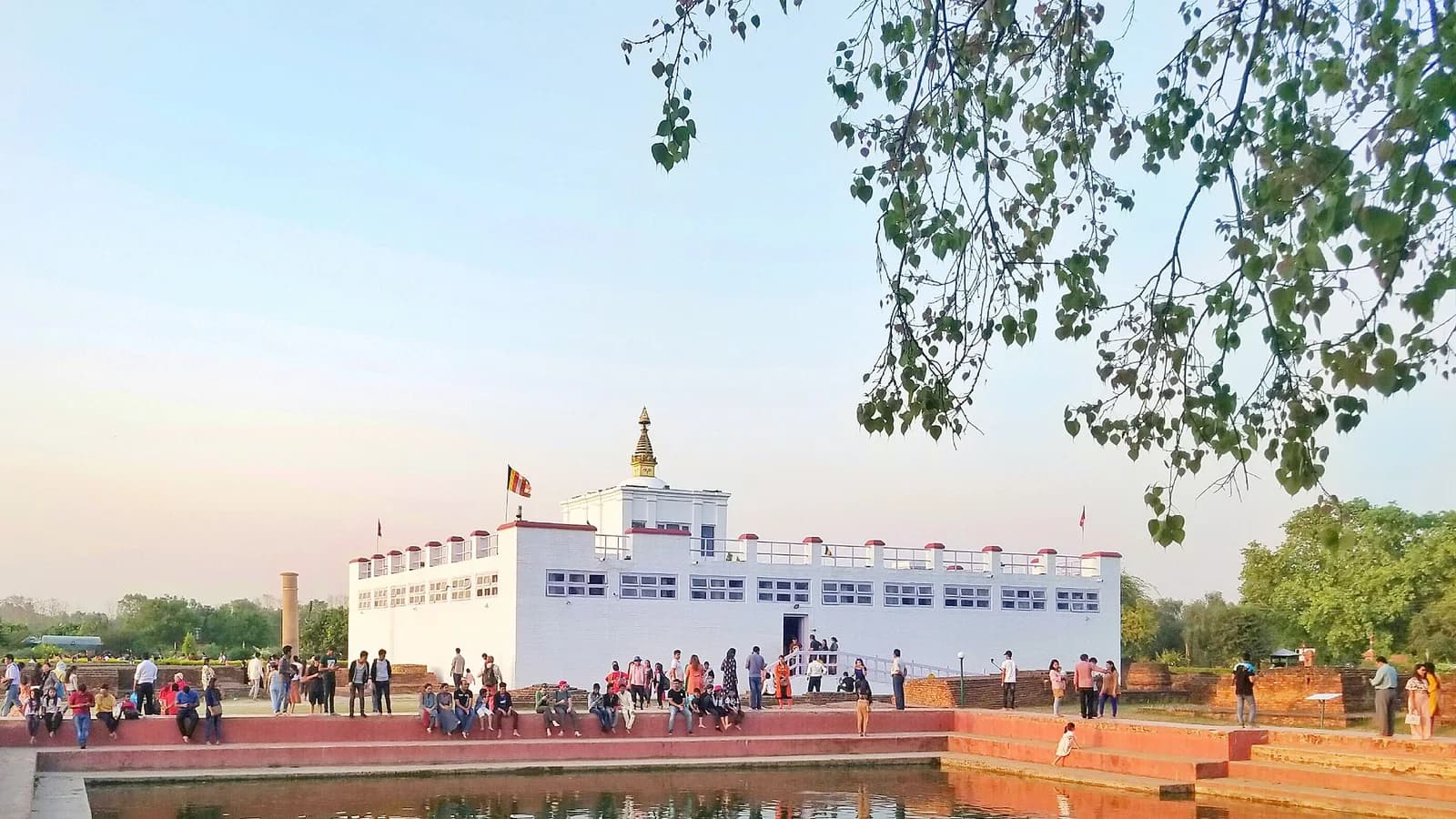
Lumbini, in the flat southern Terai near the Indian border, is the birthplace of Siddhartha Gautama — the historical Buddha — and one of the most significant pilgrimage sites in the Buddhist world. It is also genuinely remote from Nepal's tourist core: a short flight or a long, hot day's drive from Kathmandu. Getting the Kathmandu to Lumbini leg right is the difference between arriving fresh for a contemplative day among the monasteries and arriving frazzled after an unplanned eleven hours on the road. This guide breaks down the three realistic ways to make the trip — tourist bus, flight via Bhairahawa, and private jeep — with honest notes on cost, time, and the final hop into Lumbini itself, as of 2026.
All figures below come from operators and recent reporting (linked at the end). Fares and road conditions shift, so treat them as a guide and confirm when you book.
Key takeaways
- Lumbini lies roughly 250 to 280 km south of Kathmandu, with no airport at the site itself — flights use Bhairahawa nearby.
- The road trip is a full day: commonly 8 to 10 hours by bus, a little less by private jeep.
- Flying is the fast option: about 25 minutes to Bhairahawa, then roughly 30 minutes by road to Lumbini.
- A tourist bus runs around NPR 1,500 to 2,500; a local bus roughly NPR 600 to 1,000 (as of 2025).
- The final Bhairahawa-to-Lumbini hop (about 25–28 km) is a short taxi (~NPR 1,000) or a cheap local bus.
- Lumbini pairs naturally with Chitwan and Pokhara, which sit along the same Terai highway corridor.
Where you are actually going
A little geography helps. "Lumbini" is both a sacred garden and a wider area in Nepal's southern lowlands. The heart of any visit is the Maya Devi Temple, which marks the traditional spot of the Buddha's birth, surrounded by a sacred garden, the Ashokan pillar, and a sprawling monastic zone where Buddhist nations — Japan, China, Korea, Thailand, Myanmar, Sri Lanka, and others — have each built a monastery.
The nearest city is Bhairahawa (officially Siddharthanagar), about 25 to 28 km away, and that is where the airport sits. When you book a flight "to Lumbini," you are really flying to Bhairahawa and finishing the journey by road. For a fuller sense of whether the site suits your travel style, our honest take on whether Lumbini is worth visiting is a good companion to this logistics guide.
Option 1: Tourist bus — the budget standard
For most independent travellers on a budget, a bus is the default way south. There are two very different classes of service, and the distinction matters.
A tourist bus is a reserved-seat coach aimed at travellers, with assigned seats, more space, and scheduled rest stops. A local bus is far cheaper but crowded, slower, and stops constantly.
What to expect:
- Departure: Buses typically leave Kathmandu early, often around 6:30 to 7:30 AM, to complete the long run in daylight. Many depart from the tourist bus areas or the Gongabu / New Bus Park depending on service.
- Journey time: Plan for 8 to 10 hours including meal and toilet stops.
- Cost: Tourist buses generally run around NPR 1,500 to 2,500 per person; local buses roughly NPR 600 to 1,000 (as of 2025).
One important catch: despite what some agents claim, services do not always run door-to-door into Lumbini village. Many terminate at Bhairahawa or a nearby junction, from where you finish with a short local bus or taxi. Confirm the exact drop-off when you book. The booking and departure pattern mirrors the Kathmandu to Chitwan tourist bus, which heads into the same Terai region along much of the same highway.
Option 2: Flight to Bhairahawa — the time-saver
There is no airport at Lumbini, but Gautam Buddha International Airport at Bhairahawa serves the area, and flying turns a full day into a morning.
Buddha Air, Yeti Airlines and Shree Airlines all operate the Kathmandu–Bhairahawa sector on ATR turboprops, with a flying time of roughly 25 minutes. Once you land, Lumbini is about 25 to 28 km away — a 30-minute taxi or local bus.
The trade-offs:
- Cost: A flight is far more expensive than the bus, and like all Nepali domestic routes it uses nationality-based fares, so foreign tourists pay a higher US-dollar fare. Prices swing with season and demand, so confirm the live fare directly rather than relying on any single quote.
- Weather: Small domestic aircraft are vulnerable to fog and monsoon cloud. Book the earliest slot of the day and keep a buffer before any onward connection.
- Baggage: Domestic limits are tighter than international ones — check before arriving with a large bag.
For how the two-tier fare system and the wider domestic network operate, see our guide to domestic flights in Nepal. Flying makes the most sense if your time in Nepal is short, or if you simply want to skip a long, hot road day.
Option 3: Private jeep or car — comfort and control
If you are travelling as a small group or a family, or you value setting your own schedule, a private jeep or car is the most comfortable road option. You pick the departure time, you can break the journey where you like, and you go closer to door-to-door.
Cost: A private jeep from Kathmandu to Lumbini generally runs in the region of NPR 15,000 to 25,000 depending on the vehicle and number of passengers (as of 2025). Split between three or four people, the per-head cost becomes far more reasonable, and you avoid both the fixed bus schedule and the awkward final transfer.
Why pick it: beyond comfort, a private vehicle lets you turn the journey into part of the trip — pausing for views in the hills, or routing via Chitwan to combine the jungle and the pilgrimage in one southbound run.
The routes south, and the scenery
There is no single "Lumbini highway"; the drive stitches together hill and plains roads, and the distance varies with the route — anywhere from roughly 185 km via Syangja to nearer 300 km if you swing via Narayanghat and Chitwan. Broadly, vehicles leave the Kathmandu valley, descend through the middle hills, and then run west along the flat East-West (Mahendra) Highway across the Terai toward Bhairahawa.
That overlap with the Terai corridor is exactly why Lumbini combines so well with Chitwan: the two sit on the same lowland highway, so you need not backtrack through Kathmandu between them.
Timing and seasonal cautions
| Concern | Practical note | |---|---| | Best departure | Early morning to finish the long drive in daylight | | Heat | The Terai is hot and humid — pack light clothing and water | | Monsoon (Jun–Sep) | Landslides and flooding can stretch or block routes | | Motion sickness | Hill sections are winding — sit forward, bring tablets |
The final hop: Bhairahawa to Lumbini
However you reach Bhairahawa — by air or by a bus that terminates there — you still have the last 25 to 28 km into Lumbini to cover, about a 30-minute trip. Two easy options:
- Taxi: the simplest, especially straight from the airport, costing roughly NPR 1,000. Agree the fare before you set off.
- Local bus: far cheaper at around NPR 100, but slower, busier, and less direct.
If you have flown in with luggage after a long day, the taxi is usually worth it. For a primer on negotiating fares and avoiding overcharging on these short transfers, our Nepal tourist scams guide is a useful read.
A cost-and-time comparison
| Option | Time (door to door) | Rough cost | Comfort | |---|---|---|---| | Tourist bus | ~8–10 hours | NPR 1,500–2,500 | Good — reserved seats, stops | | Local bus | ~9–11 hours | NPR 600–1,000 | Basic — crowded, slow | | Flight via Bhairahawa | ~2–3 hours | Much higher; varies by season | High, but weather-dependent | | Private jeep | ~7–9 hours | NPR 15,000–25,000 per vehicle | Highest; flexible, door to door |
All prices are indicative and as of 2025; confirm current fares when you book, as Nepali transport pricing shifts with fuel costs and season.
Combining Lumbini with the rest of your trip
Lumbini rarely makes sense as a there-and-back day trip from Kathmandu — the distance is simply too great. It shines as part of a wider loop. Two patterns work especially well:
- With Chitwan: both sit in the Terai along the east-west highway, so you can link rhinos and the Buddha's birthplace without returning to Kathmandu. Our Kathmandu to Chitwan guide covers that leg.
- With Pokhara: tourist buses run Pokhara to Lumbini in around 8 hours, making a Kathmandu–Pokhara–Lumbini chain a natural southern arc.
A border crossing into India near Sunauli also lies close to Bhairahawa, so Lumbini is a logical last Nepali stop for travellers heading on to Uttar Pradesh.
A few useful Nepali phrases for the road
- Lumbini jaane bus kahaa baata chhutchha? — "Where does the bus to Lumbini leave from?"
- Kati ghantaa laagchha? — "How many hours does it take?"
- Bhairahawa dekhi Lumbini kati paryo? — "How much from Bhairahawa to Lumbini?"
- Yahaan rokna paaincha? — "Can we stop here?"
- Bistaarai! — "Slowly!" (to an over-enthusiastic driver)
For more travel vocabulary to smooth the journey, see our roundup of Nepali phrases every trekker should know.
Pre-trip checklist
- Decide bus, flight, or private jeep based on budget and how much of a day you can spare.
- If taking a bus, confirm whether it ends at Lumbini or only at Bhairahawa.
- If flying, confirm the live fare and plan the Bhairahawa-to-Lumbini taxi or bus.
- Pack light clothing for the hot Terai, plus water and motion-sickness tablets.
- Build in a buffer during the monsoon, when landslides and flooding slow the route.
- Read up on the site itself in our is Lumbini worth visiting guide before you go.
The journey to Lumbini is long, but the reward is one of the quietest, most resonant places in Nepal. Choose the option that matches your time and budget, leave early, and you can be walking the sacred garden — where a pilgrimage that spans 2,500 years still draws the faithful — by the cool of the same evening.
Sources
- Eco Nepal Trekkers — Kathmandu to Lumbini by bus, jeep and flight, cost 2025/26
- The Longest Way Home — How to get to Lumbini 2026: flights, buses and border routes
- Third Rock Adventures — Getting from Kathmandu to Lumbini
- Graceful Adventure — Pokhara to Lumbini tourist bus ticketing
- Holidify — How to reach Lumbini: flights, buses and taxi
Frequently asked questions
- How far is Lumbini from Kathmandu?
- Lumbini sits in the southern Terai plains near the Indian border, roughly 250 to 280 kilometres from Kathmandu by road depending on the route. There is no perfectly direct highway, so journeys wind through the hills before dropping onto the plains, which is why the drive takes most of a day.
- How long does it take to get from Kathmandu to Lumbini?
- By road it is a long day, commonly 8 to 10 hours by bus including stops, and a little less by private jeep. By air it is dramatically faster: the flight to Bhairahawa takes about 25 minutes, plus roughly 30 minutes by road from the airport to Lumbini. Monsoon landslides and traffic can stretch road times.
- Is there an airport at Lumbini?
- Not at Lumbini itself, but the nearby Gautam Buddha International Airport at Bhairahawa serves the area. It sits about 25 to 28 kilometres from Lumbini, around a 30-minute drive by taxi or local bus. Buddha Air, Yeti Airlines and Shree Airlines fly there from Kathmandu in roughly 25 minutes.
- How much is a tourist bus from Kathmandu to Lumbini?
- Tourist buses generally run around NPR 1,500 to 2,500 per person, while cheaper local buses cost roughly NPR 600 to 1,000 (as of 2025). Tourist buses are reserved-seat coaches aimed at travellers; local buses are crowded and slower. Book a tourist bus a day or two ahead through your hotel in peak season.
- How do I get from Bhairahawa to Lumbini?
- From Bhairahawa it is about 25 to 28 kilometres to Lumbini, roughly a 30-minute trip. A taxi costs in the region of NPR 1,000, while a local bus is far cheaper at around NPR 100 but slower and less direct. If you fly in, arrange the transfer in advance or simply take a taxi from outside the terminal.
- Can I visit Lumbini from Pokhara or Chitwan instead of Kathmandu?
- Yes, and many itineraries do. Tourist buses run from Pokhara to Lumbini in around 8 hours, and Lumbini pairs naturally with Chitwan since both sit in the Terai along the east-west highway corridor. A common loop links Kathmandu, Pokhara, Lumbini and Chitwan without backtracking through the capital each time.
- How long do I need at Lumbini?
- Most visitors find one full day, or an overnight stay with a morning at the site, is enough to see the Maya Devi Temple, the sacred garden, and a selection of the international monasteries in the monastic zone. Lumbini is a quiet, contemplative place rather than a packed sightseeing hub, so it rewards an unhurried pace.
- Is the road to Lumbini difficult?
- It is a long highway journey through hills and then flat Terai plains rather than a technically hard road, but it is tiring and can be slow. The hill sections are winding, and the monsoon between June and September brings landslide and flooding risk. Tourist buses are reasonably comfortable; carry water, snacks, and motion-sickness tablets.
Spotted an error in this post? Tell us or suggest a correction.
Related posts
ABC Trek: A Plain-English Guide to Annapurna Base Camp
The ABC trek (Annapurna Base Camp) explained — the route, how many days it takes, difficulty, the best seasons, and what daily trail life is really like.
Read postAma Dablam Climb: 2026 Expedition Guide (6,812m)
An Ama Dablam climb and expedition guide for 2026 — height, the Southwest Ridge route, camps, fixed ropes, difficulty, permits, cost and the best seasons.
Read postAnnapurna vs Manaslu: Which Trek Should You Choose?
An Annapurna vs Manaslu decision guide for trekkers — compare permits, crowds, difficulty, infrastructure and cost to pick the right Himalayan route.
Read postAsan Bazaar Kathmandu: Old Town Market Guide
A visitor guide to Asan bazaar, Kathmandu's oldest market — its six-road square, Annapurna Temple, what to buy, when to go, and how to get there.
Read postAyurveda Nepal: A Traveller's Guide to Healing
Ayurveda Nepal explained for tourists — the history, the doshas, treatments like Panchakarma and Shirodhara, where to go and how to choose a centre safely.
Read postBest Restaurants Pokhara Lakeside: Where to Eat
The best restaurants in Pokhara Lakeside — lakeside trout, wood-fired pizza, Tibetan momos and healthy cafes, with what to order and rough 2026 prices.
Read post