Domestic Flights in Nepal: Buddha Air, Yeti & More (2026)
A tourist's guide to domestic flights in Nepal — Buddha Air and Yeti Airlines routes, two-tier fares, baggage rules, Lukla and mountain flights, and booking tips.
In a country folded into Himalayan ridgelines, a 25-minute flight can replace a brutal 8-hour bus — but the mountains still decide when you actually leave.
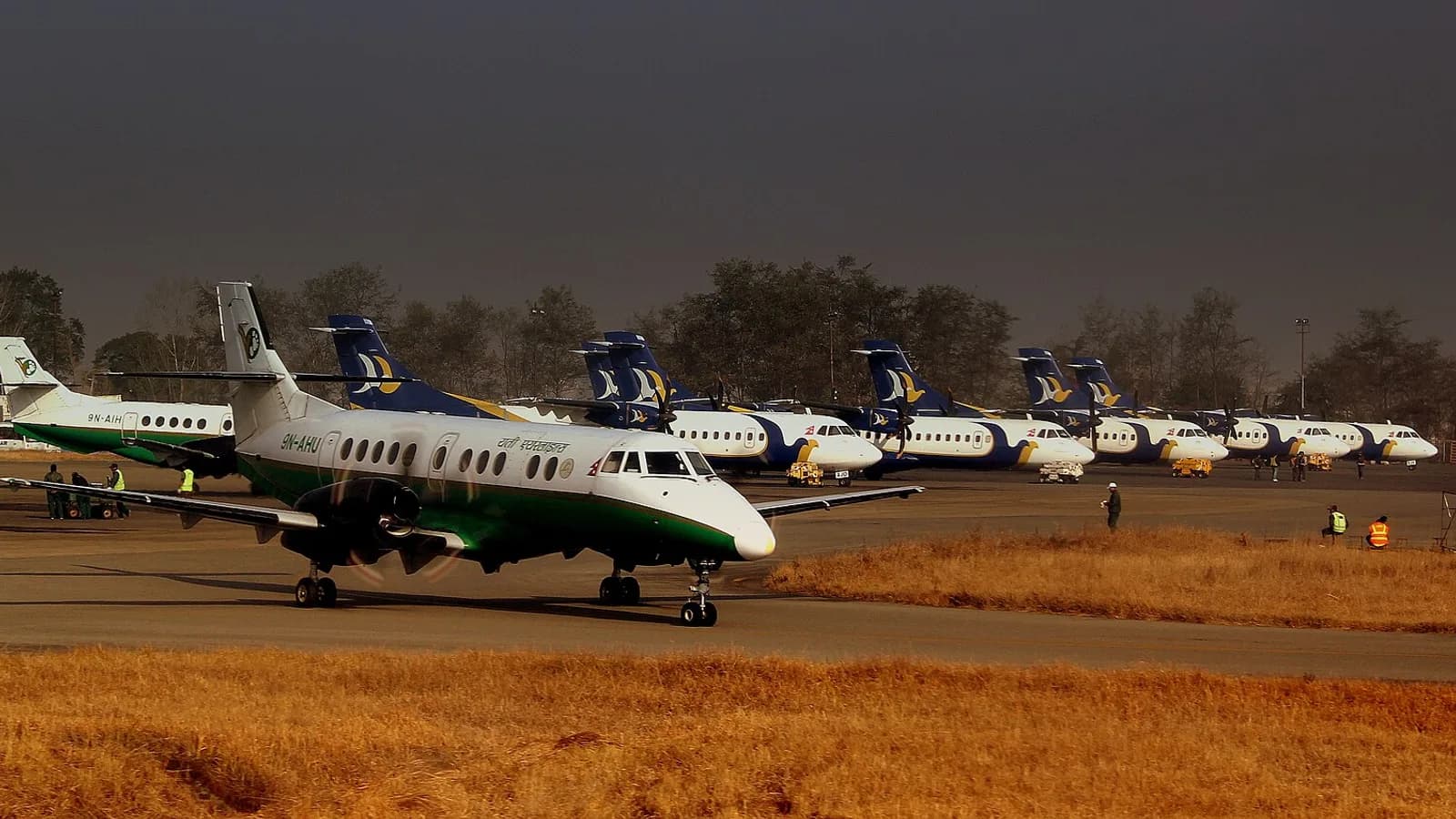
For a country the size of a single American state, Nepal is astonishingly hard to cross by road. Hills fold into deeper hills, a 200-kilometre journey can swallow a whole day, and the highways close on a landslide's whim. That is exactly why domestic flights in Nepal matter so much to travellers: a 25-minute hop can replace a punishing eight-hour bus, and on some routes flying is the only sane way to reach the trailhead at all. This guide covers the airlines you will actually fly — chiefly Buddha Air and Yeti Airlines — along with the routes, the fares, the baggage rules, and the quirks that catch first-timers out.
The headline thing to understand is that Nepal's domestic network is built around a handful of busy "trunk" routes and a scattering of short, dramatic mountain strips. Get your head around how the two differ and the whole system suddenly makes sense.
Key takeaways
- Buddha Air and Yeti Airlines are the two big carriers, both flying ATR turboprops; Shree Airlines and small mountain operators fill the gaps.
- Nepal uses nationality-based pricing — foreigners pay a higher USD fare than locals, and your passport is checked at the counter.
- The flagship route, Kathmandu to Pokhara, takes about 25 minutes and runs many times a day.
- Lukla flights (the Everest gateway) often depart from Ramechhap/Manthali in peak season, adding a long road transfer.
- Mountain routes have strict baggage limits (around 15 kg) versus roughly 20 to 25 kg on trunk routes.
- Flights are weather-dependent; book the earliest slot of the day and leave buffer days before any onward flight home.
The airlines you will actually fly
Nepal's domestic market is dominated by a small number of carriers, and as a tourist you will almost certainly end up on one of the first two below.
Buddha Air is the largest domestic airline in the country, flying a sizeable fleet of ATR 72 and ATR 42 turboprops to more than a dozen domestic destinations, plus the occasional cross-border service. It runs the highest frequency on the Kathmandu–Pokhara route and is the main operator of scenic Everest "mountain flights."
Yeti Airlines is the other heavyweight, operating modern ATR 72 aircraft to the major cities — Pokhara, Bharatpur, Bhairahawa, Nepalgunj, Biratnagar, Bhadrapur, Janakpur and more. Yeti markets itself heavily on its environmental credentials as a carbon-offsetting airline.
Shree Airlines runs jets on some of the busier routes and is often competitive on price for the Kathmandu–Pokhara sector.
Tara Air, Summit Air and Sita Air are the specialists you meet only if you are heading into the high mountains. They fly small short-takeoff aircraft into strips like Lukla and Jomsom that the big ATRs cannot use.
The practical upshot: for city-to-city travel you will book Buddha, Yeti or Shree; for a trek that starts at a mountain airstrip, your agency will usually put you on one of the small-plane operators.
The trunk routes — where flying beats the bus
These are the bread-and-butter sectors: short flights between Kathmandu and Nepal's regional hubs, operated many times a day by the big carriers.
| Route | Flight time | Why fly it | |---|---|---| | Kathmandu – Pokhara | ~25 min | Skip a long, winding road day to the lakes and Annapurna trailheads | | Kathmandu – Bharatpur | ~20 min | Quick access to Chitwan National Park's jungle safaris | | Kathmandu – Bhairahawa | ~35 min | Gateway to Lumbini, the birthplace of the Buddha | | Kathmandu – Biratnagar / Bhadrapur | ~45–55 min | Reach the far east without a multi-day overland slog | | Kathmandu – Nepalgunj | ~1 hr | Springboard for the remote far west and onward mountain flights |
The flagship is Kathmandu to Pokhara, flown many times daily by Buddha, Yeti and Shree. For the wider comparison of flying versus the tourist coach on this route — cost, comfort and reliability — see our dedicated breakdown of Kathmandu to Pokhara transport options. In short: the flight saves most of a day, but the bus is a fraction of the price and never gets fogged out.
Two-tier pricing: why your fare differs from the locals'
This trips up almost every first-time visitor, so it is worth being blunt about it. Nepal charges different fares by nationality:
- Nepali citizens pay the lowest, locally subsidised fare in rupees.
- Indian nationals often have their own intermediate fare.
- Other foreign tourists pay a higher fare quoted in US dollars.
This is entirely normal and openly published on the airlines' own booking pages — it is not a scam. What does cause grief is travellers who try to book the cheap "Nepali" fare to save money. The airline checks your original passport at check-in, and if your ticket does not match your nationality you will be sent to the counter to pay the difference in cash before you are allowed to board. Book the correct fare class from the start and the airport is painless.
On the busiest route, Kathmandu–Pokhara, foreign-tourist one-way fares have typically sat in the region of USD 100 to 145 depending on airline and timing (as of mid-2025), against roughly NPR 5,000 to 6,500 for Nepali passengers. Treat those as ballpark figures only — always confirm the live price on the airline's website or a reputable Nepali ticketing aggregator, because fares climb steadily as festivals and peak season approach. For how flights fit into a wider trip cost, our Nepal travel budget guide puts the numbers in context.
Lukla and the Ramechhap shuffle
If you are trekking to Everest Base Camp, the famous Lukla flight is its own special category — and the single most misunderstood piece of Nepal's air network.
Lukla's Tenzing–Hillary Airport sits at around 2,840 m on a short, sloping cliffside runway, served only by small aircraft from operators like Tara Air, Summit Air and Sita Air. In the quieter months you fly there directly from Kathmandu in roughly 30 to 40 minutes. But during the two big trekking seasons — broadly spring and autumn — Kathmandu's single runway becomes too congested, and the civil aviation authority shifts most Lukla flights to Manthali Airport in Ramechhap, well east of the capital.
That diversion has real consequences for your itinerary:
- You face a road transfer of roughly four to five hours from Kathmandu to Ramechhap.
- To catch an early-morning slot you may need to leave Kathmandu around 1 to 2 AM.
- The flight itself from Ramechhap to Lukla is only about 20 minutes.
- Fares are nationality-based here too, with foreign-tourist Lukla tickets typically quoted in USD and substantially higher than the Nepali rate.
Because the dates of the Ramechhap switch change year to year, do not assume — confirm with your trekking agency exactly where your flight departs from. Our Everest Base Camp itinerary guide folds these transfer realities into the day-by-day plan.
Mountain flights: seeing Everest without the trek
Not everyone has two weeks and a strong pair of legs. The mountain flight is Nepal's elegant answer: a scenic sightseeing flight from Kathmandu that cruises east along the Himalaya toward Everest and turns back, without landing anywhere.
What to expect:
- Duration of roughly one hour door-to-door in the air.
- A guaranteed window seat for every passenger on operators like Buddha Air, since the whole point is the view.
- A very early departure, often around dawn, when the peaks are clearest.
- Foreign-tourist pricing generally in the low-to-mid USD 200s per person (as of mid-2025) — check the operator for the current figure.
On a clear morning you get a parade of giants culminating in Everest itself. It is weather-dependent like everything else here, so the earliest flights have the best odds. If a Himalayan panorama at sunrise is more your speed than a flight, compare it with land-based viewpoints in our best time to visit Nepal overview, which explains when the skies are clearest.
Baggage, check-in and what the rules really mean
Allowances differ sharply between trunk and mountain routes, and the mountain limits are enforced for genuine safety reasons on short, high-altitude strips.
| Route type | Typical checked allowance | Notes | |---|---|---| | Trunk (Pokhara, Bharatpur, etc.) | ~20–25 kg | Plus a small carry-on; excess charged per kg | | Mountain (Lukla, Jomsom) | ~15 kg total | Often split as ~10 kg checked + ~5 kg carry-on |
A few practical points:
- Excess baggage is charged roughly per kilogram, so weigh your pack before you reach the counter.
- Carry your original passport — foreigners cannot check in without it, and it is also how the fare class is verified.
- Domestic terminals are basic; arrive with time to spare and do not rely on card payment for excess fees.
- Pack heavy trekking gear with the mountain-route limit in mind; consolidate, and store anything non-essential in Kathmandu.
For the wider kit question on a trek that involves a flight in, our trekking packing list helps you cut weight before you ever reach the airport scales.
When the mountains ground you: weather and delays
Here is the rule that governs everything: most of Nepal's domestic flights operate under visual flight rules. The pilot has to be able to see the ground and the surrounding peaks. Fog sitting over Kathmandu at dawn, or a bank of cloud parked over a mountain strip, and the flight simply does not go.
That has a few firm implications for how you plan:
- Always book the earliest flight of the day. Mornings are clearest; delays cascade as the day wears on.
- Build buffer days. If you have an international flight home, never schedule your Lukla or Pokhara return for the same day — give yourself a spare day in case of cancellation.
- If your flight is cancelled for weather, you are generally entitled to a refund or a seat on the next available service, usually handled at the airport counter.
- Monsoon (roughly June to August) is the least reliable window; autumn is the most dependable.
This is not a reason to avoid flying — it is a reason to plan around it. The travellers who get burned are the ones with zero slack in their schedule.
Booking: how to actually get a seat
You have several sensible ways to book a domestic flight in Nepal:
- Airline websites. Buddha Air, Yeti and Shree all sell directly online and clearly show the foreign-tourist fare.
- Nepali ticketing aggregators. Local platforms let you compare timings and fares across airlines on a single route, which is handy for matching a flight to your itinerary.
- Your hotel or a Thamel travel agency. Convenient and human, though you may pay a small markup for the service.
- Your trekking agency. For Lukla and other mountain strips this is usually the simplest path — they know the Ramechhap status and handle the road transfer.
A couple of habits pay off. Book early in peak season, because fares only rise as Dashain, Tihar and the autumn trekking rush approach — they rarely fall at the last minute. And confirm your departure airport and time the day before, especially for anything touching Lukla.
The new Pokhara airport, briefly
You may have read about Pokhara International Airport, the newer facility that opened on the edge of town. As of 2026 it primarily handled domestic flights plus occasional charters, and had not secured regular scheduled international services. For practical purposes, that means most foreign visitors still enter Nepal through Kathmandu and connect onward to Pokhara on a domestic flight, exactly as before. Once you land in Pokhara, our guide to the best things to do in Pokhara takes over.
A few Nepali phrases for the airport
Staff at the main airports speak workable English, but a word or two goes a long way and is appreciated:
- Bimansthal — "airport."
- Udaan kati baje ho? — "What time is the flight?"
- Mero udaan radda bhayo? — "Has my flight been cancelled?"
- Dhanyabaad — "thank you."
For a fuller travel vocabulary, our Nepali phrases every trekker should know covers the situations you will actually meet on the road and in the hills.
Is flying worth it?
For long sectors that would otherwise eat a day of mountain road — Kathmandu to Pokhara, to the eastern cities, or into Lukla — flying is genuinely transformative, turning a gruelling overland slog into a short morning hop with a Himalayan view thrown in. The trade-offs are real: you pay a tourist premium, the baggage rules bite on mountain routes, and the weather holds a veto over your plans. Manage those three things — correct fare, light bag, buffer day — and Nepal's little turboprops become one of the best parts of the trip.
Sources
- Yeti Airlines — official site
- Buddha Air — flight status and routes
- Buddha Air — Mount Everest sightseeing (mountain) flight
- Pokhara International Airport — CAAN official portal
- Pokhara International Airport — Wikipedia
- Domestic Airlines in Nepal: Fares, Baggage & Refunds (TripTurbo)
- Flying to Lukla via Ramechhap / Manthali Airport (Safe Holiday Adventure)
- Who Are Nepal's Main Airlines in 2025? (Avio Space)
Frequently asked questions
- Who are the main domestic airlines in Nepal?
- The two largest are Buddha Air and Yeti Airlines, both flying ATR turboprops to the busy trunk routes like Kathmandu to Pokhara. Shree Airlines also runs jets on some routes, while smaller carriers such as Tara Air, Summit Air and Sita Air specialise in short-runway mountain strips like Lukla and Jomsom.
- Do foreigners pay more than locals for domestic flights in Nepal?
- Yes. Nepal uses nationality-based pricing, so there is one fare for Nepali citizens, often a separate fare for Indian nationals, and a higher USD fare for other foreign tourists. The airline checks your passport at the counter, and if you booked the wrong fare you will be asked to pay the difference in cash before boarding.
- How much is a flight from Kathmandu to Pokhara?
- For foreign tourists the one-way fare is typically in the range of about USD 100 to 145 depending on the airline and season (as of mid-2025), versus roughly NPR 5,000 to 6,500 for Nepali citizens. Always confirm the live price on the airline website or a Nepali aggregator before you book, as fares move with demand.
- Why do Lukla flights leave from Ramechhap instead of Kathmandu?
- During the busy spring and autumn trekking seasons, Kathmandu's single-runway airport gets too congested, so the civil aviation authority shifts most Lukla flights to Manthali Airport in Ramechhap. That means a long pre-dawn road transfer of roughly four to five hours from Kathmandu before your short flight to Lukla.
- What is the baggage allowance on Nepal domestic flights?
- On trunk routes such as Pokhara and Bharatpur you usually get around 20 to 25 kg of checked baggage. On mountain routes like Lukla and Jomsom the limit is much stricter, commonly about 15 kg total including hand luggage. Excess baggage is charged per kilogram, so weigh your trekking gear before you go.
- Are Nepal domestic flights safe and why do they get cancelled?
- Most domestic flights operate under visual flight rules, meaning pilots need to see the ground and the peaks. Fog in Kathmandu or cloud over a mountain strip will ground a flight, so cancellations and delays are common, especially in monsoon. Book the earliest flight of the day and build buffer days into any trip with a fixed onward connection.
- What is a mountain flight in Nepal?
- A mountain flight is a roughly one-hour scenic sightseeing flight from Kathmandu that cruises along the Himalaya toward Everest and back, without landing. Operators such as Buddha Air guarantee every passenger a window seat so you can photograph the peaks. It is a good option if you want to see Everest but cannot trek.
- Can I fly into Pokhara's new international airport?
- Domestic flights operate into Pokhara, and the newer Pokhara International Airport handles domestic services along with occasional charters. As of 2026 it had no regular scheduled international flights, so most tourists still arrive in Nepal through Kathmandu and connect onward on a domestic flight.
Spotted an error in this post? Tell us or suggest a correction.
Related posts
Buddha Air: A Tourist's Guide to Nepal's Top Airline
A traveller's guide to Buddha Air — routes, ATR fleet, the Everest mountain flight, fares, baggage rules and booking tips for Nepal's largest airline.
Read postBest Restaurants Pokhara Lakeside: Where to Eat
The best restaurants in Pokhara Lakeside — lakeside trout, wood-fired pizza, Tibetan momos and healthy cafes, with what to order and rough 2026 prices.
Read postIs Nepal Cash Only? Cards, QR and Cash in 2026
Is Nepal cash only? Mostly yes for daily spending, but cards and tourist QR payments are spreading. Where each works, fees, and how much cash to carry.
Read postNepal 30 Day Visa: Cost, Rules, and Who It Suits
A focused guide to the Nepal 30 day visa — the USD 50 fee, multiple-entry rules, when to pick it over 15 or 90 days, and how to extend.
Read postNepal e-Visa: Online Application, ETA, and What to Expect
How the Nepal e-visa and ETA system actually works in 2026 — what you can do online, what still happens at the airport, fees, and documents.
Read postNepal Holiday Packages: How to Choose One in 2026
A practical guide to Nepal holiday packages — what they include, typical itineraries, costs, permits, the best seasons and how to compare operators.
Read post