Chandragiri Hills Cable Car: Tickets & Guide (2026)
A tourist's guide to the Chandragiri Hills cable car near Kathmandu — fares, ride time, the Bhaleshwor Mahadev temple, Himalaya views and how to get there.
From a ridge where a young king once gazed down and resolved to unify a country, you can now see the whole Kathmandu Valley on one side and the Himalaya on the other — after a ten-minute glide up the hill.
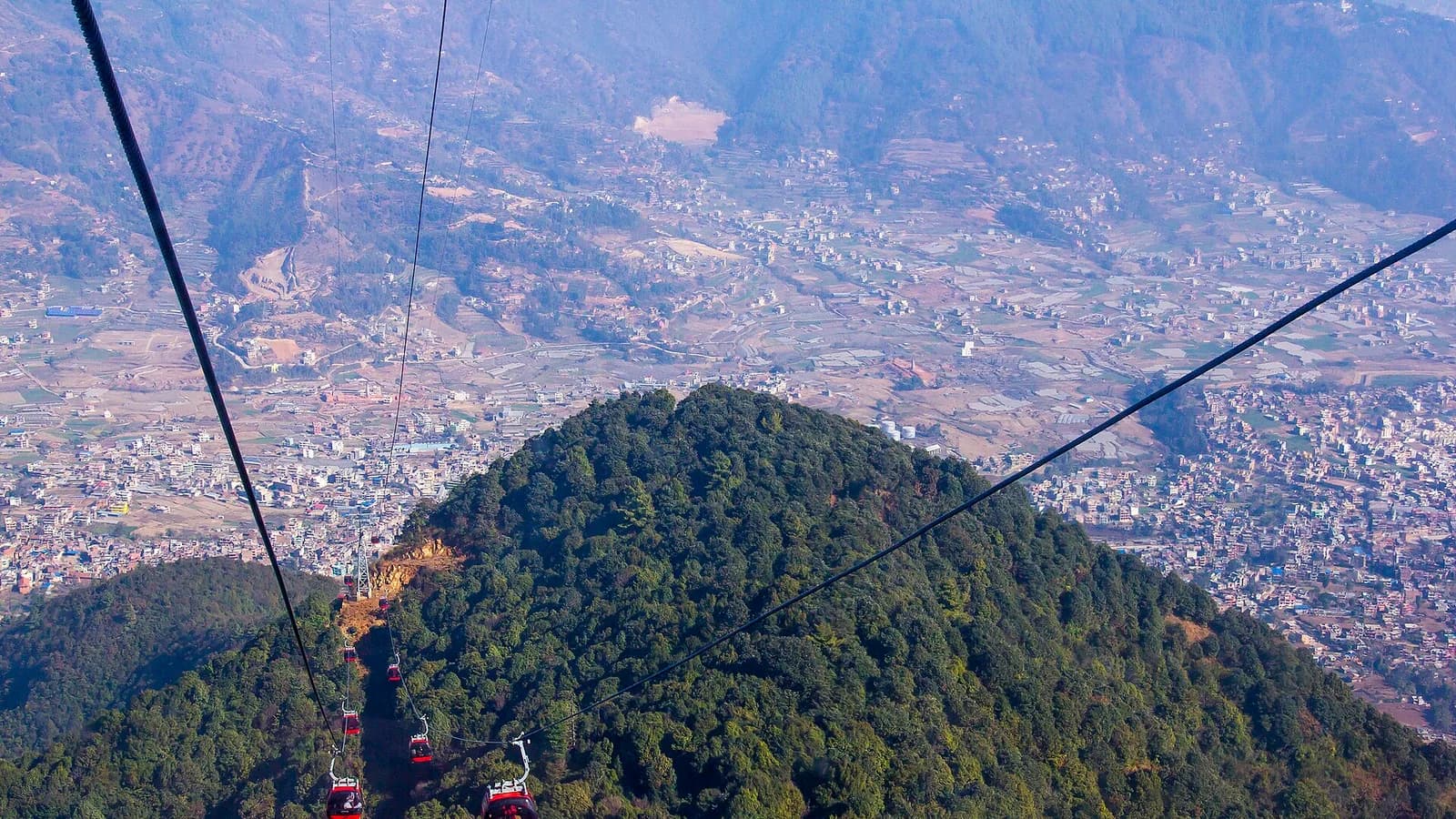
Most visitors to Kathmandu chase their Himalayan sunrise out at Nagarkot. But there is a closer, higher and more dramatic option hiding on the south-west rim of the valley: the Chandragiri Hills cable car. In about ten minutes it whisks you from a roadside base station up to a 2,551-metre ridge crowned by a Shiva temple — with the entire Kathmandu Valley spread out behind you and, on a clear day, a wall of snow peaks ahead. It is part scenic ride, part pilgrimage, part history lesson, and one of the easiest big-view half-days you can do from the capital.
This guide covers the fares, the ride, the temple and the views, plus exactly how to get there and how Chandragiri stacks up against the valley's other famous viewpoints.
Key takeaways
- The Chandragiri Hills cable car climbs from Thankot (~1,550 m) to a summit at about 2,551 m in roughly ten minutes.
- The base station is only about 12 to 14 km from central Kathmandu — an easy taxi ride.
- Foreign-tourist fares have run around USD 13 one way / USD 22 round trip (as of 2025), paid in rupees.
- At the top sits Bhaleshwor Mahadev, a Shiva temple steeped in legend and unification history.
- On clear days the summit offers a sweeping Himalayan panorama, with Everest visible far to the east.
- It is a strong, closer alternative to Nagarkot for big mountain views from Kathmandu.
What the Chandragiri cable car is
Chandragiri Hill rises on the south-western edge of the Kathmandu Valley, and the cable car is the quick, painless way to its summit. The line runs about 2.4 km and lifts passengers in distinctive cherry-red, eight-seat cabins from the base station at Thankot up to the hilltop, a vertical gain of roughly a thousand metres.
The ride takes about ten minutes (sources vary between roughly nine and thirteen depending on conditions), and it is the headline experience in itself. As the cabin climbs, the city shrinks into a grey-green sprawl across the valley floor, the surrounding hills roll away in waves, and — weather permitting — the Himalaya line the northern horizon. It is a remarkable amount of scenery for a short, smooth ride.
The base station typically operates daily from morning until evening (commonly around 9:00 AM to 7:00 PM, sometimes with a short midday break), but hours can change seasonally, so check before a late visit.
Tickets and fares
As at most Nepali attractions, Chandragiri uses tiered pricing by nationality — separate rates for Nepali citizens, Indian nationals and other foreign tourists. Tickets are sold one-way or as a round trip.
For foreign tourists, fares have generally been in the region of USD 13 one way and USD 22 round trip (as of 2025). A useful quirk: the prices are advertised in US dollars but paid in Nepali rupees at the counter, so you do not need to carry dollars. Children's and local rates are lower.
Treat those numbers as a guide, not a guarantee — prices drift over time and across listings. Confirm the current fare on the official Chandragiri Hills website or at the base-station ticket office, and carry enough rupees to cover tickets plus anything you want to do at the top.
Bhaleshwor Mahadev: the temple and its legends
What lifts Chandragiri above a simple viewpoint is the Bhaleshwor Mahadev temple at its summit — a Hindu shrine to Lord Shiva wrapped in two powerful strands of Nepali tradition.
The first is mythological. By legend, when the goddess Sati died and the grief-stricken Shiva carried her body across the world, her forehead fell to earth on Chandragiri Hill. The name Bhaleshwor is read as deriving from Bhala (forehead) and Ishwor (god), marking the spot. It ties this modest hilltop into the vast geography of Hindu sacred sites scattered across South Asia.
The second is historical, and it is the one that resonates most with Nepalis. Tradition holds that it was from Chandragiri that the young King Prithvi Narayan Shah first looked down on the Kathmandu Valley and resolved to bring it into a single, unified Nepal — surveying the Malla kingdoms below before his campaign. Standing on the same ridge and seeing the whole valley at a glance, the story suddenly feels very tangible. To connect that to where his campaign ended, our guide to Kathmandu Durbar Square covers the royal heart of the valley he set out to conquer.
Because Bhaleshwor Mahadev is an active temple, the usual courtesies apply: dress modestly, remove footwear where required, and ask before photographing worshippers. Our broader temple etiquette guide for tourists is a good primer.
The view: what you can actually see
On a clear day, the summit panorama is genuinely special, and it works in two directions:
- South and east: the entire Kathmandu Valley laid out below, with the city, the surrounding settlements and the ring of hills.
- North: a long stretch of the Himalaya, with ranges such as Langtang, Ganesh Himal and Gaurishankar, and Everest visible far to the east in the best conditions.
There is an observation deck, and some facilities offer telescopes to pick out individual peaks. The catch is the same as everywhere in Nepal: haze and cloud. The clear, dry months deliver the sharp views; the summer monsoon often draws a grey curtain across the mountains. For the seasonal picture, our best time to visit Nepal guide explains when the skies tend to be clearest.
More to do at the top
Chandragiri has been developed as a hilltop leisure destination, so the cable car is only the start. At the summit you will typically find:
| Attraction | What it is | |---|---| | Bhaleshwor Mahadev temple | The summit Shiva shrine and its viewpoints | | Observation deck | Panoramic spot for the valley and Himalaya | | Gardens and walkways | Landscaped grounds to stroll | | Restaurants and resort | Dining with a view, plus an on-site hotel | | Adventure activities | Paid extras such as a zipline, swing and skywalk |
The adventure activities are charged separately from the cable car ticket, so budget accordingly if you want to add a zipline or swing. The resort means you can also stay overnight to catch both sunset and a clear early-morning view — a quieter alternative to basing yourself in the city. If you would rather sleep down in Kathmandu, our guide to where to stay in Kathmandu lays out the neighbourhoods.
Hiking Chandragiri
You do not have to ride both ways. A moderate trail climbs from Thankot to the summit in roughly two to three hours through forest, and a popular plan is to hike one direction and take the cable car the other — most people walk up and glide down, or vice versa, buying a one-way ticket to suit.
For something more ambitious, longer ridge walks run along the valley's south-western rim, including routes toward Hattiban, turning the outing into a proper half-day hike with the cable car as one convenient leg. It is a great low-commitment way to get your boots on near the city without joining a multi-day trek.
Getting there from Kathmandu
The cable car's biggest practical advantage over Nagarkot is proximity. The base station at Thankot sits on the south-west edge of the valley, only about 12 to 14 km from central Kathmandu.
- By taxi: the simplest option, taking roughly 30 to 45 minutes from the city centre depending on traffic. Agree the fare or insist on the meter before setting off.
- By local bus: budget travellers can catch a bus from Kalanki toward Thankot, then walk the last stretch (around 20 minutes) to the base station.
- On an organised tour: many Kathmandu operators sell a half-day Chandragiri trip that bundles transport and the cable car ticket.
For the wider picture on taxis, meters, ride apps and buses in the capital, see our guide to getting around Kathmandu, which will save you a few rupees and a few headaches.
Chandragiri or Nagarkot?
This is the question most Kathmandu visitors are really asking, because both promise a Himalayan view from the valley rim. They suit different trips:
- Chandragiri is higher, closer to the city and built around a quick cable-car ride and a temple. It is ideal if you want a big view with minimal effort and travel time, plus a dose of history and some hilltop attractions. The view is more of a midday or sunset affair than a dawn pilgrimage.
- Nagarkot is further out to the north-east and is the classic sunrise destination, with a broader, more distant panorama best enjoyed by staying overnight. Our honest take on whether the early start pays off is in is the Nagarkot sunrise worth it.
If you are short on time and based in the city, Chandragiri usually wins on convenience. If a proper Himalayan sunrise is the goal and you do not mind an overnight, Nagarkot has the edge.
When to go
Two things shape the timing:
- Views: the dry autumn (roughly September to November) and spring (March to May) months bring the clearest skies and the best mountain visibility. The monsoon is green but hazy.
- Snow: at around 2,551 m, the summit occasionally gets a light dusting of snow in deep winter — a rare and popular event for valley residents, though never guaranteed.
For the clearest mountains and most comfortable weather, aim for a bright autumn or spring morning, and go on a weekday if you want to dodge the local weekend crowds.
A few Nepali phrases
A word or two of Nepali is always welcome at the counter and on the hill:
- Tikat kati ho? — "How much is the ticket?"
- Mathi pugna kati samaya lagcha? — "How long to get to the top?"
- Himal dekhincha? — "Can you see the mountains?"
- Dhanyabaad — "thank you."
Is the Chandragiri cable car worth it?
For a half-day out of Kathmandu, Chandragiri is hard to beat. You get a smooth, scenic ride, a temple with genuine mythological and historical weight, a sweeping valley-and-Himalaya panorama when the weather plays along, and the option to hike or add a little adventure — all within an easy taxi ride of the city. Pick a clear autumn or spring morning, confirm the current fare before you go, and the Chandragiri Hills cable car delivers one of the most rewarding, low-effort big views in the whole Kathmandu Valley.
Sources
- Bhaleshwor Mahadev — Wikipedia
- Chandragiri Hills — official site
- Chandragiri Cable Car ride — Chandragiri Hills
- Chandragiri entry fees and ticket prices (Travel Triangle)
- How to get from Kathmandu to Chandragiri Hills (Travelling Mandala)
- Chandragiri Hills Kathmandu — Complete Travel Guide (Himalayan Recreation)
Frequently asked questions
- How much is the Chandragiri Hills cable car ticket for foreigners?
- For foreign tourists the fare has typically been around USD 13 one way and USD 22 round trip (as of 2025), with separate lower rates for Nepali and Indian nationals. Prices are advertised in US dollars but paid in Nepali rupees at the counter. Always confirm the current rate on the official Chandragiri Hills website before you go.
- How long is the Chandragiri cable car ride and how high does it go?
- The ride takes roughly ten minutes each way over about 2.4 kilometres of cable. It lifts you from the base station at Thankot, around 1,550 metres, up to the summit at about 2,551 metres, climbing roughly a thousand metres with views of the valley and, on clear days, the Himalaya.
- How do I get to the Chandragiri cable car from Kathmandu?
- The base station is at Thankot on the south-west edge of the Kathmandu Valley, roughly 12 to 14 kilometres from the city centre. A taxi takes about 30 to 45 minutes and is the simplest option. Budget travellers can take a local bus from Kalanki toward Thankot and then walk to the base station.
- Can you see Everest from Chandragiri Hills?
- On a clear day you can see a broad sweep of the Himalaya from the summit, including ranges such as Langtang, Ganesh Himal and Gaurishankar, and Everest is visible far to the east in the best conditions. Views are sharpest in the dry autumn and spring months; monsoon haze often hides the peaks entirely.
- What is the Bhaleshwor Mahadev temple at the top of Chandragiri?
- Bhaleshwor Mahadev is a Hindu temple at the summit dedicated to Lord Shiva. By legend it marks the spot where the forehead of the goddess Sati fell to earth. The hill is also where, according to tradition, King Prithvi Narayan Shah looked over the Kathmandu Valley before his campaign to unify Nepal.
- What is there to do at Chandragiri Hills besides the cable car?
- Beyond the ride and the Bhaleshwor Mahadev temple, the hilltop has viewpoints, gardens, an observation deck, restaurants and a resort. There are also paid adventure activities such as a zipline, a swing and a skywalk, plus marked hiking trails along the ridge for those who want to walk one direction and ride the other.
- Can you hike up Chandragiri instead of taking the cable car?
- Yes. A moderate trail climbs from Thankot to the summit in roughly two to three hours through forest, and many visitors hike up and ride the cable car down, or the reverse. Longer ridge walks, such as the route toward Hattiban, let you turn the trip into a half-day hike with the cable car as one leg.
- Does it snow at Chandragiri Hills?
- Occasionally, yes. At around 2,551 metres the summit is high enough that it sometimes gets a light dusting of snow in the depths of winter, which is a rare treat for valley residents and draws crowds when it happens. Snow is not guaranteed in any given year, so treat it as a bonus rather than a plan.
Spotted an error in this post? Tell us or suggest a correction.
Related posts
ABC Trek: A Plain-English Guide to Annapurna Base Camp
The ABC trek (Annapurna Base Camp) explained — the route, how many days it takes, difficulty, the best seasons, and what daily trail life is really like.
Read postAma Dablam Climb: 2026 Expedition Guide (6,812m)
An Ama Dablam climb and expedition guide for 2026 — height, the Southwest Ridge route, camps, fixed ropes, difficulty, permits, cost and the best seasons.
Read postAnnapurna vs Manaslu: Which Trek Should You Choose?
An Annapurna vs Manaslu decision guide for trekkers — compare permits, crowds, difficulty, infrastructure and cost to pick the right Himalayan route.
Read postAsan Bazaar Kathmandu: Old Town Market Guide
A visitor guide to Asan bazaar, Kathmandu's oldest market — its six-road square, Annapurna Temple, what to buy, when to go, and how to get there.
Read postAyurveda Nepal: A Traveller's Guide to Healing
Ayurveda Nepal explained for tourists — the history, the doshas, treatments like Panchakarma and Shirodhara, where to go and how to choose a centre safely.
Read postBest Restaurants Pokhara Lakeside: Where to Eat
The best restaurants in Pokhara Lakeside — lakeside trout, wood-fired pizza, Tibetan momos and healthy cafes, with what to order and rough 2026 prices.
Read post