Buddha Statue Nepal: A Traveller's Guide to the Best
Where to see the most striking Buddha statue sites in Nepal, from the giant golden trio at Swayambhu to the stone Buddha of Mustang.
In Nepal, the Buddha is not behind glass — he watches over the valley in stone, bronze and gold.
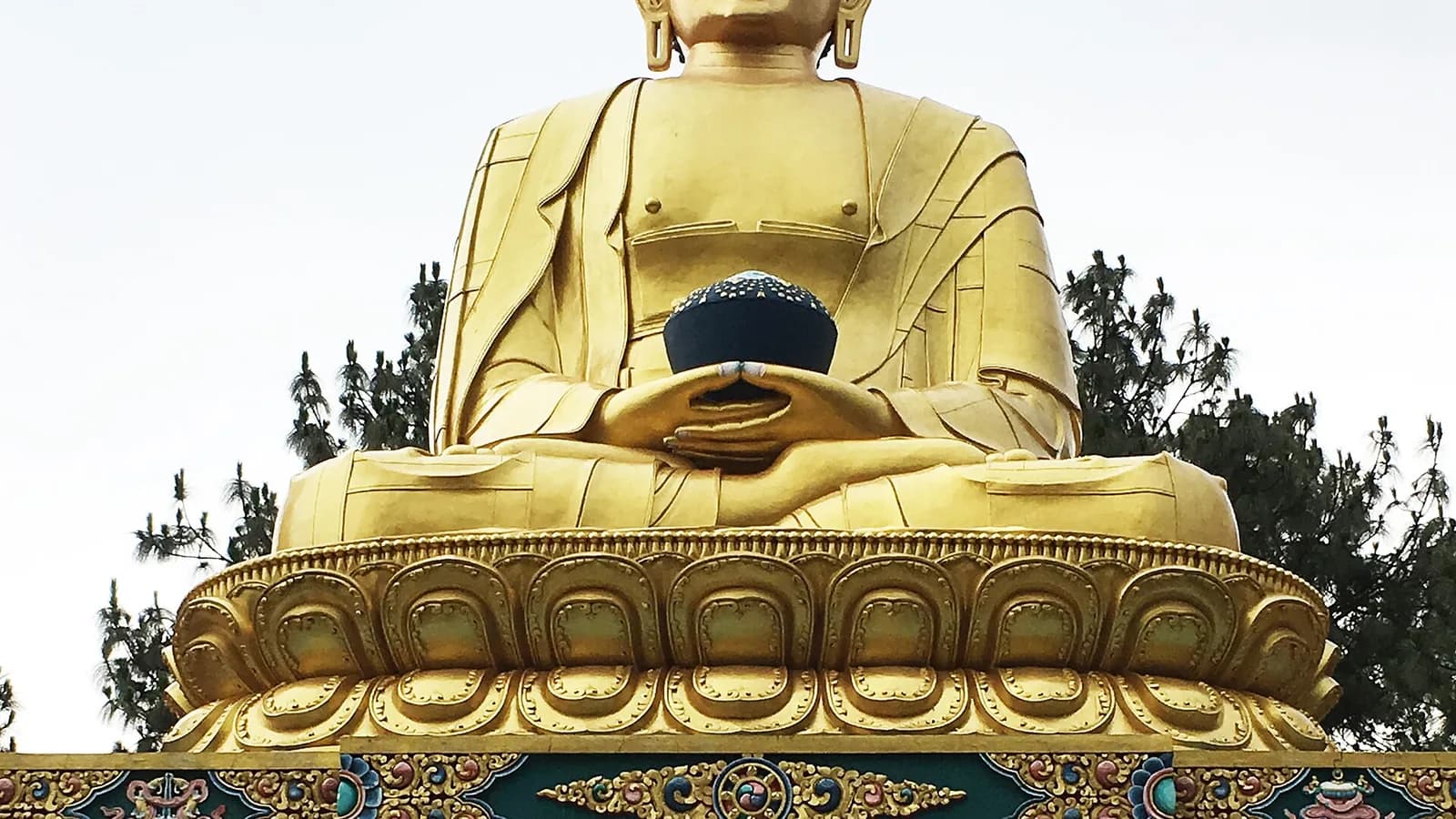
If you travel through Nepal you will meet the Buddha everywhere — painted as watchful eyes on a stupa, cast in temple bronze, and raised as a towering Buddha statue on a hilltop above the Kathmandu Valley. For many visitors these images are the most memorable part of the trip, and they are scattered from the warm plains of Lumbini to a windswept ridge in Mustang at over 3,800 metres. This guide walks you through the most striking Buddha statue sites in Nepal, what makes each one special, and a few practical tips so you can visit them respectfully.
Key takeaways
- The most photogenic statue cluster near Kathmandu is the giant golden trio at Amideva Buddha Park, just behind Swayambhunath.
- Swayambhunath and Boudhanath are UNESCO-listed stupas where statues, prayer wheels and pilgrims come together.
- Nepal's largest stone Buddha stands near Muktinath in Mustang, carved from Pharping stone.
- Lumbini, in the southern plains, is the Buddha's actual birthplace and a global pilgrimage centre.
- Watch the name trap: Budhanilkantha is a Hindu Vishnu statue, not a Buddha.
- Statues are sacred objects, so dress modestly, walk clockwise, and ask before photographing people.
Why Buddha statues matter so much in Nepal
Nepal sits at a meeting point of Buddhist and Hindu worlds, and the Buddha himself was born here. That gives the country an unusually deep relationship with his image. A statue is not just decoration; it is a focus for devotion, meditation and merit-making. You will often see worshippers circling a statue clockwise, lighting butter lamps, or pressing their foreheads to the base.
The figures you meet also vary. The historical Buddha — Siddhartha Gautama, later called Shakyamuni — is the most common. But in Himalayan Buddhism you will also see Chenrezig (the bodhisattva of compassion, Avalokiteshvara) and Guru Rinpoche (Padmasambhava), the master credited with carrying Buddhism across the mountains. Recognising the difference makes each statue far more interesting.
If you want background on the wider tradition before you go, our overview of Buddhism in Nepal and the guide to Tibetan Buddhism in Nepal are good companions to this article.
Amideva Buddha Park: the giant golden trio at Swayambhu
If you only have time for one dedicated Buddha statue stop, make it Amideva Buddha Park. It sits at the back of the Swayambhunath hill, on the road toward Ichangu, and it is built around three enormous golden statues that gleam in the afternoon light.
| Statue | Who it depicts | Approx. height | | --- | --- | --- | | Shakyamuni Buddha | The historical Buddha, Siddhartha Gautama | ~67 feet | | Chenrezig (Avalokiteshvara) | Bodhisattva of compassion | ~64 feet | | Guru Rinpoche (Padmasambhava) | The master who spread Buddhism in the Himalaya | ~64 feet |
The park is popular with Tibetan pilgrims and is a calm, uncrowded spot compared with the main stupa above it. Entry to the park itself is free, and there are basic facilities on site. It pairs naturally with a visit to the stupa, so plan to do both in one outing — our Swayambhunath (Monkey Temple) guide covers the climb, the monkeys and the viewpoint.
Getting there
Amideva Buddha Park is a short ride west of central Kathmandu. A taxi or ride-hailing app is the easiest option; combine it with Swayambhunath and you have a half-day of sightseeing. Morning light is soft, but late afternoon makes the gold glow.
Swayambhunath: stupa, statues and the watchful eyes
Swayambhunath, perched on its own hill, is one of the oldest and most important Buddhist sites in the valley. The temple complex is traditionally dated to around the 5th century AD and grew into a major centre of Buddhism over the following centuries. Most visitors come for the painted eyes of the Buddha gazing out from the central stupa, but the site is also dotted with shrines and statues, including a very large seated Shakyamuni image near the western edge of the complex beside the Ring Road.
It is a living place of worship: expect spinning prayer wheels, fluttering prayer flags, incense and the steady clockwise flow of pilgrims. A separate entry fee applies for foreign visitors to the main complex.
Boudhanath: statues around the great stupa
A few kilometres east, Boudhanath is the largest spherical stupa in Nepal and the spiritual heart of the city's Tibetan community. While the dome itself is the star, the surrounding plaza and the monasteries (gompas) that ring it are full of statues — golden Buddhas, Chenrezig, Guru Rinpoche and protector deities — often visible through open monastery doors.
It is one of the most rewarding places in Nepal simply to sit, watch the kora (the clockwise walk) and step into a gompa or two. For a deeper walk-through, see our dedicated Boudhanath Stupa visitor guide. As at Swayambhunath, foreign visitors pay an entry or area fee.
The stone Buddha of Mustang, near Muktinath
For something genuinely off the usual trail, Nepal's largest stone Buddha stands high in Mustang, near the sacred site of Muktinath in the Muktinath Valley below the Thorong La pass — a place revered by both Hindus and Buddhists. This Shakyamuni statue was carved by Shakya artisans in Patan and trucked up to the mountains. By the available accounts it weighs in the region of 60,000 kilograms, was carved from the prized stone of Pharping, and was funded through private donation; work began in 2013.
Reaching it is part of the adventure. Most travellers arrive via the Annapurna region or by flying to Jomsom and continuing up the valley. If a mountain pilgrimage appeals, our Muktinath Temple guide explains the routes and the altitude.
A note on scale
It is worth keeping perspective: Nepal's stone Buddha is the largest of its kind in the country, but it is modest beside the world's giant carved Buddhas elsewhere in Asia. Its setting — thin Himalayan air, prayer flags and snow peaks — is what makes it unforgettable, not raw size.
Lumbini: where the Buddha was born
No tour of Nepal's Buddhist heritage is complete without Lumbini, in the southern plains. This is the Buddha's birthplace, where, by tradition, Queen Maya Devi gave birth to Siddhartha Gautama. Today Lumbini is a UNESCO World Heritage Site centred on the Maya Devi Temple, which shelters the marker stone said to indicate the exact spot, alongside the ancient Ashoka Pillar.
Around the sacred garden, a sprawling monastic zone hosts temples and statues built by Buddhist nations from around the world — Thai, Burmese, Chinese, German and many more — each in its own architectural style. It is one of the best places anywhere to see how differently the Buddha is depicted across cultures. Our guides to Lumbini, the birthplace of Buddha and Lumbini's monasteries go into detail, and there is a planned colossal Buddha statue project in the wider Kapilvastu area that may add another landmark in years to come.
Namo Buddha and other valley sites
East of the valley, above the town of Panauti, Namo Buddha is one of the three great Buddhist pilgrimage sites of the Kathmandu region, alongside Swayambhunath and Boudhanath. It marks the legend in which the Buddha, in a previous life as a prince, offered his own body to a starving tigress and her cubs. A cave at the site holds statues of the prince, the tigress and her cubs, and the surrounding monastery is a peaceful place for a day trip.
The Patan (Lalitpur) area is also worth knowing for statues: it has been a centre of Newar metal-casting for centuries, and the workshops here produce many of the bronze and gilt-copper Buddha images sold across Nepal and beyond.
The name trap: Budhanilkantha is not a Buddha
One quick warning that saves confusion. The famous reclining stone statue at Budhanilkantha, on the northern edge of the valley, is sometimes assumed by visitors to be a sleeping Buddha because of the name. It is not. It is a Hindu image of the god Vishnu reclining on a bed of serpents, and it remains an active Hindu shrine. It is absolutely worth seeing — just do not arrive expecting the Buddha.
Visiting respectfully: a short etiquette guide
Statues and stupas are objects of living devotion, so a little care goes a long way.
- Walk clockwise. Circle stupas and statues with them on your right.
- Dress modestly. Cover shoulders and knees; remove shoes and hats where asked.
- Mind your feet. Never point the soles of your feet at a statue or sit with feet outstretched toward it.
- Photography. Outdoor statues are usually fine, but watch for "no photo" signs inside shrines, and always ask before photographing monks or worshippers.
- Donations. Small offerings are welcome but never required.
For the bigger picture on respectful travel, see our Nepal temple etiquette guide for tourists and the general Nepal etiquette overview.
Planning a Buddha statue route
Most travellers can see the headline sites without a special itinerary:
| If you have | Suggested Buddha statue stops | | --- | --- | | Half a day in Kathmandu | Swayambhunath + Amideva Buddha Park | | One full day | Add Boudhanath and a monastery visit | | A day trip | Namo Buddha above Panauti | | Plains time | Lumbini's sacred garden and monastic zone | | A Himalayan trek | The stone Buddha near Muktinath, Mustang |
Whichever you choose, give yourself time to slow down. The most rewarding moments at any Buddha statue in Nepal are rarely about ticking off a sight — they are about standing quietly while the prayer wheels turn and the light shifts across gilded faces that have watched over this valley for centuries.
Sources
- Atlas Obscura — Amideva Buddha Park in Kathmandu
- Swayambhunath.com — Amideva Buddha Park
- Nepal Tourism Board — Swayambhunath
- Wikipedia — Boudha Stupa
- Buddhistdoor — Nepal's Largest Stone Buddha Ready for Viewing
- Nepalnews — 35-foot-tall Buddha statue in Mustang
- Wikipedia — Budhanilkantha Temple
- Nepalnews (English) — Kapilbastu to host world's largest Buddha statue
Frequently asked questions
- Where can I see the biggest Buddha statue near Kathmandu?
- The most impressive cluster is Amideva Buddha Park behind Swayambhunath, where three giant golden statues stand together, the tallest around 67 feet.
- Is there an entry fee to visit Buddha statues in Nepal?
- Many statue sites like Amideva Buddha Park are free, though larger complexes such as Swayambhunath and Boudhanath charge a separate entry or area fee for foreign visitors.
- What is the largest stone Buddha statue in Nepal?
- Nepal's largest stone Buddha sits near Muktinath in Mustang, carved from Pharping stone and weighing roughly 60,000 kilograms.
- Is Budhanilkantha a Buddha statue?
- No, despite the name the famous reclining statue at Budhanilkantha is a Hindu image of the god Vishnu, not the Buddha, so do not expect a Buddha there.
- What should I wear when visiting Buddha statues and stupas?
- Dress modestly with shoulders and knees covered, remove shoes where signs ask, and walk clockwise around stupas and statues as a sign of respect.
- Can I photograph Buddha statues in Nepal?
- Outdoor statues are usually fine to photograph, but check for signs inside shrines and monasteries and always ask before photographing monks or worshippers.
- Where was the Buddha actually born?
- The Buddha was born in Lumbini in southern Nepal, now a UNESCO World Heritage Site centred on the Maya Devi Temple and the Ashoka Pillar.
Related posts
Boudhanath Stupa: Architecture & Symbolism Guide
How to read the Boudhanath stupa — its mandala shape, the Buddha eyes, the 13 golden steps, and the meaning behind the clockwise kora walk.
Read postBuddhism in Nepal — A Traveler's Guide to Its Roots
Buddhism in Nepal began at Lumbini and split into three living traditions. Where to see it, what it means, and how to visit with respect.
Read postKathmandu to Lumbini: How to Get There (2026)
How to travel Kathmandu to Lumbini in 2026 — tourist bus, flight to Bhairahawa, or private jeep. Honest cost, time, and the final hop to Lumbini.
Read post