Tiger Safari Nepal: Where to See Wild Tigers 2026
Planning a tiger safari in Nepal? Compare Bardia, Chitwan and the Terai parks, honest sighting odds, best season, fees and how to choose for 2026.
Nepal went from about 121 tigers to 355 in just over a decade — one of the great conservation comebacks anywhere. Finding one in the grass is still the hardest thrill in the country.
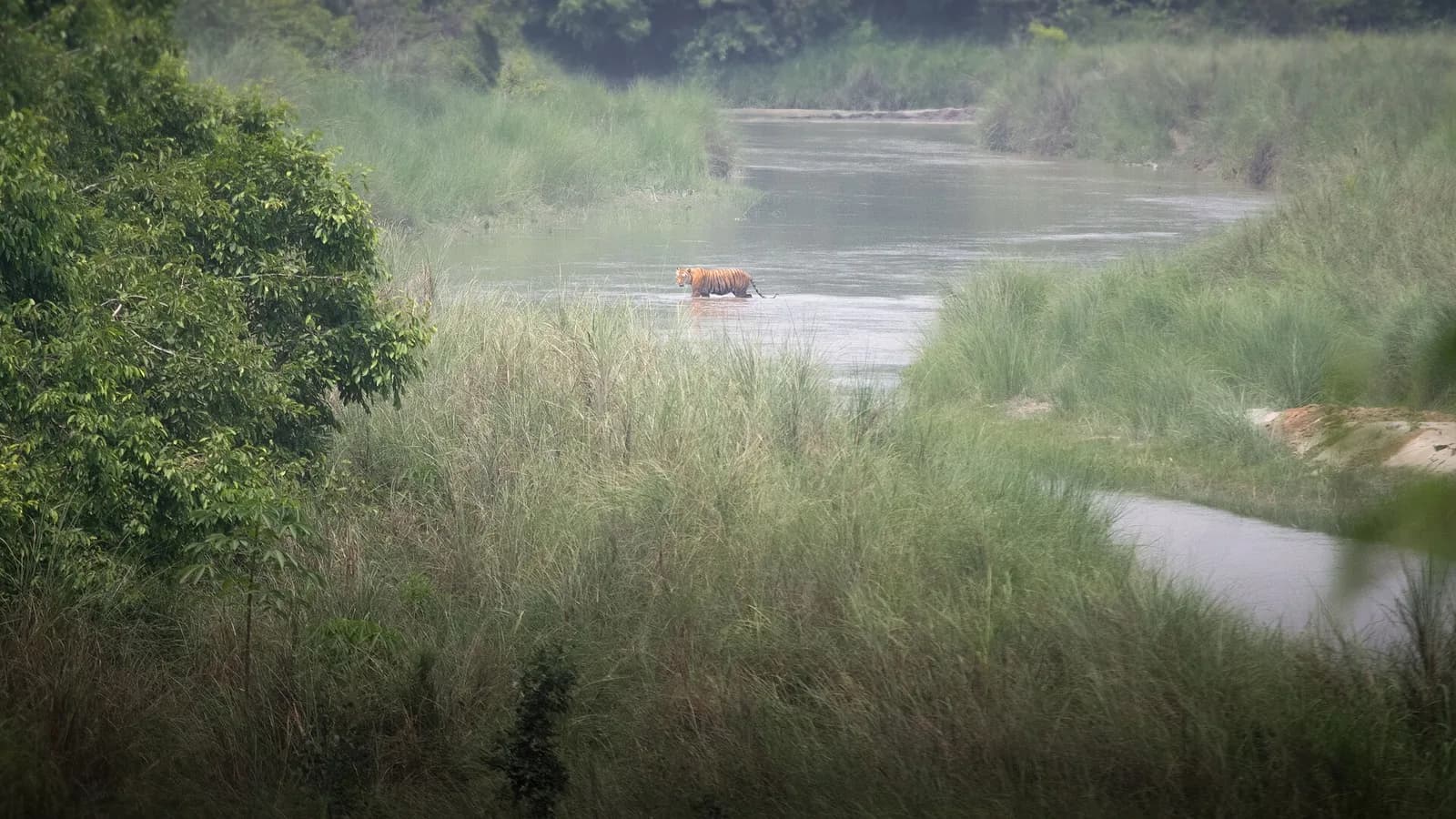
A tiger safari in Nepal is a gamble in the best sense. The country's southern lowlands — the Terai — have just pulled off one of the most celebrated wildlife recoveries on Earth, nearly tripling their wild tiger population in little over a decade. Yet the cat itself stays hidden, padding through dense grass and sal forest at dawn before most visitors ever raise a camera. This guide lays out where the tigers actually are, the honest odds of seeing one, the best season, what it costs and how to choose between Nepal's tiger parks in 2026.
Key takeaways
- Nepal had 355 wild tigers in its 2022 national census, up from roughly 121 in 2009 — close to a tripling, and the first country to meet the global tiger-doubling pledge.
- Bardia and Chitwan are the two main parks, holding about 125 and 128 tigers respectively; Bardia is quieter and favoured for tiger odds, Chitwan is easier to reach.
- Sightings are hard. Realistic odds on a short visit are often quoted around 30 to 40 percent or lower, because tigers are elusive and the forest is thick.
- The dry season (March to May) is best for tigers, when water sources shrink and vegetation thins — though the heat is intense.
- A fifth national census began in December 2025 and runs into 2026, with new figures expected around 29 July 2026; until then, 355 is the official number.
- Budget for park fees plus guide and activities. Foreigner entry at Bardia is listed at NPR 1,000 per person per day (as of 2025), with Chitwan similar.
Nepal's tiger comeback, in numbers
Nepal's story is the reason a tiger safari here feels different from anywhere else. At the 2010 St Petersburg tiger summit, the 13 tiger-range countries pledged to double their wild tigers by 2022, the next Year of the Tiger. Nepal went from around 121 tigers in 2009 to 355 in the 2022 census — nearly a tripling — and became the first country to hit the doubling goal, an achievement recognised by conservation bodies including WWF and IUCN.
The 2022 count, the most recent completed national figure, breaks down by park roughly like this:
| Park | Tigers (2022 census) | Region | Notes | | --- | --- | --- | --- | | Chitwan | 128 | Central Terai | UNESCO World Heritage Site, easiest access | | Bardia | 125 | Far-western Terai | Remote, high density, quietest | | Parsa | 41 | Central Terai | Adjoins Chitwan | | Shuklaphanta | 36 | Far west | Grassland, also great for swamp deer | | Banke | 25 | Mid-west | Adjoins Bardia |
Those numbers are now being refreshed. Nepal launched its fifth nationwide tiger census on 16 December 2025, using more than 2,300 automated camera traps across roughly 8,400 square kilometres of parks, corridors and buffer zones, organised into three blocks: Chitwan-Parsa, Banke-Bardiya and Shuklaphanta-Laljhadi. The fieldwork runs into 2026, and results are expected to be made public around International Tiger Day on 29 July 2026. Until then, treat 355 nationwide and the per-park figures above as the official baseline.
For more on the flagship park, see our Bengal tiger in Chitwan guide and the deeper Bardia National Park guide.
The honest odds of seeing a tiger
This is the part most brochures gloss over. Tigers are solitary and territorial, hunt mainly at dawn and dusk, and in a landscape with thick cover and plenty of water they simply do not need to come near people or roads. Guides and operators commonly put realistic sighting odds on a short visit at around 30 to 40 percent over several drives, and often lower for a single afternoon.
What improves your chances:
- Give it time. Two or three full days with multiple activities beats a rushed overnight.
- Go in the dry pre-monsoon months, when tigers concentrate near shrinking water.
- Pick a high-density, low-traffic park — this is Bardia's core appeal.
- Use experienced local naturalists who know recent movements and territories.
Even with all of that, plenty of visitors leave without a tiger. The rhinos, wild elephants, gharial crocodiles, deer and spectacular birdlife are far more reliable, so go in wanting a great jungle experience first and a tiger as the jackpot. If a one-horned rhino is high on your list, our rhino safari guide and one-horned rhino in Nepal explain why those sightings are near-guaranteed in Chitwan.
Bardia vs Chitwan: which park to choose
Both parks are genuinely excellent and close in tiger numbers, but they suit different travellers.
Chitwan
Chitwan is Nepal's best-known wildlife destination and a UNESCO World Heritage Site, set in the central Terai a few hours from Kathmandu or Pokhara. It has the country's largest single tiger population, the most developed safari infrastructure and the easiest logistics, plus rhinos, gharial and rich Tharu culture. The trade-off is crowds: more lodges and more jeeps mean more competition at each sighting. It is the natural pick for first-time visitors, families and anyone short on time. Plan it with our Chitwan National Park safari and practical Chitwan safari guide.
Bardia
Bardia, in the remote far west, is the connoisseur's choice. It recovered from fewer than 20 tigers in 2009 to about 125 by the 2022 census, and its low visitor numbers mean a high tiger density per jeep and a quieter, wilder feel. Getting there takes longer — a long drive or a domestic flight to Nepalgunj plus a road transfer — which is exactly why it stays uncrowded. For travellers whose main goal is tigers and genuine wilderness, Bardia consistently earns the strongest reputation.
| Factor | Chitwan | Bardia | | --- | --- | --- | | Tigers (2022) | ~128 | ~125 | | Access | Easy (3-5 hrs from Kathmandu/Pokhara) | Remote (long drive or flight via Nepalgunj) | | Crowds | Higher | Low | | Best for | First-timers, families, variety | Serious tiger-seekers, wilderness | | Status | UNESCO World Heritage Site | Largest park in the Terai |
Shuklaphanta and Banke are quieter alternatives for repeat visitors, while Parsa effectively extends Chitwan's tiger landscape.
When to go
Season makes a real difference to both comfort and odds.
- March to May (hot, dry): the prime window for tigers. Water sources shrink, vegetation thins and animals concentrate along rivers and pools. Expect heat that can climb into the high 30s Celsius.
- October to February (cool, dry): the most pleasant time to travel, with clear skies and comfortable days. General wildlife viewing is excellent and rhinos are easy, but tigers are typically harder to spot in the thicker, well-watered landscape.
- June to September (monsoon): heavy rain, high grass, leeches and frequent park or activity closures. Generally avoid for safaris.
For the wider picture, see best time to visit Nepal and our month-by-month Nepal weather guide.
Safaris, costs and what to expect
A tiger-focused trip usually combines several activity types over a couple of days.
Activities
- Jeep safari: the workhorse for tigers, covering ground and reaching waterholes and grasslands.
- Canoe trips: dugout rides on jungle rivers, strong for gharial, birds and riverside mammals.
- Guided jungle walks: immersive and good for tracks and signs, but lower odds and strictly with trained naturalists.
- Tharu cultural visits: village walks and dance evenings round out the experience near both parks.
Note that elephant-back safaris have fallen out of favour on welfare grounds and are increasingly replaced by jeeps and walks; our elephant safari in Nepal piece covers the debate.
Costs
The one fixed cost is the national park entry fee. The Nepal Tourism Board lists foreigner entry at Bardia at NPR 1,000 per person per day (as of 2025), plus an applicable service charge, with Chitwan in a comparable range; children under ten are generally exempt. Some older listings quote higher figures, so always confirm the current rate at the official counter or with your operator. Beyond the entry fee you pay for a licensed guide, jeep or canoe activities, accommodation (from simple lodges to comfortable resorts) and transport to the park. Because so much is bundled differently between operators, ask exactly what a quoted package includes. For planning your wider trip budget, see how much does a trip to Nepal cost.
Responsible viewing
Tiger numbers have grown alongside rising human-wildlife conflict for communities living beside the parks, so responsible behaviour matters. Choose operators who employ local guides and follow park rules, keep noise down, never pressure a guide to approach an animal, and stay in the vehicle or on the trail at all times. The point of Nepal's tiger story is that the cats are thriving — keep it that way by watching lightly.
Getting there and combining with the rest of Nepal
Chitwan slots neatly into most itineraries: it sits roughly between Kathmandu and Pokhara, reachable by tourist bus, private vehicle or a short flight, and many travellers stop at Sauraha on the park's edge. Bardia takes more commitment — typically a domestic flight to Nepalgunj followed by a road transfer, or a long overland drive — which is the price of its solitude. Either park pairs well with a trek or a cultural loop; our Nepal national parks overview and places to visit in Nepal help you build the rest of the trip around your safari.
Sources
- Nepal's tiger population reaches 355 — The Kathmandu Post
- Nepal successfully doubles their wild tiger population — WWF
- Nepal achieves a global commitment to double the tiger — IUCN
- Nepal begins national tiger census today — The Kathmandu Post
- Nepal starts tiger census to track recovery — Phys.org
- Tiger census commences in Nepal; 1,100 advanced cameras installed — Nepal Press
- Park entry fees in Nepal — Nepal Tourism Board
- Bardiya National Park — Nepal Tourism Board
- National Park Entry Fees in Nepal: A 2025 Guide — The Longest Way Home
Frequently asked questions
- Where is the best place for a tiger safari in Nepal?
- Bardia National Park in the far west is the favourite among serious tiger-seekers because it is remote, quiet and has a high tiger density, so fewer jeeps compete for each sighting. Chitwan in the central Terai holds a similar number of tigers, is far easier to reach and is a UNESCO World Heritage Site, but it is busier. Both are excellent; pick Bardia for the best tiger odds per visitor and Chitwan for convenience and a fuller range of wildlife and culture.
- How many wild tigers does Nepal have?
- Nepal's most recent completed national census, in 2022, recorded 355 wild tigers, up from roughly 121 in 2009. By park that was about 128 in Chitwan, 125 in Bardia, 41 in Parsa, 36 in Shuklaphanta and 25 in Banke. A fifth nationwide census began in December 2025 and runs into 2026, with updated figures expected around International Tiger Day on 29 July 2026, so until then 355 remains the official total.
- What are my chances of actually seeing a tiger?
- Lower than most first-timers hope. Tigers are solitary, mostly active at dawn and dusk, and the Terai forest is dense, so they rarely need to come near people. Guides and operators often put realistic odds on a short visit at roughly 30 to 40 percent over several drives, sometimes lower. Treat a tiger trip as a chance rather than a guarantee, and enjoy the rhinos, elephants, gharial and birdlife regardless.
- When is the best time of year for a tiger safari in Nepal?
- The hot, dry months of March, April and May are generally considered best, because shrinking water sources draw tigers to predictable rivers and pools while thinner vegetation improves visibility. The trade-off is intense heat, often in the high 30s Celsius. The cooler October-to-February window is far more comfortable and still good for general wildlife, including the near-guaranteed rhinos, but tiger sightings are typically harder.
- How much does a tiger safari in Nepal cost?
- Costs vary widely by park, length and comfort level. The fixed part is the national park entry fee, which the Nepal Tourism Board lists at NPR 1,000 per person per day for foreigners at Bardia (as of 2025), plus a service charge; Chitwan is in a similar range. On top of that you pay for a licensed guide, jeep or canoe activities, accommodation and transport. Confirm current fees and what is bundled when you book, as park rates change periodically.
- Is Bardia or Chitwan better for tigers?
- They are close in tiger numbers but offer different experiences. Chitwan is easier to reach and busier, with more jeeps competing for each sighting and a heritage tag. Bardia in the far west is remote and quiet, with a high tiger density and a strong reputation for better tiger odds per visitor, partly because it sees far fewer tourists. If tigers are your main goal and you have the extra travel time, many enthusiasts favour Bardia; if you want easy access and variety, choose Chitwan.
- Are tiger safaris in Nepal safe for tourists?
- On a properly run jeep, canoe or guided safari the risk is very low, because tigers generally avoid people and vehicles. The genuine danger sits with local communities living beside the parks, where human-wildlife conflict has risen as tiger numbers have grown. As a visitor, follow your guide's instructions at all times, never leave the vehicle or trail without permission and treat any sighting with calm respect rather than trying to get closer for a photo.
- Can you track tigers on foot in Nepal?
- Guided jungle walks exist in both Bardia and Chitwan and can turn up tiger signs such as pug marks, scratch marks and scat, and occasionally a real glimpse, but walking is more about immersion than reliable tiger viewing. It must be done with trained naturalists who brief you carefully on safety. Most actual sightings happen from jeeps covering more ground, or from machans and riverbanks near water in the dry season.
- What is the difference between a Bengal tiger and a Royal Bengal tiger?
- They are the same animal. Royal Bengal tiger is simply a common name used across Nepal and India for the Bengal tiger, the subspecies Panthera tigris tigris. The word royal carries no biological meaning; it is a traditional honorific. Whether a brochure says Bengal tiger or Royal Bengal tiger, it refers to the same big cat that lives in Bardia, Chitwan and the other Terai parks.
Related posts
Bengal Tiger in Chitwan: Tiger Safari Nepal Guide 2026
Chitwan holds 128 of Nepal's 355 Bengal tigers. Honest odds, best season, and how to plan a tiger safari in Nepal — plus why Bardia rivals it.
Read postOne-Horned Rhino in Nepal: Where to See Them in Chitwan
See the greater one-horned rhino in Nepal. Chitwan holds 694 of the country's 752 rhinos — where, when, and how to spot them on safari in 2026.
Read postRhino Safari Chitwan: Where, When & How in 2026
A rhino safari Chitwan trip has the best one-horned rhino odds in Nepal. Park fees, jeep vs canoe, the monsoon closure, and best season for 2026.
Read post