Mohare Danda Trek: Nepal's First Community Eco-Lodge Trail
A guide to the Mohare Danda Trek — a quiet, lower community-lodge alternative to Poon Hill with sunrise views of Dhaulagiri and the Annapurnas from ~3,300m.
Sunrise on Dhaulagiri from a ridge where every rupee you spend pays for a village school.
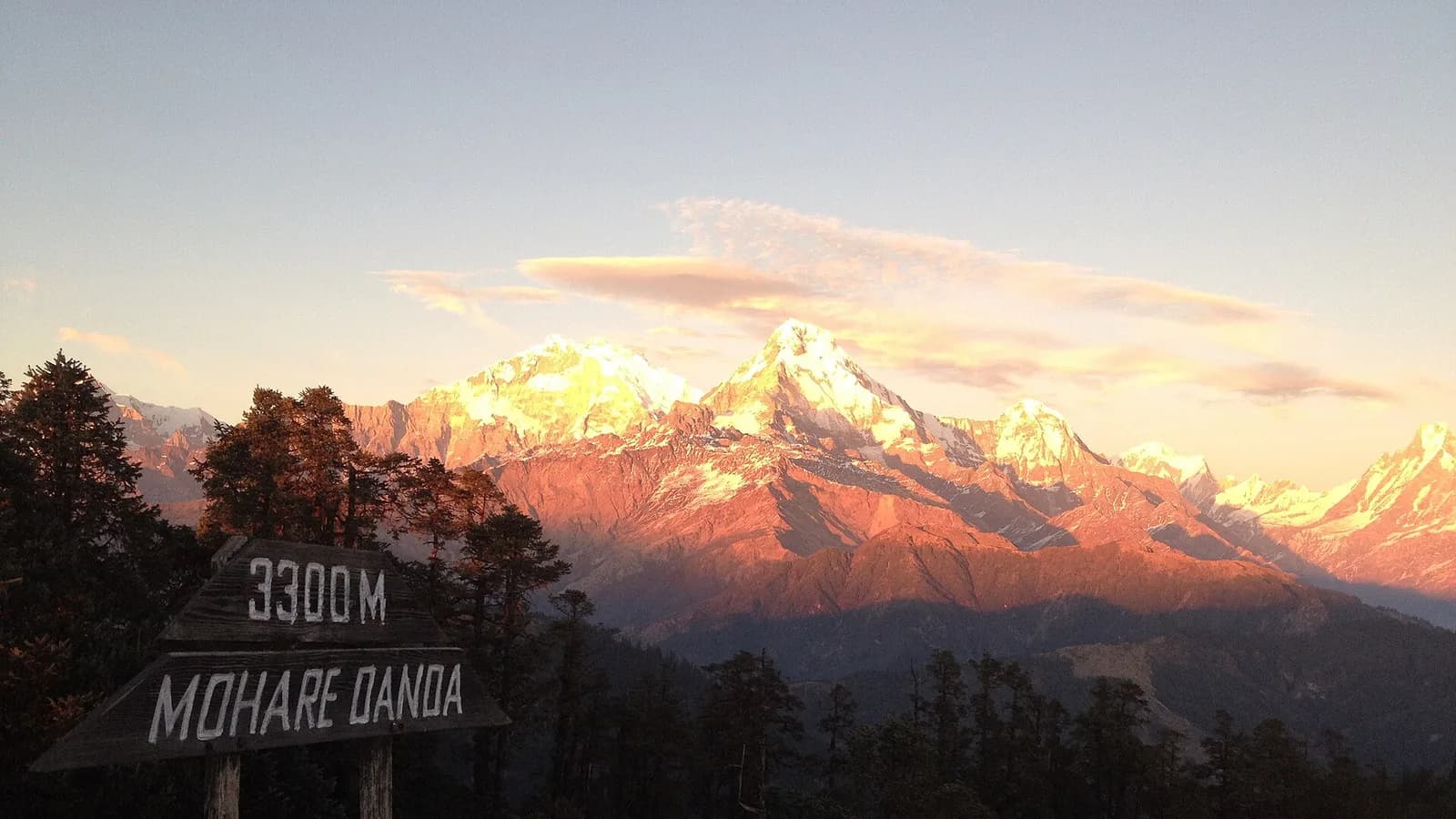
The Mohare Danda Trek answers a tempting question: what if the famous Poon Hill sunrise came without the Poon Hill crowds — and what if the money you spent reaching it paid for a village school instead of a corporate tour desk? This is exactly that trek. It climbs to a grassy ridge at roughly 3,300m in the Annapurna foothills, hands you a dawn panorama of Dhaulagiri, Annapurna South, Nilgiri and Machhapuchhre, and puts you up each night in lodges owned and run by the villages themselves. It is widely regarded as Nepal's first community-based trekking route, and it remains one of the most quietly rewarding short treks in the country.
This guide covers the route and itinerary, how difficult it really is, the best season, permits and rules, the community-tourism model that makes it special, and how to reach the trailhead from Pokhara and Beni.
Key takeaways
- Mohare Danda is a moderate 5 to 7 day trek from Pokhara, with longer variants that link to Khopra Danda or Ghorepani and Poon Hill.
- The viewpoint sits at about 3,300m — low enough that altitude sickness is uncommon, but high enough for a head-on Himalayan sunrise.
- Lodges are owned and run by local cooperatives and schools, so your spending funds village education and infrastructure.
- The trail was pioneered by educator and innovator Mahabir Pun and the village of Nangi as Nepal's first community trekking circuit.
- The main permit is the ACAP (NPR 3,000 for foreigners, as of June 2026); the TIMS card is now issued only through a registered agency, so it is usually bundled with your guide.
- Best in autumn (late Sept–Nov) or spring (Mar–May); the monsoon hides the views.
Where Mohare Danda sits
Mohare Danda is a ridge on the south-western flank of the Annapurna Conservation Area, in Myagdi district, west of the busy Ghorepani–Poon Hill loop. The trail threads through Magar villages — most famously Nangi, at around 2,300m — before climbing above the treeline to the open viewpoint at the top of the ridge.
What you get for the effort is an unobstructed front-row seat. Where many Annapurna viewpoints look into the sanctuary, Mohare Danda turns you toward the deep Kali Gandaki valley and the wall of Dhaulagiri (8,167m), the world's seventh-highest mountain, with Annapurna South, Nilgiri and the Fishtail peak of Machhapuchhre filling out the skyline. Because the ridge is grassy and exposed, the sunrise here feels wide-open in a way forested lower viewpoints rarely do. Where the flagship Annapurna Base Camp walk takes you deep into the glacial sanctuary, Mohare Danda keeps you on its rim — an open ridge instead of an enclosed amphitheatre, and a fraction of the foot traffic.
The route, day by day
There is no single "official" itinerary — operators adjust the start and end road heads depending on how far the jeep track has advanced and how many days you have. A common, comfortable version looks like this:
| Day | Stage | Approx. altitude | Why it matters | | --- | --- | --- | --- | | 1 | Pokhara → Beni → Galeshwor, walk to Banskharka | ~1,500m | Drive in via Beni; gentle first afternoon's walk | | 2 | Banskharka to Nangi | ~2,300m | Magar village and the heart of the community project | | 3 | Nangi to Mohare Danda | ~3,300m | The big climbing day to the ridge and sunrise viewpoint | | 4 | Mohare Danda to Danda Kharka | ~2,800m | Mostly downhill through forest and pasture | | 5 | Danda Kharka to Tikot, then down to Tiplyang | Tikot ~2,250m, dropping to the low Kali Gandaki road head | Magar settlements, then a long descent to the warm valley floor | | 6 | Drive back to Pokhara | — | Out via a road head near Tiplyang |
Expect roughly 5 to 7 hours of walking on the bigger days, much of it on stone-stepped trails through oak, rhododendron and bamboo forest. The climb from Nangi up to Mohare Danda is the hardest single stretch; the descent days are easier on the lungs but tough on the knees.
Longer itineraries extend the loop by linking Mohare Danda to Khopra Danda or by dropping down to Ghorepani and Poon Hill for a second sunrise before returning to Pokhara — turning the trip into an 8 to 10 day circuit. Operators can stitch these add-ons on at the ridge, so it is worth deciding before you book how many sunrises you want.
Difficulty and fitness
Mohare Danda is moderate. There is no glacier travel, no high pass and no scrambling — the challenge is simply the up and down. Several days involve sustained climbs of five to seven hours, often on relentless stone staircases, so you want a reasonable base of hill-walking fitness before you arrive. If you can comfortably manage a full day of uphill hiking at home, you can manage this.
Crucially, the altitude ceiling is low. At about 3,300m, the ridge sits well below the threshold where most people develop serious altitude sickness, which makes Mohare Danda a sensible choice for first-time Himalayan trekkers and families wanting real mountain views without the risk profile of a 4,000m-plus route. That said, the air is thinner than at home and you should still walk at a steady pace and hydrate well; our altitude sickness guide covers the early warning signs worth knowing on any Nepal trek. If you can handle a similar low-altitude ridge walk such as Pikey Peak in the Everest foothills, you are ready for this one.
Best season
| Season | Conditions | Verdict | | --- | --- | --- | | Autumn (late Sept–Nov) | Clear skies, stable weather, crisp cold nights | Best | | Spring (Mar–May) | Rhododendron forests in bloom, generally clear | Excellent | | Winter (Dec–Feb) | Cold ridge, possible snow up top, very quiet | For the prepared | | Monsoon (Jun–Aug) | Cloud, rain, leeches in the lower forest | Avoid |
Autumn is the classic window: the post-monsoon air is at its clearest and Dhaulagiri shows up sharp at dawn. Spring is a close second and has its own draw — the rhododendron forests this trail is known for erupt into pink and red. Winter is doable for well-equipped walkers who do not mind the cold and want the ridge almost to themselves. For the full picture across all of Nepal's trekking calendars, see our guide to the best season to trek in Nepal.
Permits and rules
For Mohare Danda you need a single permit:
- Annapurna Conservation Area Permit (ACAP) — NPR 3,000 for foreign nationals, NPR 1,000 for SAARC nationals (as of June 2026). Children under 10 are generally exempt.
The TIMS card is no longer sold to individual trekkers — since 2023 it has only been issued through registered agencies, so in practice your agency bundles it with the mandatory guide. Checkpoint enforcement of TIMS has been inconsistent across the Annapurna region, but the ACAP is what staff reliably check. Rules and fees do change, so confirm the current requirements before you travel; our permits page tracks what is needed where. Buy the ACAP in Kathmandu or Pokhara before you start — it is not sold on the trail — and carry a printed copy, because mobile coverage in these hills is patchy.
Since 2023, Nepal has also required most foreign trekkers in its conservation areas to walk with a licensed guide rather than fully solo. On a quiet, lesser-marked community trail like this one, a local guide earns their keep at trail junctions and helps you connect with the villages. Our guide to whether you need a guide to trek in Nepal explains how the rule works in practice and where it is checked.
The community-tourism model
The thing that genuinely sets Mohare Danda apart is who owns the beds you sleep in. The route was conceived by Mahabir Pun — the educator and innovator who famously brought wireless internet to the remote village of Nangi, connecting it to Pokhara years before most of rural Nepal came online. Building on that spirit of village-led development, he and the surrounding communities laid out the trail as Nepal's first community-based trekking circuit.
The practical result is a chain of cooperative eco-lodges run by villages and local schools rather than outside companies. Profits do not leave the hills: they are reinvested into education, health posts and village infrastructure. When you pay for a bed, a plate of dal bhat or a pot of tea here, you are quite literally helping fund a classroom. It is one of the cleanest examples of responsible tourism in Nepal — the social good is built into the trail's very structure, not bolted on as marketing.
The lodges are deliberately simple. Expect twin rooms with shared bathrooms, hearty Nepali meals, wood-fired warmth, and limited electricity or Wi-Fi at the higher stops. This is comfortable, community-run trekking, closer in spirit to a homestay than a commercial teahouse — if you want to understand the broader style, our teahouse trekking guide sets expectations for food, beds and etiquette. Bring cash for the whole trek (there are no ATMs once you leave the road) and a power bank for charging.
Highlights
- Sunrise from the ridge. The reason everyone comes: a head-on dawn panorama of Dhaulagiri and the Annapurnas, with far fewer people than Poon Hill.
- Nangi village. The cultural heart of the trek — a Magar settlement and the home of the community project, where you can see village-led development first-hand.
- Rhododendron and oak forest. In spring the lower trail blazes with red and pink blooms; year-round, the forest is rich with birdsong.
- Genuine community lodges. Sleeping and eating in cooperative-run lodges where your money stays local.
- The Kali Gandaki valley. The deep gorge between Dhaulagiri and the Annapurnas, the deepest in the world by some measures, frames the entire trek.
Learning a few words of the language deepens every village stop. A simple namaste and dhanyabaad (thank you) go a long way in lodges where English is limited, and a handful of basic trail phrases will earn you warmer welcomes than any guidebook.
How to get there from Pokhara and Beni
Mohare Danda starts and ends near Pokhara, so it slots easily into a lakeside trip. The standard approach is to drive from Pokhara to Beni, the district headquarters of Myagdi, and on to a road head near Galeshwor — roughly four to five hours by jeep or local bus, depending on conditions. At Galeshwor it is worth pausing at the riverside Galeshwor temple before the walking begins.
On the way out, most itineraries descend to a road head near Tiplyang on the banks of the Kali Gandaki River, then drive back to Pokhara via Beni. Because both ends use jeep transfers, you can shorten or lengthen the trek simply by adjusting where you start and stop walking — handy if you are short on days or want to ease into the climbing.
For a wider itinerary, Mohare Danda pairs naturally with time in Pokhara at either end. The Langtang Valley offers a similar community-recovery story, while the Tsum Valley and the bigger Manaslu Circuit sit at the wilder, longer, higher end of the spectrum. Mohare Danda holds its own among them as the gentlest, most purposeful introduction to community trekking in the Annapurnas; our trekking section lays the options out side by side.
Sources
- Nepal Hiking Team — A Complete Guide to Mohare Danda Trek
- Nepal Mother House Treks — Mohare Danda Community Eco-Lodge Trek
- Glorious Himalaya — Mohare Danda Trek Itinerary and Cost (2026/2027)
- Nepal Hiking Team — Annapurna Trekking Permits 2026: ACAP, TIMS & RAP Guide
- Shikhar Adventure — Annapurna Trek Permits: TIMS & ACAP 2026 Update
Frequently asked questions
- How many days is the Mohare Danda trek?
- Most trekkers do it in 5 to 7 days from Pokhara. A short version reaches the ridge and loops back in about 5 days; longer 8 to 10 day itineraries link it with Khopra Danda or Ghorepani and Poon Hill. Driving time at each end shortens or lengthens the walking days.
- How high is Mohare Danda and how hard is the trek?
- The viewpoint sits at about 3,300m, so altitude sickness is unlikely for most fit walkers. The difficulty is the sustained uphill — several 5 to 7 hour climbing days on stone-stepped trails. It is rated moderate: no technical sections, but you need decent fitness.
- What permits do I need for Mohare Danda?
- The main permit is the Annapurna Conservation Area Permit (ACAP), which is NPR 3,000 for foreign nationals and NPR 1,000 for SAARC nationals as of June 2026. A TIMS card is also part of the system but is now issued only through a registered trekking agency, so it is normally bundled with your guide rather than bought separately. Buy the ACAP in Kathmandu or Pokhara before you start — it is not sold on the trail — and carry a printed copy.
- Is Mohare Danda better than Poon Hill?
- It depends on what you want. Mohare Danda is quieter, lower in foot traffic, and built around a community-tourism model, with a Dhaulagiri sunrise to rival Poon Hill's. Poon Hill is shorter, busier and easier to reach. Many trekkers combine the two on a longer loop.
- When is the best time to trek Mohare Danda?
- Autumn (late September to November) and spring (March to May) give the clearest skies and most stable weather. Spring adds blooming rhododendron forest. Winter is cold with possible snow on the ridge, and the June to August monsoon brings cloud, rain and leeches in the forest.
- How do I get to the trailhead from Pokhara?
- Drive from Pokhara to Beni, then on to a road head near Galeshwor in Myagdi district — roughly four to five hours by jeep or local bus. The walk begins from there. On the way out, most routes descend to a road head near Tiplyang on the Kali Gandaki and drive back to Pokhara.
Spotted an error in this post? Tell us or suggest a correction.
Related posts
Ganesh Himal Ruby Valley Trek: The Quiet Valley Between Langtang and Manaslu
A practical guide to the Ganesh Himal Ruby Valley trek: route, duration, difficulty, best season, community homestays and permits in Dhading and Rasuwa.
Read postKhopra Ridge Trek (Khopra Danda): Quiet Annapurna Balcony
A community-run, low-crowd alternative in the Annapurna region — ridge-top Dhaulagiri views, Khayer Lake, and village lodges that fund local schools.
Read postLimi Valley Trek: Nepal's Last Tibetan Corner Beyond the Karnali
A practical guide to the Limi Valley trek in remote Humla — route, the Nyalu La pass (~4,990m), duration, difficulty, best season and restricted-area permits.
Read post