Lo Manthang Upper Mustang: The Walled City Guide
A guide to Lo Manthang in Upper Mustang — the last walled city in the Himalayas, its monasteries, sky caves, royal palace, permits and how to visit.
A medieval mud-walled capital of an old Tibetan kingdom, hidden in Nepal's high desert behind the Annapurnas.
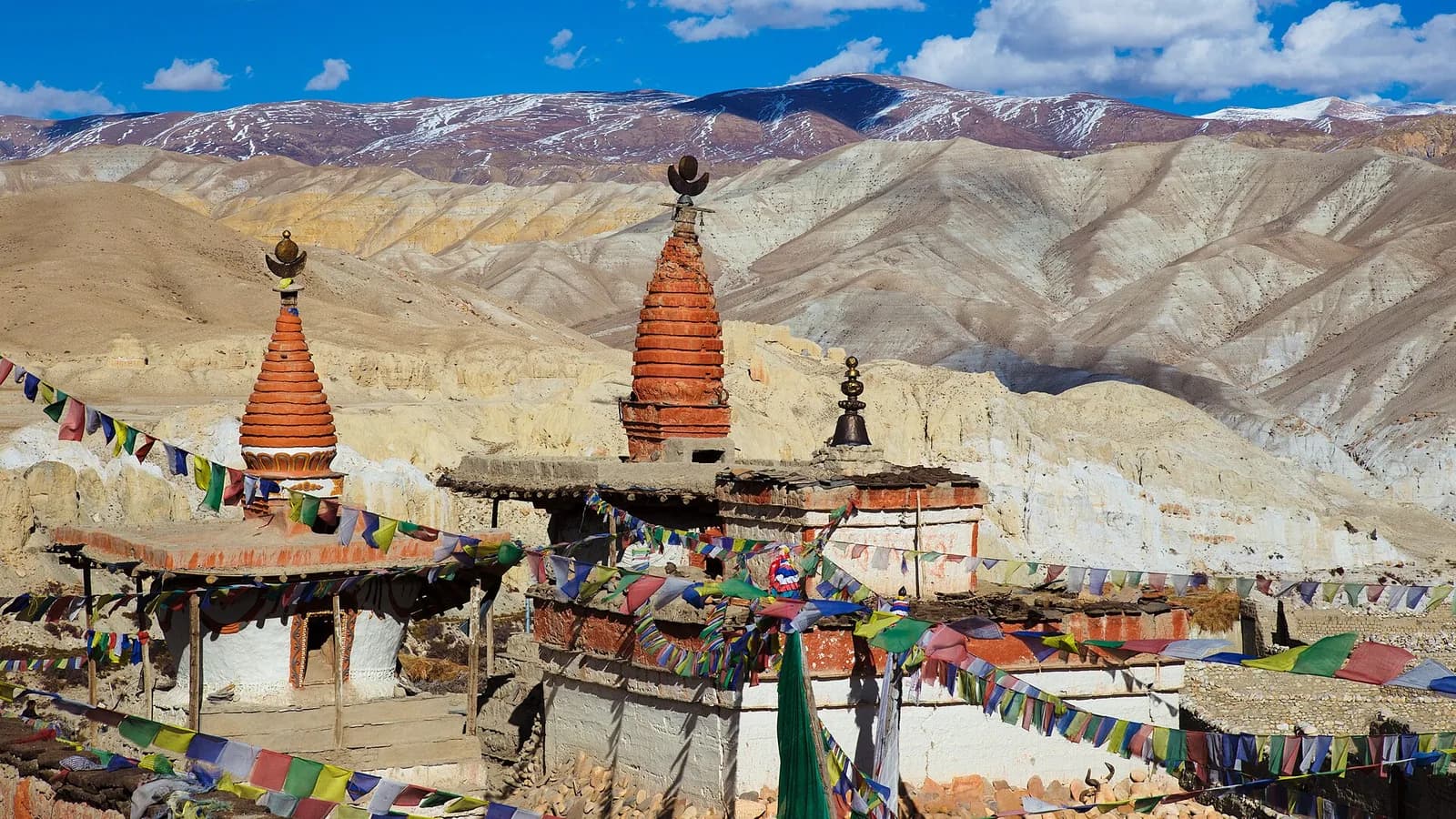
Lo Manthang in Upper Mustang is one of the most extraordinary places you can reach in Nepal: a medieval mud-walled town that served as the capital of an independent Tibetan-cultured kingdom for some 600 years, set on a windswept desert plateau behind the Annapurna and Dhaulagiri ranges. Often called the last walled city in the Himalayas, it sits at around 3,800 metres in Nepal's rain shadow, where ochre cliffs, ancient monasteries and cave-riddled canyons feel far closer to Tibet than to the green hills most people picture when they think of the country.
This guide focuses on the walled city itself — its history, its monasteries and palace, the famous sky caves, and the practicalities of reaching it. For the full walking route and a deeper dive on fees, read it alongside our Upper Mustang trek guide and the focused Upper Mustang permit guide.
Key takeaways
- Lo Manthang is the walled former capital of the old Kingdom of Lo, founded in 1380 and ruled by about 25 successive kings.
- It sits at roughly 3,800m in Upper Mustang, a restricted high-desert region near the Tibetan border.
- The cultural core is three monasteries (Jampa, Thubchen and Chode) plus a five-storey royal palace, many with restored 15th-century murals.
- Nearby are the Chhoser sky caves, part of a system of thousands of cliff caves, some over 2,000 years old.
- Visiting needs a Restricted Area Permit (USD 50 per person per day since November 2025, as of June 2026), an ACAP, and a mandatory licensed guide.
- A rough road now reaches the town, so you can trek or take a jeep from Jomsom; spring and autumn are the prime seasons.
A medieval kingdom in the high desert
Lo Manthang was established in 1380 by King Ame Pal, who unified the feuding chiefs along the upper Kali Gandaki trade route and built a permanent capital for the new land of Lo. For roughly six centuries it functioned as the seat of an effectively independent kingdom, growing wealthy on the salt-and-grain caravan trade between the Tibetan plateau and the lowlands of the subcontinent.
That history is written into the town. The defining feature is the city wall — a rampart of sun-dried mud brick that still encloses a dense warren of whitewashed houses, narrow lanes and monastery courtyards. Because Upper Mustang was closed to outsiders until 1992 and remains restricted today, this fabric survived largely intact while similar settlements across the border were lost. The result is widely described as the last walled city in the Himalayas, and one of the few places where a medieval Tibetan-Buddhist townscape can still be walked through in person.
The royal line endured into the modern era. Although the monarchy lost its official status after Nepal became a republic, the Tashi Gephel palace at the heart of the town — a five-storey, multi-cornered structure — remains the historic seat of the kings of Lo and a focal point of the old quarter.
The three great monasteries
The spiritual heart of Lo Manthang is its trio of historic gompas (monasteries), all rooted in the Sakya school of Tibetan Buddhism. Together they hold some of the finest medieval religious art in the Himalayas.
Jampa Lhakhang
Jampa Lhakhang (also written Champa), the "God House of Maitreya," is among the oldest, dating to the early 15th century under the early kings of Lo. It is famous for a towering multi-storey image of the future Buddha Maitreya and for walls covered in intricate mandalas rendered in mineral pigments and gold. Decades of restoration have brought much of this painting back to life.
Thubchen Gompa
Thubchen (or Thupchen) is a vast, dim assembly hall raised in the late 15th century, its roof carried on massive timber columns. The interior murals — long, narrative friezes of Buddhas and protective deities — were painstakingly conserved and, in places, reconstructed in the original 15th-century style. Much of this work was led by the American Himalayan Foundation and master conservator Luigi Fieni, who spent years training local people in mural restoration alongside the project.
Chode Gompa
Chode (Chhoede), the principal active monastery, traces its lineage back centuries and remains the centre of monastic life in Lo Manthang. Its monks perform the masked dances of the famous spring Tiji festival in the square before the palace. If your visit overlaps with it, our Tiji festival guide explains what the three days of ritual actually mean.
| Monastery | Roughly dates from | Known for | | --- | --- | --- | | Jampa Lhakhang | early 15th century | Tall Maitreya image, gold-and-mineral mandalas | | Thubchen Gompa | late 15th century | Huge pillared hall, restored narrative murals | | Chode Gompa | medieval | Active monastery, hosts the Tiji festival dances |
When you visit any of them, treat them as living places of worship rather than museums: remove shoes where asked, do not photograph murals where it is prohibited, walk clockwise around shrines and chortens, and follow your guide's lead.
The Chhoser sky caves
A short drive north of the town, near the village of Chhoser, the cliffs are pierced by one of Mustang's strangest sights: the sky caves. The best-known, often called Jhong or Shija Jhong, is a multi-storey honeycomb of dozens of rooms and passages carved high into a sandstone face, linked internally by ladders, with soot-blackened ceilings hinting at long human use.
These are part of a far larger phenomenon. Across the Mustang district, researchers estimate there are on the order of 10,000 man-made caves dug into the valley walls. Many are extremely old: archaeological work — including excavations near Samdzong led by teams under archaeologist Mark Aldenderfer — has recovered human remains and artefacts dated to well over 2,000 years ago, alongside later material from the centuries when families and fighters used the caves for shelter, storage, meditation and burial. Exactly who first dug them, and why so high in the cliffs, is still not fully resolved, which is much of their appeal.
The caves and monuments of Upper Mustang were placed on Nepal's UNESCO World Heritage tentative list in the 1990s. They are not yet a fully inscribed World Heritage Site, but they remain protected within the wider Annapurna Conservation Area.
What there is to do
Lo Manthang rewards slowing down. A typical visit builds in at least one full day in and around the town so you can take it at altitude-friendly pace.
- Walk the walled quarter. Wander the lanes inside the walls, visit the three monasteries, and look up at the royal palace.
- Day-trip to the sky caves. Combine Chhoser's cave complex with the surrounding villages and chortens.
- Visit outlying gompas and villages. Side excursions reach places such as Namgyal and Garphu monasteries and remote hamlets on the way toward the border.
- Time it with Tiji. If your dates align with the spring festival, the masked dances are the region's cultural high point.
- Simply watch the landscape. The eroded red, grey and ochre cliffs — often nicknamed the "Himalayan Mars" — change colour through the day.
Because the area is genuinely remote, facilities are simple. Expect basic guesthouses, limited and intermittent power and connectivity, and cold nights even in the trekking seasons.
Permits, guide and access
Upper Mustang is a restricted area, and the rules are stricter than on Nepal's open trails. You cannot travel here independently; a licensed guide booked through a registered Nepali agency is mandatory throughout.
The permits
The headline change is recent. Since November 2025, Nepal scrapped the old flat USD 500 Restricted Area Permit (which covered the first ten days) in favour of a simple USD 50 per person per day rate for the days you spend above Kagbeni. A short visit now costs far less than before, while a ten-day trip still works out near the old figure. All prices here are as of June 2026 — confirm the current rate with your agency before you pay.
| Item | Cost (as of June 2026) | Notes | | --- | --- | --- | | Restricted Area Permit | USD 50 per person per day | Replaced the old flat USD 500 fee in November 2025 | | Annapurna Conservation Area Permit (ACAP) | NPR 3,000 per person | Required for the surrounding Annapurna region | | Licensed guide | Varies by agency | Mandatory; no solo travel in the restricted zone |
For a fuller breakdown of the paperwork and how it is checked at Kagbeni and Lo Manthang, see our Upper Mustang permit cost article.
Getting there
The usual approach is to fly Pokhara to Jomsom (about 2,720m), then head north through Kagbeni, where the restricted area begins. From there you have two broad options:
- Trek: several days on foot up the Kali Gandaki and side valleys to Lo Manthang and back, the classic and quieter way to arrive.
- Jeep: a 4WD drive over roughly two to three days along the rough gravel road that now reaches the town, far easier on the legs but dustier.
Many travellers mix the two — driving one direction and walking the other. If you want help getting to Jomsom in the first place, our guides to Kathmandu to Pokhara transport and domestic flights in Nepal cover the earlier legs of the journey.
Best time to go
Lo Manthang's weather is shaped by its position in the Annapurna rain shadow, which keeps it dry for most of the year.
| Season | Months (approx.) | What to expect | | --- | --- | --- | | Spring | April to May | Clear, mild, the Tiji festival window | | Monsoon | June to August | Mostly dry here, but flights can be delayed | | Autumn | September to October | Crisp, stable, excellent visibility | | Winter | November to March | Very cold; many locals leave for lower ground |
Spring and autumn are the prime windows for comfort and clear mountain views. The monsoon, which washes out much of Nepal, leaves Mustang relatively dry — one reason it appears on lists of where to go in the rainy season — though the flight to and from Jomsom remains weather-dependent year-round. Deep winter is harsh and many residents migrate to warmer valleys.
Sources
- Lo Manthang | Upper Mustang | Nepal Tourism Board
- Lomanthang Rural Municipality — Wikipedia
- Mustang Caves — Wikipedia
- Mustang's Sky Caves: A 2,000-Year Mystery in Stone — NepalConnect
- Meet Luigi, the maestro behind the mural renaissance in Mustang — American Himalayan Foundation
- Upper Mustang Permit 2025: $50 Per Day Fee — The Longest Way Home
- How to Reach Upper Mustang / Lo Manthang — A1 Excursion
Frequently asked questions
- What is Lo Manthang famous for?
- Lo Manthang is the walled former capital of the old Kingdom of Lo in Upper Mustang. It is often described as the last surviving walled city in the Himalayas, and is known for its medieval mud-brick walls, centuries-old Tibetan Buddhist monasteries, a five-storey royal palace, and the nearby Chhoser sky caves carved into the cliffs.
- How high is Lo Manthang?
- Lo Manthang sits at roughly 3,800 metres in the high desert of Upper Mustang, north-central Nepal, close to the Tibetan border. The walking on the way in mostly stays below 4,000 metres, so it is moderate by Nepal standards, but the altitude, dust and strong afternoon wind still deserve respect.
- How do you get to Lo Manthang?
- Most visitors fly from Pokhara to Jomsom, then continue north through Kagbeni either on foot over several days or by 4WD jeep over two to three days. A rough road now reaches Lo Manthang along the Kali Gandaki, so overland trips are possible, though many trekkers still prefer quieter side trails away from the road dust.
- Do you need a permit to visit Lo Manthang?
- Yes. Upper Mustang is a restricted area, so you need a Restricted Area Permit plus the Annapurna Conservation Area Permit, and you must travel with a licensed guide arranged through a registered Nepali agency. Since November 2025 the restricted permit costs USD 50 per person per day rather than the old flat USD 500 fee (as of June 2026).
- Can you visit Lo Manthang without trekking?
- Largely, yes. With the gravel road now reaching Lo Manthang, you can travel most of the way by jeep from Jomsom, which makes the walled city accessible to travellers who cannot manage long trekking days. You still need the restricted permit and a guide, and short walks around the town and caves remain on foot.
- What are the sky caves near Lo Manthang?
- The Chhoser or Jhong sky caves are a honeycomb of man-made chambers cut high into a sandstone cliff a short drive north of Lo Manthang. They are part of a vast system of thousands of caves across Mustang, some dated to well over 2,000 years old, and were used over the centuries for shelter, storage, meditation and burials.
- When is the best time to visit Lo Manthang?
- Spring (roughly April to May) and autumn (roughly September to October) give the clearest skies and mildest temperatures. Because Lo Manthang sits in the Annapurna rain shadow and gets little rain, it is also one of the few areas you can visit during the June to August monsoon, though flights to Jomsom can still be delayed.
- Is Lo Manthang a UNESCO World Heritage Site?
- Not as a full inscribed site. Upper Mustang and its caves and monuments have been on Nepal's UNESCO World Heritage tentative list since the 1990s, but Lo Manthang is not a finalised World Heritage Site. It remains a protected cultural area within the Annapurna Conservation Area.
Related posts
Mustang Mountain Biking: Routes, Permits & 2026 Guide
A practical Mustang mountain biking guide — Lower vs Upper Mustang routes, the new USD 50/day permit, difficulty, season and how to plan your ride.
Read postTiji Festival Upper Mustang — Lo Manthang's Sacred Dance
The Tiji festival in Upper Mustang is a three-day masked dance of good over evil in walled Lo Manthang. What it means and how to attend the May rites.
Read postUpper Mustang Trek: Route, Permits & Lo Manthang Guide
A complete Upper Mustang trek guide — the route to Lo Manthang, the new 2026 USD 50/day permit, costs, difficulty, culture and the best time to go.
Read post