Everest Marathon: The World's Highest Race Explained
A 2026 guide to the Everest Marathon — the world's highest race from Base Camp to Namche, with route, categories, dates, acclimatisation and how to enter.
Start at 5,300-plus metres, finish in Namche — a marathon run on the same trails the first summiteers walked.
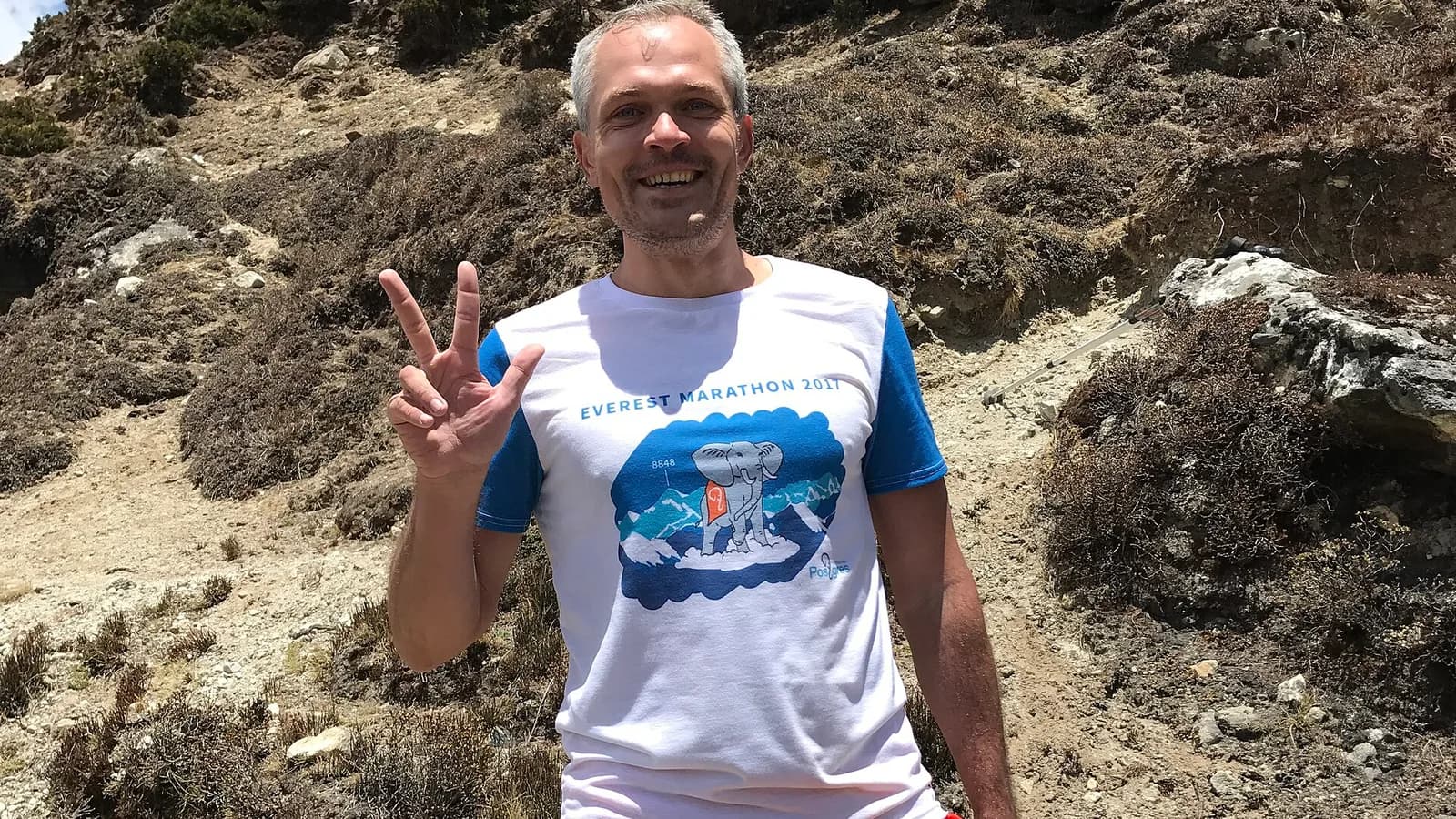
The Everest Marathon is, by almost any measure, the most extreme road on the road-running calendar — except there is no road. Officially the Tenzing Hillary Everest Marathon, it sends runners off from near Everest Base Camp at over 5,300 metres and finishes far below in the Sherpa town of Namche Bazaar. It is recognised as the highest marathon in the world, run on the same rugged Khumbu trails that trekkers and climbers use to reach the foot of the planet's tallest mountain. This guide explains how the Everest Marathon works, when it is held, what the route and categories are, and what it takes to line up at that thin-air start.
Key takeaways
- The Everest Marathon (Tenzing Hillary Everest Marathon) is the world's highest marathon, certified by Guinness World Records.
- It is run every year on 29 May, the anniversary of the 1953 first ascent of Everest by Tenzing Norgay Sherpa and Sir Edmund Hillary.
- The course starts near Everest Base Camp (about 5,356 m) and finishes in Namche Bazaar (about 3,440 m), so it loses serious altitude overall.
- There are three distances: a half marathon (about 21 km), the full marathon (42.195 km) and an extreme ultra (about 60 km).
- Entry comes as a multi-week package that treks in from Lukla, with acclimatisation days built in — you cannot simply fly in and race.
- The 2026 edition, on 29 May 2026, is the 21st running of the event.
What the Everest Marathon is
The Everest Marathon is a high-altitude trail race held in the Khumbu valley of north-eastern Nepal, in the shadow of Mount Everest. Its formal name is the Tenzing Hillary Everest Marathon, honouring the two men credited with the first ascent. Rather than a flat city course, it follows the established Sherpa trails that link Everest Base Camp to the villages below, crossing suspension bridges, climbing short brutal rises and dropping through forest as it heads down-valley.
What sets it apart is the air. The start line sits high enough that the atmosphere holds roughly half the oxygen found at sea level. That single fact reshapes everything about the race — pace, recovery, even how clearly you think — and it is the reason the event is treated as much as a mountain expedition as a footrace.
Why it counts as the world's highest marathon
A marathon's "height" is judged by where it is run, and the Everest Marathon's start above 5,300 metres puts it at the top of the list. The event is certified by Guinness World Records as the highest marathon in the world. No ordinary training prepares the lungs for racing at that elevation, which is why the field is a mix of seasoned mountain runners, adventurous trekkers and Sherpa athletes who live and train in the high country.
A short history
The race began as a one-off celebration. In May 2003, Nepal marked the 50th anniversary of the first Everest ascent with a "Golden Jubilee Everest Marathon", organised around the Khumbu trails. The idea proved popular enough to become an annual fixture, and from 2004 it has been held as the Tenzing Hillary Everest Marathon. It was developed by Nepali tourism figures, with the early organisation associated with the company Himalayan Expeditions and tourism entrepreneur Bikram Pandey.
Since then it has run each year on 29 May, the date Tenzing Norgay Sherpa and Sir Edmund Hillary reached the summit in 1953. Over two decades it has grown from a commemorative event into a bucket-list race that draws runners from around the world, alongside a strong contingent of Nepali and Sherpa competitors who are often the ones to beat. One widely cited early benchmark is a course time of around 3 hours 28 minutes set by Deepak Rai in 2006 — a reminder of just how fast the trails can be run by those born to the altitude.
The route, step by step
The defining feature of the course is that it is net downhill: runners start near Base Camp and finish almost 2,000 metres lower in Namche. That does not make it easy. The terrain is uneven, the early kilometres are run on tired, oxygen-starved legs, and there are sharp climbs mixed into the descent.
From the start near Base Camp, the trail drops past Gorakshep, Lobuche and Thukla, then heads toward Dingboche, where the route typically includes a loop before turning down-valley. From there it threads through the classic Khumbu villages — Pangboche, Tengboche with its famous monastery, and on toward Kyanjuma — before a final descent past the Hillary School and Syangboche into Namche Bazaar. Many of these names will be familiar to anyone who has read about the Everest Base Camp trek, because the marathon shares the same legendary corridor.
Course at a glance
| Point | Approx. elevation | Role on the course | | --- | --- | --- | | Everest Base Camp area | ~5,356 m | Start line | | Gorakshep / Lobuche | ~5,000–5,180 m | Early descent | | Dingboche | ~4,400 m | Loop section | | Tengboche | ~3,860 m | Monastery village | | Namche Bazaar | ~3,440 m | Finish line |
Elevations are approximate and rounded; exact figures vary by source and route year.
Race categories and distances
The event is not a single race but a set of distances sharing the same high country, so runners can match the challenge to their experience.
| Category | Approx. distance | Best suited to | | --- | --- | --- | | Half marathon | ~21 km | Strong trekkers and first-time altitude racers | | Full marathon | 42.195 km | Experienced runners comfortable on trails | | Extreme ultra | ~60 km | Elite mountain and ultra specialists |
The full marathon is the headline event over the standard 42.195 km. The half marathon offers a shorter but still serious option on the lower part of the course, while the ultra adds extra distance higher up for those chasing the hardest version of the day. Whichever distance you choose, the altitude is the common denominator — even the half is run higher than the summits of most European peaks.
When it is held and the 2026 edition
The Everest Marathon is anchored to one date: 29 May, every year, to commemorate the 1953 ascent. That consistency is part of its identity. The 2026 edition falls on 29 May 2026 and marks the 21st running of the event.
The timing matters for more than symbolism. Late May sits at the tail of the spring climbing and trekking season in the Khumbu, when the weather is generally settled and the high trails are open. It is the same broad window many people target for the mountains generally — see our guide to the best season to trek in Nepal for how spring and autumn compare.
How runners prepare and acclimatise
You cannot fly to Base Camp and race the next morning — the altitude would be dangerous and the result poor. Instead, entry is built around a guided multi-week programme, commonly in the region of two to three weeks, that treks in from the airstrip at Lukla and climbs gradually toward Base Camp with rest days along the way.
This walk-in is the acclimatisation. By the time race day arrives, runners have spent many days sleeping progressively higher, giving their bodies time to adapt to the thin air. Most itineraries also include the ascent of Kala Patthar (around 5,545 m), the celebrated viewpoint for Everest, as part of the build-up. The packages typically bundle internal flights, lodging in teahouses, meals, guides, porters and medical support.
Altitude is the real opponent
Acclimatisation reduces but never removes the risk of altitude sickness, and the cold and sun at elevation add their own hazards. Anyone considering the event should understand the warning signs and the golden rules of high-altitude travel; our altitude sickness guide for Nepal covers the symptoms and sensible precautions. Reaching the start in good shape is as much about patient acclimatisation as it is about running fitness.
Getting to the start
The gateway to the whole Khumbu — for trekkers and marathoners alike — is Lukla, reached by a short, famously dramatic mountain flight from Kathmandu (or from Ramechhap in peak season). Flights here are weather-dependent and can be delayed, which is one reason event packages build in buffer days. If you want to know what that flight involves, see our notes on whether Lukla airport is dangerous and on domestic flights in Nepal.
What it is like to take part
The Everest Marathon attracts a wide spread of people: elite trail and ultra runners chasing a unique title, club runners after the adventure of a lifetime, and Sherpa athletes who frequently dominate the podium. You do not have to be a professional to enter, but you do need genuine hill fitness, comfort on rough ground and a tolerance for cold and altitude.
Race day starts early and cold near Base Camp. The first kilometres are deceptively hard — running downhill on tired legs at altitude is its own discipline — and the descent is punctuated by climbs that sap whatever rhythm you find. The reward is a finish line in one of the most atmospheric towns in the Himalaya, having run a course that doubles as a tour of the Khumbu's greatest hits. Because the days surrounding the race are spent trekking and acclimatising, most participants treat the whole trip as a combined expedition and race rather than a single morning's effort.
Practical pointers for would-be entrants
- Book early. Entry is package-based and places, permits and logistics are arranged months ahead; registration and payment forms generally close in the weeks before late May.
- Budget for the package, not just a bib. The cost covers the trek, lodging, internal flights and support — typically excluding international airfare, visas, insurance and personal spending.
- Train on hills and trails, not just flat roads, and build long back-to-back efforts so descending on tired legs feels familiar.
- Pack for cold and altitude. Warm layers, sun protection and broken-in footwear matter; our Everest Base Camp packing list is a good starting point for the trek-in.
- Respect the acclimatisation schedule. Skipping rest days to save time is the single biggest avoidable risk.
- Insure properly, including cover for high-altitude trekking and, ideally, helicopter evacuation, given how remote the course is.
Sources
- Everest Marathon — Wikipedia
- Tenzing Hillary Everest Marathon — official site
- Unique Features — Everest Marathon official site
- Tenzing Hillary Everest Marathon 2026 — Trail Running Nepal
- Tenzing Hillary Everest Marathon route info — Travelling Fit
- Tenzing Hillary Everest Marathon: 2026 Registration & 2025 Results — Runners' Quest
Frequently asked questions
- What is the Everest Marathon?
- It is a high-altitude trail race in Nepal's Khumbu region, officially the Tenzing Hillary Everest Marathon. It starts near Everest Base Camp at over 5,300 metres and finishes in Namche Bazaar at about 3,440 metres, and it is recognised as the highest marathon in the world.
- When is the Everest Marathon held?
- It is run every year on 29 May to mark the anniversary of the first ascent of Everest by Tenzing Norgay Sherpa and Sir Edmund Hillary in 1953. The 2026 edition, the 21st, is scheduled for 29 May 2026.
- Where does the Everest Marathon start and finish?
- The race starts near Everest Base Camp at roughly 5,356 metres at the foot of the Khumbu Icefall and finishes in Namche Bazaar at about 3,440 metres, descending through Sherpa villages along the main Khumbu trekking trail.
- How long is the Everest Marathon?
- The full marathon covers the standard 42.195 kilometres. There is also a half marathon of about 21 kilometres and an extreme ultra marathon of about 60 kilometres, so runners can pick a distance that suits their fitness and experience.
- Is the Everest Marathon the highest marathon in the world?
- Yes. It is widely described as the world's highest marathon and is certified by Guinness World Records, because the start line sits above 5,300 metres on the trails below Everest.
- How do you train and acclimatise for the Everest Marathon?
- Most runners join a multi-week package that treks in from Lukla to Base Camp over roughly two to three weeks, with planned rest days and often a climb of the Kala Patthar viewpoint, so the body adjusts to the thin air before race day.
- Do you need to be an elite runner to take part?
- No. Strong fitness and hill experience help, but the event welcomes a range of abilities and the trails are walked as well as run. The real challenges are altitude, cold and rough mountain terrain rather than pure speed, so steady preparation matters more than racing pedigree.
- How do you enter the Everest Marathon?
- Entry is sold as a package through the official organiser and approved agents, and it bundles the race with the trek, permits and logistics. Registration, medical and payment forms generally close in the weeks before the event, so it is best to book several months ahead.
Related posts
Ama Dablam Climb: 2026 Expedition Guide (6,812m)
An Ama Dablam climb and expedition guide for 2026 — height, the Southwest Ridge route, camps, fixed ropes, difficulty, permits, cost and the best seasons.
Read postBest Time for Everest Base Camp Trek: Month Guide
The best time for the Everest Base Camp trek is spring and autumn. Here is how each month stacks up for weather, views, crowds and Lukla flights.
Read postHow to Book the Everest Base Camp Trek (2026)
A practical guide to book the Everest Base Camp trek: when to reserve, choosing a registered agency, deposits, permits, and what a package includes.
Read post