Pashmina Nepal: Real vs Fake Buying Guide (2026)
How to buy real pashmina in Nepal — spot fakes, read the Chyangra trademark, understand grades and ply, and know what a genuine shawl actually costs.
The shiny NPR 500 'pashmina' on the rack is polyester. The real thing is matte, warm in seconds, and never that cheap.
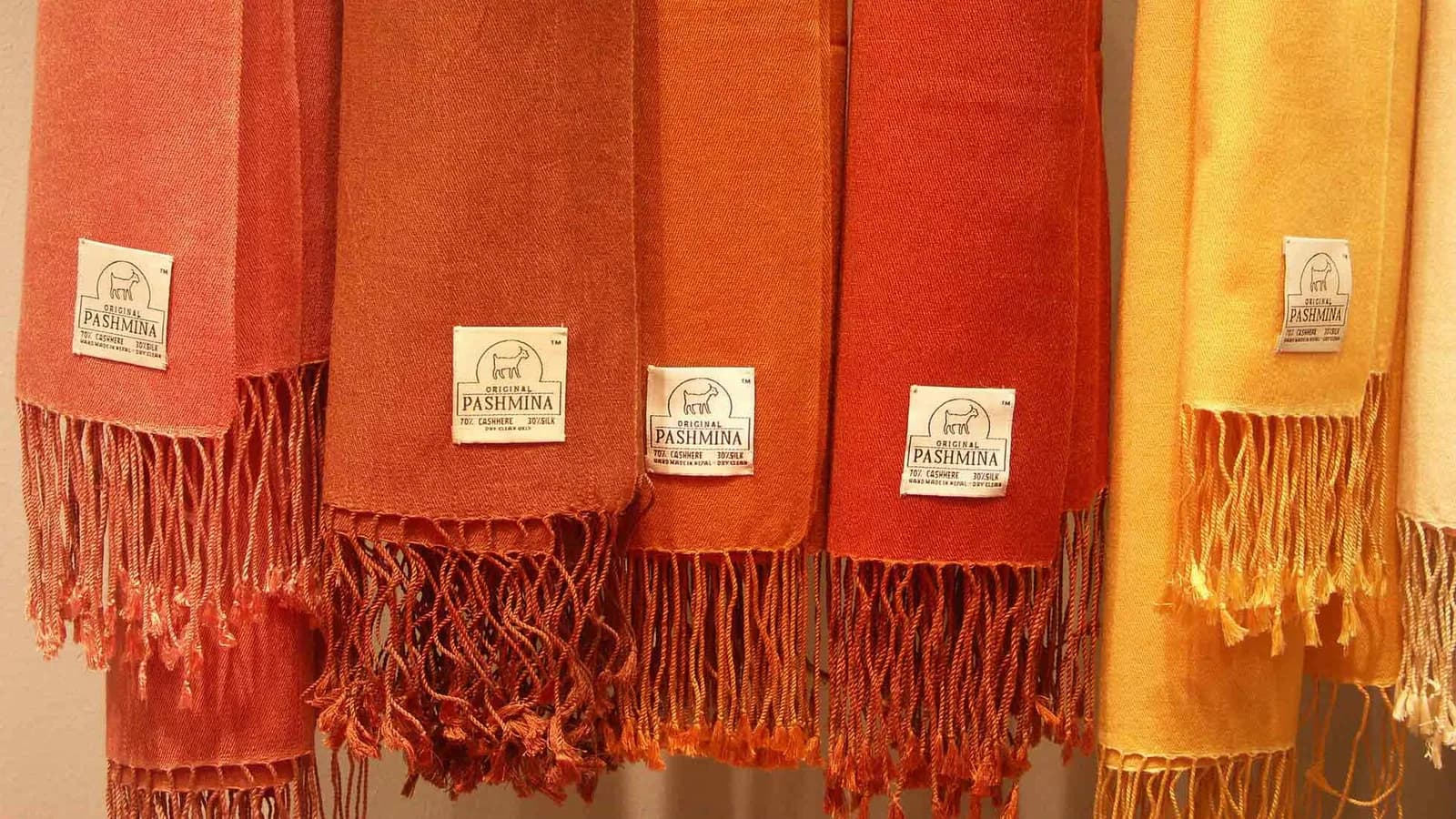
A pashmina shawl is the souvenir most travellers most want to bring home from Nepal — and the one most likely to be faked. Walk through Thamel and you will see "pashmina" draped over every second railing, some of it NPR 500, in colours no goat ever grew. The genuine article is a different thing entirely: a feather-light wrap of Himalayan cashmere that warms your shoulders in seconds and lasts for decades. This guide explains how to buy real pashmina in Nepal — how to spot a fake, what the Chyangra trademark means, how grades and ply work, and what an honest shawl actually costs.
This is a deeper dive on one item from our broader what to buy in Nepal guide. Prices below are rough 2024-2025 ranges from Nepal-based sellers (sources at the end); exchange rates and stock move, so treat them as a calibration tool, not a fixed tariff.
Key takeaways
- Pashmina is the finest grade of cashmere, combed from the winter undercoat of high-altitude Himalayan goats — roughly 12 to 16 microns, finer than a hair.
- A large share of "pashmina" sold to tourists is synthetic or a heavy blend — industry estimates put the fake share around 70%.
- The clearest authenticity signal is the Chyangra Pashmina trademark, backed by the Government of Nepal and the NPIA.
- Quick checks: matte not shiny, warms fast, uneven fibres against the light; the burn test on a single thread is decisive.
- Real pashmina is never NPR 500 — expect a quality piece to cost meaningfully more, and treat suspiciously cheap "pure pashmina" as a red flag.
What pashmina actually is
The word comes from pashm, the Persian for the soft inner wool that certain mountain goats grow to survive a Himalayan winter. In Nepal that goat is the chyangra (Capra hircus), grazing at high altitude where the cold forces it to produce an exceptionally fine undercoat. Each spring that downy layer is combed out by hand, sorted, and spun.
Cashmere as a category comes from the undercoat of several high-elevation goat breeds, with fibres generally in the 14-to-19-micron range. Pashmina is the top slice of that range. Nepal's chyangra fibre is measured at roughly 12 to 16 microns, against the 18-to-21 microns of much commercial cashmere — and that fineness is exactly why a good pashmina feels weightless, drapes like liquid, and warms you almost on contact. It is also why it can never be mass-produced cheaply.
So the rule of thumb: all pashmina is cashmere, but only the finest cashmere earns the name pashmina. A label saying "pashmina" guarantees nothing on its own — the word is not legally protected the way the Chyangra trademark is.
The Chyangra trademark and certifications
Because "pashmina" is an unprotected word, Nepal created a hallmark that is protected. The Chyangra Pashmina trademark is an internationally registered mark backed by the Government of Nepal and the Nepal Pashmina Industries Association (NPIA). It certifies that a product is made from genuine Nepali pashmina fibre and was produced to the association's quality standards.
On a real shawl this shows up as a woven or printed tag, increasingly with a QR code you can scan to verify. For higher-value purchases, serious sellers can also point to deeper paperwork: NPIA certification, independent fibre testing to the ISO 17751 standard, or third-party yarn certification. You do not need all of that for a single travel scarf — but a seller who can produce it, and who will tell you the exact fibre content in percentages, is showing you they have nothing to hide.
What the certifications tell you
| Signal | What it means | How much to weight it | |---|---|---| | Chyangra Pashmina tag (with QR) | Government/NPIA-backed authenticity mark | High — the clearest single signal | | Stated fibre content (%) | Seller knows and discloses the blend | High | | ISO 17751 fibre test | Lab-verified fibre composition | Very high (for pricey pieces) | | "Pashmina" written on a label | Almost nothing — unprotected word | Very low |
How to spot a fake
You will not always have a lab handy, so learn the hand-and-eye tests. No single one is conclusive, but together they are very reliable.
- Feel the finish. Genuine pashmina has a soft, slightly matte surface. A bright, plasticky sheen is the classic tell of viscose or polyester.
- The warmth test. Hold the fabric against your bare skin for a few seconds. Real animal fibre absorbs body heat and feels warm almost immediately; synthetics stay cool or feel clammy.
- Hold it to the light. A pure pashmina lets light through unevenly, revealing slightly irregular, hand-spun fibres. A perfectly even, uniform weave suggests a machine-made synthetic.
- Check the colours. Natural pashmina sits comfortably in earthy, muted tones. A rack of identical shawls in a dozen neon shades is a warning sign.
- Watch for shedding. Excessive fluff and shedding points to short, low-grade or blended fibres.
The burn test (the decisive one)
If you can sacrifice a single thread from the fringe, fire settles the argument. Pull one strand and touch a flame to it:
- Real pashmina behaves like hair — it smells of burning hair and leaves a small amount of crumbly grey ash you can crush to powder.
- Synthetic melts and shrinks away from the flame, smells of burning plastic, and leaves a hard bead at the tip.
A cooperative, confident seller will often let you do this; reluctance to part with one fringe thread is itself informative.
Why the ring test is overrated
The famous "if it passes through a wedding ring it's real" trick is weak. The ring test only measures how thin and fine the fabric is — and a thin synthetic can slide through a ring just as easily, while a thicker, warmer two-ply pashmina may legitimately get stuck. Use it as a curiosity, never as your proof.
Grades, ply, and what you are paying for
Two words come up constantly when you shop seriously: grade and ply.
Grade usually refers to the fibre mix. A common framing among Nepali sellers runs roughly like this:
| Grade | Typical composition | Character | |---|---|---| | A | Pure pashmina, no silk | Lightest, softest, most delicate | | B | About 70% pashmina / 30% silk | Light, with a subtle sheen and more strength | | C | About 50% pashmina / 50% silk | Heaviest, most durable, more lustrous |
Higher pashmina content means a lighter, finer, usually pricier piece; adding silk brings sheen, drape, and durability. Neither is "fake" — a 70/30 blend is a legitimate, popular choice — but you should be told which you are buying.
Ply is how many yarn strands are twisted together. A two-ply shawl twists two strands, making it warmer, thicker, and more durable than a single-ply wrap. For a wearable everyday scarf, two-ply pure pashmina or a good pashmina-silk blend is the sweet spot most travellers are happiest with.
What real pashmina costs
The single most useful fact to internalise: authentic pashmina is never cheap. The fibre is rare and the weaving is labour-intensive, so price is one of your better fake-detectors.
As a rough guide from Nepal-based sellers (as of 2025), a quality pashmina-silk blend or entry-level pure piece often lands around NPR 3,000-6,000 (about US$25-50), with pure hand-spun, hand-finished, or hand-embroidered shawls climbing well beyond that. International boutique pricing for genuine hand-woven pashmina commonly sits in the US$120-300+ band, which tells you how compressed Nepal's prices already are at source.
The flip side: a shawl marked NPR 500 and called "pure pashmina" is, realistically, viscose or a heavy synthetic blend. That does not make it a useless object — it may be a perfectly nice cheap scarf — but do not pay pashmina money or believe pashmina claims for it.
Because so much of this is bought in bargaining markets, knowing the numbers in Nepali genuinely shifts the price. Our Nepali numbers and bargaining guide gives you the exact phrases; the moment you counter-offer in rupees pronounced in Nepali, the opening price tends to soften.
Where to buy pashmina in Kathmandu
You have two broad routes, and the right one depends on how much you enjoy haggling.
The markets (bargaining expected). Thamel and the lanes around Kathmandu's old Durbar Square hold hundreds of textile shops with the widest selection in the country. Quality is genuinely mixed here, prices are negotiable, and the authenticity tests above are essential. The upmarket hotel arcades (around the Annapurna and Yak & Yeti, for instance) also stock reliable higher-end pieces.
Fair-trade and certified emporiums (fixed prices). If you would rather not negotiate and want guaranteed fibre content, buy from a government-certified emporium or a fair-trade cooperative. Local Women's Handicrafts, a well-reviewed collective on the western edge of Thamel, trains and employs disadvantaged women to produce Nepali textiles — you pay a fixed, fair price and the money is clearly accounted for.
If your trip takes you across the river to Lalitpur, the craft shops there are excellent for textiles and metalwork alike; see our Patan (Lalitpur) guide for the lay of the land. And before you part with serious cash anywhere, it is worth knowing the local cons — our Nepal tourist scams guide covers the textile and "pure pashmina" markups you are most likely to meet.
Caring for your pashmina
A genuine shawl rewards a little gentleness and will outlast almost anything else in your wardrobe.
- Wash by hand in cool water with a dedicated wool or cashmere shampoo; let it soak rather than scrubbing.
- Never wring or twist — press the water out gently and reshape it flat.
- Dry flat, away from direct sun and heat, both of which can yellow or shrink the fibres.
- Do not iron — heat crushes the natural loft of the yarn.
- Store in a breathable cotton bag, never sealed plastic, which traps moisture and encourages yellowing.
- De-pill gently with a sweater comb on fine pieces, or a pumice sweater stone on heavier ones; never yank pills off by hand.
The bottom line
Buy pashmina the way you would buy anything handmade and genuinely valuable: slowly, with your hands and eyes engaged. Feel for matte softness and fast warmth, hold it to the light, look for the Chyangra tag, ask for the fibre content in plain percentages, and let the price be a sanity check rather than a temptation. Spend a little more for the real thing from a seller who can stand behind it, and you will carry home not a tourist scarf but a piece of the Himalaya that still feels luxurious years from now. When you are ready to browse properly, base yourself near the markets — our where to stay in Kathmandu guide will put you within walking distance of the best of them.
Sources
- Verify Your Pashmina — Pashminas Nepal
- What Is Chyangra Pashmina? Nepal's Finest Himalayan Cashmere Guide — Rita Cashmere
- How to Identify Genuine Pashmina Shawl: Expert Tests — Diamond Knitland
- Pashmina in Nepal: A Complete Buying Guide — Handicrafts in Nepal
- Shopping for Pashmina in Kathmandu: A Complete Guide — Wandering Educators
- Cashmere Pashmina Care Instructions — Angela Jey
- The Traveler's Guide to Buying Authentic Pashmina in Nepal — Best Heritage Tour
Frequently asked questions
- What is pashmina, and is it the same as cashmere?
- Pashmina is the finest grade of cashmere, combed from the soft winter undercoat of high-altitude Himalayan goats. All pashmina is cashmere, but not all cashmere is fine enough to be called pashmina — the best Nepali fibre measures only about 12 to 16 microns across, finer than a human hair.
- How can I tell if a pashmina is real or fake in Nepal?
- Feel for a soft matte texture rather than a shiny one, check that it warms your skin within seconds, hold it to the light to see uneven natural fibres, and look for the Chyangra Pashmina trademark tag. If you can spare a single thread, the burn test is decisive: real animal fibre smells like burning hair and turns to crumbly ash, while synthetic melts into a hard plastic bead.
- What is the Chyangra Pashmina trademark?
- It is an official hallmark backed by the Government of Nepal and the Nepal Pashmina Industries Association, certifying that a product is made from genuine Nepali pashmina fibre. The label, often with a QR code, is the single clearest signal you are buying the real thing rather than a synthetic blend.
- How much should a real pashmina cost in Nepal?
- Genuine pashmina is never cheap. A quality blend often lands in the rough range of NPR 3,000 to 6,000 (about US$25 to 50), with pure hand-spun pieces and hand embroidery climbing well above that. Anything sold for NPR 500 is almost certainly synthetic or a heavy viscose blend.
- Is the ring test a reliable way to check pashmina?
- Not on its own. The ring test only shows how thin and fine a fabric is, and some thin synthetics will slide through a ring while a thicker genuine two-ply shawl may not. Treat it as one weak signal among several, not as proof.
- What do grade and ply mean when buying pashmina?
- Grade usually describes the fibre mix — for example pure pashmina versus a pashmina-and-silk blend — while ply is how many yarn strands are twisted together. A two-ply shawl uses two strands, making it warmer and more durable than a single-ply one. Sellers who can explain both clearly tend to be the more trustworthy ones.
- Where is the best place to buy pashmina in Kathmandu?
- Thamel and the streets around the old Durbar Squares have the widest choice, but quality is mixed and bargaining is expected. For guaranteed fibre content and fixed, fair prices, buy from a certified emporium or a fair-trade cooperative such as Local Women's Handicrafts.
- How do I care for a pashmina so it lasts?
- Hand wash gently in cool water with a wool or cashmere shampoo, never wring it, and dry it flat away from direct heat or sun. Do not iron it, store it in a breathable cotton bag rather than plastic, and lift off any small pills with a sweater comb rather than pulling them.
Spotted an error in this post? Tell us or suggest a correction.
Related posts
ABC Trek: A Plain-English Guide to Annapurna Base Camp
The ABC trek (Annapurna Base Camp) explained — the route, how many days it takes, difficulty, the best seasons, and what daily trail life is really like.
Read postAma Dablam Climb: 2026 Expedition Guide (6,812m)
An Ama Dablam climb and expedition guide for 2026 — height, the Southwest Ridge route, camps, fixed ropes, difficulty, permits, cost and the best seasons.
Read postAnnapurna vs Manaslu: Which Trek Should You Choose?
An Annapurna vs Manaslu decision guide for trekkers — compare permits, crowds, difficulty, infrastructure and cost to pick the right Himalayan route.
Read postAsan Bazaar Kathmandu: Old Town Market Guide
A visitor guide to Asan bazaar, Kathmandu's oldest market — its six-road square, Annapurna Temple, what to buy, when to go, and how to get there.
Read postAyurveda Nepal: A Traveller's Guide to Healing
Ayurveda Nepal explained for tourists — the history, the doshas, treatments like Panchakarma and Shirodhara, where to go and how to choose a centre safely.
Read postBest Restaurants Pokhara Lakeside: Where to Eat
The best restaurants in Pokhara Lakeside — lakeside trout, wood-fired pizza, Tibetan momos and healthy cafes, with what to order and rough 2026 prices.
Read post