What to Buy in Nepal: Souvenirs & Where to Shop 2026
The best things to buy in Nepal — pashmina, singing bowls, khukuri, thangka and more — how to spot fakes, where to shop, and the export rules to know.
Half the fun is the buying. The other half is getting it home — which is where the export rules quietly matter.
Nepal is one of the great shopping countries — not for malls and brands, but for things made by hand within a few kilometres of where you buy them. A pashmina spun from mountain-goat wool, a singing bowl hammered in a Kathmandu workshop, a knife forged in the eastern hills. This is your guide to what to buy in Nepal: the souvenirs worth your luggage space, how to tell the real thing from the tourist-grade copy, where to shop, and the export rules that quietly matter at the airport.
Prices below are rough 2025 ranges from Nepal-based sellers (sources at the end). Exchange rates and stock vary, so use them to calibrate, not as gospel.
Key takeaways
- The classics: pashmina, singing bowls, khukuri, thangka, lokta paper, prayer flags, Dhaka topi, Ilam tea, and metal or felt handicrafts.
- A lot of "pashmina" is synthetic — learn the burn test and look for the Chyangra trademark.
- Bargain in the markets, but never at fair-trade shops where prices are fixed for the artisans.
- Two export rules matter: antiques over ~100 years cannot leave Nepal, and a khukuri must fly in checked baggage.
The souvenirs worth buying
Pashmina shawls
The signature Nepal buy. True pashmina is the premium grade of cashmere, spun from the fine undercoat of high-altitude Himalayan goats — a fibre far thinner than human hair, which is why a good shawl feels weightless and warm. Expect roughly NPR 3,000–6,000 (US$25–50) for a quality cashmere-silk blend and NPR 8,000–12,000 (US$60–90) for pure pashmina, with hand-embroidered pieces climbing higher. The NPR 500 "pashmina" on a Thamel rack is something else entirely.
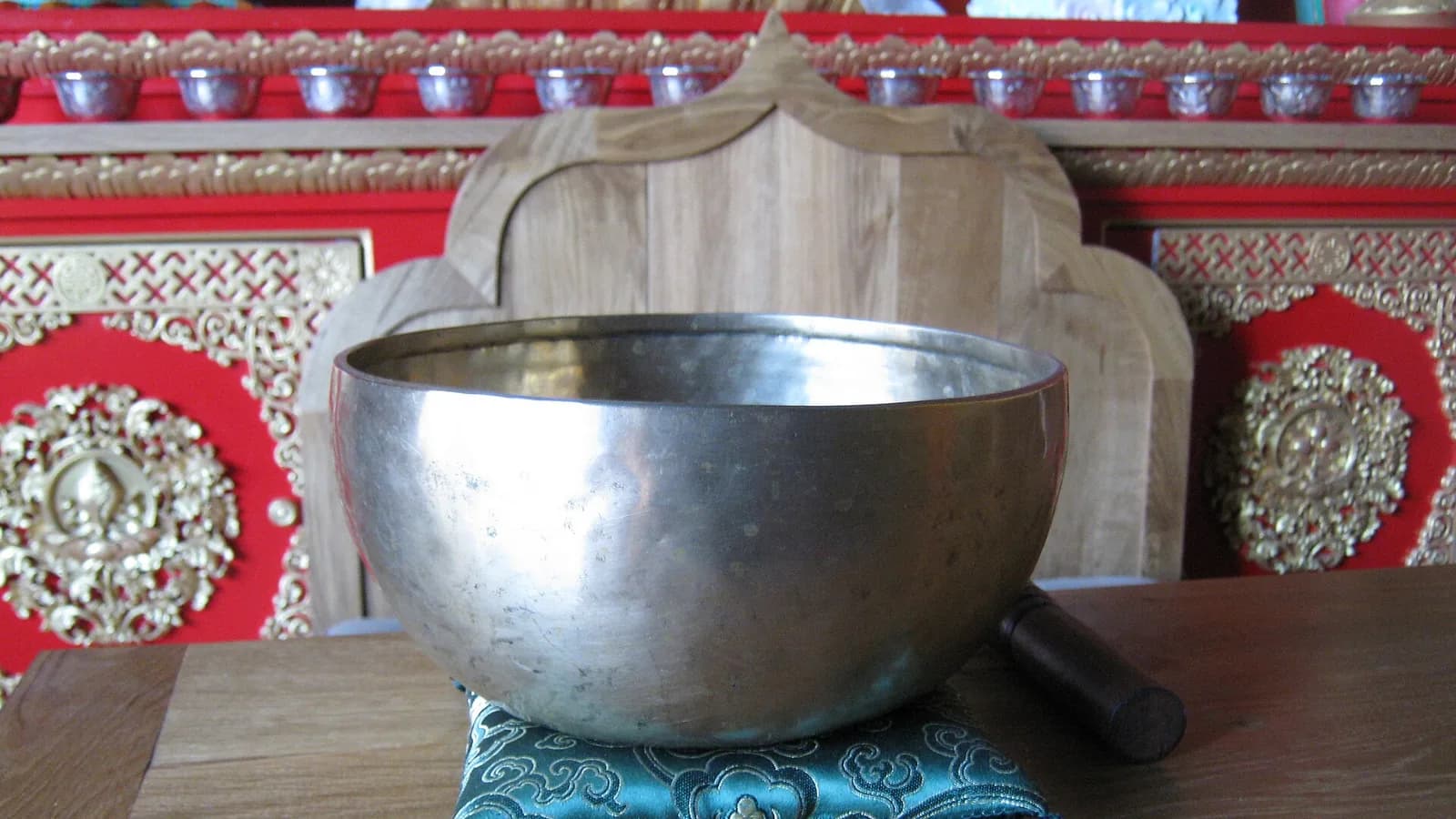
Singing bowls
Hemispherical metal bowls that ring with a long, layered tone when struck or rimmed — used in meditation and sound healing, and made by Newar artisans around Kathmandu. Hand-hammered bowls show small dents and tonal complexity; machine-made ones are perfectly smooth with a short, simple ring. Small bowls start around NPR 1,000–2,500 (US$7–19); large or antique pieces run much higher.
Khukuri (the Gurkha knife)
The forward-curved blade carried by Nepal's legendary Gurkha soldiers, hand-forged in the eastern towns of Bhojpur and Dharan. A genuine working khukuri has a full tang, hammer marks, and a leather sheath; the NPR 500 display pieces are cast, not forged. Budget NPR 3,000–6,000 (US$25–50) for a solid functional one. Crucial: it flies home in checked baggage only (see the export rules below).
Thangka paintings
Intricate Buddhist and Hindu scroll paintings, the finest using mineral pigments and real gold, taking months to complete. A small genuine hand-painted thangka runs NPR 5,000–15,000 (US$40–120); printed posters are a fraction of that. Look for real brushwork texture and natural canvas, and be wary of anything "hand-painted" sold cheap or finished in days.
Lokta paper
Beautiful, durable handmade paper from the bark of the high-altitude lokta shrub — sustainably harvested because the plant regrows. Sold as journals, cards, lampshades and gift wrap, mostly made around Bhaktapur. Notebooks from NPR 200–500 (US$1.50–4) make perfect light, cheap, authentic gifts.
Prayer flags
Strings of five-coloured cloth panels block-printed with mantras, meant to scatter blessings on the wind. A set costs as little as NPR 100–500 (US$0.75–4) — the easiest souvenir to pack and gift. Choose cotton, block-printed flags over glossy polyester for the traditional article.
Dhaka topi and Dhaka fabric
The geometric hand-loomed cotton that is Nepal's national fabric, and the Dhaka topi cap that's part of national dress. The most authentic comes from Tansen in Palpa, though Asan and Indra Chowk in Kathmandu stock plenty. A genuine handloom piece carries the small irregularities machine copies lack.
Nepali tea
From Ilam in the east — many drinkers rate it alongside neighbouring Darjeeling for aroma and clarity. Orthodox loose-leaf and spring "first-flush" teas are the prize; a 100-gram box runs NPR 300–1,200 (US$2–10). Buy from a specialty tea shop rather than an airport stall.
Metalwork, masks and felt
Patan is the home of lost-wax bronze and brass deity statues; Bhaktapur for carved wooden masks and pottery; and women's cooperatives across Kathmandu for hand-felted wool — finger puppets, slippers, ornaments — often fair-trade certified and very packable.
How to spot a fake
Three quick tests cover most of what you'll buy:
- Pashmina — the burn test. Pull a single thread and touch a flame to it. Real animal fibre smells like burning hair and leaves a crumbly ash; synthetic melts into a hard bead and smells of plastic. A soft matte finish and the Chyangra Pashmina trademark tag are good signs; a shiny sheen is a warning.
- Singing bowl — look and listen. Run your fingers over the outside: genuine hand-hammered bowls have visible bumps and a complex, long-lasting tone. Mirror-smooth surfaces and a short, high ring mean machine-made.
- Thangka — feel the surface. Real brushwork has fine raised texture and natural canvas grain; printed replicas are flat and uniform. Consecrated pieces often carry mantras on the reverse.
Where to shop
| Place | Best for | |---|---| | Thamel (Kathmandu) | Variety and convenience; bargain hard, quality is mixed | | Asan Bazaar | Old local market — spices, metalware, better prices, cash only | | Indra Chowk | Beads (pote), fabrics, textiles, brassware | | Patan / Mangal Bazaar | Fine bronze statues, silver, thangkas — superior quality | | Bhaktapur Pottery Square | Clay pottery, masks, carvings, straight from artisans | | Boudha stupa market | Incense, prayer wheels, Tibetan crafts | | Fair-trade co-ops | Mahaguthi, Sana Hastakala, Dhukuti — quality and ethics, fixed prices |
For a sense of Patan's craft district while you're there, see our Patan (Lalitpur) guide, and for Bhaktapur's potters and mask-carvers, our Bhaktapur day-trip guide.
Bargaining: the unwritten rules
In the markets, haggling is expected and half the fun. Opening prices often start at two to three times the real one, so counter below half and work toward the middle. Keep it light — a smile and patience get you further than hard tactics, and walking away (then being called back) is a normal part of the dance. A little Nepali helps enormously here; our Nepali numbers and bargaining guide gives you the exact phrases.
Where not to bargain: fair-trade cooperatives, boutiques and the airport, where prices are fixed — at the co-ops, deliberately, to guarantee artisans a fair wage. And remember that traditional markets like Asan are cash only.
Before you fly home: export rules that matter
A few rules trip up travellers at the airport. These are well documented, but enforcement and thresholds can change — verify with Nepal Customs or the Department of Archaeology if you're buying something significant.
- Antiques over ~100 years old cannot be exported. Statues, paintings, manuscripts and religious items of that age are national heritage. Genuine antiques need a clearance certificate from the Department of Archaeology (Ram Shah Path, Kathmandu). Because new items are sometimes sold as "antique," keep receipts and, for valuable pieces, get written confirmation it's a modern reproduction.
- A khukuri must travel in checked baggage — never carry-on — and you should check your destination country's knife-import laws too.
- No wildlife products. Nepal is a CITES signatory; anything made from ivory, animal skins, or other protected species is illegal to export and can be seized on departure. Don't buy it.
Avoiding the classic rip-offs is its own skill — our Nepal tourist scams guide covers the shopping-related ones, from gemstone cons to "antique" markups.
The bottom line
Buy the things Nepal actually makes: a shawl, a bowl, a journal, a knife, a painting, a box of tea. Spend a little more for hand-made over machine-made, support a fair-trade co-op when you can, and pack the khukuri in your hold bag. Do that, and your souvenirs will be the kind that still mean something years later — not the kind that fall apart before the trip photos are even sorted. Base yourself near the markets with our where to stay in Kathmandu guide and give yourself an afternoon to browse properly.
Sources
Frequently asked questions
- What should I definitely buy in Nepal?
- If you want a shortlist: a pashmina shawl, a hand-hammered singing bowl, a lokta-paper journal and a box of Ilam tea. They are lightweight, genuinely made in Nepal, and useful or beautiful long after the trip. Add a khukuri or a thangka if you want something with more weight and story.
- Is the pashmina sold in Thamel actually real?
- Often not. A large share of cheap tourist-market pashmina is synthetic or a blended fabric rather than pure Himalayan cashmere. Look for the Chyangra Pashmina trademark tag, feel for a soft matte finish rather than a shiny one, and if you can spare a thread, the burn test is decisive: real animal fibre smells like burning hair and crumbles to powder, while synthetic melts into a hard plastic bead.
- Can I take a khukuri knife on the plane?
- Only in checked baggage, wrapped and secured — never in your carry-on. A khukuri is a bladed weapon and will be confiscated at security if it is in your cabin bag. Also check your home country's knife-import rules before you buy, because they vary a lot from country to country.
- Do you bargain in Nepal, or are prices fixed?
- In markets like Thamel, Asan and Indra Chowk, bargaining is expected — opening prices are often two to three times the real one, so counter below half and settle somewhere in the middle, always with a smile. Prices are fixed at fair-trade cooperatives, boutiques and the airport, where haggling is not appropriate.
- What is cheap and good to buy in Nepal?
- Lokta-paper notebooks and cards (from a couple of dollars), prayer-flag sets, felt finger puppets, incense, and 100-gram boxes of Ilam tea are all inexpensive, light, and easy to pack for gifts. They give you a lot of authentic Nepal for very little money.
- Where is the best place to shop in Kathmandu?
- Thamel is the most convenient for variety; Asan Bazaar is the old local market with better prices and atmosphere; Patan is the place for fine metalwork and thangkas; and fair-trade shops like Mahaguthi, Sana Hastakala and Dhukuti are best if you want guaranteed quality and ethical sourcing.
- Can I bring an old statue or thangka out of Nepal?
- Anything genuinely over about 100 years old is treated as cultural heritage and cannot be exported without a clearance certificate from the Department of Archaeology in Kathmandu. Modern reproductions are fine to take home. Because tourists are sometimes sold new items described as antiques, keep your receipt and, for valuable pieces, ask the seller for written confirmation that it is not an antique.
Spotted an error in this post? Tell us or suggest a correction.
Related posts
ABC Trek: A Plain-English Guide to Annapurna Base Camp
The ABC trek (Annapurna Base Camp) explained — the route, how many days it takes, difficulty, the best seasons, and what daily trail life is really like.
Read postAma Dablam Climb: 2026 Expedition Guide (6,812m)
An Ama Dablam climb and expedition guide for 2026 — height, the Southwest Ridge route, camps, fixed ropes, difficulty, permits, cost and the best seasons.
Read postAnnapurna vs Manaslu: Which Trek Should You Choose?
An Annapurna vs Manaslu decision guide for trekkers — compare permits, crowds, difficulty, infrastructure and cost to pick the right Himalayan route.
Read postAsan Bazaar Kathmandu: Old Town Market Guide
A visitor guide to Asan bazaar, Kathmandu's oldest market — its six-road square, Annapurna Temple, what to buy, when to go, and how to get there.
Read postAyurveda Nepal: A Traveller's Guide to Healing
Ayurveda Nepal explained for tourists — the history, the doshas, treatments like Panchakarma and Shirodhara, where to go and how to choose a centre safely.
Read postBest Restaurants Pokhara Lakeside: Where to Eat
The best restaurants in Pokhara Lakeside — lakeside trout, wood-fired pizza, Tibetan momos and healthy cafes, with what to order and rough 2026 prices.
Read post