Nepal Government: How the Country Is Governed
How the Nepal government works: a guide to the federal democratic republic — president, prime minister, parliament, 7 provinces and local levels.
In 2015 Nepal rewrote itself from a centralised kingdom into a federal democratic republic governed across three levels — central, provincial and local.
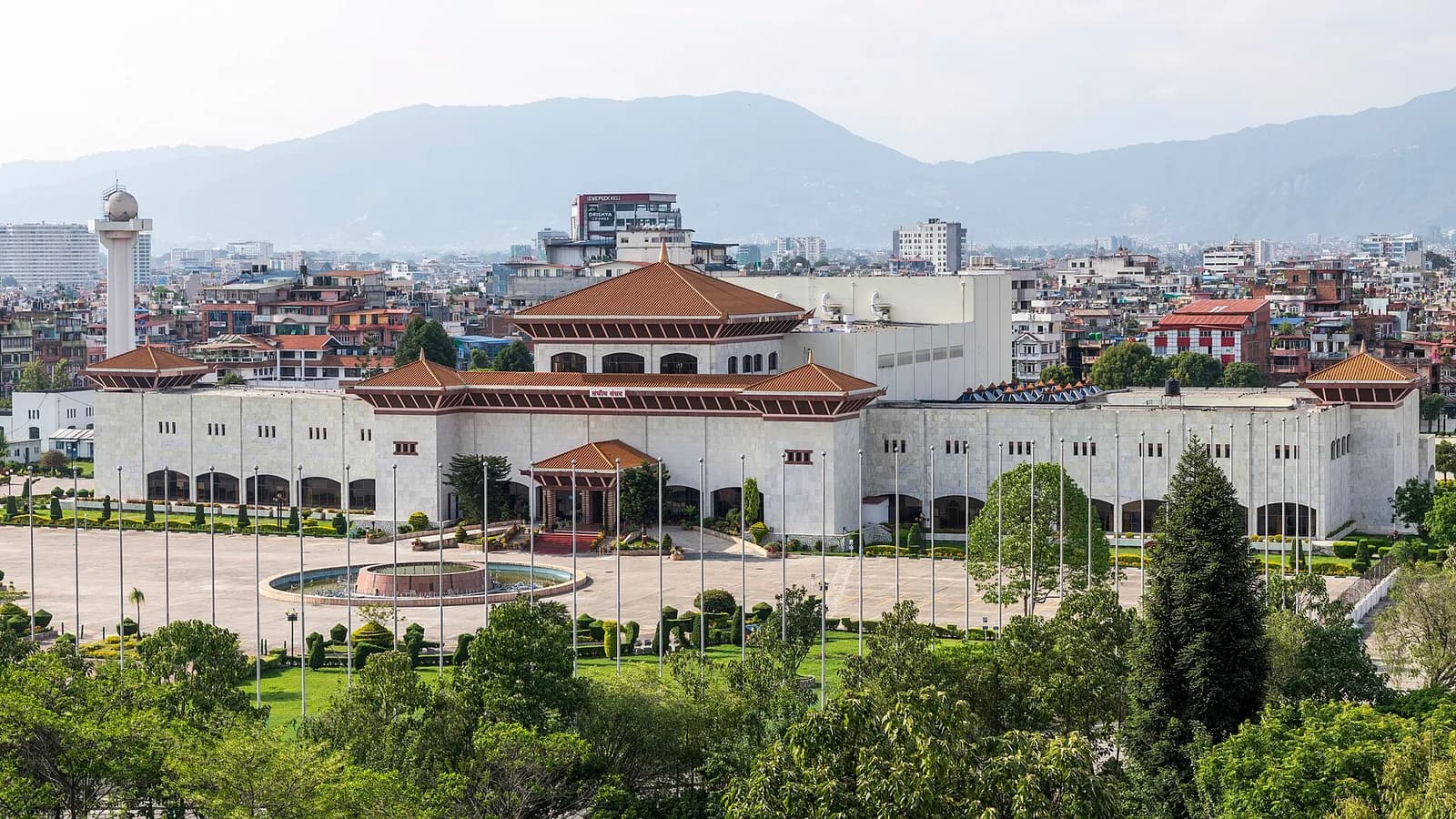
The government of Nepal is one of the world's newer federal systems, built on a constitution that took effect on 20 September 2015. In a single generation the country moved from a centralised Hindu kingdom to a federal democratic republic governed across three levels — central, provincial and local — with a ceremonial president, a powerful prime minister and an elected parliament. This guide explains how Nepal is governed in clear, neutral terms, describing the institutions rather than the politics of the day.
It is written for travelers and curious readers who want to understand the structure behind the headlines. It pairs naturally with our guides to the Prime Minister of Nepal and the seven provinces, and it keeps to documented constitutional facts.
Key takeaways
- Nepal is a federal democratic republic under the 2015 constitution, effective 20 September 2015.
- The president is the ceremonial head of state; the prime minister is the head of government.
- The Federal Parliament is bicameral: a 275-seat House of Representatives and a 59-member National Assembly.
- Government runs across three levels: federal, 7 provinces and 753 local governments.
- Nepal became a republic in 2008, ending around 240 years of monarchy.
From kingdom to republic: a brief background
For most of its modern history Nepal was a unitary kingdom ruled from Kathmandu. A decade-long civil conflict and a popular movement led, in 2008, to the abolition of the monarchy and the declaration of a republic. A long and contested constitution-drafting process followed, producing the Constitution of Nepal, promulgated on 20 September 2015.
That document is the foundation of today's system. It defines Nepal as an independent, sovereign, secular, inclusive, federal democratic republic with a multi-party, competitive parliamentary form of government. It also created the federal structure — dividing power among a central government, provinces and local bodies — which is the single biggest change from the old order. For more on how that reshaped the map, see our guide to Nepal's provinces.
The executive: president and prime minister
Nepal's executive branch is split between a head of state and a head of government, as in many parliamentary democracies.
The president (rashtrapati) is the head of state, the first citizen and the supreme commander of the army, but the role is largely ceremonial. The president promulgates laws, appoints the prime minister and generally acts on the advice of the cabinet. The president is indirectly elected by an electoral college made up of the Federal Parliament and the seven provincial assemblies, using a weighted voting formula. As of June 2026 the head of state is President Ram Chandra Paudel, in office since March 2023.
The prime minister (pradhanmantri) is the head of government and holds the real executive power. The prime minister chairs the Council of Ministers (the cabinet), sets policy and runs the administration, and must hold the confidence of the House of Representatives. As of June 2026 the prime minister is Balen Shah, who took office in March 2026; our Prime Minister of Nepal guide covers the office in detail.
The legislature: a bicameral Federal Parliament
Nepal's national lawmaking body is the Federal Parliament, which has two houses.
- House of Representatives (lower house): 275 members. Of these, 165 are elected by first-past-the-post from single-member constituencies and 110 by proportional representation from nationwide party lists. Members serve five-year terms unless the house is dissolved earlier. This chamber determines who becomes prime minister and can remove a government through a vote of no confidence.
- National Assembly (upper house): 59 members. Fifty-six are elected by an electoral college of provincial assembly members and local representatives — eight from each of the seven provinces — and three are nominated by the government with presidential approval. Members serve six-year terms, with one-third renewed every two years, making it a permanent house that is never fully dissolved.
Together the two houses pass federal laws and approve the national budget. The split design — a directly accountable lower house and a more stable, regionally balanced upper house — is intended to combine democratic responsiveness with continuity. The proportional element of the lower house is also a deliberate tool for inclusion, helping ensure representation across Nepal's many ethnic and linguistic communities.
Federalism: three levels of government
The most distinctive feature of the post-2015 system is federalism. Power is shared across three levels, each with its own elected assembly and constitutionally defined responsibilities:
| Level | Units | Headed by | | --- | --- | --- | | Federal (central) | One national government | Prime minister | | Provincial | 7 provinces | Chief minister (each) | | Local | 753 local governments | Mayor or chairperson (each) |
Each of the seven provinces — Koshi, Madhesh, Bagmati, Gandaki, Lumbini, Karnali and Sudurpaschim — has a unicameral provincial assembly that elects a chief minister to lead the provincial government. Below them sit 753 local-level units: metropolitan cities, sub-metropolitan cities, municipalities and rural municipalities (gaunpalika), each with its own elected executive and council. These local bodies are spread across Nepal's 77 districts; see our overview of Nepal's districts.
The constitution divides powers using schedules that list exclusive and concurrent competencies for each tier — covering areas from foreign affairs and defence (federal) to local infrastructure, basic services and community development. The aim is to bring government closer to citizens than the old, highly centralised system allowed.
Independent constitutional bodies
Beyond the three branches, the constitution establishes several independent bodies that are meant to operate at arm's length from the government of the day. The best known to anyone following an election is the Election Commission of Nepal, a constitutional body responsible for conducting and supervising elections for the president, vice-president, parliament, provincial assemblies and local governments. Others include the public service commission, the auditor general and various rights and oversight commissions. For how elections themselves work, see our guide to the 2026 Nepal election.
How power changes hands
In Nepal's parliamentary system, governments are formed and unmade through parliament, not only through general elections. Because Nepali parties rarely win an outright majority alone, governments are often coalitions, and a prime minister can lose office through a no-confidence vote or a coalition breakup between elections. General elections to the House of Representatives are normally held every five years, with separate elections for provincial assemblies and, on their own cycle, local governments.
This is why Nepal has had frequent changes of government in the post-2008 era. It is a normal feature of the system rather than a sign of crisis, though it does mean the names of officeholders change relatively often — one reason any political article should be read with its date in mind.
Why this matters for travelers
Understanding the structure is useful background, but it rarely affects a trip directly. Visa rules, trekking permits and tourist services are administered by long-standing institutions that keep working regardless of which party is in power. Occasionally a political event leads to a bandh (general strike) that briefly affects transport, usually announced in advance, so a quick check of a local English-language news site each morning is enough to plan around it.
If you find yourself in a conversation about politics — Nepalis often follow it closely — the courteous approach as a guest is to listen and stay neutral rather than to take sides. With the structure in mind, you will find it easier to make sense of the flags, rallies and headlines you encounter, and to appreciate how much the country has changed in a short time. To carry on planning the enjoyable part, see our best places to visit in Nepal.
The bottom line
The government of Nepal is a federal democratic republic built on the 2015 constitution: a ceremonial president, a powerful prime minister, a two-house Federal Parliament, and power shared across federal, provincial and local levels — 7 provinces and 753 local governments in all. It is a young system, born from the end of the monarchy in 2008, and it is still maturing. For the people and votes that fill these institutions, continue with our guides to the Prime Minister of Nepal, the 2026 election and the seven provinces.
Sources
Frequently asked questions
- What type of government does Nepal have?
- Nepal is a federal democratic republic with a multi-party parliamentary system, established by the constitution that took effect on 20 September 2015. It has a ceremonial president as head of state and a prime minister as head of government.
- Who is the head of state and head of government in Nepal?
- The president is the head of state and plays a largely ceremonial role, while the prime minister is the head of government and holds the real executive power, leading the cabinet that is accountable to parliament.
- How many levels of government does Nepal have?
- Nepal has three levels of government: the federal (central) government, seven provincial governments and 753 local-level governments. Each tier has its own elected assembly and defined powers under the constitution.
- How many provinces does Nepal have?
- Nepal has seven provinces, created by the 2015 constitution. They are Koshi, Madhesh, Bagmati, Gandaki, Lumbini, Karnali and Sudurpaschim, and each has its own provincial assembly and chief minister.
- What is Nepal's parliament called?
- Nepal's federal legislature is a bicameral Federal Parliament made up of the House of Representatives, the lower house with 275 members, and the National Assembly, the upper house with 59 members.
- When did Nepal become a republic?
- Nepal abolished its monarchy and was declared a federal democratic republic in 2008. The current constitution, which defines the federal structure in detail, came into effect on 20 September 2015.
- Is Nepal a secular country?
- Yes. The 2015 constitution defines Nepal as a secular state, though it specifies that secularism includes protection of the religions and cultures practised since ancient times. Nepal is a religiously diverse country with a Hindu majority.
Related posts
Nepal Election 2026: System and Results Explained
A factual guide to the Nepal election 2026: how the voting system works, the March 2026 general election timeline, and the reported results.
Read postPrime Minister of Nepal: The Office, Role and Holders
Who is the Prime Minister of Nepal? A neutral guide to the office: its role, how the PM is chosen under Article 76, notable holders and who holds it now.
Read postBalen Shah: A Traveler's Guide to Nepal's Mayor-PM
Who is Balen Shah? A neutral, fact-checked profile of the rapper-turned-engineer who led Kathmandu and became Nepal's prime minister, for curious visitors.
Read post