Gharial Crocodile in Nepal: Chitwan's Fish-Eating Croc
See the gharial crocodile in Nepal. Identify this fish-eating river croc, visit the Kasara breeding centre, and learn why it is critically endangered.
Long-snouted, harmless to people and clinging to survival, the gharial is the strangest reptile you can still meet in a Nepali river.
Nepal's most famous wildlife tends to be big, grey and easy to photograph: rhinos in the grass, elephants on the riverbank, the occasional tiger. The gharial crocodile is none of those things. It is a long, pale, almost prehistoric-looking reptile that lies low in the water with only its eyes and the knobbly tip of its snout showing, and it is one of the rarest large animals you can still encounter in a Nepali river. If you visit Chitwan, you can meet gharials of every size at a riverside breeding centre and, with luck, spot a wild one basking on a sandbank. This guide explains what the gharial is, how to tell it apart from Nepal's other crocodile, where to see it, and why it is fighting for survival.
Key takeaways
- The gharial is a fish-eating crocodilian with an unmistakable long, thin snout and over a hundred fine teeth, found in the rivers of Nepal's Terai.
- It is harmless to people. Its delicate jaws are built for fish, not large prey, unlike the broad-snouted mugger crocodile that shares the same rivers.
- Chitwan National Park is the best place to see it, both at the Kasara Gharial Breeding Centre and along the Rapti and Narayani rivers; Bardia holds a smaller wild population.
- It is Critically Endangered, with the global population down an estimated 90 percent or more since the mid-1900s.
- Chitwan's wild count reached 265 in 2024, up about 11 percent year on year, supported by decades of captive breeding and release at Kasara.
- Only adult males grow the ghara, a pot-shaped lump on the snout that gives the species its name.
Meet the gharial: a crocodilian like no other
The gharial (Gavialis gangeticus) is one of the most distinctive crocodilians on Earth and a true Asian river specialist. It belongs to its own evolutionary line, separate from the "true" crocodiles and the alligators, and it has changed remarkably little over millions of years. In Nepal it lives only in the lowland Terai rivers, where slow, deep pools meet clean, flowing water and undisturbed sandbanks.
What sets it apart is the snout. Where a mugger crocodile has a broad, blunt muzzle, the gharial's snout is extraordinarily long, narrow and almost cylindrical, lined with more than a hundred sharp, interlocking teeth. That shape is a piece of precision engineering: a thin snout slips through water with very little resistance, letting the gharial whip its head sideways to snap up fish before they can dart away. Adults eat fish almost exclusively, while juveniles also take insects, frogs and crustaceans.
How big do they get?
Gharials are among the longest of all living crocodilians. The largest individuals have historically been recorded at around 6 metres, although most adults you are likely to see fall in the 3.5 to 4.5 metre range. Despite that length, the animal is lightly built compared with a bulky mugger, and its legs are weak on land, so it spends most of its life in or right beside the water.
The ghara
The feature that gives the gharial its name appears only on mature males: a fleshy, rounded growth at the very tip of the snout called a ghara. The word comes from a regional term for an earthenware pot, which the bulge resembles. The ghara is not just decoration. It works as a resonating chamber, helping the male produce a low buzzing sound, and as a visual signal to females during the breeding season. If you see a crocodilian in Chitwan with a knob on its nose, you are looking at an adult male gharial.
Gharial vs mugger: telling Nepal's two crocodiles apart
Chitwan's rivers are home to two very different crocodilians, and visitors often confuse them. Knowing the differences makes a safari far more rewarding, and it matters for safety, because one is harmless and the other is not.
| Feature | Gharial | Mugger crocodile | | --- | --- | --- | | Snout shape | Very long, thin, tube-like | Broad, blunt, V-shaped | | Main diet | Fish | Fish, mammals, birds, reptiles | | Adult male feature | Pot-shaped ghara on snout tip | None | | Risk to humans | Considered almost harmless | Can occasionally be dangerous | | Typical pose | Basking on sandbanks, very aquatic | Basking on banks, more mobile on land |
The takeaway for travellers is simple. A gharial is a shy fish-eater that wants nothing to do with you. The mugger, with its broad jaws and varied diet, is the crocodile to treat with respect near the water. Your safari guide will point out which is which, and following local advice about where to stand and swim is always the right call.
Where to see gharials in Nepal
Chitwan National Park
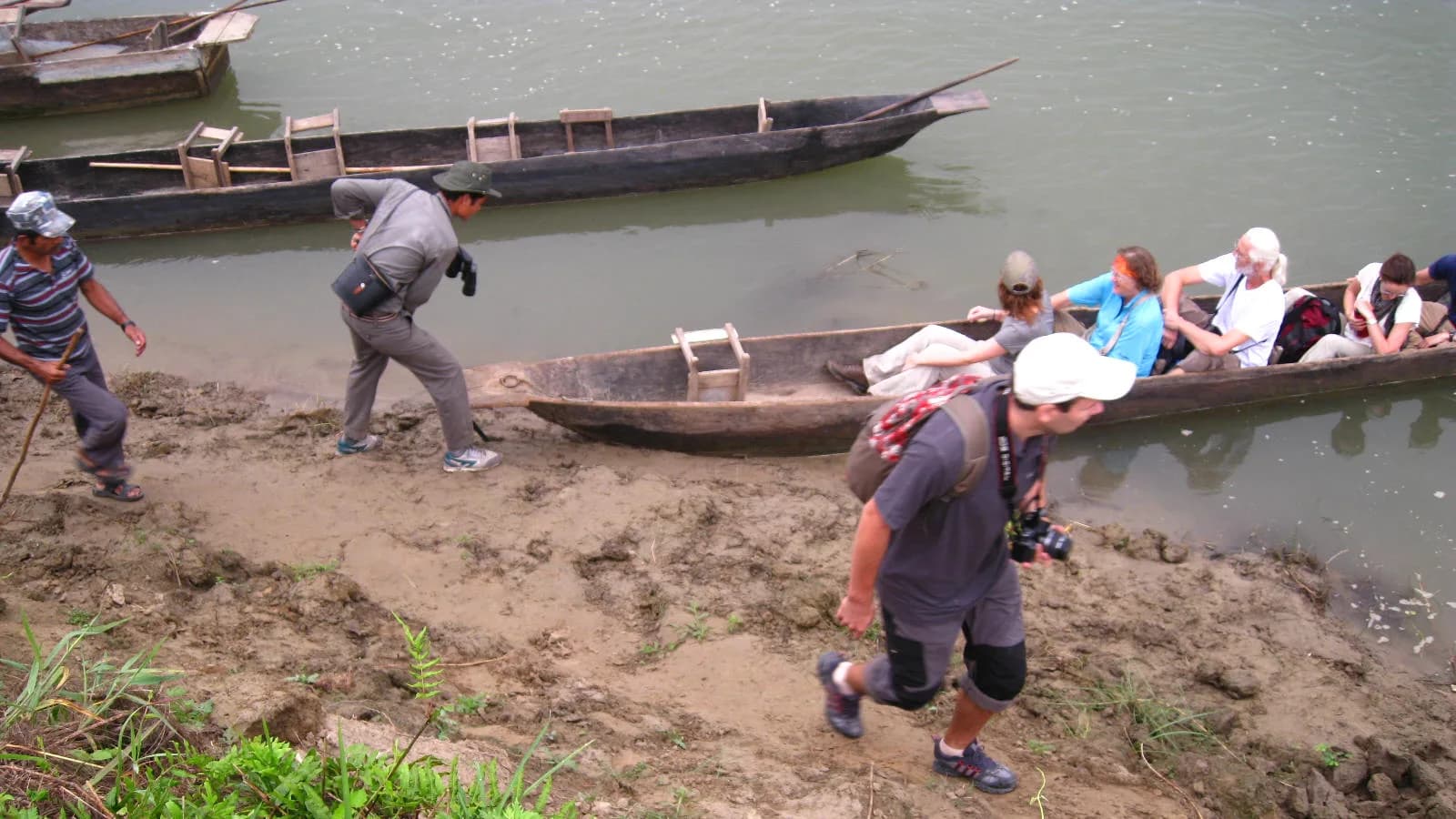
Chitwan, in the central Terai, is the heart of gharial country in Nepal and the easiest place for visitors to see them. The park protects long stretches of the Rapti and Narayani rivers, which together hold the country's main wild population. A canoe trip on the Rapti or Narayani is the classic way to look for wild gharials basking on sandbanks, often alongside muggers and a rich cast of water birds. A jeep safari that includes the park headquarters at Kasara is another reliable option and the standard way to reach the breeding centre. For the wider experience, see our guides to the Chitwan National Park safari and jungle safari in Chitwan.
The Gharial Breeding Centre at Kasara
The single best place to see gharials up close is the Gharial Breeding Centre, established by the Government of Nepal in 1978 next to the Chitwan park headquarters in Kasara. The centre collects eggs from vulnerable wild nesting sites, hatches them in protected conditions, and rears the young for several years before releasing them into the rivers, a strategy known as head-starting. Walking the enclosures, you can see hatchlings, juveniles and full-grown adults in one visit, along with mugger crocodiles and tortoises, which makes it an excellent stop for families and anyone visiting Nepal with kids.
Bardia and the far west
Beyond Chitwan, a smaller wild gharial population survives in the Karnali river system within and around Bardia National Park in far-western Nepal. Bardia is wilder, quieter and harder to reach than Chitwan, which makes sightings less predictable but the setting more remote. If you are weighing up the two destinations, our Bardia National Park guide covers what to expect.
A river ecosystem worth protecting
The gharial is what biologists call an indicator species. Because it needs clean, flowing water, healthy fish stocks and undisturbed sandbanks, a river that still supports gharials is usually a river in good health. The same Terai waters and grasslands shelter the one-horned rhino and the Bengal tiger of Chitwan, and the wetlands draw an exceptional range of birds, as our Nepal birdwatching guide describes. Seeing a gharial, in other words, is a sign that the whole river system around it is still working.
Why the gharial is critically endangered
The gharial is listed as Critically Endangered on the IUCN Red List, the highest risk category before extinction in the wild. The global population is thought to have collapsed by roughly 90 percent or more since the middle of the twentieth century, and the species now survives in only a handful of river systems across Nepal and India. Several pressures drive the decline:
- Loss of river habitat. Dams and barrages chop rivers into disconnected stretches and change the natural flow gharials depend on.
- Sand and gravel mining. Extraction strips away the sandbanks where gharials bask and lay their eggs.
- Fishing nets. Gharials regularly drown after becoming tangled in nets set across rivers.
- Pollution and overfishing. Dirty water and depleted fish stocks remove the food base the species relies on.
These threats are well documented in Chitwan itself, where conservationists note that the same rivers face pressure from sand extraction, pollution and fishing even inside a protected park.
Conservation in Chitwan
There is cautious good news. A 2024 survey counted 265 wild gharials inside Chitwan National Park, up about 11 percent from 239 the year before, with roughly 152 in the Rapti and 113 in the Narayani. The Kasara breeding centre has reared and released more than 2,000 gharials over the decades, and recent years have seen large batches returned to the rivers, including a release of well over a hundred animals into the Rapti reported in 2025. Park authorities have also stepped up counting and monitoring along the Rapti and Narayani.
The programme is not a guaranteed fix. Conservationists point out that many captive-reared juveniles do not survive their first years in the wild, and some drift downstream across the border into India, so the released numbers do not translate one-for-one into a bigger wild population. A shortage of adult males at the breeding centre has also been flagged as a concern for future breeding. Even so, the long-term trend in Chitwan is one of the more encouraging gharial stories anywhere in its range.
Planning a visit: practical tips
You do not need a specialist tour to see gharials. Most travellers visit on the standard Chitwan safari circuit out of Sauraha and the nearby lodges. A few practical points help:
- Combine a canoe ride with the breeding centre. A river canoe gives you the best chance of a wild gharial, while Kasara guarantees close-up views. Doing both in one day is common.
- Bring binoculars. Wild gharials often lie still and far off on a sandbank, looking like pale driftwood until they move.
- Go in the cooler, drier months. River trips and wildlife viewing in the Terai are generally most comfortable outside the summer monsoon; our best time to visit Nepal guide has the seasonal detail.
- Budget for park fees and a safari. Expect a national park entry permit plus a canoe or jeep safari fee. As a rough guide, shared jeep safaris in Chitwan have been quoted around NPR 2,500 per person and the foreign-tourist park entry permit around NPR 2,260 (as of 2025), though rates differ for Nepali and SAARC nationals and change over time, so confirm current prices when you book.
A note on etiquette
Whether you are watching from a canoe or the bank, keep noise down, do not try to lure or feed any crocodile, and follow your guide's instructions about distance. Gharials are easily disturbed, and the quiet, respectful visitor sees far more than the loud one. The same calm approach that rewards you with a sighting also protects an animal that has very little margin left.
Sources
- Gharial - Wikipedia
- Nepal's gharial population rises, but threats to the crocs persist - Mongabay
- Chitwan National Park releases 133 gharials into Rapti River - Khabarhub
- 25 gharials from Chitwan's breeding centre translocated to Shuklaphanta - The Kathmandu Post
- Gharial Breeding Center - National Trust for Nature Conservation (NTNC)
- Counting, monitoring of gharial crocs initiated in Rapti and Narayani Rivers - Nepalnews
- Gharial - Smithsonian's National Zoo and Conservation Biology Institute
- Gharial Breeding Center Kasara, Chitwan National Park - Tiger Encounter
- Jeep Safari Cost in Chitwan National Park - Vivaan Adventure
Frequently asked questions
- What is a gharial crocodile?
- The gharial (Gavialis gangeticus) is a large, fish-eating crocodilian native to the rivers of the Indian subcontinent, including Nepal's Terai. It is easily recognised by its extremely long, thin snout lined with more than a hundred needle-like teeth, which it sweeps sideways through the water to catch fish. It is one of the longest crocodilians in the world, yet its delicate jaws make it harmless to people.
- Where can I see a gharial in Nepal?
- The best place is Chitwan National Park in the central Terai. You can see captive gharials of every age at the Gharial Breeding Centre in Kasara, near the park headquarters, and wild ones along the Rapti and Narayani rivers on a canoe trip or jeep safari. Bardia National Park in the far west also holds a smaller wild population in the Karnali river system.
- Is the gharial dangerous to humans?
- No. The gharial is considered almost entirely harmless to people. Its long, narrow snout and fine, interlocking teeth are built for gripping slippery fish, not for taking large prey, so it cannot tackle a human the way a mugger or saltwater crocodile can. Gharials are also shy and highly aquatic, spending most of their time in the water and basking on quiet sandbanks.
- How is a gharial different from a mugger crocodile?
- The two share Nepal's rivers but look and behave very differently. The gharial has a slender, almost tube-like snout for catching fish and avoids people, while the mugger has a broad, V-shaped snout, eats a wide range of mammals, birds and reptiles, and can occasionally be dangerous. Adult male gharials also grow a bulbous lump on the snout tip, called a ghara, which muggers never have.
- Why is the gharial critically endangered?
- The gharial is listed as Critically Endangered on the IUCN Red List after the global population fell by an estimated 90 percent or more since the mid-twentieth century. The main pressures are loss of clean, flowing river habitat, dams and barrages that cut rivers into pieces, sand and gravel mining on nesting banks, water pollution, and accidental drowning in fishing nets. Overfishing also removes the fish the gharial depends on.
- What is the ghara on a gharial's snout?
- The ghara is a fleshy, pot-shaped growth that adult male gharials develop at the tip of the snout. Its name comes from the Hindi-Urdu word for an earthenware pot, which the shape resembles, and it is also the origin of the animal's English name. The ghara acts as a sound resonator and visual signal during the breeding season, helping males make a buzzing call and attract females.
- How many gharials are left in Chitwan?
- A 2024 count recorded 265 wild gharials inside Chitwan National Park, up about 11 percent from 239 the previous year, with roughly 152 in the Rapti river and 113 in the Narayani. Numbers are boosted by the Kasara breeding centre, which has reared and released more than 2,000 gharials over the decades, although many released juveniles do not survive or drift downstream into India.
- Can tourists visit the Gharial Breeding Centre in Kasara?
- Yes. The Gharial Breeding Centre sits beside the Chitwan National Park headquarters at Kasara and is a standard stop on most jeep safaris from Sauraha and the surrounding lodges. You will need a national park entry permit and usually a guide or safari booking; many visitors combine the centre with a Narayani or Rapti canoe ride to look for wild gharials in the same trip.
Related posts
Elephant Breeding Centre Chitwan: Visitor Guide
What the elephant breeding centre in Chitwan really is, how to visit Khorsor near Sauraha, opening hours, fees, and the welfare debate explained.
Read postBengal Tiger in Chitwan: Tiger Safari Nepal Guide 2026
Chitwan holds 128 of Nepal's 355 Bengal tigers. Honest odds, best season, and how to plan a tiger safari in Nepal — plus why Bardia rivals it.
Read postBirdwatching Nepal: Plan a Trip by Target Birds
A practical birdwatching Nepal trip-planner: pick a region by target species, see vulture restaurants and key reserves, plus a sample itinerary.
Read post