Blue Sheep of Nepal: The Bharal and Where to See It
A trekker's guide to the blue sheep (bharal) of Nepal: habitat, snow leopard link, behaviour, and the best regions to spot this Himalayan caprine.
Slate-grey and almost invisible against the scree, the bharal is the ghost-coloured grazer the snow leopard cannot live without.
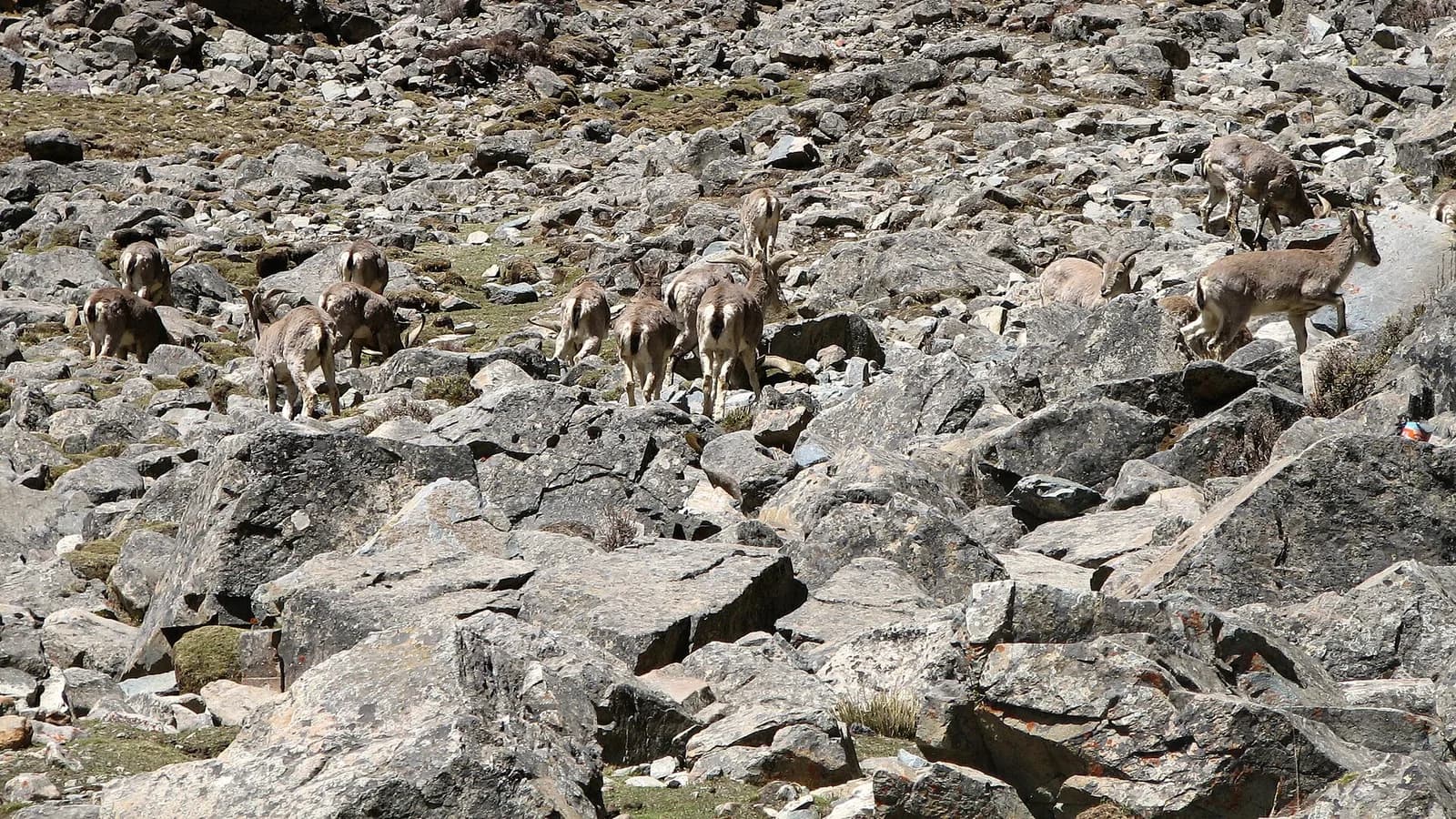
Most of Nepal's famous wildlife is built for the spotlight: the great one-horned rhino grazing the Terai grass, the tiger, the flame-bright red panda. The blue sheep is the opposite kind of animal. It lives high above the treeline, on grey scree and alpine meadow where the air is thin and the rock is the same colour as its coat, and it can stand a hundred metres away in plain sight while every trekker on the trail walks past without seeing it. Known across the mountains as the bharal, the blue sheep is one of the great rewards of high-altitude trekking in Nepal, and the keystone that keeps the snow leopard alive. This guide explains what the animal actually is, how to recognise it, where your odds of seeing one are best, and why it matters so much.
Key takeaways
- The blue sheep (bharal), Pseudois nayaur, is a high-Himalayan caprine that sits genetically between sheep and goats; it is not literally blue, but slate-grey.
- It is the single most important prey of the snow leopard across much of its range, making it a barometer for high-altitude ecosystem health.
- Best viewed in open alpine terrain above roughly 3,500 m in Dolpo, Dhorpatan, Nar Phu, and the Annapurna, Manaslu and Sagarmatha protected areas.
- Males are larger, bluer and carry heavy curved horns; females are smaller, browner, with short horns.
- The IUCN lists the bharal as Least Concern, though local declines occur from poaching and livestock competition.
- The rut peaks late November to January, with head-clashing rams; lambs arrive the following early summer.
What exactly is a blue sheep?
The blue sheep, or bharal, carries the scientific name Pseudois nayaur — and that genus name, "false sheep," hints at a long-running puzzle. Anatomically and behaviourally the animal blurs the line between sheep and goats, and genetic work generally places it closer to the goats despite its sheep-like silhouette. It is a medium-sized caprine: bodies run roughly 115 to 165 cm long, with adults weighing somewhere in the range of about 35 to 75 kg depending on sex and condition.
The coat is the giveaway and the source of the English name. Rather than vivid blue, it is a slate-grey to brownish-grey that can pick up a faint bluish sheen in flat mountain light, especially on mature males. The underparts are paler, and there are darker markings down the flanks and legs. Against a backdrop of grey Himalayan rock and scree, the effect is near-perfect camouflage, which is exactly why so many trekkers miss them.
Built for thin air and steep rock
Blue sheep are animals of altitude and slope. They are documented across the high Himalaya at elevations from around 2,200 m up to about 5,500 m, in alpine meadows and rugged rocky terrain, and they are confident, sure-footed climbers on ground that would stop most predators. Their range spans several countries — Bhutan, China, India, Myanmar, Nepal and Pakistan — with the high mountains of Nepal holding important populations.
The snow leopard connection
If there is one fact to take away about the bharal, it is this: across much of its range it is the favoured, staple prey of the snow leopard. Where the two species overlap, blue sheep make up a large share of what the cat eats, which means the fortunes of the two are tightly linked. Healthy, well-distributed blue sheep herds tend to support healthy snow leopard numbers; when bharal decline, the predator above them feels it too.
That dependence is why conservationists pay such close attention to blue sheep counts. A density survey of bharal in a valley is, in effect, a partial health check on the entire high-altitude food web. In the popular trekking imagination the snow leopard is the prize, but the bharal is the quiet foundation that makes the prize possible — and realistically, you are vastly more likely to see the grazer than the cat. For more on the predator side of this relationship, our wider Nepal national parks guide sets the protected-area context.
Males, females and herds: how to read what you see
Blue sheep are sexually dimorphic, so once you have a herd in your binoculars you can usually sort it out quickly.
| Feature | Males (rams) | Females (ewes) | | --- | --- | --- | | Size | Larger, heavier | Smaller, lighter | | Coat tone | More blue-grey, stronger dark markings | Browner, lighter markings | | Horns | Heavy, backward-and-outward curving, can exceed ~50 cm | Short, nearly straight, much smaller | | Role in herd | Compete in the rut | Lead nursery groups with lambs |
In practice, a scattered group on a slope will often show a few big-horned rams standing slightly apart from a larger cluster of smaller ewes and this year's lambs. Outside the breeding season, males and females may split into separate groups entirely.
Diet and daily rhythm
The bharal is primarily a grazer, cropping alpine grasses where it can. When grass is scarce — through deep winter, or on poorer ground — it switches to browsing on forbs and shrubs to get by. Like many mountain ungulates, blue sheep are most active in the cooler parts of the day, feeding in the early morning and again toward late afternoon, then resting up in steeper, more broken ground. That daily rhythm is your best timing cue for sightings.
Where to see blue sheep in Nepal
Blue sheep are spread across Nepal's high country, but some regions stack the odds in your favour far more than others. The common thread is open, high alpine terrain above the treeline, generally from around 3,500 m upward, with rocky escape ground nearby.
Dolpo and Shey Phoksundo
The remote trans-Himalayan district of Dolpo, and Shey Phoksundo National Park within it, is classic bharal country and one of the great wildlife landscapes of Nepal. This is also prime snow leopard habitat, so blue sheep here are part of a genuinely intact predator-prey system. If you are heading this way, our Dolpo trek overview and the dedicated Upper Dolpo guide cover the routes, permits and seasons.
Dhorpatan Hunting Reserve
Dhorpatan, in west-central Nepal, is globally associated with the bharal — it is the country's only hunting reserve, and blue sheep are its signature species. The reserve sees very few foreign visitors compared with the Everest or Annapurna trails, so for trekkers who prefer a camera to a crowd it offers excellent, low-pressure wildlife watching in big open basins where the sheep are well established.
Nar Phu and the Annapurna region
You do not have to go to the far west. The restricted Nar Phu valley, which branches off the Annapurna Circuit at Koto, climbs into stark high terrain favoured by both bharal and snow leopard, with the village of Phu sitting around 4,080 m beneath glaciated peaks. Blue sheep are also reported more widely in the Annapurna and Manaslu conservation areas and in the Everest region's Sagarmatha National Park.
Quick comparison
| Region | Access | Crowds | Notes | | --- | --- | --- | --- | | Dolpo / Shey Phoksundo | Remote, restricted-area permits | Very low | Strong snow leopard overlap | | Dhorpatan | Remote, west-central | Very low | Nepal's only hunting reserve | | Nar Phu | Off Annapurna Circuit, restricted | Low to moderate | High, wind-scoured valley | | Annapurna / Manaslu / Sagarmatha | Established trekking regions | Higher | Sightings possible at altitude |
Behaviour through the year
The most dramatic blue sheep behaviour comes with the rut. The breeding season runs roughly from late November into January, and during it rams compete for ewes in earnest. They use a range of tactics, but the one that stays with anyone lucky enough to witness it is the head-on clash: two males rear up on their hind legs and crash down, smashing horns together with a crack that carries across a cold valley. After this winter rut, gestation lasts about five months, and lambs are born in the following early summer, around late June and July, when the high meadows green up.
For the rest of the year, life is mostly about feeding, watching for predators, and staying close to steep ground. Herd sizes shift with the seasons — animals tend to congregate more in winter, when conditions push them together into favourable valleys, and densities in Nepal have been recorded broadly in the low single digits per square kilometre, climbing higher locally in winter aggregations.
Conservation status and threats
Globally, the bharal is in reasonable shape. The IUCN Red List classifies it as Least Concern, reflecting a wide distribution across several Himalayan countries and a substantial overall population that extends well beyond formal protected areas into remote high mountains. Firm range-wide population figures are genuinely hard to come by, given how rugged and inaccessible much of the habitat is.
That global comfort, though, hides local stress. In parts of the range, hunting and poaching pressure has eaten into numbers, and blue sheep also compete for forage with domestic goats and sheep grazed in the same high pastures. Several Nepali reserves have seen declines tied to overhunting and livestock competition. Because the bharal underwrites the snow leopard, those local declines carry consequences well beyond the species itself — which is the strongest argument for the regulated, well-managed approach Nepal takes to its high-altitude grazing lands.
Watching responsibly
Blue sheep are wary, and a disturbed herd that bolts up a slope burns energy it needs in a harsh environment. Keep your distance, use binoculars or a long lens rather than trying to close in, never get between animals and their escape terrain, and let your local guide set the pace. The reward for patience is the chance to watch a wild herd behave naturally — and, just occasionally, to understand why a hidden snow leopard might be watching the very same animals you are. If wildlife is your focus, a specialist Nepal photography tour can be built around the right regions and seasons.
A trekker's bottom line
The blue sheep will not announce itself. It will not pose by the trail like a rhino or fill a forest with colour like the red panda. What it offers instead is the quiet thrill of high places: a grey shape that resolves, through binoculars, into a herd grazing an impossible slope, with the whole architecture of the Himalayan food web standing on their backs. Slow down above the treeline, scan the scree in the soft light of early morning, and give the bharal the attention it hides so well — it is one of the truest signs that the wild high Himalaya is still working as it should.
Sources
- Bharal — Wikipedia
- Blue sheep — Encyclopaedia Britannica
- In the shadows of snow leopards: density and habitat selection of blue sheep in Manang, Nepal (PMC)
- Hunting takes its toll on Himalaya's blue sheep, favored prey of snow leopards — Mongabay
- Bharal (Blue Sheep): Characteristics, Behavior and Reproduction — Facts and Details
- Bharal Facts — Natural Habitat Adventures Himalayas Wildlife Guide
- Beyond the Hunt: Guide to Dhorpatan Hunting Reserve — Langtang Ri
Frequently asked questions
- What is a blue sheep?
- The blue sheep, or bharal (Pseudois nayaur), is a medium-sized wild caprine of the high Himalaya. Despite the name and its sheep-like build, it sits genetically between sheep and goats and is often considered closer to goats. Males carry a slate-blue-grey coat that gives the animal its English name.
- Where can I see blue sheep in Nepal?
- Look in high, open alpine terrain above the treeline, roughly 3,500 metres and up. Reliable regions include Dolpo and Shey Phoksundo National Park, Dhorpatan Hunting Reserve, the Nar Phu valley off the Annapurna Circuit, plus Manaslu, Annapurna and Sagarmatha conservation areas. Scan rocky slopes and scree with binoculars in early morning and late afternoon.
- Are blue sheep endangered?
- No. The IUCN lists the bharal as Least Concern thanks to a large range across several countries and a broad total population. That said, local declines do happen where poaching and competition with domestic livestock are heavy, so the picture varies place to place across the Himalaya.
- Why are blue sheep important to snow leopards?
- Across much of the high Himalaya the bharal is the snow leopard's single most important prey animal. Healthy blue sheep numbers underpin healthy snow leopard numbers, which is why wildlife surveys often count bharal as a proxy for the health of the whole high-altitude ecosystem.
- What is the difference between male and female blue sheep?
- Males are larger, more blue-grey, and carry heavy backward-curving horns that can exceed half a metre. Females are smaller, browner, and have short, nearly straight horns. In a herd the big-horned rams are usually easy to pick out from the smaller ewes and lambs.
- Do blue sheep look blue?
- Not vividly. The coat is really a slate or brownish-grey that can take on a soft bluish cast in certain light, especially on adult males. The colouring is superb camouflage against grey Himalayan rock, which is one reason the animals are so easy to walk past without noticing.
- When is the blue sheep rut?
- The rut runs roughly from late November into January. During this period rams clash head-on, rearing up and crashing their horns together to compete for ewes. Lambs are then born in the following early summer, around late June and July, after a gestation of about five months.
- Can you hunt blue sheep in Nepal?
- Only in one place and only under a strictly regulated, fee-paying trophy programme: Dhorpatan Hunting Reserve, the country's sole hunting reserve. Everywhere else the bharal is protected and hunting is illegal. Most travellers experience blue sheep purely as a wildlife-watching highlight.
Related posts
Snow Leopard in Nepal: Where the Ghost Cat Lives
A traveller's guide to the snow leopard in Nepal: the 397 national estimate, where they live, tracking treks in Dolpo and Kanchenjunga, and realistic sighting odds.
Read postSnow Leopard Trek Dolpo: A Realistic Guide
Plan a snow leopard trek in Dolpo, Nepal: where the cats live, real odds of a sighting, Shey Phoksundo permits, best season and ethics.
Read postElephant Breeding Centre Chitwan: Visitor Guide
What the elephant breeding centre in Chitwan really is, how to visit Khorsor near Sauraha, opening hours, fees, and the welfare debate explained.
Read post